In short
A hiring manager skill gives every manager the same kickoff: a scorecard in your criteria, interview questions with follow-ups, and a draft interview, all from one request in Claude. Tracy AI Interviewer is the connector that turns the draft into real interviews. The manager approves a preview, then Tracy interviews each applicant on video and returns a recording, transcript and what each person said to each question. A person reads the evidence and decides. One customer cut its average time to hire from 44 days to 7, and Tracy did the work of 53 full-time recruiters in one month.
What does a hiring manager skill do?
It turns a vague request such as "open a backend role" into the same sequence every time: ask for the brief, draft criteria and questions in your format, wait for edits, then set up the interviews. Anthropic's docs describe skills as reusable instructions that Claude loads on demand, where a normal prompt applies to one conversation.
If your team has none yet, start from a scorecard template and put its criteria into the skill. The skill also cannot interview anyone; that takes a connector, covered below. Anthropic's help center puts the split plainly: "MCP connections give Claude access to tools, while skills teach Claude how to use those tools effectively."
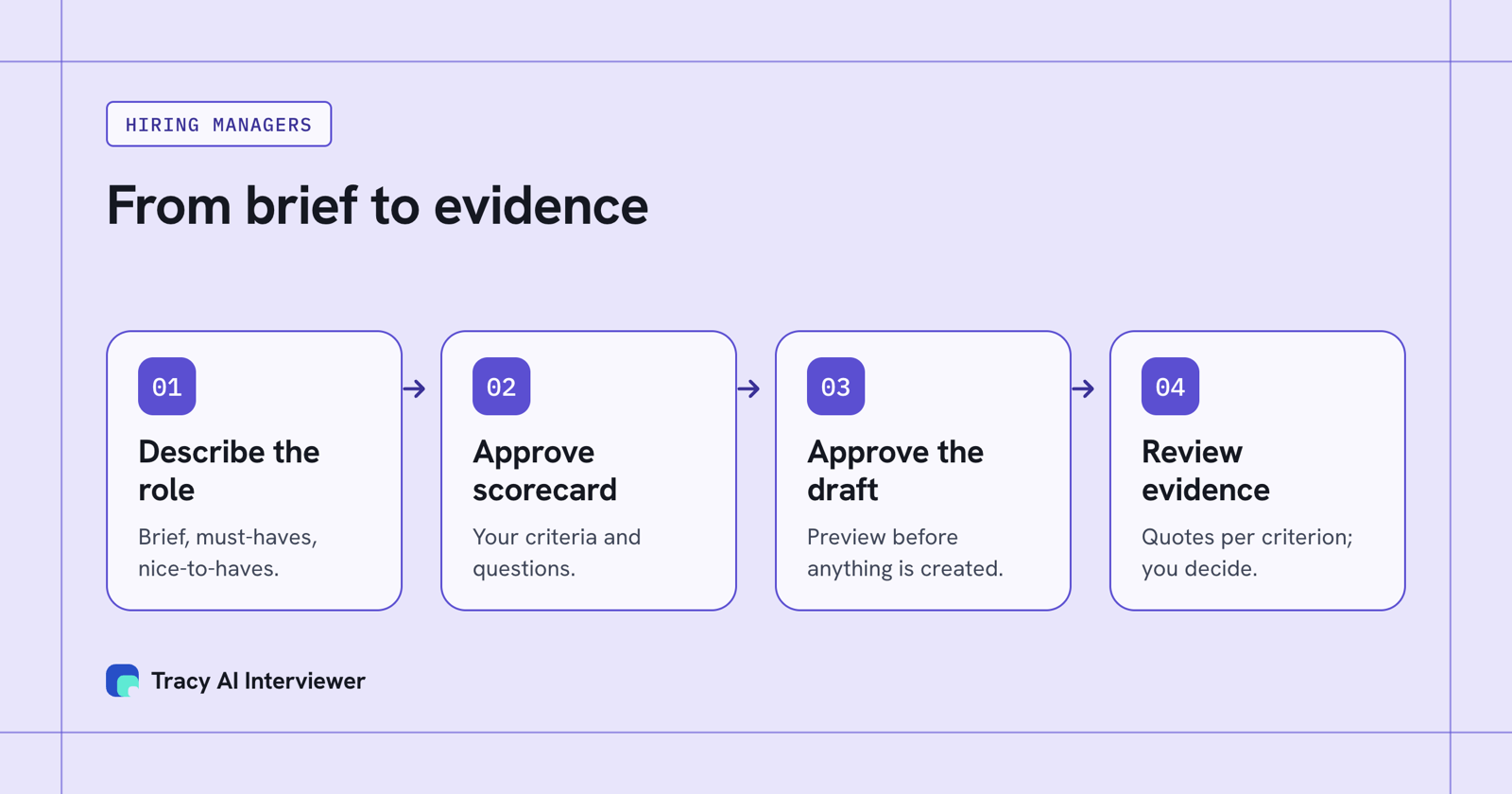
Four steps take a manager from a blank role to approved interviews.
A sample SKILL.md for hiring managers
Copy this, then change the criteria wording, the number of questions and the rules to match your hiring process. Run it on a practice role first.
---
name: hiring-manager-kickoff
description: Turns a role brief into a scorecard, interview questions and a draft interview. Use when a hiring manager opens a role, asks for a scorecard, wants interview questions or wants to set up screening interviews.
disable-model-invocation: true
---

# Hiring manager kickoff

## Steps
1. Ask for the role title, team, level, three must-haves and two nice-to-haves.
   If one is missing, ask before drafting.
2. Draft a scorecard: 4 to 6 criteria. For each, one line saying what it
   means and what good evidence sounds like. Leave the weights to the manager.
3. Draft 6 to 8 questions, at least one per criterion, each with a follow-up
   to ask when the answer is vague.
4. Show the scorecard and questions. Wait for edits.
5. When the manager approves, ask Tracy AI Interviewer to draft an interview
   from the approved questions. Show the preview. Do not create it or invite
   anyone until the manager says yes.
6. When results are in, ask Tracy for them. For each criterion, quote what the
   person said. Do not rate, rank or recommend rejecting anyone. The manager
   decides.

## Rules
- No questions about age, family, health, religion or origin.
- Use the manager's wording for criteria, not generic labels.
The description states what the skill does and when to use it, which Anthropic says it must, up to 1,024 characters. disable-model-invocation: true is a Claude Code field that stops Claude loading the skill by itself, so a manager starts it by typing /hiring-manager-kickoff; Anthropic describes it as the setting for workflows you want to trigger by hand. And step 6 keeps the call with the manager: the skill asks for evidence, not a rating, because Tracy reports what was said and does not score, rank or reject anyone.
Where do you put the skill?
Where it goes depends on where your managers use Claude.
- Claude Code: Place the folder at
~/.claude/skills/hiring-manager-kickoff/SKILL.mdfor yourself, or.claude/skills/hiring-manager-kickoff/SKILL.mdin a project. The sample setsdisable-model-invocation: true, so Claude does not load it on its own and it runs only when you type/hiring-manager-kickoff. - claude.ai: Delete the
disable-model-invocationline from the sample first, because it is a Claude Code field. Then zip the folder with the skill folder as the zip's root, upload it under Customize, Skills, and enable it. Custom skills need code execution turned on. Anthropic's API docs list the zip upload on Pro, Max, Ultra, Team and Enterprise. - A whole team: Team and Enterprise Owners can provision skills organisation-wide.
Custom skills do not sync between claude.ai, the API and Claude Code, so a skill in one is not in the others. If managers use Anthropic's desktop agent instead, Claude Cowork for recruiters covers that setup.
How does Tracy fit into the skill?
Step 5 is where the skill hands over to Tracy AI Interviewer. Add the connector once: in Claude, open Customize, then Connectors, choose Add custom connector, name it Tracy AI Interviewer and use https://tracyinterview.ai/mcp. In Claude Code, run claude mcp add --transport http tracy https://tracyinterview.ai/mcp, then sign in with /mcp. The setup is written up in AI interviews in Claude, and how MCP connections work explains the idea.
With the connector on, the skill's request becomes real work. Tracy drafts an interview from the approved questions, and the manager can edit them or bring their own. Claude shows a preview and asks before it uses the connector. Invitations are previewed too and go out only after approval. Applicants open a link in a browser, with no account, and are told the conversation is recorded and transcribed. Tracy follows up in each person's own field, reads the CV when the CV check is on, and every applicant can start at any hour, so the manager's list does not queue behind a calendar.
Asking Claude for results brings back, in the chat, what each participant said to each question, the result fields and a note for an applicant tracking system. The recording, timestamped transcript and written assessment per question stay in Tracy, with integrity signals shown for a person to review. They are evidence, not proof. Pay as you go includes MCP access at $1 per credit, with the first 3 results free. For question writing that suits an AI follow-up, see how to write interview questions an AI can follow up on.
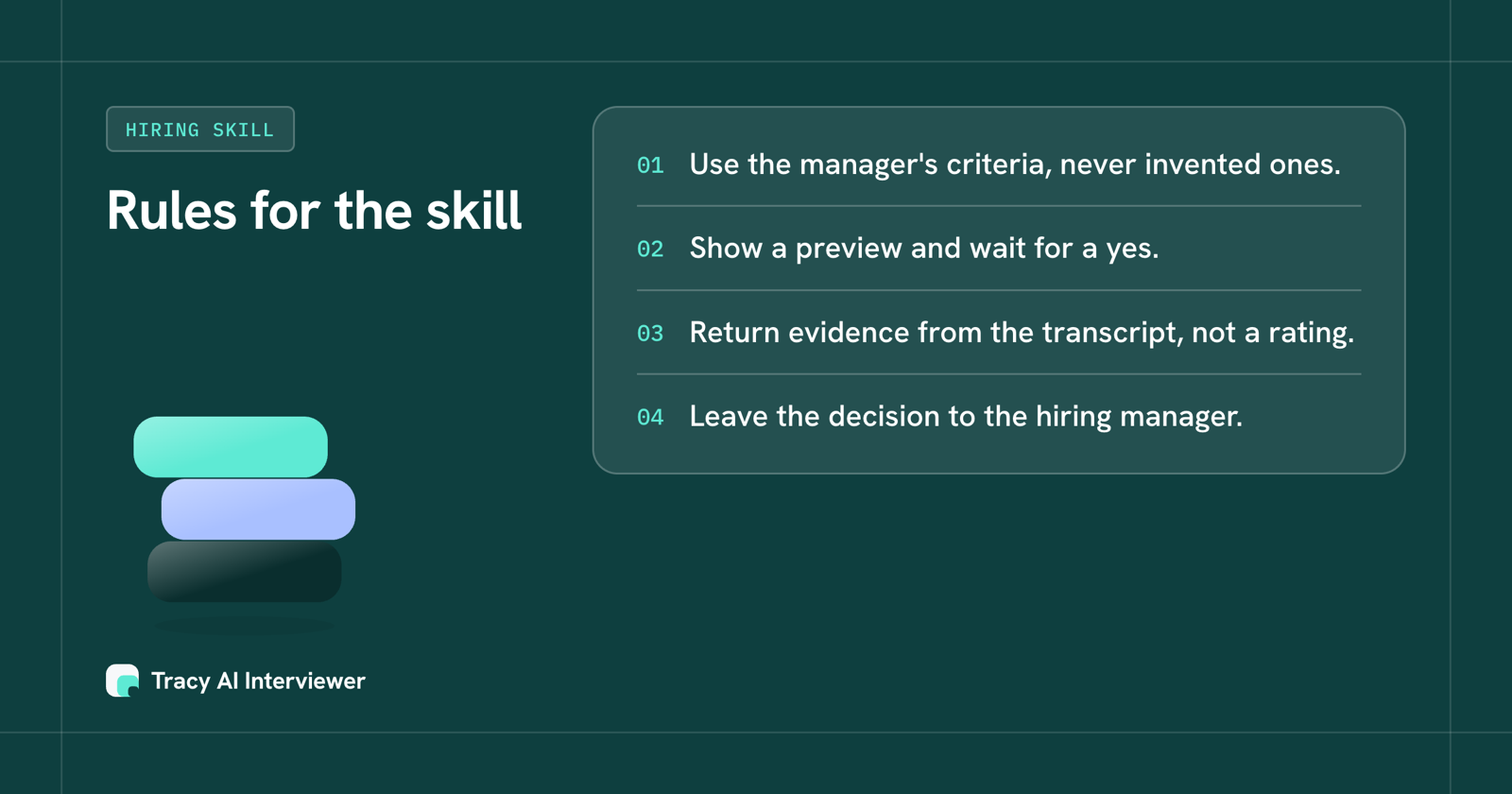
Rules to write into any hiring manager skill.
What should the skill never do?
Write the limits into the file, because Claude follows what it reads. Never let it invent criteria the manager did not set. Never let it create an interview or invite anyone without a preview and a yes. Never let it rate, rank or reject people. And keep personal data out of the skill itself.
Also read what you download. Anthropic's advice is to use skills you wrote or got from Anthropic, because a malicious skill can direct Claude to call tools in ways that do not match its stated purpose. For scoring and rating practice, our structured interview scoring guide and interview rating scale give anchors a reviewer can use once the evidence is in.
Which path fits you
- Recruiters rather than hiring managers: the skills-to-tasks map for recruiters shows which skills fit which task.
- Teams interviewing at volume: start from hiring at volume.
- A scorecard first, skill later: copy the scorecard layout or the interview guide template.
- Ready-made prompts instead of a skill: Claude prompts for recruiters.
Common questions
What is a Claude hiring manager skill?
Can Claude run the hiring process for me?
Can the skill score candidates?
Does a hiring manager skill need the Tracy connector?
Where do managers type it?
Is the sample SKILL.md safe to use as is?
Run the sample skill on one role
Connect Tracy to Claude, then run the sample skill on one real role; nothing is created until you approve the draft.
Try it free (opens in a new tab) Book a demo (opens in a new tab)
Your first 3 results are free. No card needed.
Sources
- Anthropic: Agent Skills overview, retrieved 14 Nov 2026.
- Claude Code docs: Skills, retrieved 14 Nov 2026.
- Anthropic help center: What are skills?, retrieved 14 Nov 2026.
- Add Tracy AI Interviewer to Claude (public guide), retrieved 14 Nov 2026.