In short
High volume recruitment breaks at the first screen, where CV, form and order filters are quick but leave most applicants unheard. Tracy AI Interviewer gives every applicant a video interview on click, at any hour, with no scheduling, and follows up in the applicant's own field. Your reviewer reads a recording, a timestamped transcript and what each person said to each question, and decides who moves on.
What filters do well in high volume recruitment
High volume recruitment is hiring for many openings, or for openings that draw far more applicants than your team can speak to. Greenhouse's Hire Standard reports 194 applications per hire in the US for January to August 2026, across 161.8 million applications and 9,473 companies. At that ratio teams filter on the CV, a form or the order people applied, and the filters do their job: they are quick and they apply one rule to everyone. They also leave most applicants unheard. Our guides on screening hundreds of applicants and screening candidates when there are too many applicants cover the filters.
Every filter you add decides who is never heard. An interview for everyone removes that decision from the first screen, and this guide covers how to run it.
What Tracy adds to high volume recruitment
Three things change when Tracy does the interviewing.
01 Reach every applicant
Each applicant starts on click, at any hour, with no scheduling and no recruiter on the call. The whole pool gets a first round, not the shortlist.
02 Ask the next question
Tracy asks in the applicant's own field, follows what they said and waits. A rehearsed first answer meets a second question.
03 Keep the evidence
Every result includes a recording, a timestamped transcript and what the person said to each question, so your reviewer can check any point.
Why 194 applications per hire breaks the first call
Take one US hire at 194 applications. A 20-minute first call with each applicant is 3,880 minutes, about 65 hours, before anyone books a slot. A role with 1,000 applicants is about 333 hours of calls. No recruiter team holds that, so most applicants are never spoken to and the CV becomes the first screen. With Tracy each of those applicants starts on click, and the reviewer reads evidence instead of sitting through calls.
One customer cut its average time to hire from 44 days to 7, and Tracy did the work of 53 full-time recruiters in one month. Tracy has delivered 100K+ interviews, with a reported 99% completion rate.
How do you interview every applicant in the first round?
Give every applicant the same short video interview, run by an AI interviewer, as soon as they apply, and have a person read the evidence afterwards. The run has five steps.
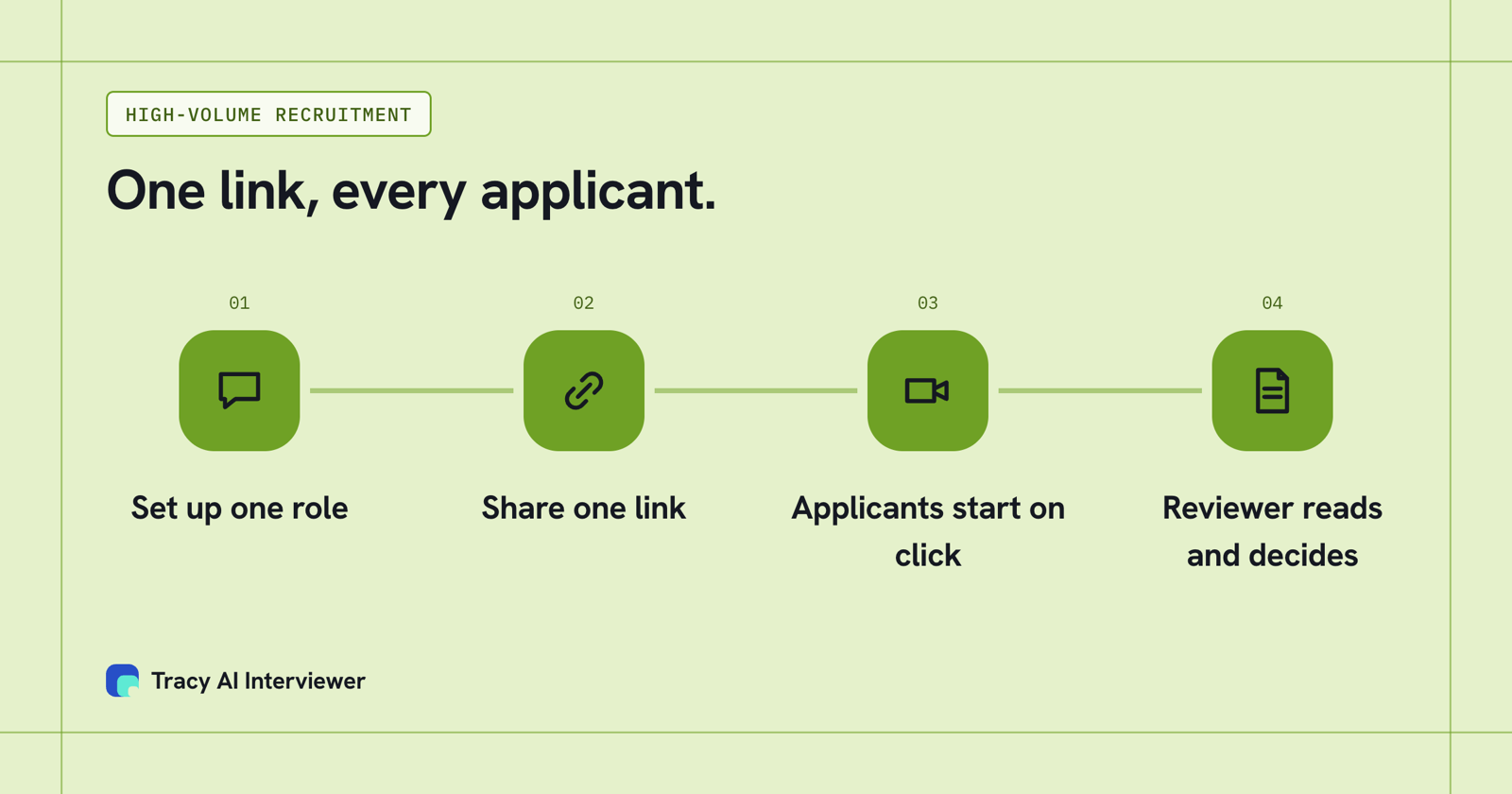
One link per role reaches every applicant, and your reviewer reads the evidence afterwards.
- Set up one role. Describe the role and Tracy drafts the questions; you edit them or bring your own. Writing interview questions an AI can follow up on shows how.
- Share one link in the apply confirmation or the message you already send.
- Each applicant starts on click, at any hour, in the browser with no calendar. The interview is ready in under 10 seconds. A dropped applicant can rejoin within 10 minutes and a reminder goes out after a day, settings your account can change.
- Tracy follows up in their field. She waits for the end of the thought and asks for the missing detail, so a rehearsed first answer is followed by a second question.
- A reviewer reads the results and decides who goes to the next round.
AI screening interviews walks through a first round end to end, and how AI interviews work covers what each person sees.
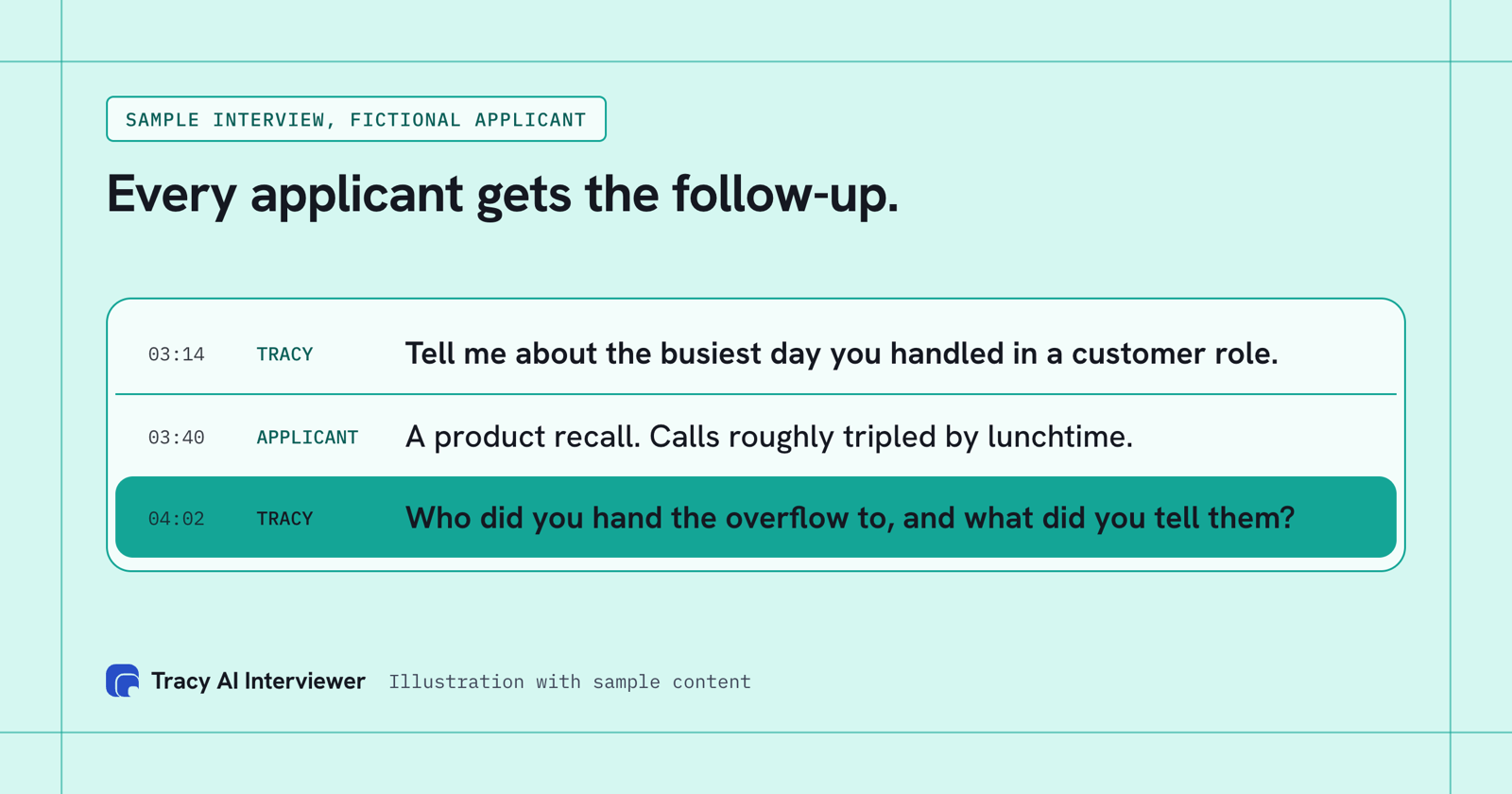
Every applicant gets the follow-up a recruiter would ask, not only the first question.
What should you decide before you share the link?
Interviewing everyone only helps if the results are easy to read, so settle four things before you share the link.
First, decide what the role must prove. Pick three to five things, such as troubleshooting, ownership or a stated skill, and turn each into a question with follow-ups. Structured interview scoring shows how to define a strong answer for each.
Second, choose the must-have questions. Put shift availability, location and similar basics in the same interview, so a reviewer can scan those answers first.
Third, name who reads and by when, for example every result read within one working day, because a slow review wastes the speed of the first screen.
Fourth, consider a pilot on one role. You could have two reviewers read the same ten results and compare what they would do next, and tighten the questions if they disagree before you open the link wider. A pilot costs a few credits.
What goes wrong at volume
Avoid three mistakes at volume. Interviewing everyone and reading no one leaves results unread, so name reviewers and a turnaround. One long question list for every role makes the first round too long to finish, so keep it to what the role must prove. Treating the first answer as the evidence skips the follow-up, which is where a rehearsed answer breaks down or holds up.
What does a reviewer read instead of hundreds of CVs?
Each result holds a recording of both sides, a timestamped transcript, what the person said to each question with the words and timestamps behind it, and integrity signals with their evidence. The reviewer replays the minute behind any point. AI interview reports shows what a good one contains.
Tracy does not score, rank or reject applicants. Your reviewer decides who moves on, so no applicant is turned away by a number nobody can check.
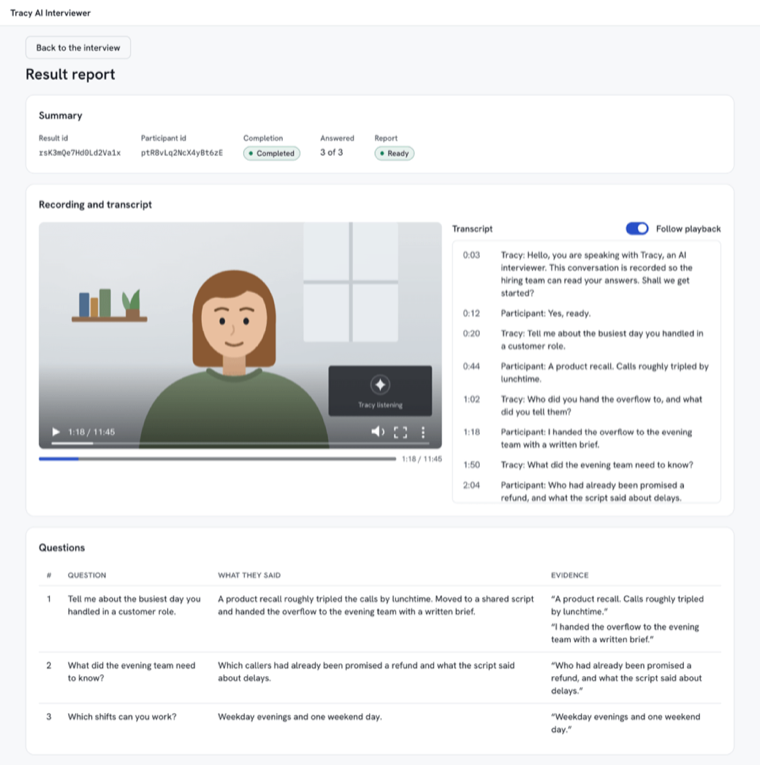
The reviewer reads what the person said, with quotes and a place in the recording, and decides.
What does it cost to interview every applicant?
Tracy charges $1 per credit, and one credit covers each started 20 minutes of an interview that produced a result. There are no seats and no upfront cost, and a session with no answers is never charged. The first 3 results are free.
| Applicants interviewed | Up to 20 minutes each | 21 to 40 minutes each |
|---|---|---|
| 100 | $100 | $200 |
| 500 | $500 | $1,000 |
| 1,000 | $1,000 | $2,000 |
Cost by interview length at $1 per credit. Prices as on tracyinterview.ai/pricing, read 11 Nov 2026.
Run live, the 1,000-applicant row is about 333 hours of recruiter calls; here it is a line of credits. Above that, Enterprise is priced to your volume, so book a demo for a figure. AI interview cost works through more cases.
What stays with your recruiters
Interviewing everyone moves the recruiter's time from the first call to the decisions that need judgment: who to invite next, what to ask a finalist, how to close an offer. Applicants are told on the join screen that the conversation is recorded and transcribed, and every applicant gets the same first questions, so the reviewer compares like with like.
Which path fits you?
- Staffing and RPO: AI interview tools for RPO firms and speed to submit.
- Technical volume hiring: AI interview tools for high-volume hiring and AI interviews for software engineers.
- Time to hire is the problem: time-to-hire benchmarks.
Common questions
What is high-volume recruitment?
How do you manage high-volume recruitment?
How do you interview every applicant?
Does Tracy rank or reject applicants?
What happens if an applicant drops out of the interview?
Interview every applicant for one open role
Create one interview for your busiest role and share the link. Each applicant starts on click. The first 3 results are free.
Try it free (opens in a new tab) Book a demo (opens in a new tab)
Your first 3 results are free. No card needed.
Sources
- Greenhouse, The Hire Standard (fall 2026): applications per hire, US, January to August 2026, retrieved 14 Nov 2026.
- Tracy AI Interviewer pricing, retrieved 11 Nov 2026.