In short
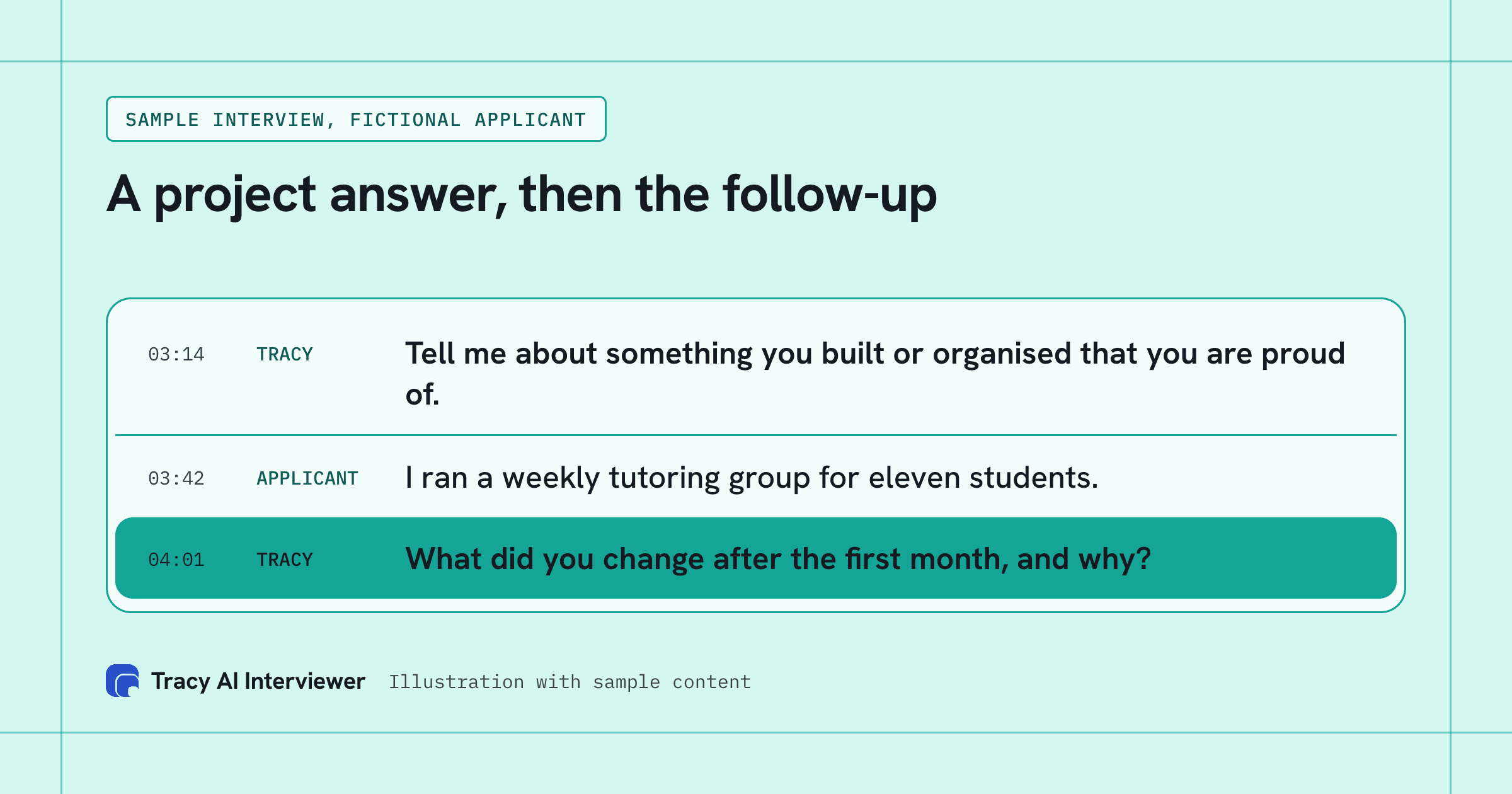
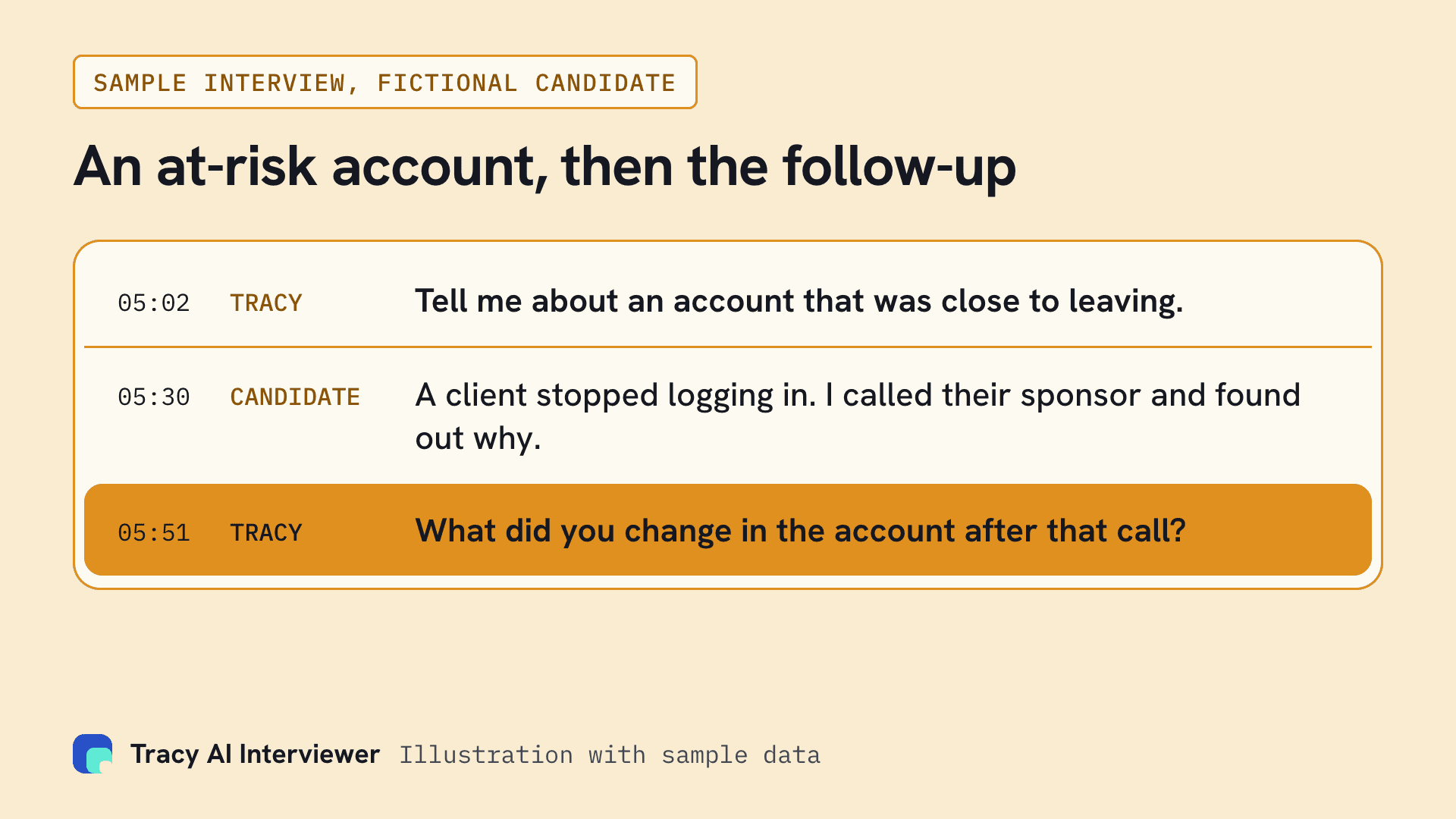
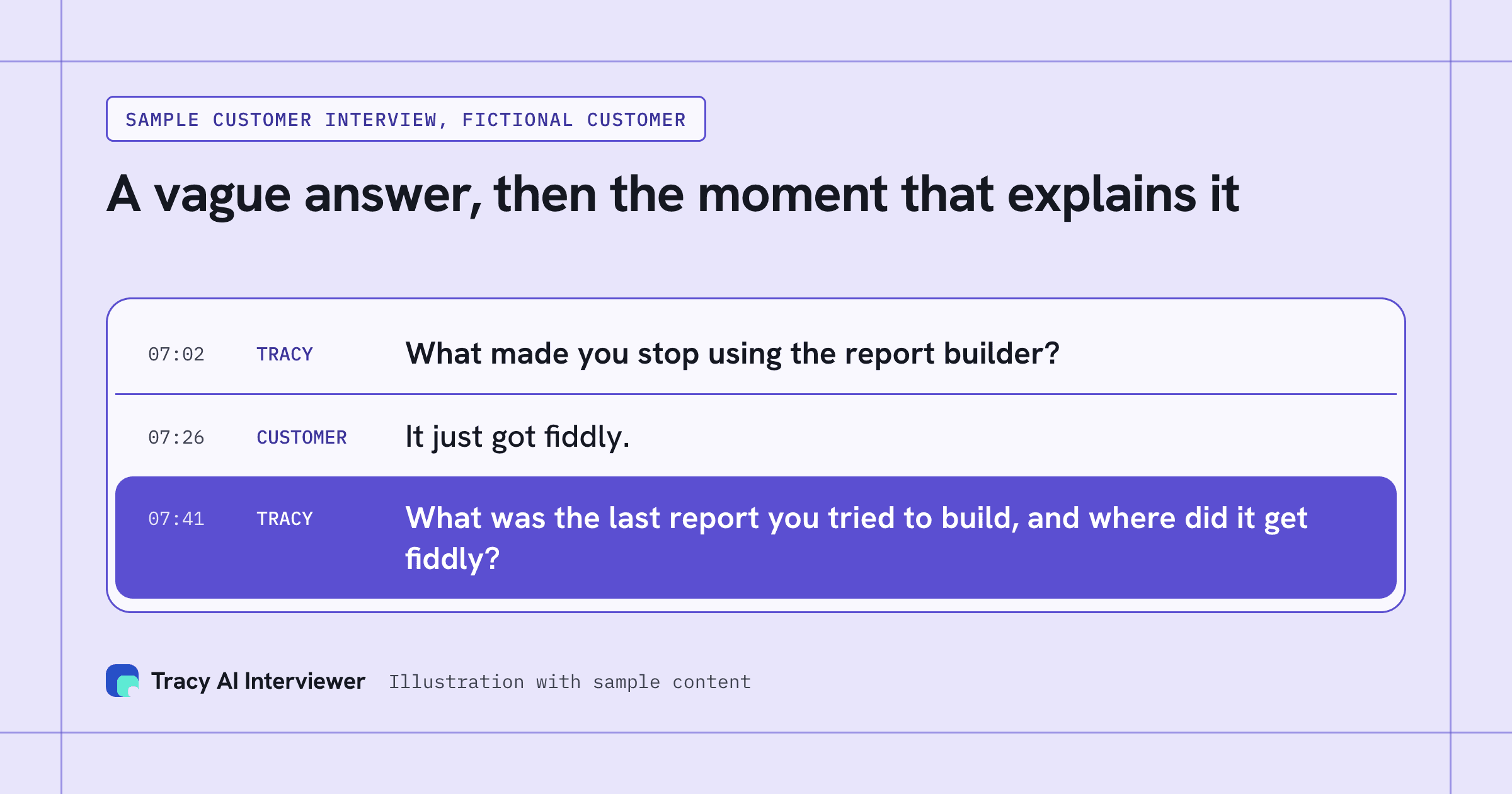
Tracy AI Interviewer drafts questions from your job description, asks each person in their own field and follows up on what they say, so questions get answered in depth and not recited.
A good AI interview question asks about one event, one decision and one part, so there is something to follow up on.
A recording, a timestamped transcript and a written assessment for each question come back, and a person decides.
Next step: send us one role and read the follow-ups Tracy asks.
Most AI interview questions fail because nobody said anything that happened. A hiring manager pastes twelve questions into an interview tool. "Tell me about yourself." "What are your strengths?" "Where do you see yourself in five years?" The answers come back fluent, similar and impossible to tell apart. There is nothing in them to ask a second question about.
AI interview questions have one extra job compared with a human script. Tracy AI Interviewer listens to the answer, waits for the end of the thought and asks about the part that matters. That works when the answer contains something specific. This page shows how to write questions that do, with rewrites of weak ones and a way to test your set before you send it. The AI interviewer explained covers what she does, and how AI interviews work walks through a session. Candidates: skip to the last section.
A good AI interview question has something to hold on to
A follow-up needs an anchor: a fact, a choice or a number in the answer. Four features make an anchor likely:
- It asks about something that happened. "Describe the last time a launch slipped" gets an event. "How do you handle deadlines?" gets a policy.
- It asks for a decision. What did you choose, and what else could you have done? A decision has reasons, and reasons can be probed.
- It has one part. "What was the problem, what did you do and what did you learn?" invites three short answers. One part gets one real one.
- It fits the person's own field. A question about a model's grading rubric means nothing to a nurse. A question about a patient handover means nothing to a data engineer.
Imagine the best answer you could expect. If you cannot think of a second question to ask it, the first question is the problem.
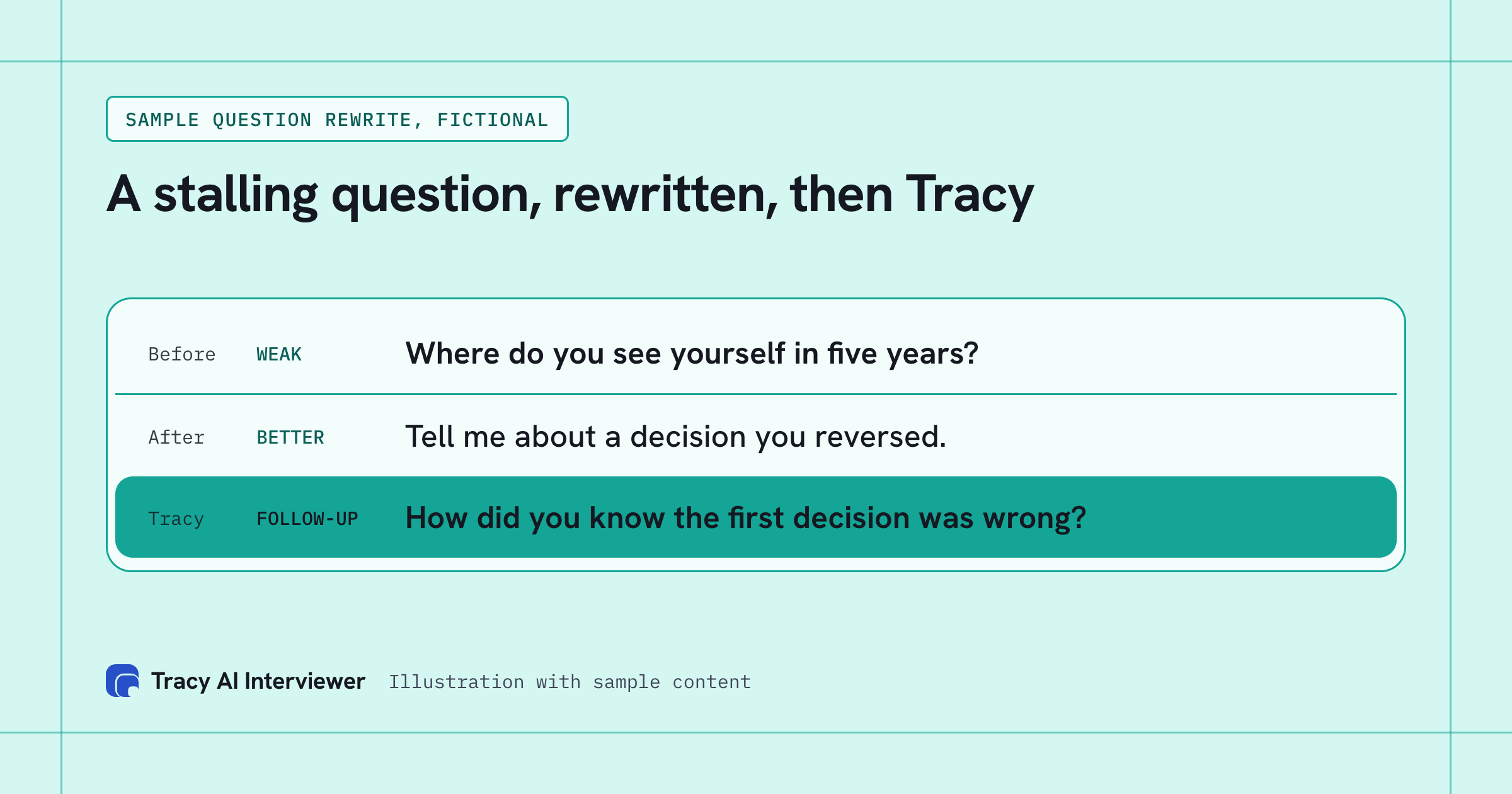
Tracy asks a follow-up on a question rewritten from a stalling one.
Write each question in four parts
For each question, write four lines before you send it. For worked sets, see our AI behavioral interview guide and the question banks for software engineers and AI trainers.
- The question. One part, about an event or a decision.
- A strong answer holds. Two or three things, such as a named cost, a number or an owned mistake.
- Gaps to probe. What the answer might leave out, which becomes the follow-up.
- A stopping point. When you have enough and should move on.
| Question | A strong answer holds | Probe if missing |
|---|---|---|
| Describe the last project of yours that slipped. | A cause, a date, what they decided not to do | What did you tell your manager that week? |
| Tell me about a decision you reversed. | What changed their mind, what it cost | How did you know the first decision was wrong? |
| Walk me through how you would find why a report is wrong. | Where they start, what they rule out first | What would make you stop and ask someone? |
You do not have to write every follow-up in advance. Tracy asks them from the answers. The probe column is for you, to check that a follow-up exists.
Six weak questions and how to rewrite them
Most weak questions fail in the same few ways. Here are six rewrites.
| Weak question | Why it stalls | Rewrite |
|---|---|---|
| What are your strengths? | A list of adjectives, nothing to probe | Tell me about something you did that a colleague could not have done as well. |
| Where do you see yourself in five years? | A rehearsed answer | What would you want to be doing in 18 months that you cannot do now, and why? |
| Are you good with deadlines? | Yes or no | Describe the tightest deadline you met. What did you cut? |
| What would you do if a client was angry? | Hypothetical, so any answer is safe | Tell me about a client who was angry with you. What did you say first? |
| Explain how a hash map works. | Recall, one right answer | You chose a hash map in a recent project. What else did you consider? |
| Why do you want this job? | A script every candidate has | What in the job description did you read twice, and why? |
Each rewrite swaps a general claim for something that happened, and a real event gives the follow-up somewhere to go.
Avoid questions an AI cannot follow up well
Some questions fail for any interviewer, human or AI:
- Yes or no questions. They end the answer where it begins.
- Questions with several parts. The person answers the easiest part.
- Trivia. A definition tests memory.
- Leading questions. "Don't you think testing matters?" teaches the answer.
- Questions about age, health, family plans or other personal characteristics. They do not belong in a hiring interview. If you are unsure, ask your legal adviser for your region's rules.
Keep the list short: fewer questions with deeper follow-ups.
Set the depth to match the decision
How deep Tracy goes is a setting. You choose a style from quick to deep, and from technical to behavioural. A first screen for a high-volume role can use the quick style. For a decision about an expert or an engineer we suggest fewer questions with deeper follow-ups.
Pay is by length: $1 per credit, one credit per started 20 minutes, so 100 interviews of 20 minutes cost $100, and the first three results are free. See pricing.
Where Tracy enters: from a job description to questions you can edit
You do not have to write the set alone. Describe the role, or paste the job description, and Tracy drafts the questions. You edit them or bring your own, and set the skills and the weight each one carries for the role or role family. Each person takes the interview from a browser link at any hour, with no calendar and no account.
She asks the question, listens, waits for the end of the thought and follows up on what the person said. A Director at a top-tier early-stage VC says Tracy "sometimes brings up exactly those questions I might have forgotten to ask, which has been a pleasant surprise." Afterwards your team reads a recording of both sides, a timestamped transcript and a written assessment for each question with its reasoning. A person decides. See what the interview report shows. Our technical interviews and people teams pages show where teams use her.
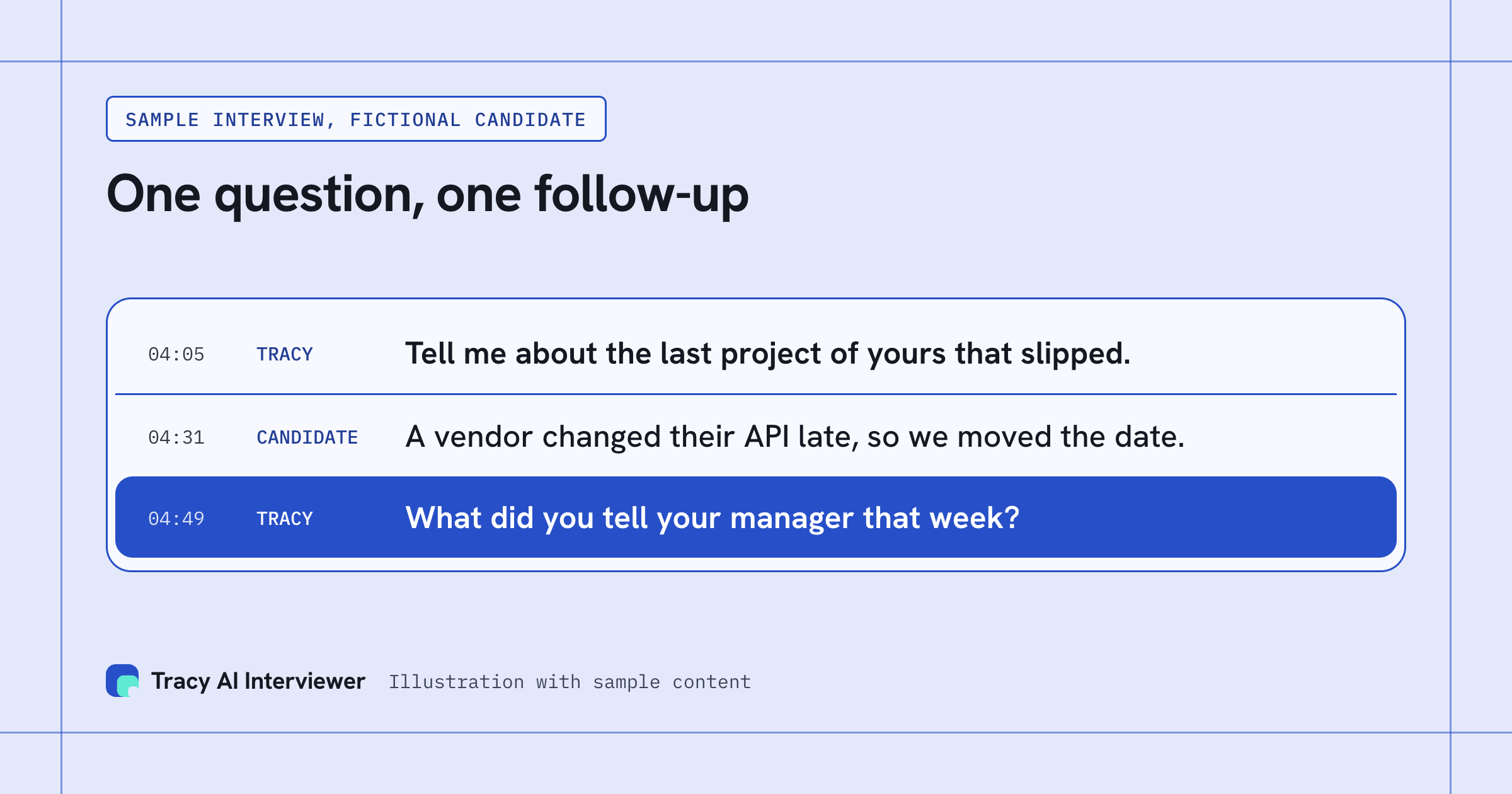
A question about an event gets a follow-up built from the answer.
Test your questions before anyone else sees them
A short test finds most problems:
- Answer each question aloud yourself. If you cannot say a specific answer, the question is too general.
- Ask a colleague to answer one. Write down the second question you want to ask. If none comes, rewrite it.
- Read the first five results. Look for answers that all sound alike. That means the question is generic.
- Run a small first batch. The first 3 results are free.
You decide which questions are fair for the role, how the skills are weighted and what a strong answer is. Tracy asks and records.
Prefer to start from a draft? Send us one role and we will build the interview plan in days.
If you are a candidate: how to answer AI interview questions
Searching for AI interview questions and answers as a candidate? You will not find a script that works, because the follow-up depends on what you say. What helps:
- Use a real event. Pick one specific project, decision or mistake, with a date and a number if you have one.
- Say what you did. "We" hides your part. Say "I" and name the step.
- Expect the follow-up. It will ask about what you just said, and does not mean the first answer was wrong.
- Say what you do not know. Honest and specific beats confident and vague.
You need only a browser link, and you are told on the join screen that the conversation is recorded and transcribed. See what the person interviewed sees.
Common questions
What are good AI interview questions?
Is there an AI interview questions generator?
Are there AI interview questions and answers I can practise?
How do you write questions an AI interviewer can follow up on?
Try Tracy on your next role
Tracy interviews every applicant, asks follow-up questions and sends you a ranked shortlist.
Try it free (opens in a new tab) Book a demo (opens in a new tab)
Your first 3 results are free. No card needed.
Sources
- Tracy AI Interviewer pricing, retrieved 5 Nov 2026.
- Tracy AI Interviewer home page, customer testimonial, retrieved 9 Nov 2026.