In short
Layered checks work because each stage can catch what another one misses, and no single signal proves fraud. Tracy AI Interviewer covers the interview stage: every applicant gets the same interview, follow-ups on their own CV and work, and integrity signals with their times beside a recording and transcript. A person reviews each signal and decides.
What candidate fraud detection already does well
Candidate fraud detection starts with checks that need no special software. Search your records for the same resume text, phone or email under other names, review communication accounts for reused numbers, ask plain questions about location or education, and add an identity step. The FBI's January 2025 alert recommends most of these, and they are worth running on every application.
Records, plain questions and an identity step cover the paperwork. The interview is the first place anyone is asked about the work itself, and that is the stage Tracy runs.
What is candidate fraud detection?
Candidate fraud detection is the set of checks that tell you whether an applicant is who they say they are and whether their experience is real. It works in layers, across the application, the interview and the first weeks of work, and a person weighs the evidence at each one, because no single signal proves fraud.
Fraud covers five different things, and each needs a different check:
| Form | What happens | Read more |
|---|---|---|
| Stolen or invented identity | Someone applies with another person's details | Interview fraud |
| Deepfake or face swap | The face or video is altered on the call | Deepfake candidates |
| Proxy | Someone else attends the interview | Proxy interviews |
| AI-fed answers | The applicant reads answers from a tool | Cheating detection |
| Invented experience | A real person with a false CV | Spotting a fake candidate |
Five forms of candidate fraud. The FBI reported the first two in alerts dated 28 June 2022 and 23 January 2025.
The FBI's June 2022 alert reports that background checks found applicants' personal data belonged to another individual. Its January 2025 alert says North Korean IT workers have been observed using AI and face-swapping technology during video job interviews.
How common is candidate fraud?
Nobody has a census, so the best figures are what managers report. In Checkr's September 2026 survey of 3,000 US managers who had been involved in hiring in the past 12 months, 67% had suspected a candidate of using AI to misrepresent themselves, and 40% had personally interviewed a candidate later revealed to be using a fake identity. Only 23% were extremely confident their process would catch a fraudulent candidate. Checkr sells background checks, and these are managers' reports, not measured fraud rates.
The clearest enforcement figures are from one scheme. On 30 June 2025 the US Department of Justice announced searches of 29 known or suspected laptop farms across 16 states, and said North Korean IT workers had obtained jobs at more than 100 US companies and compromised the identities of more than 80 US persons. The checks below need no special software.
How do you detect candidate fraud at each stage?
Put a check at each stage so one miss does not decide the outcome. The FBI's January 2025 alert on North Korean IT workers recommends most of these checks, and the last column says where each one comes from.
| Stage | Check | Where it comes from |
|---|---|---|
| Application | Search your records for the same resume text, phone or email under other names | FBI, Jan 2025 |
| Application | Review applicants' communication accounts for reused numbers, including voice-over-IP | FBI, Jan 2025 |
| Interview | Ask plain questions about location or education background | FBI, Jan 2025 |
| Interview | Add an identity-verification step | FBI, Jan 2025 |
| Interview | Follow up on each CV claim, one level deeper | Interview practice |
| Interview | Review the integrity signals for a person to read | Tracy signals |
| Onboarding | Do as much hiring and onboarding in person as you can | FBI, Jan 2025 |
| Onboarding | Watch for changes in address or payment platform | FBI, Jan 2025 |
Checks by stage. FBI alert of 23 January 2025, read 14 Nov 2026; the alert was written about North Korean IT workers.
An accent, a name, a poor connection or a camera angle is not a sign of fraud, because honest candidates have all of them. A fair process asks every applicant the same questions and reads the same evidence.
What an interview shows that a record check cannot
The problem is a clean CV that nobody has asked about. In Checkr's survey, 67% of managers had suspected a candidate of using AI to misrepresent themselves, yet only 23% were extremely confident their process would catch a fraudulent candidate.
Say a CV claims a billing migration. A record check passes it. An interview that asks which part the person owned and what they did when it failed gets an answer in their own words, at their own pace, with a time on it. That answer is what a reviewer can compare with the CV one level deeper. It proves nothing alone, and a person weighs it with the other layers.
What can an AI interviewer add to candidate fraud detection?
An interview is the one stage where you hear the person. Tracy AI Interviewer runs that stage the same way for every applicant. When the CV check is on, she reads the CV and asks about it, then follows up in the person's own field and waits for the end of the thought. For engineers she can set a coding task and ask about approach and trade-offs, so an answer from anywhere has to be explained. See AI technical interviews for how that works.
Tracy captures tab changes, abnormal eye tracking (gaze), live face detection, delay before answers, leaving fullscreen and external screens, and shows them to a person in the report with their times, beside a recording of both sides and a timestamped transcript. A signal is a reason to look, not proof. Tracy gives no detection rate and decides nothing.
The person interviewed is told on the join screen that the conversation is recorded and transcribed. A reviewer looks at each moment a signal was shown, and no decision is automated.
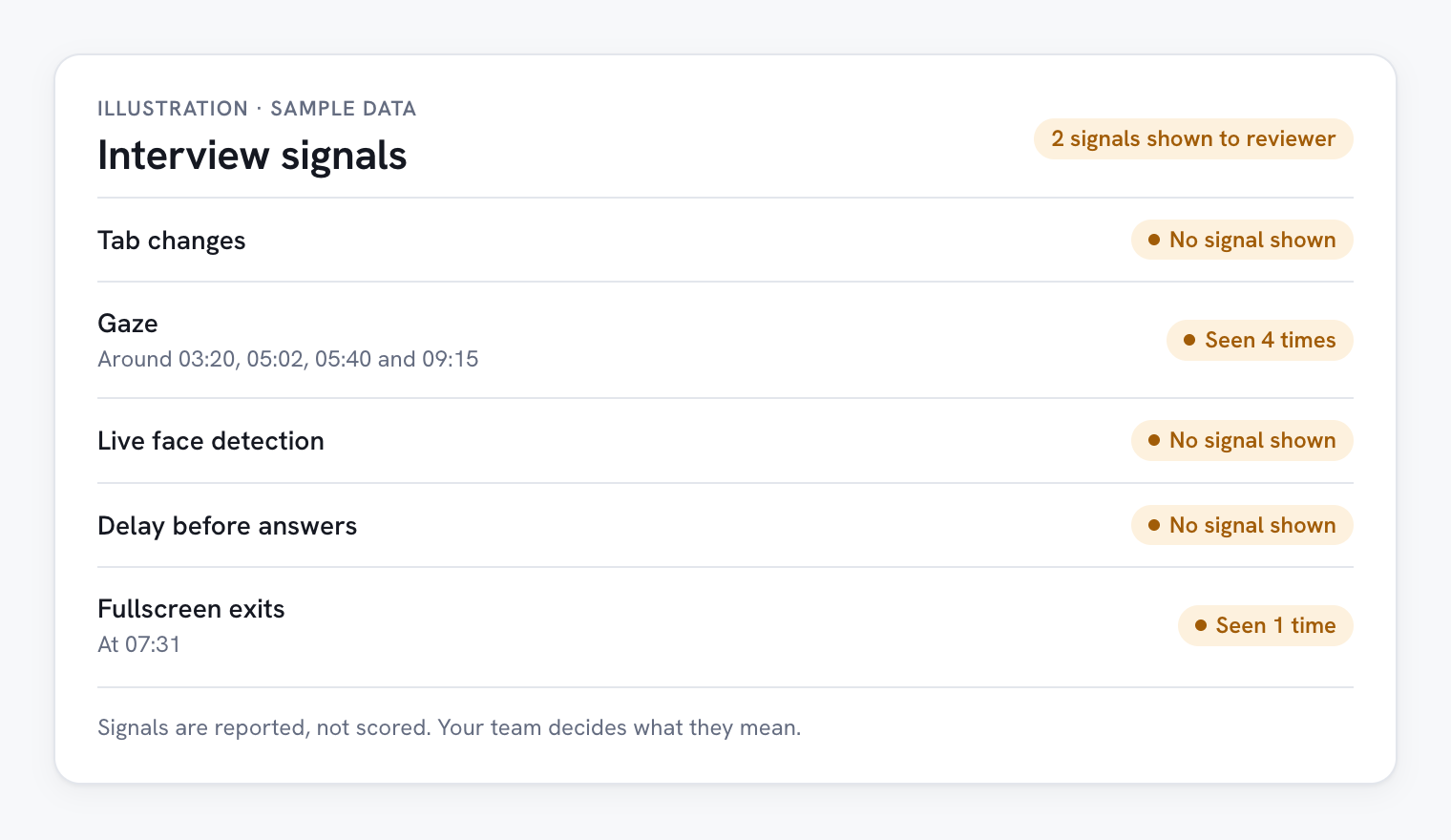
Signals appear with their times, and a reviewer decides what each one means.
What Tracy adds to candidate fraud detection
01
Give every applicant the same interview
Each applicant can start on click, at any hour, with no scheduling and no recruiter on the call. Signals and answers can be compared like with like.
02
Ask about the CV, one level deeper
When the CV check is on, Tracy asks about the applicant's own CV and work, follows the answer and waits for the end of the thought. A claim has to be explained.
03
Keep the evidence and the signals
Each result carries a recording of both sides, a timestamped transcript and integrity signals with their times. A signal is a reason to look, never proof.
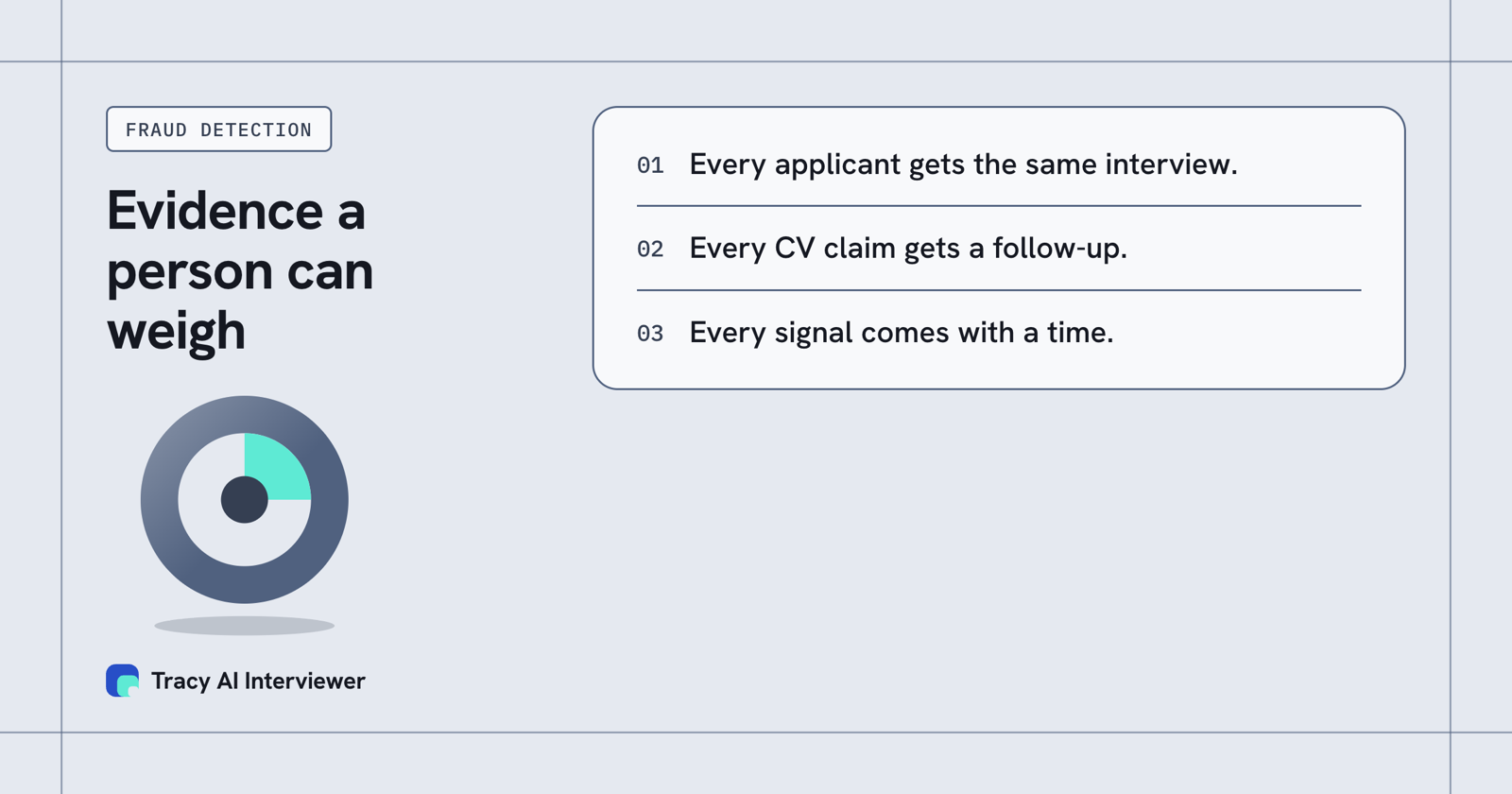
Same interview, a follow-up on the CV and a time on every signal.
What should you ask a candidate fraud detection tool vendor?
Candidate fraud detection software varies in what it claims. Five questions help you tell evidence from marketing.
- What does it capture, and does it show the evidence or only a verdict? A flag with a time and a recording can be checked, and a verdict cannot.
- Who sees a flag, and can a person overrule it? Look for human review and no automated rejection.
- Does it quote a detection rate? Ask who was measured, how many and when, because a rate with no answer is not usable.
- What does the candidate see before it starts? Candidates should be told about recording and monitoring.
- Is identity verification part of it, or a separate step? Be clear which one you are buying.
What to do when a signal appears
When a signal appears, read the transcript at that minute, compare the answer with the CV one level deeper, ask the person a few of the same questions you would ask anyone in a short live call, and record the decision with its evidence so a second person can review it.
Pauses, a slow connection and nerves look like signals and are common in honest interviews, which is why one signal is never enough to reject someone.
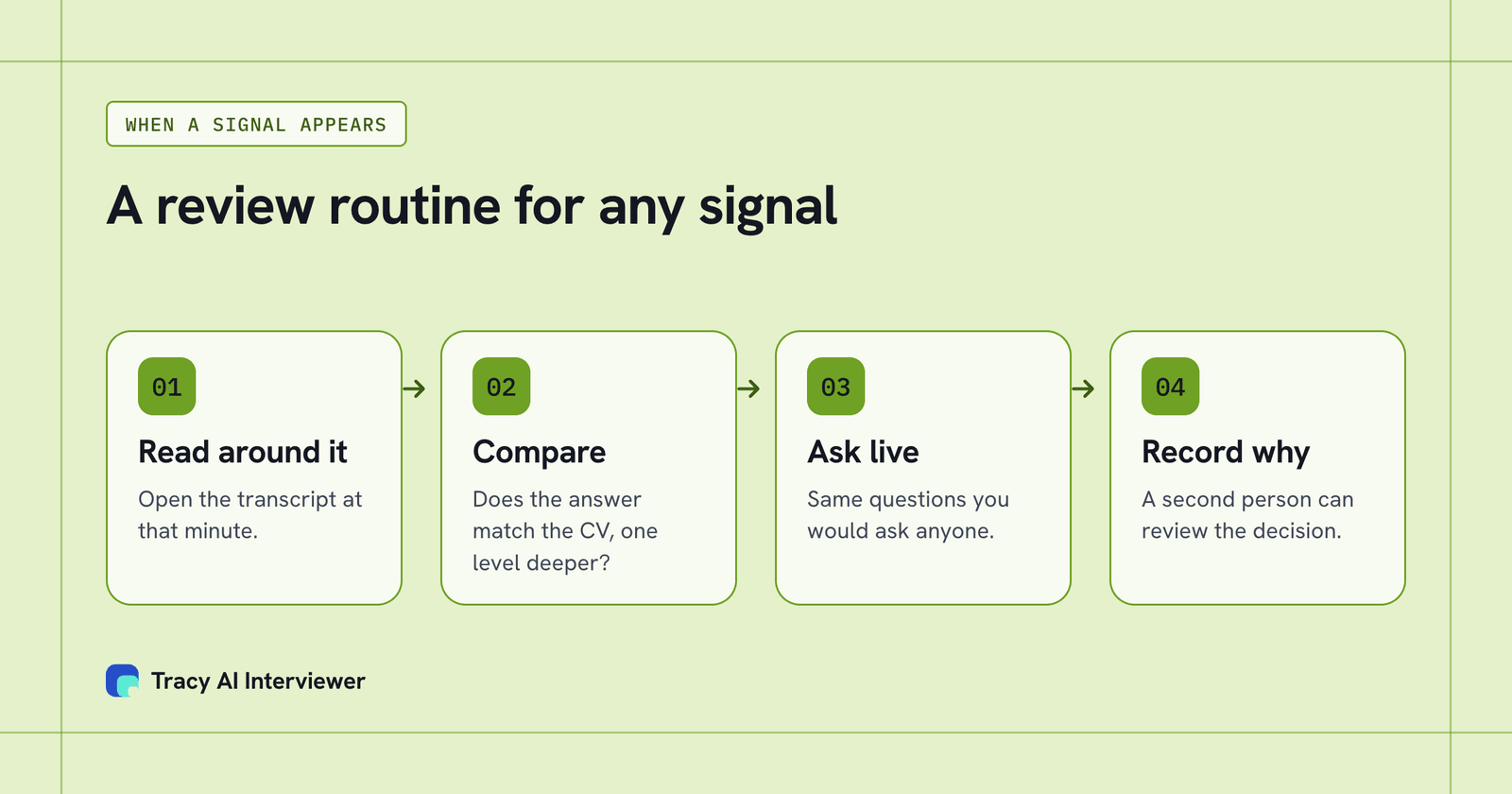
The routine is the same for every signal: read, compare, ask, record.
Which path fits you
- Hiring many people at once: AI interview tools for high-volume hiring and how to screen hundreds of applicants.
- Hiring engineers: AI interviews for software engineers.
- Want to see a report first: AI interview reports.
Common questions
What is candidate fraud detection?
What does candidate fraud detection software do?
How do you spot fake candidates?
Can software detect deepfake candidates in an interview?
How do you prevent candidate fraud?
Review the evidence on one interview
Create one interview for your role and read the recording, transcript and signals yourself. The first 3 results are free.
Try it free (opens in a new tab) Book a demo (opens in a new tab)
Your first 3 results are free. No card needed.
Sources
- FBI IC3 public service announcement I-062822-PSA, 28 June 2022, retrieved 9 Nov 2026.
- FBI IC3 public service announcement I-012325-PSA, 23 January 2025, retrieved 14 Nov 2026.
- US Department of Justice press release, 30 June 2025: coordinated actions against North Korean remote IT worker schemes, retrieved 14 Nov 2026.
- Checkr, The hiring hoax 2026: manager survey of 3,000 US managers, 11 to 16 September 2026, retrieved 14 Nov 2026.