In short
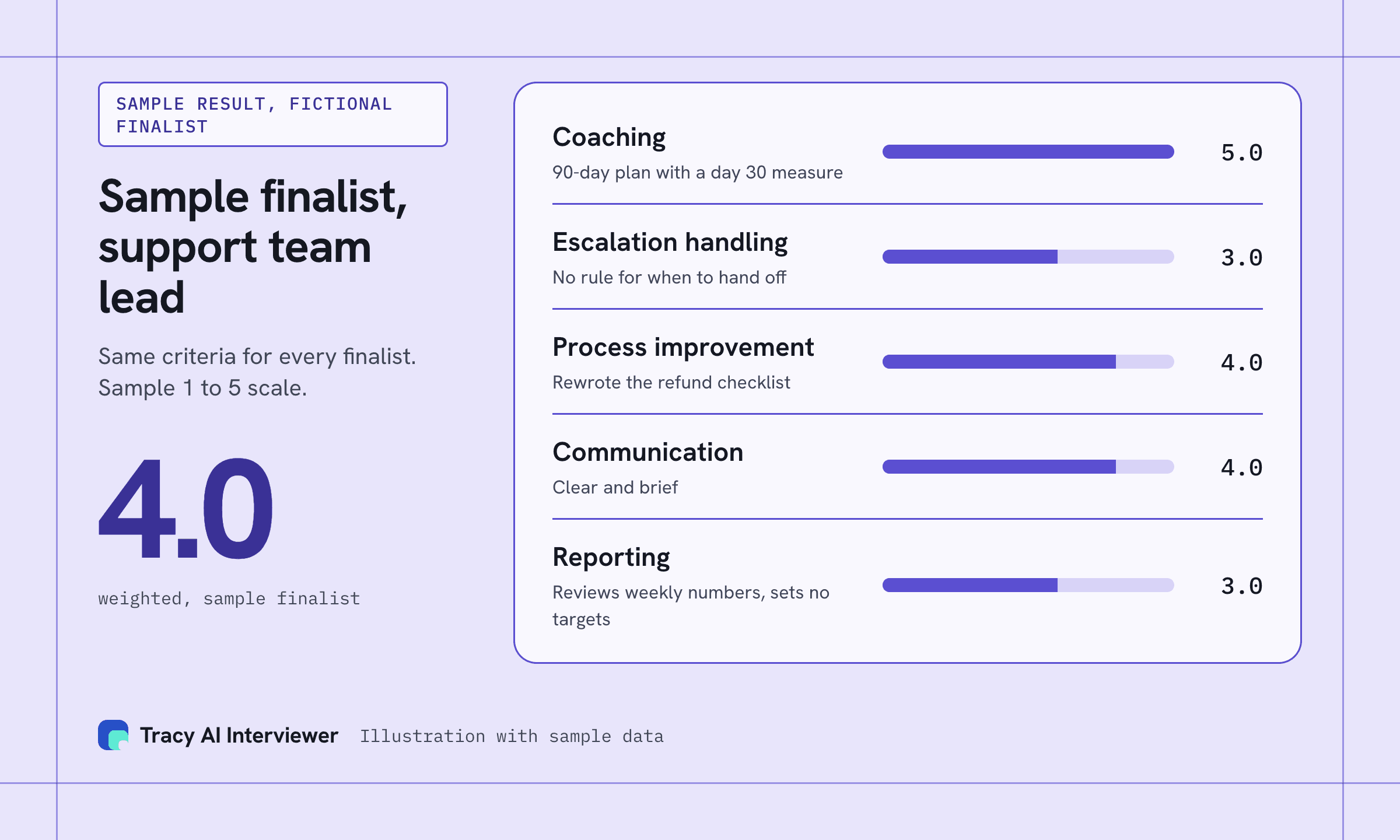
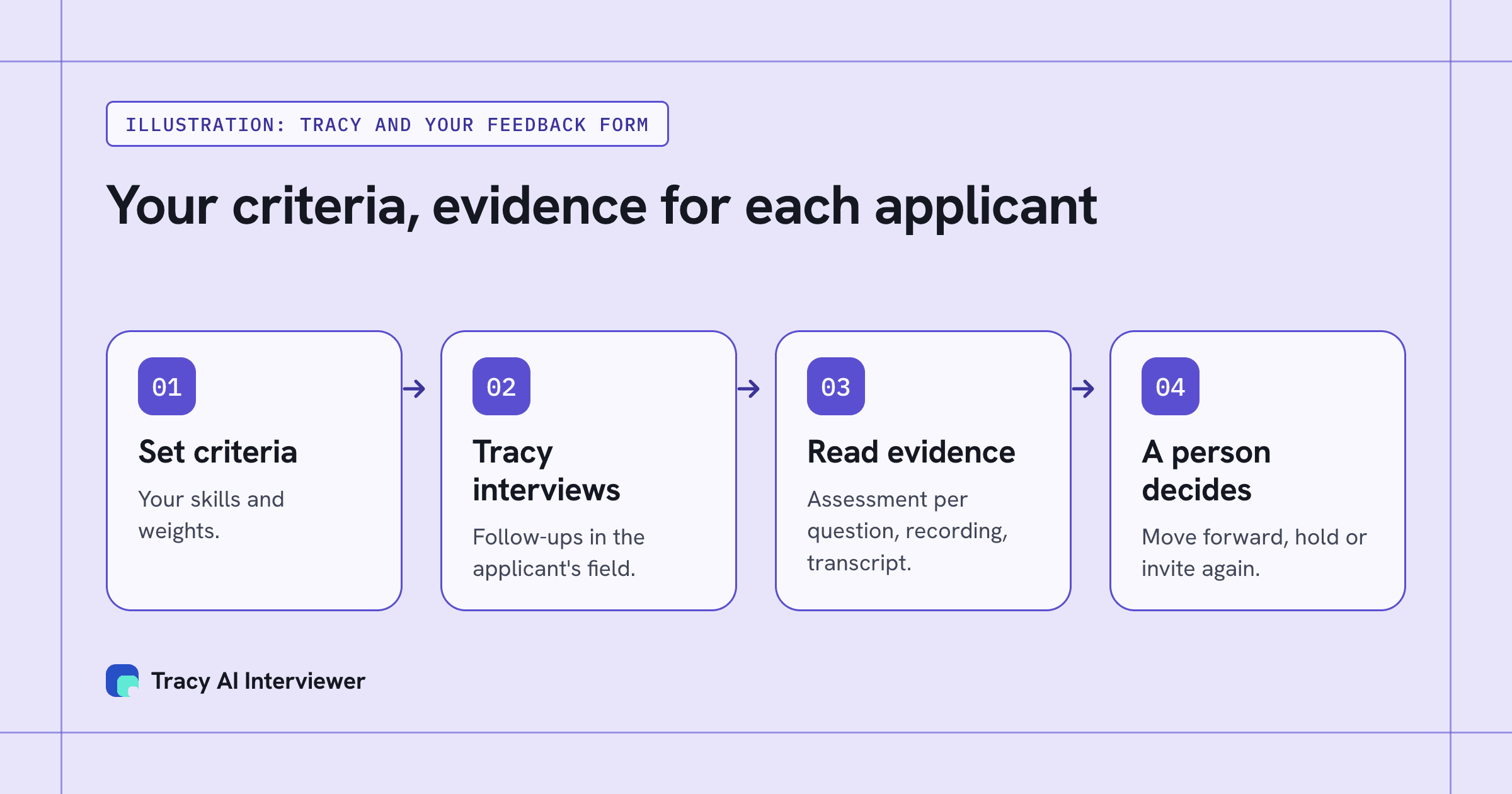
Tracy AI Interviewer scores each applicant on the skills and weights you set, with a written assessment per question and the recording behind it, which a reviewer can read against your anchors.
Below: a 1 to 5 interview rating scale with written anchors, a scoring sheet to copy, the rating errors to catch and a filled example.
Define what a 3 means before the first interview.
Next step: copy the scale, then run one role as a Tracy interview.
We make Tracy AI Interviewer.
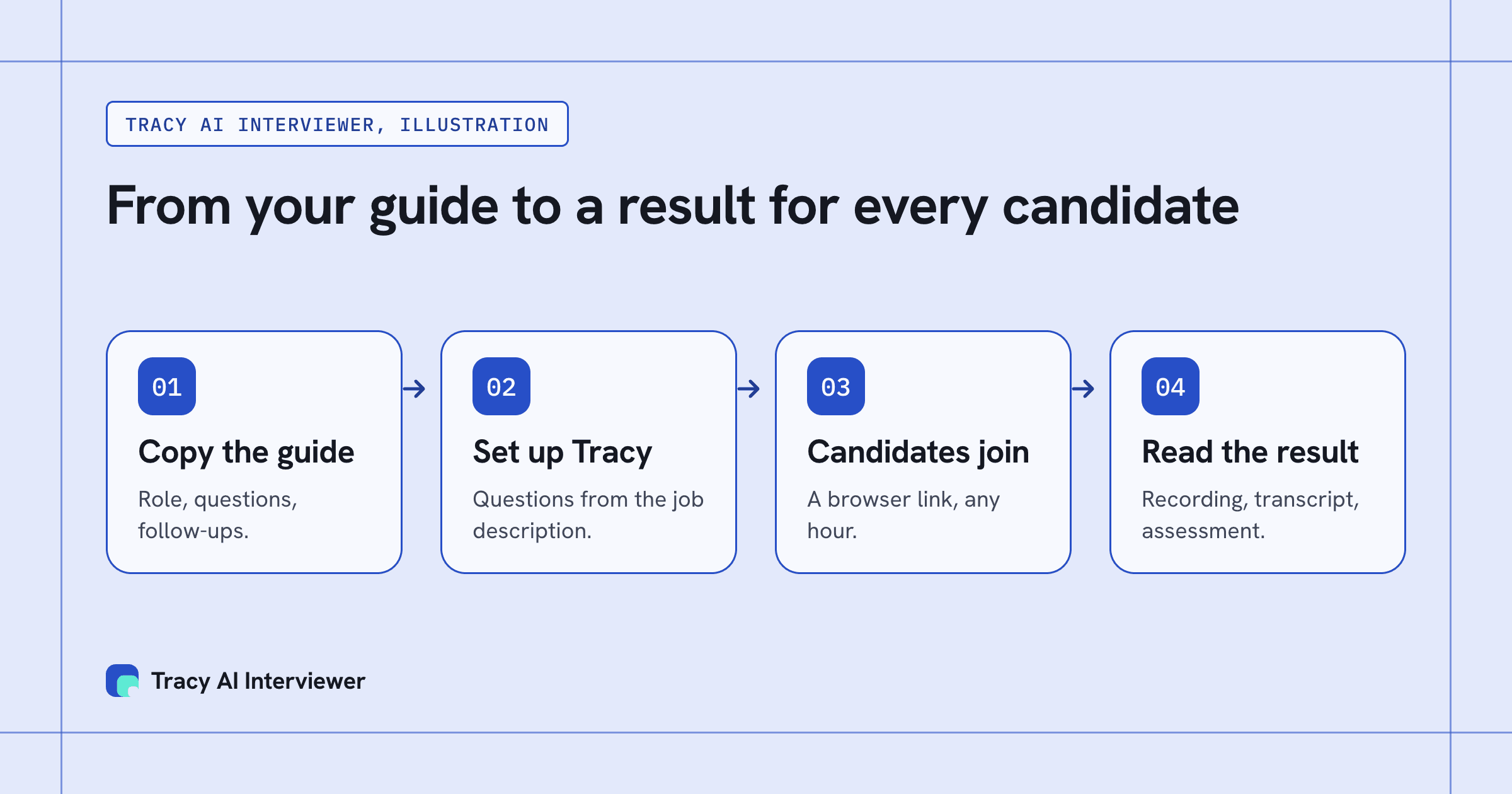
Two interviewers hear the same answer. One writes a 4, the other a 3, and neither is wrong, because nobody told them what a 4 is. An interview rating scale fixes that by defining each point in terms of what the candidate said or did. This page gives you a 1 to 5 interview rating scale with anchors, an interview scoring sheet to copy and a filled example. Then it shows how Tracy AI Interviewer scores each applicant on your skills and weights, with the recording behind each result.
The interview rating scale: 1 to 5 with anchors
An anchor describes what you would see or hear at that score, in behaviour. "Good communicator" is not an anchor. "Explained the trade-off in two sentences and checked I had followed" is. These generic anchors work for any criterion. A 2 sits between the 1 and 3 descriptions, and a 4 between the 3 and 5.
Table 1: generic anchors, 1 to 5
| Score | Label | Anchor | In the answer |
|---|---|---|---|
| 1 | Absent | The skill is missing, or the answer shows the opposite. | No example, or an example that went wrong and was not recognised. |
| 2 | Thin | Some evidence, thin under follow-up. | An example with no detail on the candidate's own part. |
| 3 | Role-ready | A real example and sensible answers to follow-ups. | What they did, why, and the result. |
| 4 | Strong | Specific detail, a result and what they would change. | The trade-off named, with an outcome. |
| 5 | Outstanding | Deep and consistent under follow-up. | Handles a harder version of the question unprompted. |
Scroll the table sideways to see all 4 columns.
A 3 means the person can do the job at the level you hire for.
Anchors for a real criterion
Generic anchors need a version for each criterion. Write the 1, 3 and 5, and let interviewers place a 2 or a 4 between them. Three examples:
Table 2: anchors for three criteria
| Criterion | 1 | 3 | 5 |
|---|---|---|---|
| Prioritising work | Does tasks in the order they arrive. | Ranks by deadline and names one trade-off. | Ranks by impact and deadline, says what was dropped and who was told. |
| Explaining a decision | States the outcome with no reason. | Gives the reason. | Gives the reason, the option rejected and what would change the call. |
| Learning from a mistake | Cannot name one, or blames others. | Names the error and what they fixed. | Names the error, the change to how they work and shows the change held. |
Scroll the table sideways to see all 4 columns.
The interview scoring sheet
Copy the tables into a sheet. With the scores in column B, rows 2 to 6, the average for equal weights is =AVERAGE(B2:B6).
Table 3: scoring sheet header
| Field | Entry |
|---|---|
| Candidate | |
| Role | |
| Interviewer | |
| Date | |
| Recording or notes link |
Table 4: scoring sheet
| Criterion | Score (1 to 5) | Evidence: quote or time | Why not one higher |
|---|---|---|---|
| Criterion 1 | |||
| Criterion 2 | |||
| Criterion 3 | |||
| Criterion 4 | |||
| Criterion 5 | |||
| Average |
Scroll the table sideways to see all 4 columns.
The last column does the work. To justify a 3, the interviewer must say what the 4 anchor needed and the candidate did not give.
Choose a 1 to 3, 1 to 4 or 1 to 5 scale
Table 5: choosing a scale length
| Scale | Use it when | Watch for |
|---|---|---|
| 1 to 3 | A fast screen of many applicants where the decision is pass, maybe or stop. | Too coarse to separate strong candidates. |
| 1 to 4 | Interviewers who all drift to the middle. With no midpoint, they have to lean. | A 2 and a 3 can feel like fail and pass, so define both. |
| 1 to 5 | Most roles. A clear bar at 3 and two steps either side. | Without anchors, 3 becomes the safe answer for everyone. |
Skip 1 to 10. In our view nobody can say what separates a 6 from a 7, and the numbers look more precise than the judgement behind them.
Rating errors to catch
Central tendency, halo, leniency, contrast and recency are the common rating errors. The "why not one higher" column in the scoring sheet catches most of them, because it forces the interviewer to name the evidence the next anchor needed.
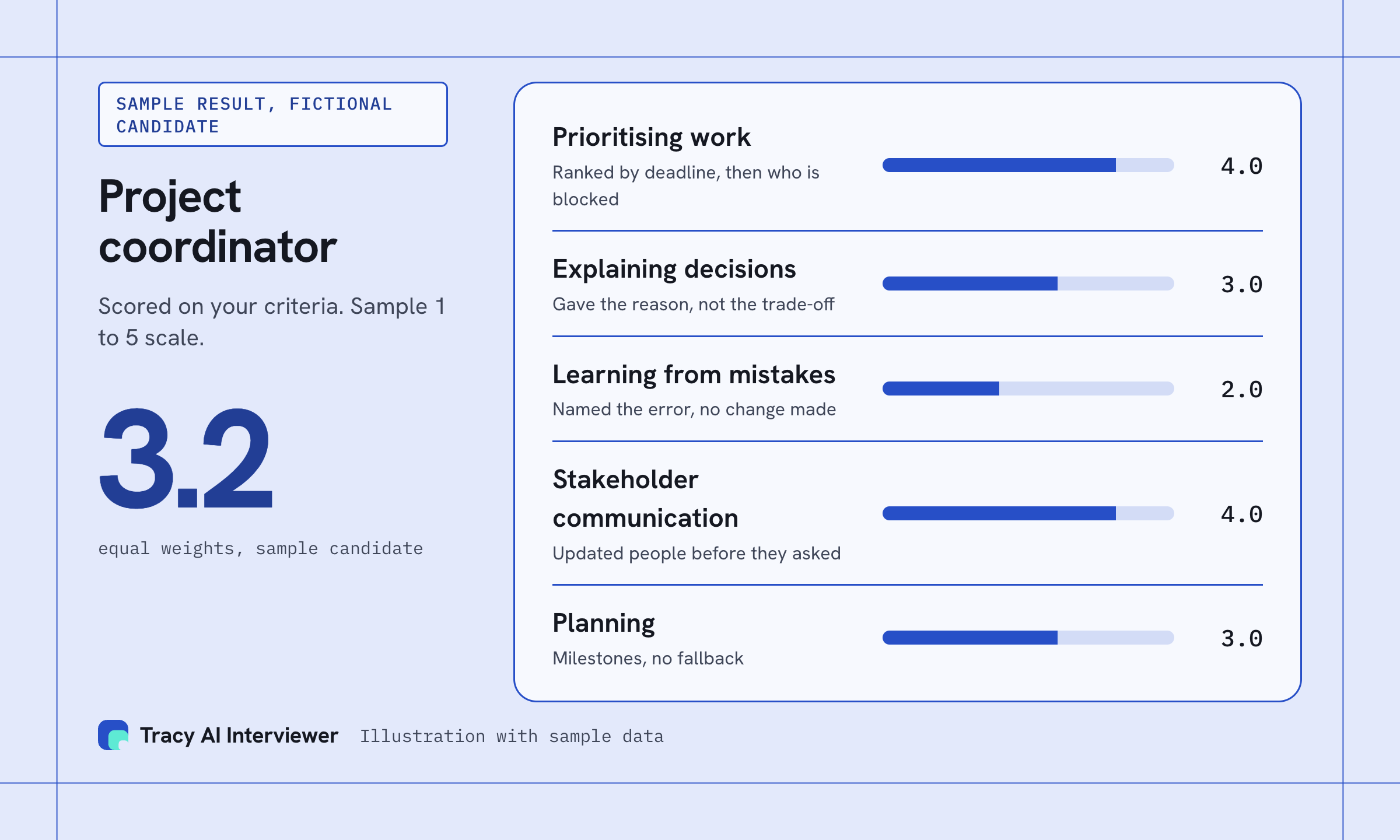
Each result carries a written assessment per question, so a reviewer can compare it with your anchors.
A filled example: project coordinator
A fictional candidate. The evidence is written for this page, and the anchors are the ones in the section above.
Table 6: filled example, fictional candidate
| Criterion | Score | Evidence | Why not one higher |
|---|---|---|---|
| Prioritising work | 4 | "I rank by deadline, then by who is blocked." Said the reporting task would slip and told the client. | Did not say who else was told. |
| Explaining decisions | 3 | Gave the reason for choosing a vendor. | Did not name the option rejected or what would change the call. |
| Learning from mistakes | 2 | Named a missed deadline and said "it was the other team". | Named no change to how they work. A 3 needs the fix. |
| Stakeholder communication | 4 | Updates the sponsor on Fridays and before a risk lands. | Example had one stakeholder, not conflicting ones. |
| Planning | 3 | Plan had milestones and owners. | No fallback if a milestone slipped. |
| Average | 3.2 | Equal weights: (4 + 3 + 2 + 4 + 3) / 5. |
Scroll the table sideways to see all 4 columns.
The 2 follows the anchors: the mistake is named, but the 3 anchor needs the fix. A line like that is one a debrief can argue with.
Calibrate before you score
- Pick two recorded or written answers and have every interviewer score them alone.
- Compare. Any gap of two points or more means an anchor is vague. Rewrite it.
- Revisit the anchors after the first ten interviews for a role. Keep the ones that separated candidates and rewrite the ones everybody scored the same.
- Give every candidate for the role the same core questions. A scale cannot compare answers to different questions.
Use the scale in Tracy
A scale only helps for the candidates who are scored on it. Tracy AI Interviewer interviews each applicant who takes it and scores each on the skills and weights you set.
- Your criteria, your anchors. Set the skills and weights for each role or role family. Keep your 1, 3 and 5 anchors in your own scoring sheet so reviewers read each assessment against them. A Director at a top-tier early-stage VC advises other teams to "spend time designing the depth and structure of your interview questions during the initial setup. The better you define what you want to evaluate, the more meaningful and actionable the results will be."
- A follow-up that separates a 3 from a 4. A first answer rarely shows the difference. She follows up on what the candidate said and waits for the answer, in the candidate's own field.
- Evidence for each rating. A written assessment per question with its reasoning, a recording of both sides and a timestamped transcript, so a reviewer can read the rating against your anchors.
- A person decides. A recruiter can move a candidate forward, override a rejection or invite someone to interview again, and the full history stays on the record. See how an AI interview report reads.
The first 3 results are free with no card. After that it costs $1 per credit, one credit per started 20 minutes of an interview that produced a result, with no seats and no upfront cost. See pricing. To try it, write your anchors into one role and run three real interviews.
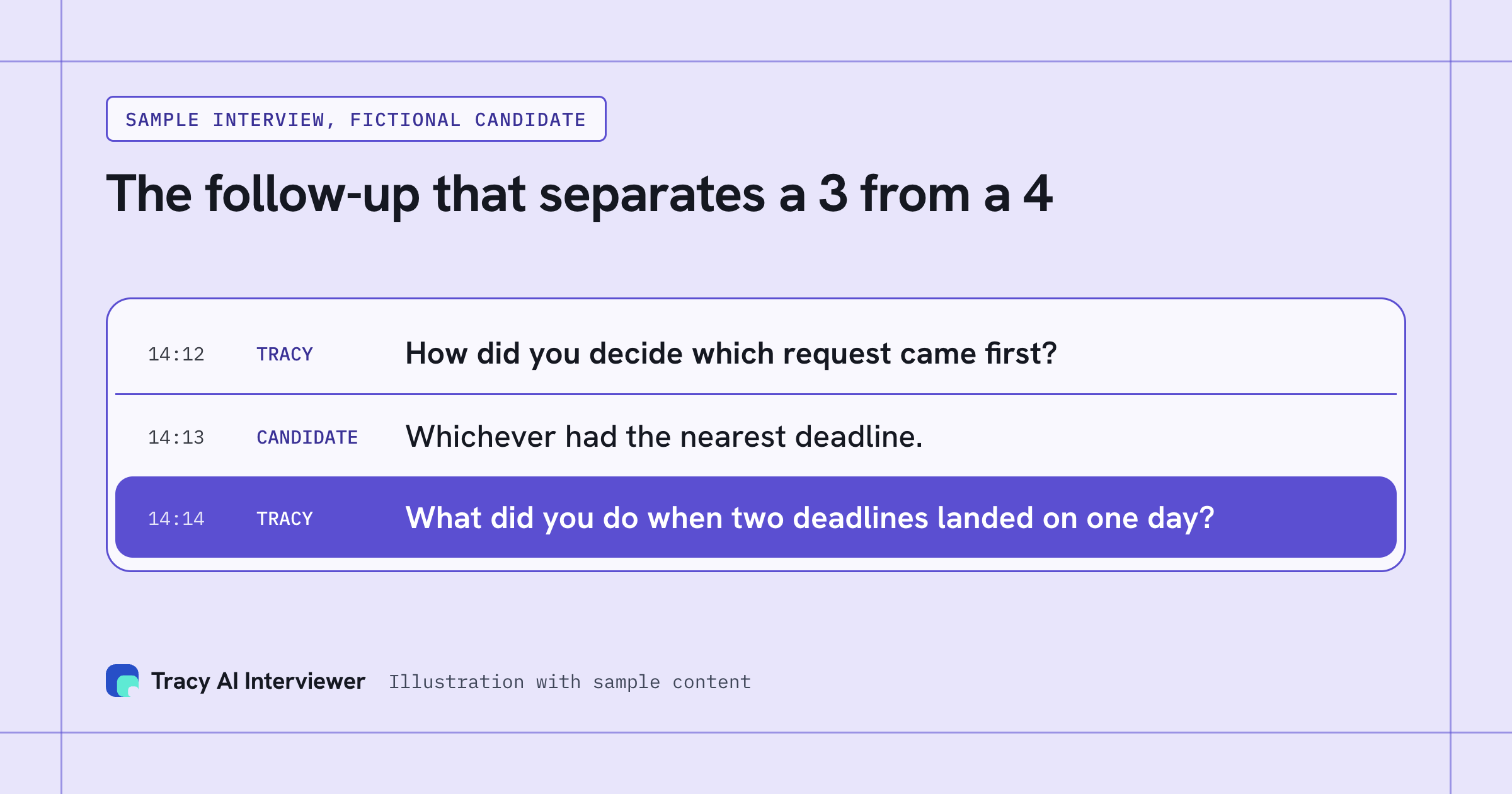
The follow-up is where a 3 and a 4 come apart.
Which path fits you
- Scoring many applicants for one role: volume hiring.
- Technical roles: technical interviews.
- Choosing the questions the scale will score: how to screen candidates.
Common questions
What is a good interview rating scale?
What does a 3 mean on an interview rating scale?
Should I use a 1 to 5 or a 1 to 10 scale?
Should an interview rating scale have an odd or even number of points?
How do you stop every interviewer scoring a 3?
Try Tracy on your next role
Tracy interviews every applicant, asks follow-up questions and sends you a ranked shortlist.
Try it free (opens in a new tab) Book a demo (opens in a new tab)
Your first 3 results are free. No card needed.
Sources
- Tracy AI Interviewer home page, customer quotes, retrieved 9 Nov 2026.
- Tracy AI Interviewer pricing, retrieved 9 Nov 2026.
- Tracy AI Interviewer Connect page, retrieved 9 Nov 2026.