In short
Tracy AI Interviewer asks your core questions of each candidate: she follows up on what each person says and leaves a recording and a written assessment for each question.
Below: a copyable guide with a timed run order, core questions with follow-ups and a decision block, plus a filled example.
Structured interviews outperform unstructured ones in the research; the guide below is the asking half.
The first 3 results are free. Paste the guide into one role and run it.
We make Tracy AI Interviewer.
You have the job description, a free hour and an interview tomorrow. An interview guide template turns that into a plan: what to cover, in what order, which questions every candidate gets and what a good answer sounds like. Without one, the conversation follows whoever talks most, and the next candidate gets a different interview.
Below is an interview guide template for hiring managers, a filled example, and how Tracy AI Interviewer asks your core questions of each candidate, built from the job description.
Why use a guide
A guide is the asking half of a structured interview. A 2022 re-analysis in the Journal of Applied Psychology by Sackett and colleagues, covering earlier published meta-analyses, put the mean validity of structured employment interviews at .42 and of unstructured interviews at .19. That is a correlation between the interview rating and later job performance ratings: 105 studies and 7,864 people for structured interviews, 32 studies and 3,125 people for unstructured ones. It is a stronger link, not a guarantee. The guide fixes the questions and their order; a scorecard fixes how you rate the answers. For screening before the interview, see how to screen candidates.
The interview guide template
Copy each table into a document or sheet. Fill the header first, then write the questions, then fix the minutes. A 45-minute guide works for most first and second rounds.
Table 1: header
| Field | Entry |
|---|---|
| Role and level | |
| Hiring manager | |
| Interviewer | |
| Length | 45 minutes |
| Three must-haves | 1. 2. 3. |
| What would end the process |
Table 2: timed run order, 45 minutes
| Block | Minutes | What you do |
|---|---|---|
| Opening | 3 | Say who you are, how long this takes, that you will take notes, and what happens after. |
| Context | 7 | Ask about their current role and why this one. Listen for fit, not polish. |
| Core questions | 25 | Ask the same four or five questions of every candidate. Use the follow-ups. |
| Their questions | 7 | Let them ask. Note what they ask. |
| Close | 3 | Say when and how they will hear back, and keep to it. |
Table 3: core questions
| # | Skill | Ask | Follow up with | Listen for | Score (1 to 5) |
|---|---|---|---|---|---|
| 1 | |||||
| 2 | |||||
| 3 | |||||
| 4 | |||||
| 5 |
Scroll the table sideways to see all 6 columns.
Table 4: notes and decision
| Field | Entry |
|---|---|
| Best moment (a quote) | |
| Biggest concern | |
| Recommendation | Advance, hold or do not advance |
| Send to the next interviewer | The one thing to probe next |
Write each question from a must-have, so that every row of table 3 traces back to something in table 1. If a question does not test a must-have, cut it.
How to use the guide
- Start from the job description. Pull three must-haves from it, and write the questions from those.
- Ask the same core questions of every candidate. Add or skip the context questions as you like.
- Keep the follow-up for after the answer. Ask it only once you have heard the first one.
- Write the quote, not the verdict. "Strong communicator" tells the next interviewer nothing; the sentence the candidate said does.
- Hold the minutes. If the core block runs long, drop a question for everyone, not for the candidate you like.
- Close the loop. Say when they will hear back, and do it.
A filled example: support team lead
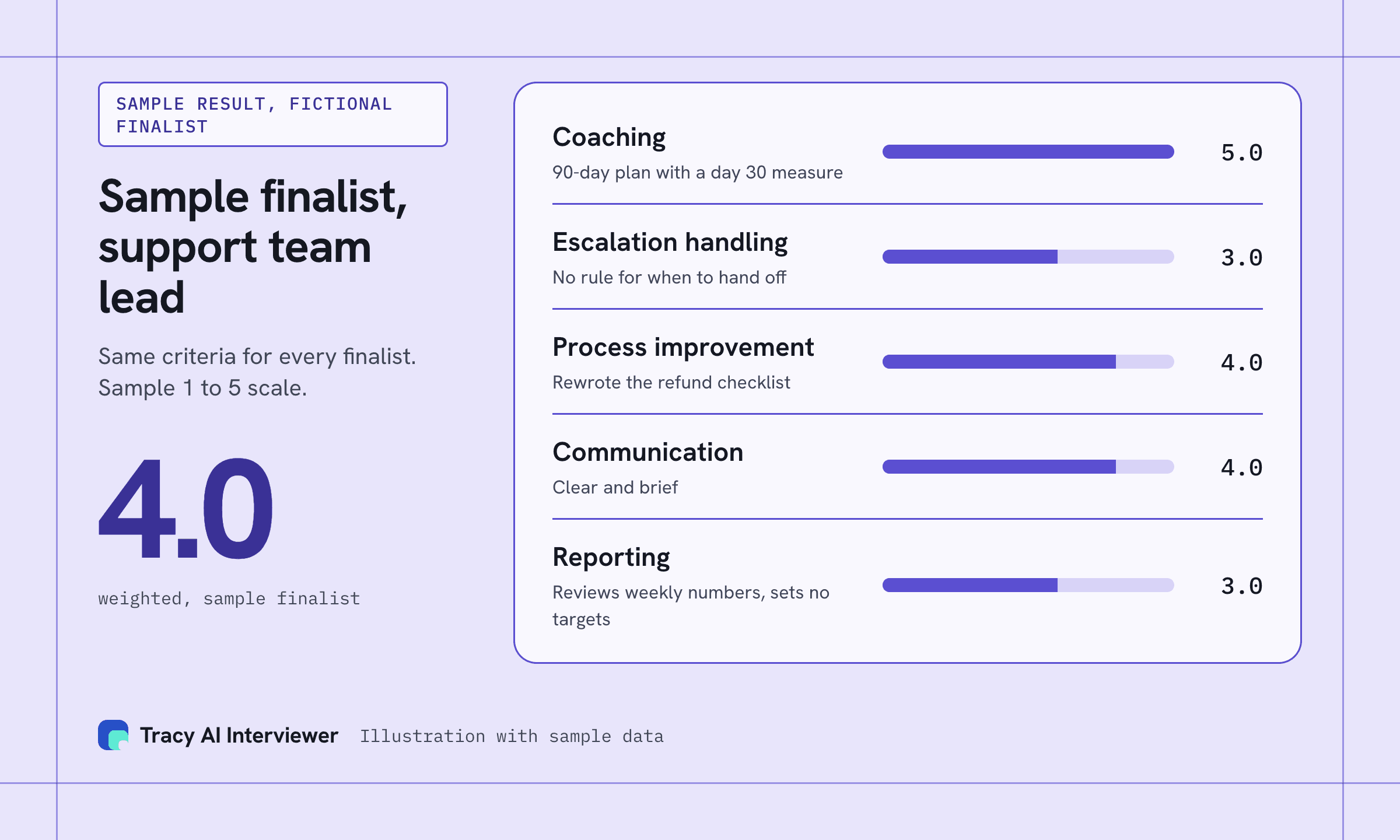
A fictional guide for a support team lead role: the header, then the core questions.
Table 5: filled example, header (fictional role)
| Field | Entry |
|---|---|
| Role and level | Support team lead, 8 agents |
| Must-haves | Coaches agents. Handles an angry escalation. Reads queue data. |
| What would end the process | Cannot give one example of coaching someone else |
Table 6: filled example, core questions (fictional role)
| # | Skill | Ask | Follow up with | Listen for |
|---|---|---|---|---|
| 1 | Coaching | Tell me about an agent whose work you helped turn around. | What did you say in the first conversation? | A specific change in the agent's behaviour, not a general approach |
| 2 | Escalations | Describe the angriest customer you handled and how it ended. | What would you do differently now? | Calm steps, an owner for the fix, a follow-up call |
| 3 | Queue data | Which numbers do you look at first on a Monday? | Which one did you act on last month? | A decision made from a number, not a list of dashboards |
| 4 | Planning | A teammate is out sick and the queue doubles. What happens in the next hour? | Who do you tell, and what do you drop? | A clear order of actions and who hears about it |
Scroll the table sideways to see all 5 columns.
After the interview the manager adds the score for each row, a best-moment quote and a recommendation. Fictional content, written for this page.
Run the guide with Tracy
A guide still needs someone to ask it of every applicant. Tracy can take the asking:
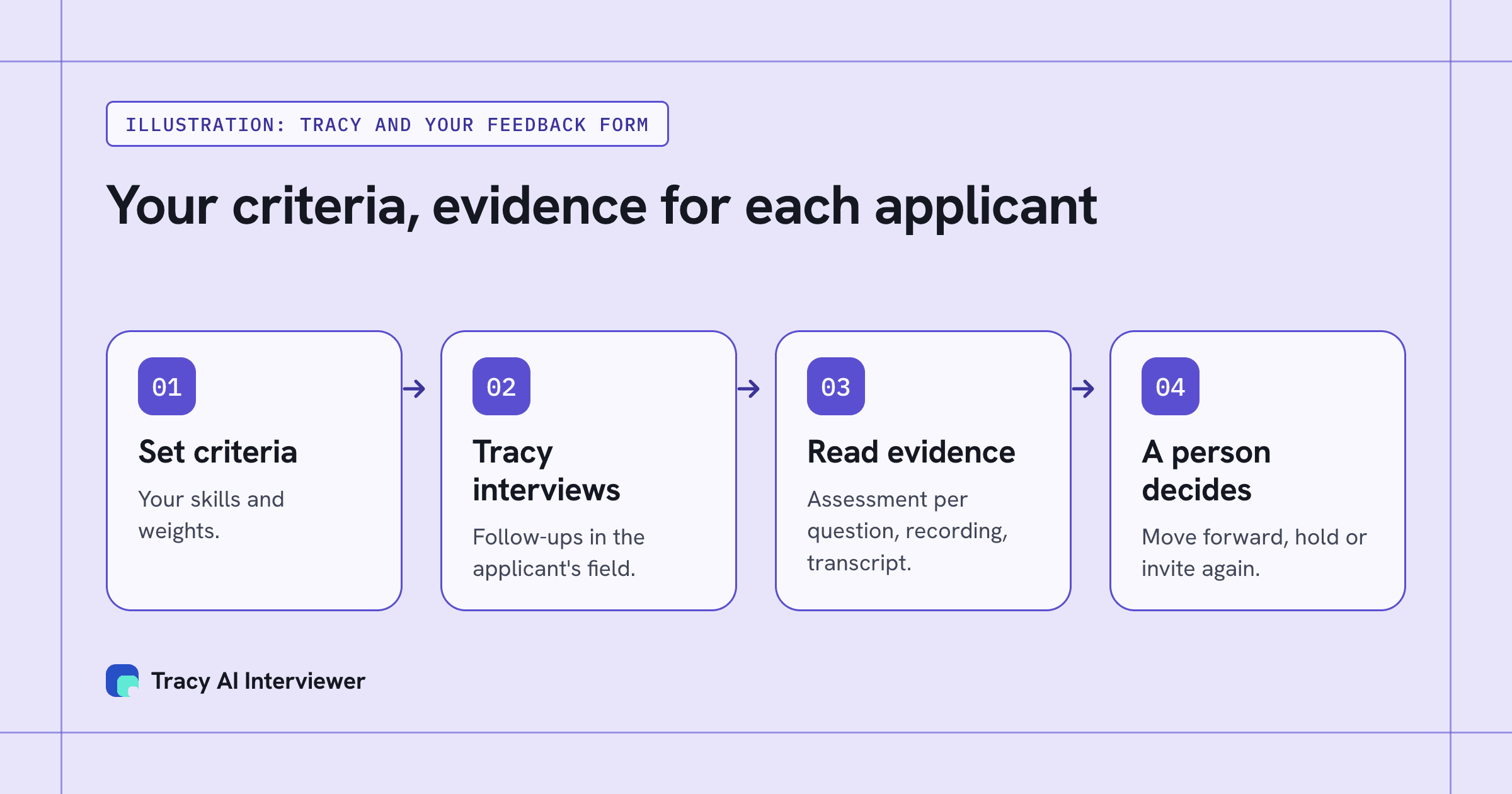
- Set up from the job description. Tracy generates the questions from the role. Edit them or paste in your own core questions, from a quick screen to a deep one, technical to behavioural.
- Follow-ups on what was said. She asks in the candidate's own field, follows up on the answer and waits for it. A Director at a top-tier early-stage VC says: "Tracy sometimes brings up exactly those questions I might have forgotten to ask, which has been a pleasant surprise."
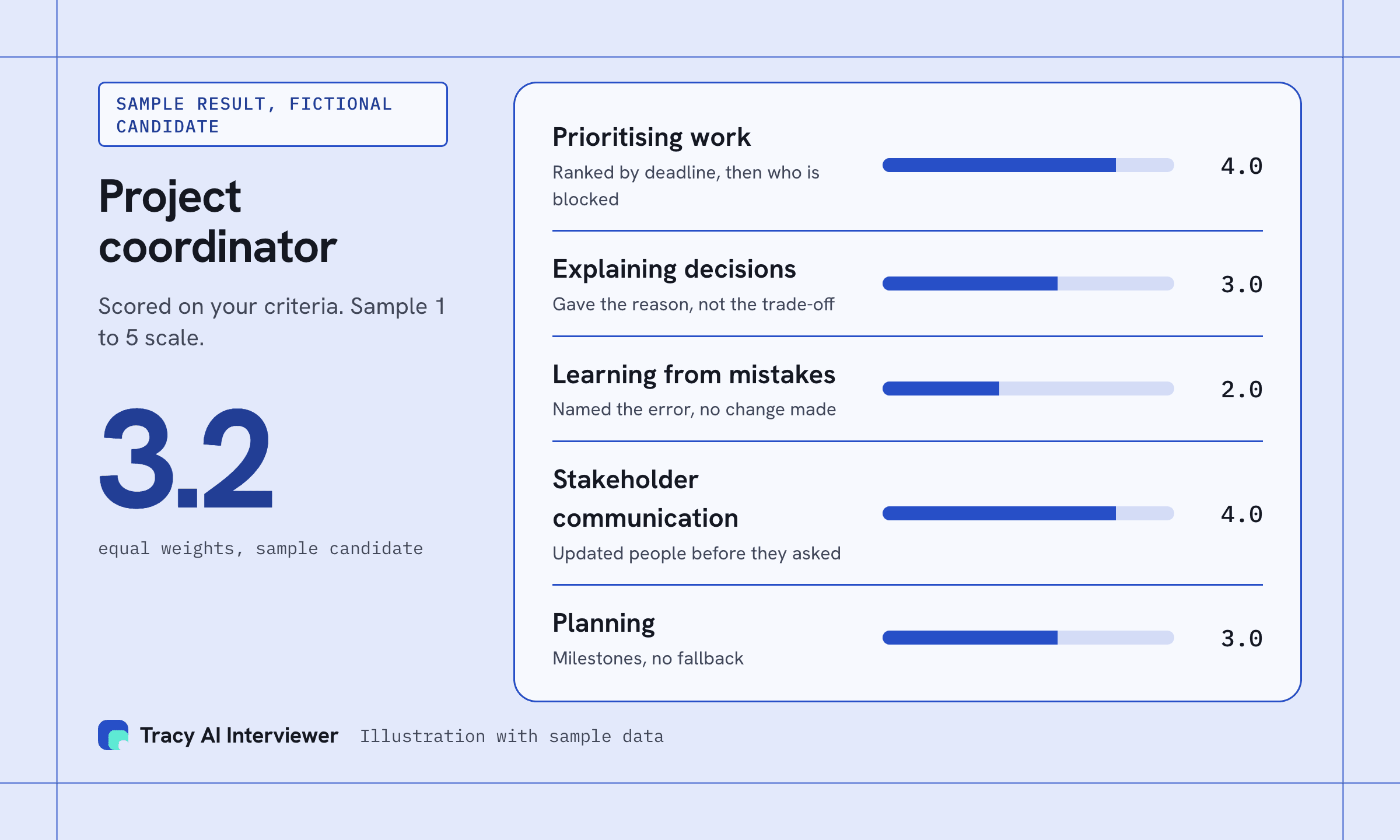
- Your criteria. You set the skills and their weights for each role, so the rows of your guide become what each result is scored on.
- Evidence per result. A recording of both sides, a timestamped transcript and a written assessment per question with its reasoning, so a reviewer can check each result.
- Any hour. Each candidate starts on a click, with no scheduling and no one from your team present.
A person decides. A recruiter can move a candidate forward, override a rejection or invite someone to interview again, and the history stays on the record. See how an AI interview report reads and the volume hiring page.
To try it, paste the core questions from your guide into one role and run it.
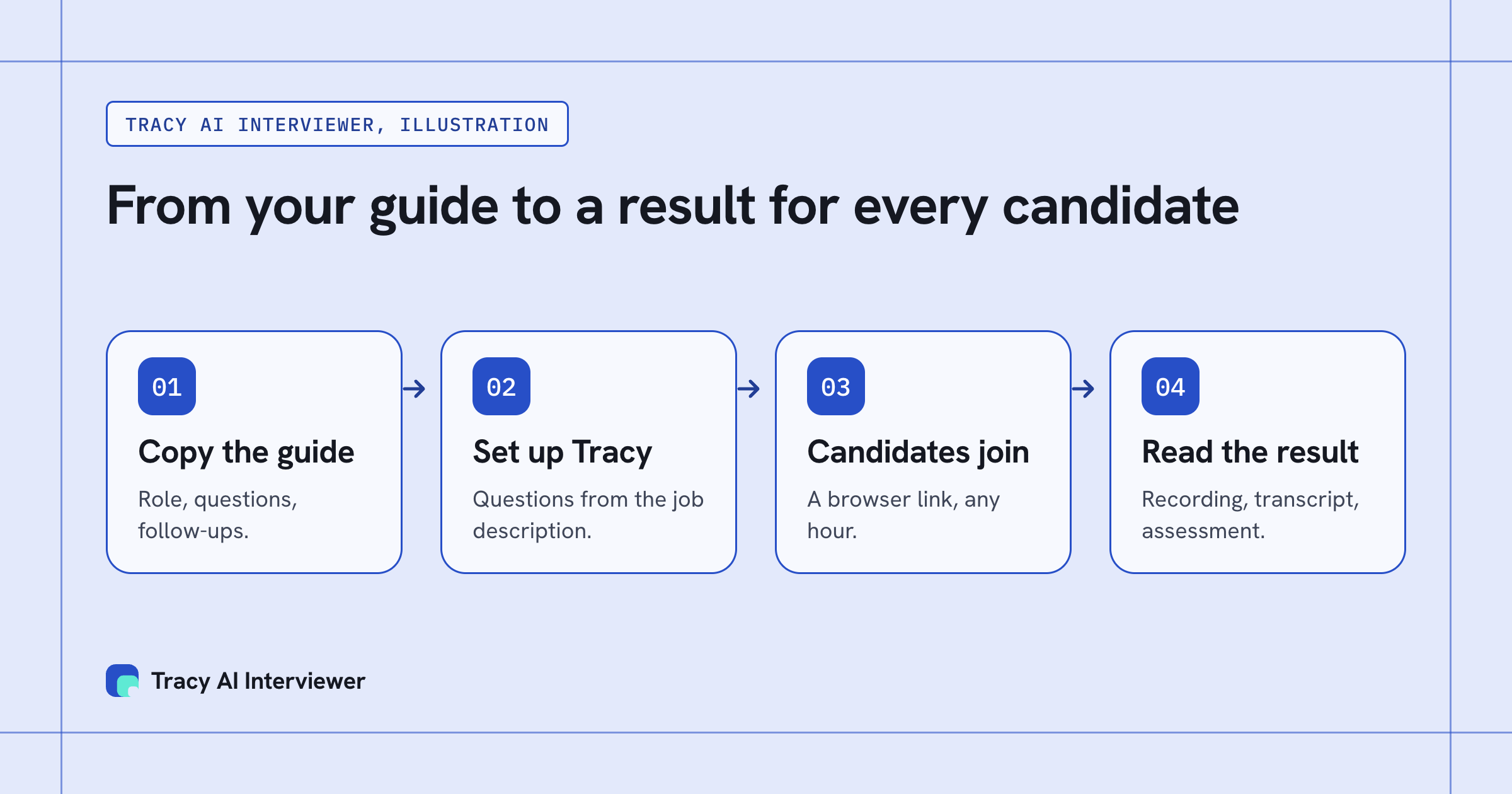
Your questions stay yours; Tracy asks them and leaves the evidence.
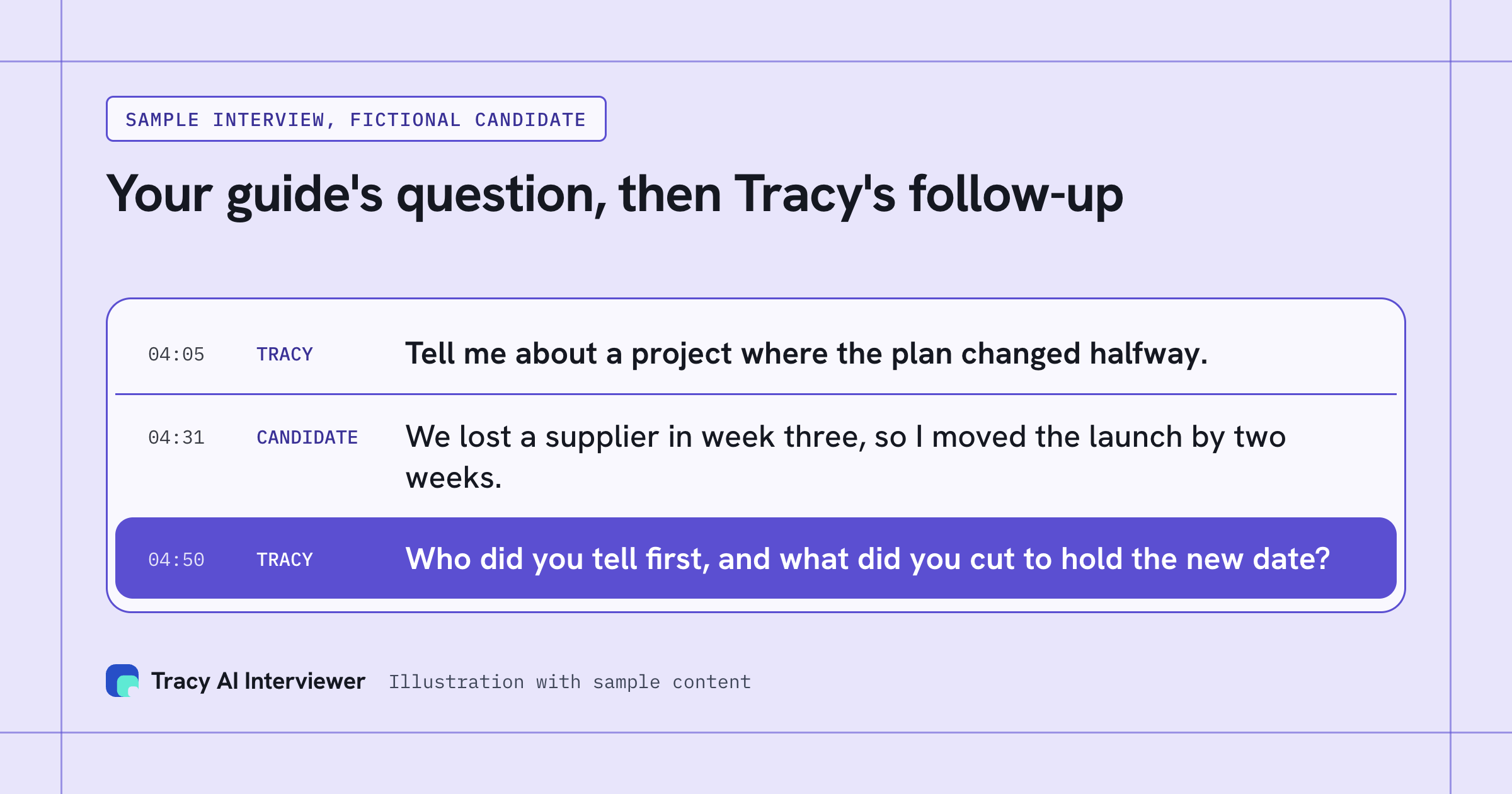
The follow-up asks for the detail behind the answer, so the next reviewer reads it.
Which path fits you
- One role, many applicants: volume hiring.
- Technical roles with a coding task in the interview: technical interviews.
- Cost before you start: pricing.
Common questions
What is an interview guide?
What should an interview guide template include?
How long should an interview guide be?
What is the difference between an interview guide and a scorecard?
Can Tracy use my interview guide?
Try Tracy on your next role
Tracy interviews every applicant, asks follow-up questions and sends you a ranked shortlist.
Try it free (opens in a new tab) Book a demo (opens in a new tab)
Your first 3 results are free. No card needed.
Sources
- Sackett, Zhang, Berry and Lievens (2022), Revisiting meta-analytic estimates of validity in personnel selection, Journal of Applied Psychology 107(11), retrieved 9 Nov 2026.
- Tracy AI Interviewer home page, customer quotes, retrieved 9 Nov 2026.
- Tracy AI Interviewer Connect page, retrieved 9 Nov 2026.