
TLDR Tracy AI Interviewer scores every applicant on the skills and weights you set, with a recording and written assessment behind each result.
Below: five weighted criteria, a 1 to 5 scale, an evidence column, a decision block, the Excel formula and a filled example.
A person decides who goes forward.
Next step: send us one role and we build the interview plan from your scorecard.
We make Tracy AI Interviewer.
The debrief starts well enough. Then three interviewers say "good energy", "a bit thin" and "strong" about the same candidate, and the loudest voice wins. An interview scorecard template ends that. Every interviewer scores the same criteria on the same scale and writes down what they heard, so the debrief compares evidence and not impressions.
Below is a template you can paste into a sheet, a filled example, and how Tracy AI Interviewer scores every applicant on the criteria and weights you set, from a recorded interview.
Why a scorecard matters
Structure in the interview is what a scorecard enforces. A 2022 re-analysis in the Journal of Applied Psychology by Sackett and colleagues, covering earlier published meta-analyses, put the mean validity of structured employment interviews at .42 and of unstructured interviews at .19. That is a correlation between the interview rating and later job performance ratings: 105 studies and 7,864 people for structured interviews, 32 studies and 3,125 people for unstructured ones (source). That is a stronger link and no guarantee. A scorecard is the scoring half of structure. The other half is asking every candidate for the role the same questions.
The interview scorecard template
Make a copy of the scorecard in Google Sheets. The sheet has the same fields, weights and scale as the tables below, and the formulas are for you to add. Or copy each table into your own sheet. With the weights in column C and the scores in column D, rows 2 to 6, work out the weighted score in Excel or Google Sheets with =SUMPRODUCT(C2:C6,D2:D6)/SUM(C2:C6).
1. Header
| Field | Entry |
|---|---|
| Candidate | |
| Role | |
| Round and date | |
| Interviewer | |
| Recording or notes link |
2. Scoring
| Criterion | What it covers | Weight | Score (1 to 5) | Evidence: quote or time |
|---|---|---|---|---|
| Criterion 1 | The skill or behaviour, in one line | 25 | ||
| Criterion 2 | 25 | |||
| Criterion 3 | 20 | |||
| Criterion 4 | 15 | |||
| Criterion 5 | 15 |
3. The scale
| Score | Meaning |
|---|---|
| 1 | No relevant example, or the answer shows the skill is missing. |
| 2 | A partial example. Cannot go deeper when asked. |
| 3 | Meets the bar. A real example and sensible answers to the follow-up. |
| 4 | Above the bar. Specific detail, results and what they would change. |
| 5 | Strong. Deep, consistent under follow-up, and could teach it. |
4. Decision
| Field | Entry |
|---|---|
| Weighted score | |
| Recommendation | Advance, hold or do not advance |
| Biggest risk | |
| What to probe next |
Pick four or five criteria that the role really needs, and make the weights add up to 100. More than five and the scores blur, because nobody remembers six things from a twenty-minute conversation.
How to use the scorecard
- Set the criteria and weights before the first interview. Choosing weights after you have met the candidates defeats the point.
- Each interviewer scores alone. Write the scores and evidence before the debrief, and do not look at anyone else's first.
- One quote or moment per score. If you cannot point to something the candidate said or did, the score is a guess.
- Score the answer, not the person. Accent, confidence and a shared background are not criteria.
- Discuss the gaps. A difference of two points or more on one row is where the debrief should spend its time.
- Keep the candidates comparable. Same criteria, same scale and the same core questions for every candidate for the role.
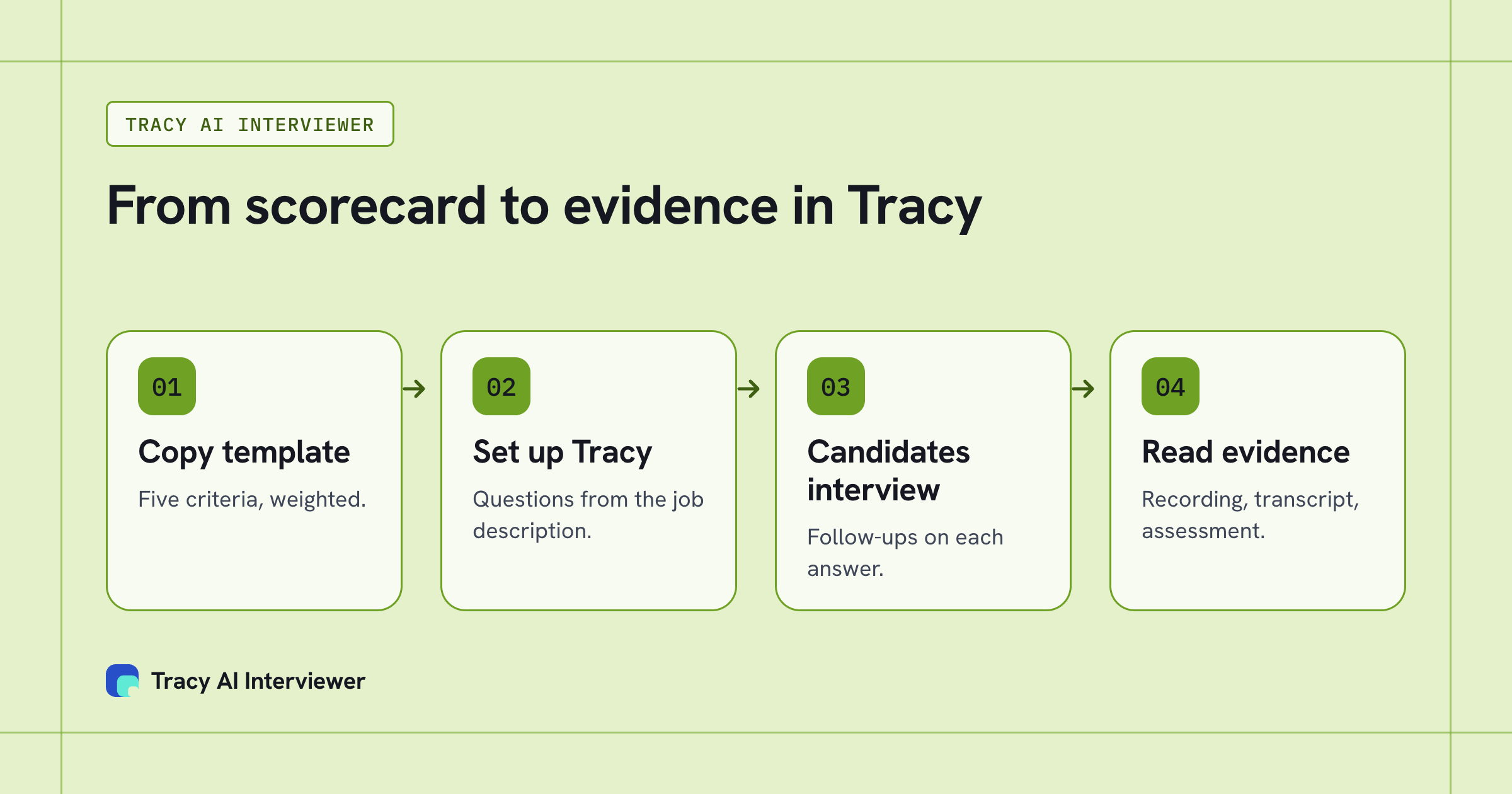
The scorecard works because the order is fixed: criteria first, scores alone, evidence written, then the discussion.
A filled example: support engineer
A fictional candidate for a support engineer role. The evidence is written for this page.
| Criterion | Weight | Score | Evidence |
|---|---|---|---|
| Troubleshooting | 25 | 4 | "I ask for the exact error and the time it started, then check the logs." Followed with two causes ranked by likelihood. |
| Customer communication | 25 | 5 | "I describe what they will see on screen before I name the setting." Kept it plain without being asked. |
| Ownership | 20 | 4 | Told a customer a fix would take two days and called back at the end of day one. |
| Tool knowledge | 15 | 3 | Named the ticket tool's macros but could not say how they would automate a repeated case. |
| Availability and fit | 15 | 4 | Can work the European afternoon shift from the first of next month. |
The weighted score is (25 x 4 + 25 x 5 + 20 x 4 + 15 x 3 + 15 x 4) / 100 = 4.1. Recommendation: advance. Next round: probe the tool knowledge row.
Build the Tracy interview from your scorecard
A scorecard only helps for the candidates you actually interview against it. Tracy scores every applicant on the skills and weights you set, with a recording and written assessment behind each result.
- Set up from the job description. Tracy generates the questions from the role. Edit them or use your own, from a quick screen to a deep one, technical to behavioural.
- Your criteria, your weights. You set the skills and their weights for each role or role family. The five rows of your scorecard become the skills.
- Follow-ups. She asks in the candidate's own field, follows up on what they said and waits for the answer.
- Evidence per result. Each result has a recording of both sides, a timestamped transcript and a written assessment for each question with its reasoning. A reviewer can read the recording and the transcript behind each result.
- Every applicant, any hour. Each applicant starts on a click with no scheduling, so every applicant gets a score. One Tracy customer cut its average time to hire from 44 days to 7.
A person decides. A recruiter can move a candidate forward, override a rejection or invite someone to interview again, and the full history stays on the record. See how an AI interview report reads, how AI screening interviews fit a funnel, and the volume hiring page for the full flow.
Cost is $1 per credit, one credit per started 20 minutes of an interview that produced a result. One hundred 20-minute interviews cost $100. The first 3 results are free with no card, and there are no seats and no upfront cost. See pricing. To try it, make a copy of the scorecard in Google Sheets, paste your five criteria into one role and run three real interviews.
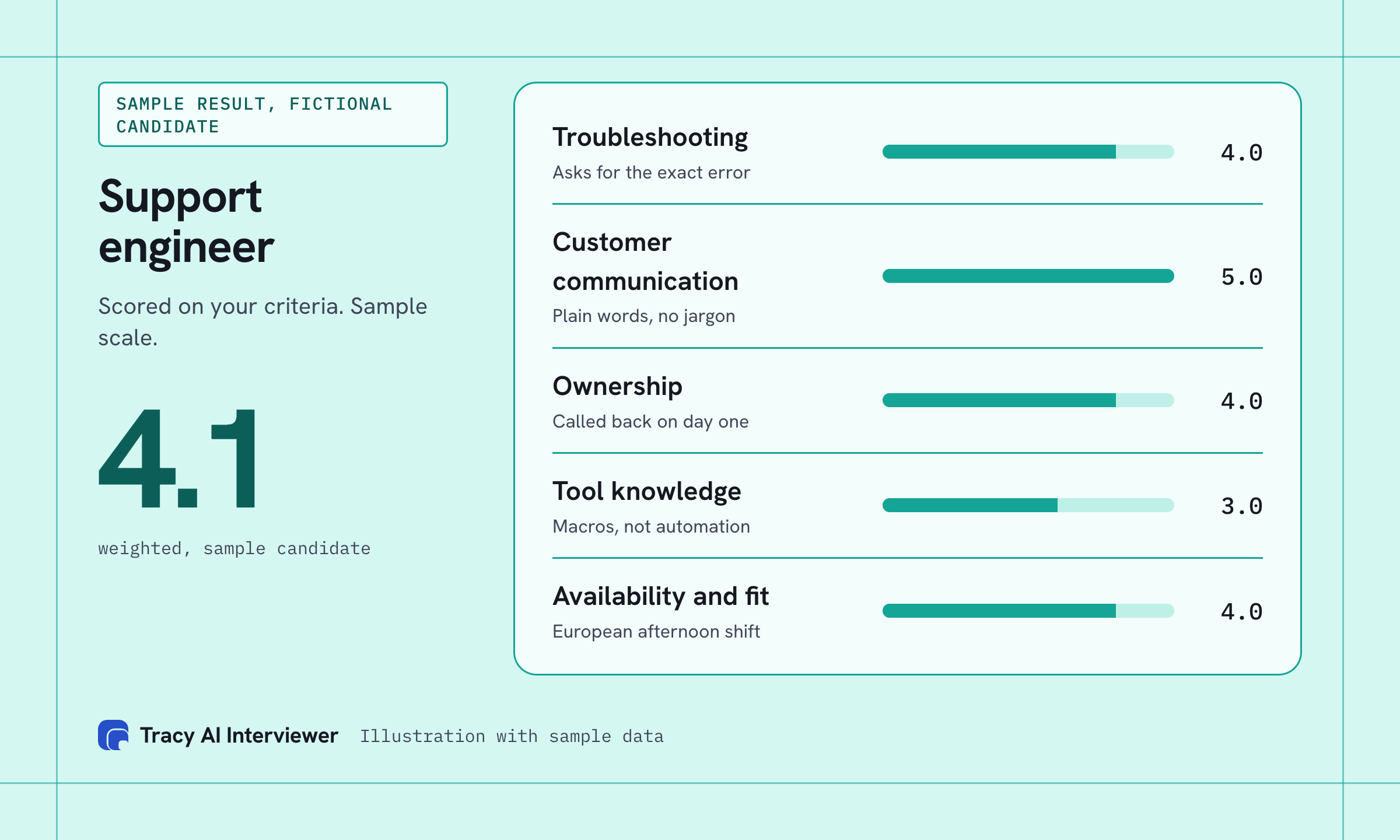
A weighted result a reviewer can compare, with a recording and a timestamped transcript behind it.
Which path fits you
- Screening applicants for one role in large numbers: volume hiring.
- Technical roles: technical interviews.
- Checking a candidate funnel before you set criteria: how to screen candidates.
Questions
What should an interview scorecard include?
How many criteria should a scorecard have?
Is there an interview scorecard template for Excel?
Should interviewers see each other's scores?
How do you weight the criteria?
Can Tracy use my scorecard?
Copy the template, then run it as a Tracy interview. Send us one role and we will build the interview plan from it in days, with a recording and report you can check. Try it free · Book a demo
Sources
- Sackett, Zhang, Berry and Lievens (2022), Revisiting meta-analytic estimates of validity in personnel selection, Journal of Applied Psychology 107(11), retrieved 9 Nov 2026.
- Tracy AI Interviewer home page, customer quotes, retrieved 9 Nov 2026.
- Tracy AI Interviewer pricing, retrieved 5 Nov 2026.
- Tracy AI Interviewer Connect page, retrieved 5 Nov 2026.