In short
A Claude skill teaches Claude how you recruit: your rubric, your wording, your steps. It gives Claude no new access, and it cannot interview anyone. Tracy AI Interviewer is the connector for interviews. Claude drafts the interview, you approve it, and Tracy interviews each applicant on video with follow-ups in their own field. You get a recording, a transcript and what each person said to each question. A person makes the decision.
What is a Claude skill?
A skill is a folder with a SKILL.md file. The file starts with a name and a description, then holds instructions Claude follows. Anthropic's docs describe skills as reusable resources that give Claude domain expertise, and say that, unlike a prompt, a skill loads on demand, so you do not repeat the same guidance in every chat. Until a skill triggers, only its name and description sit in Claude's context.
For a recruiter that means one place for the things you keep pasting into chats: the screening rubric, the outreach tone, the layout of a hiring-manager summary. Write it once and Claude applies it whenever a request matches the description. Anthropic's help center draws the line that matters here: a connection is what lets Claude reach a tool, and a skill is what teaches it to use that tool well. A skill supplies the method and a connector supplies the access. (If the term is new, how a remote MCP server gives Claude access covers the access half.)
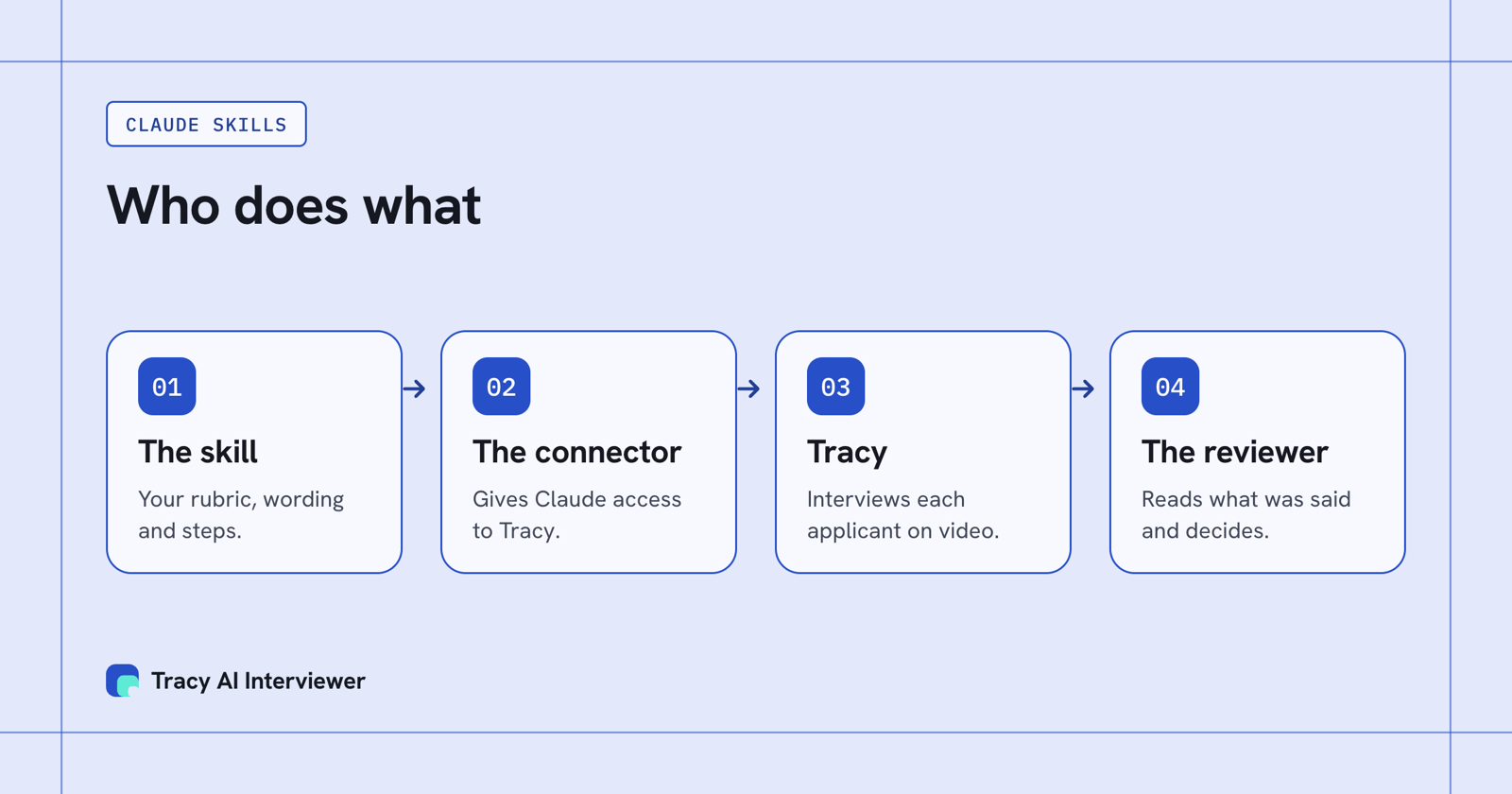
The skill sets your method, Tracy interviews, and a person reads the results and decides.
Which Claude skills help recruiting?
A recruiting skill often holds work Claude can do from text you give it. Three starting points are real and documented:
- Skills you write. Anthropic's own advice is to use skills you created yourself or got from Anthropic. A rubric for screening CVs, an outreach style guide or a debrief layout are the usual first skills.
- Anthropic's document skills. PowerPoint, Excel, Word and PDF skills are built in on claude.ai, which helps when the output is a scorecard sheet or a client-ready summary.
- The Human Resources plugin. Anthropic's knowledge-work plugins repository includes a
recruiting-pipelineskill (source, screen, interview and offer stages) and aninterview-prepskill (competency-based questions, scorecards, debrief templates). It is a plugin built for Claude Cowork and works in Claude Code too.
Skills from public libraries and blogs are a different matter. Anthropic warns that a malicious skill can direct Claude to call tools or run code against its stated purpose, and tells you to review every bundled file before you enable one. Read a downloaded recruiting skill the way you would read a macro from a stranger. Sample prompts are a separate, simpler thing: our list of Claude prompts for recruiters needs no install.
| Task | What a skill holds | What needs a connector |
|---|---|---|
| Job post | Your tone, structure and banned words | Nothing; Claude alone |
| CV screen | The rubric and the output layout | The CVs, by upload or from your own system |
| Outreach | Length, tone and sign-off rules | Your mailbox (Gmail connects to Claude), or your ATS if it offers a connector |
| Interview plan | Your criteria and format | Nothing; Claude alone |
| Interviews | When to run one and what to ask | Tracy: the interview itself, on video |
| Invitations | Your shortlist rule and email wording | Tracy: invitations, sent after you approve the preview |
| Results | The report layout you want | Tracy: results from your account |
| Manager brief | Your debrief template | Tracy: the transcript and answers to quote from |
Skill versus connector for eight recruiting tasks.
Where do interviews fit?
Claude can write the questions but cannot sit across from a long list of applicants, which takes a connector. Tracy AI Interviewer publishes one at tracyinterview.ai/mcp for Claude, ChatGPT and other MCP hosts. With it on, you ask Claude in plain words to set up an interview for a role. Claude shows a draft with the title, the questions and the result fields, and nothing is created until you approve. Invitations are previewed the same way and go out only after your yes.
The interview itself is Tracy's work, and it is built for volume. Each applicant starts on click, at any hour, in a browser with no account, and is told on the join screen that the conversation is recorded and transcribed. Tracy follows up in the person's own field and waits for the end of the thought. It reads the CV when the CV check is on. You bring your own questions, or describe the role and edit what Tracy drafts. Our Claude connector guide has the setup, and the volume hiring use case shows what the applicant meets.
Ask Claude for the results and it brings back, in the chat, what each participant said to each question, the result fields and a note for an applicant tracking system. In the Tracy account sit the recording, a timestamped transcript and a written assessment per question, with integrity signals shown for a person to review. Tracy does not score, rank or reject anyone. Your skill can say how you want the summary laid out; the reviewer makes the call. Candidates rate Tracy 92 on NPS. On Pay as you go, Tracy costs $1 per credit, one credit per started 20 minutes, and the first 3 results are free.
Write your first recruiting skill
Start with one repeated task, not a whole recruiting function. A skill that does one job well beats a long one that triggers on everything.
- Pick the task. Choose something you do weekly, such as screening a batch of CVs for one role family.
- Write the description first. Anthropic's docs say it must state what the skill does and when to use it, and allow up to 1,024 characters. Claude matches your request against it.
- Put the rubric in the body. Criteria, what counts as evidence, and the output layout. Keep the body short; Anthropic puts the target under 5k tokens.
- Name the connector step. Write a line such as "for shortlisted people, ask Tracy AI Interviewer to draft an interview and show me the preview." Claude can then use the connector, asking your approval as usual.
- Load it where you work. On claude.ai, upload the folder as a zip under Customize, Skills, with code execution on. In Claude Code, place it in
~/.claude/skills/or.claude/skills/. Skills do not sync between surfaces, so each place needs its own copy.
A full worked example for the manager side is in the Claude hiring manager skill, and a Cowork setup for recruiters shows the same pieces in Anthropic's desktop agent. Test the skill on a practice interview first. Unless you have set Always allow, Claude asks before each use of Tracy, so you see what it is about to do.
Keep the decision with a person
A recruiting skill should shape the work, not make the call. Write that into it: Claude drafts and summarises, and a recruiter decides who moves forward. Tracy's integrity signals (full-screen exit, face on camera, a pop-up if the face leaves the frame) are shown to a human reviewer as evidence, never as proof, and applicants are told before the video starts. For screens you plan to automate, our candidate screening questions and interview scorecard template give the criteria to put in the skill.
On connectors, Claude asks before it uses one. "Allow once" is the safe default until you trust a task; "Always allow" suits only tools you trust. On Team and Enterprise plans an owner adds a custom connector first, and Anthropic notes it does not verify custom connectors, so connect only servers you trust.
Which path fits you
- Recruiters with a high applicant count: start from hiring at volume, then write one skill around it.
- Hiring managers who want a scorecard and an interview set up from one chat: build a hiring manager skill.
- Teams comparing tools first: see best AI tools for recruiters.
- Wider Claude use in recruiting: Claude for recruiting covers what it does well.
Common questions
What are Claude skills?
Are Claude skills available on the free plan?
Do I need a skill if I have the Tracy connector?
Can a Claude skill interview candidates?
Can I share a recruiting skill with my team?
Does the skill decide who to hire?
Add Tracy to Claude and draft one interview
Add the connector in five steps, then ask Claude to draft one interview for a real role; you approve before anything is created.
Try it free (opens in a new tab) Book a demo (opens in a new tab)
Your first 3 results are free. No card needed.
Sources
- Anthropic: Agent Skills overview, retrieved 15 Nov 2026.
- Anthropic help center: What are skills?, retrieved 14 Nov 2026.
- Anthropic knowledge-work plugins: human-resources, retrieved 14 Nov 2026.
- Claude Code docs: Skills, retrieved 14 Nov 2026.
- Add Tracy AI Interviewer to Claude (public guide), retrieved 14 Nov 2026.
- Tracy AI Interviewer Connect page, retrieved 14 Nov 2026.