
TLDR Tracy AI Interviewer asks your candidate screening questions of every applicant, then follows up on the answer, which is where depth shows.
Questions come from your job description, edited or your own, and each result carries a recording and an assessment per question.
Below: ten questions with the follow-up and what to listen for.
Next: load them into one role and compare the follow-ups.
We make Tracy AI Interviewer.
Picture a recruiter who asks 120 applicants "tell me about a time you handled a conflict". She gets 120 smooth answers. Each one has a situation, an action and a result, and none can be told from the next. The question was fine. The screening stopped one step too early.
Candidate screening questions only help if they separate people who have done the work from people who can describe it well. That separation rarely sits in the first answer. It sits in the follow-up. Tracy AI Interviewer asks your questions of every applicant and then asks the follow-up a good recruiter would, so the depth shows up before anyone books a call.
Listen for specifics, trade-offs and their own part
Three habits show up in answers from people who did the work, and are missing from answers that were rehearsed:
- Specifics. A named tool, a number, a date, a person. Polish stays general.
- Trade-offs. They say what they gave up and why. Rehearsed answers have no cost.
- Their own part. "I" appears where the work was theirs, and "we" appears where it was not. They can say which is which.
Write each of your screening questions so that one of these three can be heard, and write the follow-up before you need it.
Split the knockout questions from the depth questions
Keep a form for facts you can check without a conversation: work authorisation, location, notice period, salary range. Those are knockout questions, and a form does them well. Do not spend interview time on them.
Keep the interview for what a form cannot test: how someone reasons, what they have actually done, and what they do when the first answer is not enough. Avoid questions about age, family, health or anything else unrelated to the job. They add risk and no signal.
Ten candidate screening questions with follow-ups
Ten depth questions for technical and high-volume roles. Ask the follow-up only after you have heard the first answer. Swap the nouns for your own stack. Our guide to how to screen candidates covers the process around them.
| Ask | Follow up with | Listen for |
|---|---|---|
| What was the last thing you built or fixed that you are proud of? | What would you do differently now? | A real decision, not a title |
| Walk me through how you diagnosed your last hard fault. | What did you rule out first, and why? | Order and reasons |
| What did you leave out of your last project? | What did leaving it out cost? | A trade-off they own |
| Which tool or method did you pick over another? | When would you pick the other? | Conditions, not loyalty |
| Tell me about a number you moved. | What would it have been if you had done nothing? | Whether they know the cause |
| Describe a time you were wrong at work. | Who found out, and what changed? | Honesty and a fix |
| What part of your CV would you rather we asked about? | And the part you would rather we did not? | Candour about gaps |
| How do you explain this work to someone outside your field? | What do they usually get wrong? | Plain words |
| What did your team do that you disagreed with? | What did you do about it? | Action, not complaint |
| What would you learn first in this role? | How would you know it was working? | A plan with a test |
The table lists ten questions, the follow-up for each and what to listen for.
Ask every applicant the questions you set for the role. The follow-ups differ with each answer, and that is the point.
Follow up with an example, a number or a decision
Weak screening stops at the first answer. A useful follow-up does one of three things: asks for an example ("which project?"), asks for a number ("how many?"), or asks for a decision ("why that one?"). If an applicant cannot give any of the three, you have learned something real. If they can, you have the evidence to write down.
Tracy: How do you handle a tight deadline?
Candidate (fictional): I prioritise and communicate early.
Tracy: What did you drop the last time that happened?
This is an illustration with sample content. "I prioritise" fits anyone. What they dropped is a fact.
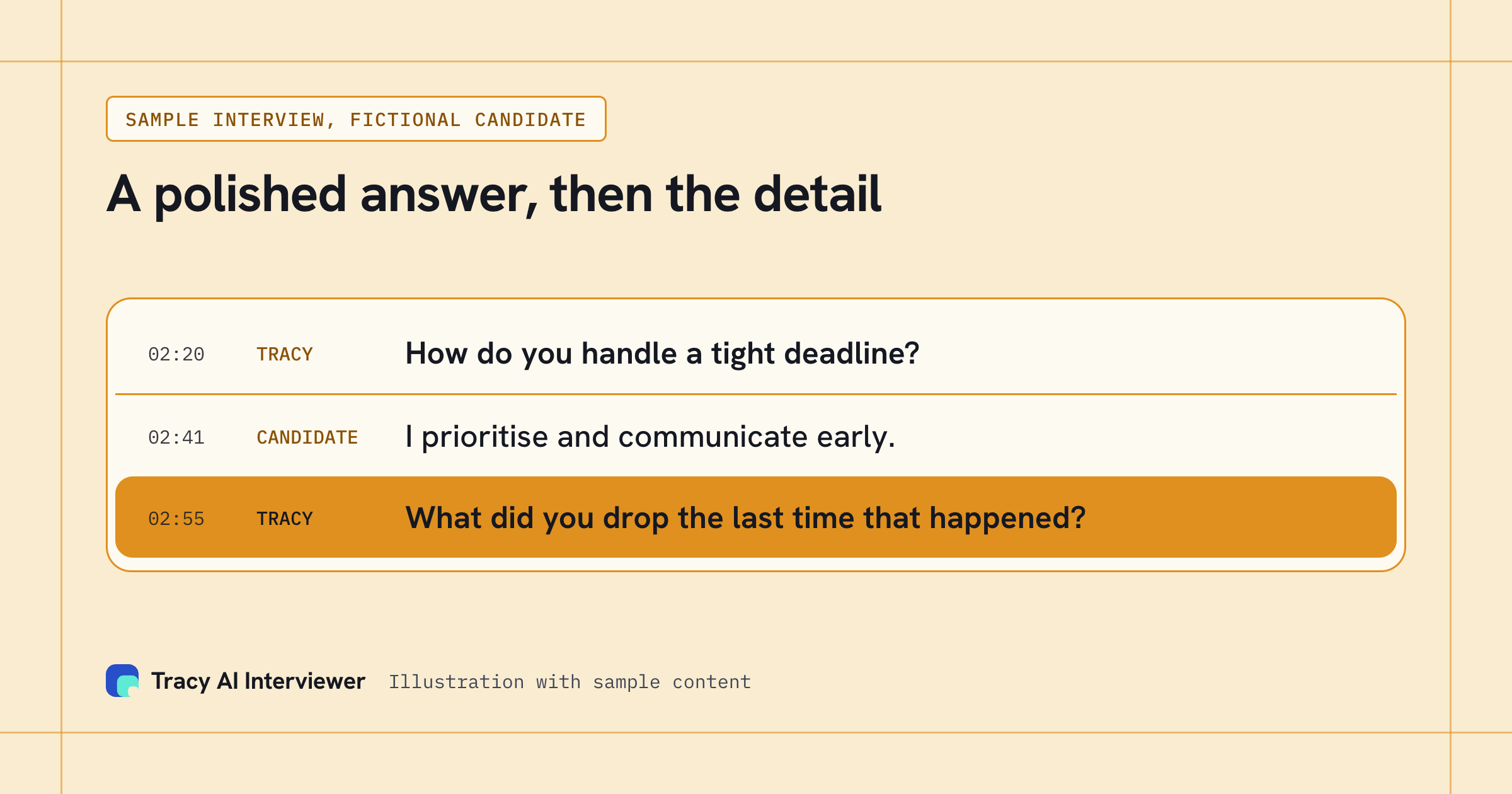
One short follow-up separates a general answer from a specific one.
Run the questions at volume without cutting the follow-ups
Asking these ten questions of two hundred applicants takes a team, and the follow-ups are the part that gets cut first. Tracy takes the job. Give her a job description and she drafts the questions, in a style from quick to deep and from technical to behavioural. Edit them or write your own. Each applicant starts from a link, at any hour, and Tracy follows up on what they said and waits for the end of the thought.
For each result you get a recording, a timestamped transcript and a written assessment for each question. A person reads and decides. For technical roles, a coding task can sit in the same interview. See AI screening interviews and screening hundreds of applicants.
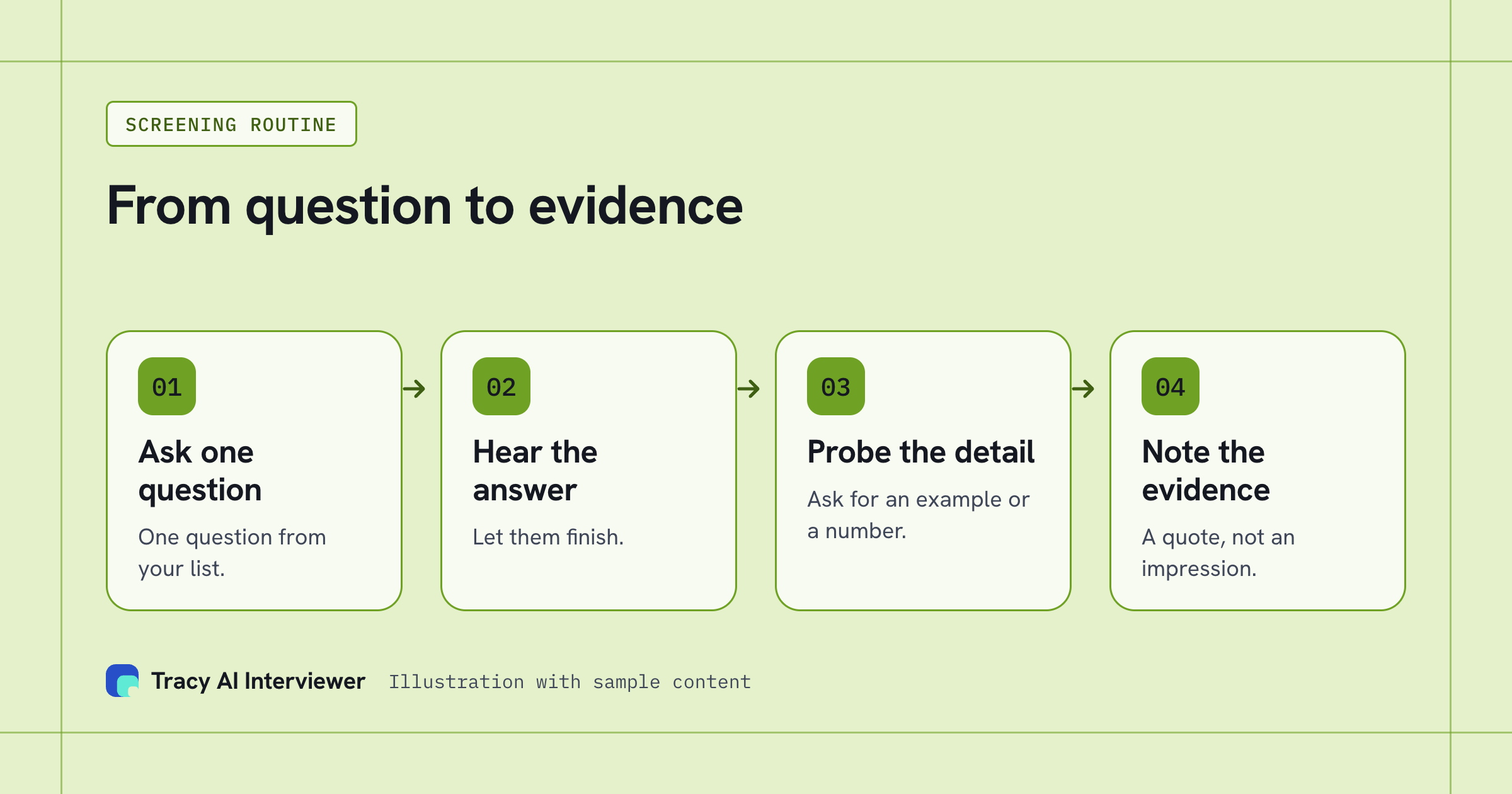
One question, the full answer, a probe, then evidence.
Pilot the questions on one role
Roy Junyoung Jang, Director, Residency & Investment at Antler Korea, gives one piece of advice for teams starting out: "spend time designing the depth and structure of your interview questions during the initial setup." The ten above are a first draft for that work.
Tracy costs $1 per credit, one credit per started 20 minutes, and the first 3 results are free with no card and no seats. Run your own questions on one role, then read three reports. Start on the Connect page.
Which path fits you:
- Many applicants for the same role: volume hiring.
- Technical roles: technical interviews.
Good looks like this: you can read an applicant's answer and see, in their own words, a decision they made.
Questions
What are good candidate screening questions?
What should an applicant screening questionnaire include?
How many screening questions should you ask?
Can an AI interviewer ask candidate screening questions?
See the method applied in one real interview. Send us one role and we will build the interview plan from your questions in days, with a recording and report you can check. Try it free · Book a demo
Sources
- Tracy AI Interviewer home page, customer quotes, retrieved 9 Nov 2026.
- Tracy AI Interviewer pricing, retrieved 5 Nov 2026.