In short
Yes. Claude is useful for the written work around hiring: job posts, outreach, CV summaries, interview guides, and debrief notes. Connect Tracy AI Interviewer when you want Claude to set up first-round video interviews, invite applicants, check progress, and read the results back in the chat. Tracy conducts the conversation; your team makes the hiring decision.
What Claude does well in recruiting
Claude is strongest before and after the interview. Give it the role, your hiring criteria, and the source material; it can turn scattered input into usable recruiting work.
Turn notes into a job post
Give Claude the hiring manager's rough brief and ask for a clear post with must-haves separated from preferences.
Draft outreach
Create a short first message tied to the role and the person's relevant work, then edit it before sending.
Summarize CVs
Ask for evidence against the role's must-haves. Treat the output as a reading aid, not a hiring decision.
Build an interview guide
Draft questions, follow-up prompts, and a scorecard that the hiring team can review together.
Tidy debrief notes
Combine interviewer notes, pull out disagreements, and list the evidence the team still needs.
Reuse the process
Keep the role brief, criteria, and instructions in one project or reusable skill so each recruiter starts from the same standard.
Claude helps a recruiter prepare faster. It still needs a way to reach an applicant, hold the conversation, and return the result. That is the job of the Tracy connector.
The recruiting work that a chat does not cover
A first-round interview is more than a list of questions. Someone has to ask, listen, notice what is missing, and follow the answer into useful detail. At volume, that is where the process breaks: recruiters cannot hold the same careful conversation with every applicant before the strongest people move on.
Claude prepares. Tracy interviews. Your team decides.
One clear handoff, with the result returned to the same chat.
Tracy connects to Claude through MCP. From the chat, a recruiter can draft an interview from the job post, review the questions, approve the interview, invite applicants, and ask for completed results. Applicants open a browser link. They do not need a Claude or Tracy account.
How Claude and Tracy work together
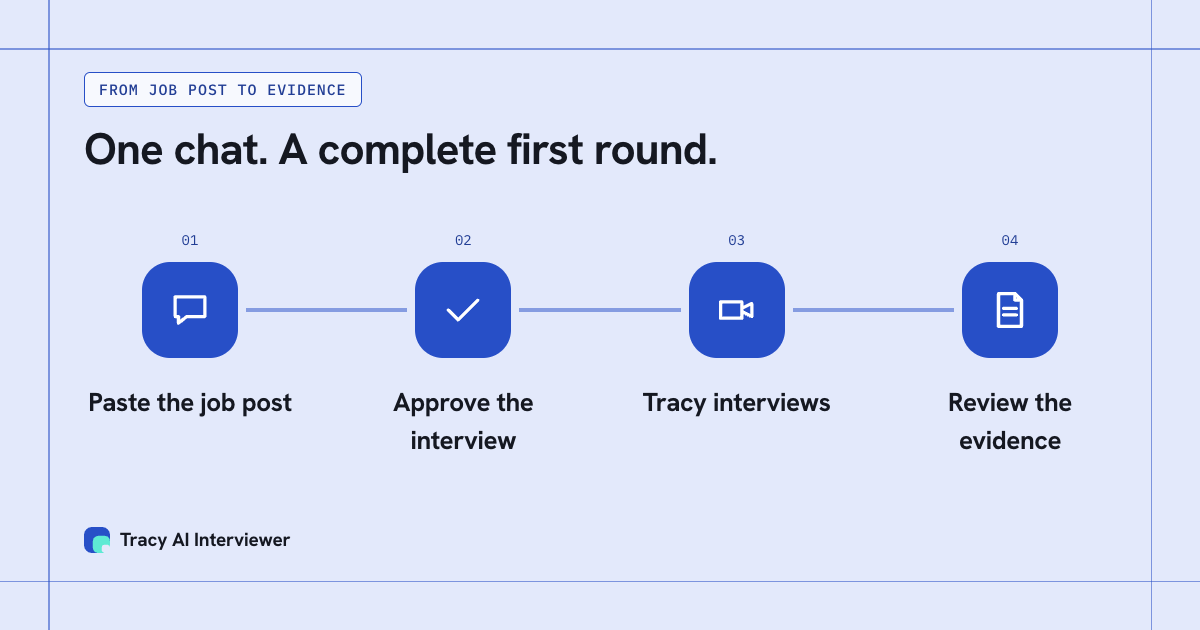
- Paste the role into Claude. Include the job post, the must-have skills, and any questions your team already uses.
- Ask Tracy to draft the interview. The questions can be generated from the job description, edited in the chat, or replaced with your own.
- Approve before anything happens. Review the title, questions, and result fields. The interview is created only after approval, and invitations go only to the addresses you provide.
- Let applicants start on click. Each person opens the link in a browser, at a time that suits them, with no recruiter present.
- Read the evidence in Claude. Ask who has finished, open a result, and review what the person said to each question.
What Tracy adds to Claude for recruiting
1. Interview every applicant
Each applicant can start on click, at any hour, with no scheduling and no recruiter on the call. The same first-round opportunity reaches the whole pool.
2. Ask the next question
Tracy asks in the applicant's own field, follows what they said, and waits for the answer. A polished headline has to survive a specific follow-up.
3. Keep the evidence
Every result includes a recording, a timestamped transcript, and a written assessment per question with its reasoning.
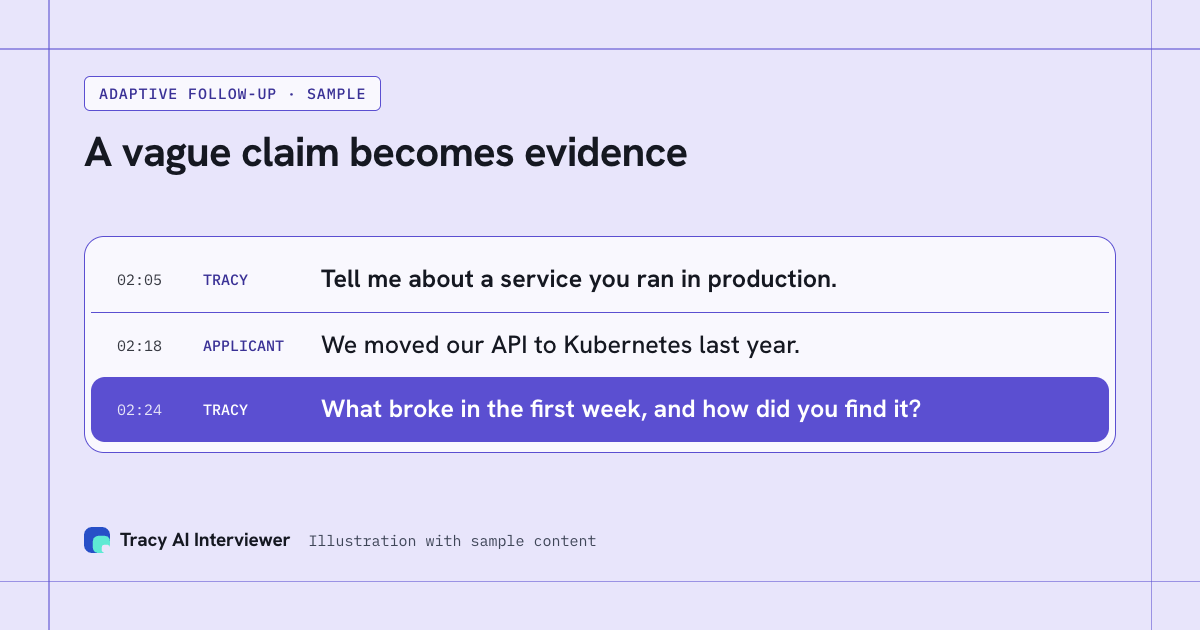
The follow-up is the difference between collecting an answer and learning from it. “We moved our API to Kubernetes” sounds relevant. “What broke in the first week, and how did you find it?” reveals the person's role, judgment, and operating depth.
What the recruiter gets back
The result is a record a reviewer can inspect.
- A recording of the full interview
- A timestamped transcript
- What the applicant said to each question
- A written assessment per question
- Result fields and an ATS-ready note
- Integrity signals for a person to review
Tracy can capture signals such as response timing, tab switching, leaving full screen, gaze, and an external screen. Those signals are evidence for a person to review; they do not prove cheating on their own. Your recruiter can move someone forward, reconsider a result, or invite the person to interview again.
Proof that the workflow can handle volume
- 100K+ interviews delivered, with a reported 99% completion rate
- 92 candidate NPS for the Tracy interview experience
- 44 to 7 days to hire in one customer result; Tracy handled the work of 53 full-time recruiters in one month
When Claude alone is enough, and when to add Tracy
| Your job | Use Claude | Add Tracy |
|---|---|---|
| Write a job post or outreach | Yes | No extra value needed |
| Summarize CVs or notes | Yes, with human review | No extra value needed |
| Create interview questions | Yes | Use Tracy when those questions need to be asked to applicants |
| Interview every applicant | Needs an interview tool | Tracy runs the conversation on video |
| Ask adaptive follow-ups | Only inside your own chat | Tracy follows up with the applicant |
| Review recordings and transcripts | Only if you provide them | Included with each Tracy result |
How to run a first-round interview from Claude
- Add Tracy as a custom connector. Follow the Tracy guide for Claude. Workspace settings and owner approval may apply.
- Start with a direct prompt. Try: “Use Tracy AI Interviewer to draft a 20-minute first-round interview for this senior backend engineer role. Test system design depth, production ownership, and communication. Show me the questions before creating anything.”
- Edit the interview in plain language. Ask Claude to replace a weak question, add your own, or make the interview more technical or behavioural.
- Approve the draft and invitations. Tracy waits for approval before it creates the interview or sends an invite.
- Return for results. Ask Claude which applicants have finished, then open the evidence for the people you want to review.
What Tracy costs
Pay for interviews, not seats
One credit covers a started 20 minutes. A session with no answers is not charged. MCP access is included in Pay as you go.
$1 per credit. The first 3 results are free.
Enterprise pricing is based on volume. Teams with a custom workflow, ATS requirements, or procurement needs can book a demo.
Common questions
Can Claude be used for recruiting?
Can Claude interview candidates?
What makes Tracy different from a form or one-way video?
Do applicants need a Claude or Tracy account?
Does Tracy make the final hiring decision?
Run one interview from Claude
Connect Tracy, paste a job post, and review the interview before anything is created. The first three results are free.
Try it free (opens in a new tab) Book a demo (opens in a new tab)
Your first 3 results are free. No card needed.
Sources
- Tracy AI Interviewer: add Tracy to Claude, read 9 November 2026.
- Tracy AI Interviewer: Connect, read 14 November 2026.
- Tracy AI Interviewer: Pricing, read 11 November 2026.
- Anthropic: custom connectors using remote MCP, read 14 November 2026.
- Anthropic: documents you can upload to Claude, read 14 November 2026.