In short
An interview scorecard lists what a role needs and gives every interviewer one scale, so ratings can be compared. Tracy AI Interviewer interviews every applicant on the skills you set, follows up on thin answers and gives the reviewer a recording, a timestamped transcript and what the person said to each question. The reviewer rates on the scorecard and decides.
What is an interview scorecard?
An interview scorecard is a form that lists the skills and qualities a role needs and gives every interviewer the same scale to rate them. Greenhouse calls it "a key component of structured hiring" that "provides a framework for everyone involved in interviewing or assessing candidates". It is sometimes called a candidate scorecard or an evaluation form.
The interviewer rates each criterion separately, writes the evidence beside it and gives a recommendation. The scorecard replaces an overall impression with a record the team can compare.
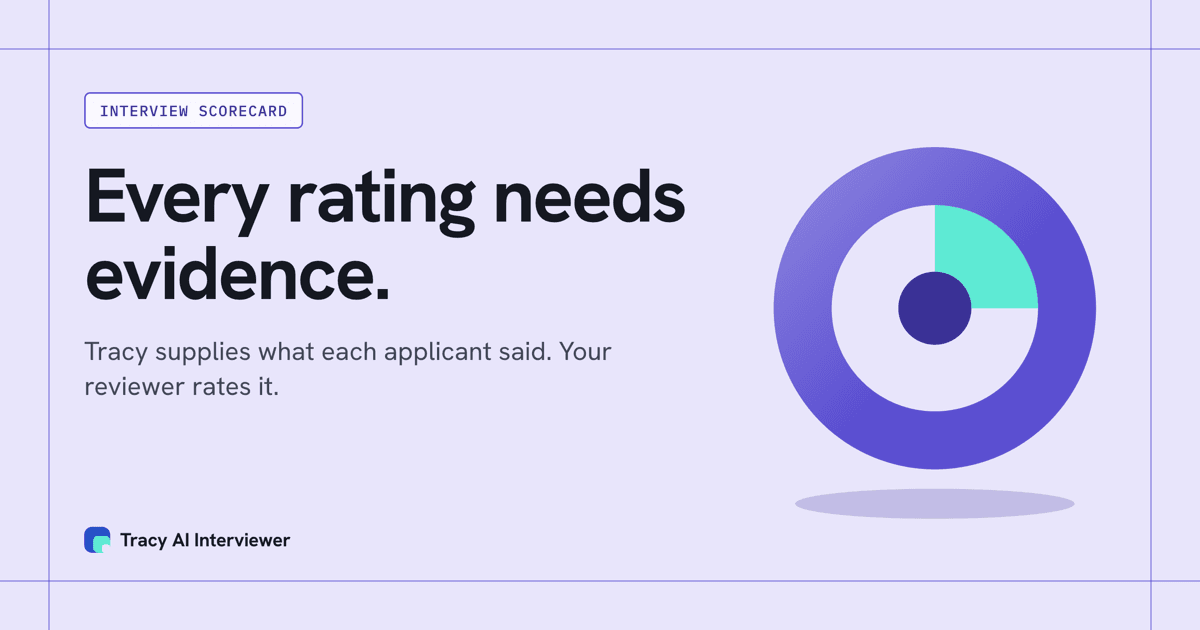
A scorecard is only as good as the evidence beside each line. Tracy supplies that evidence from an interview every applicant took the same way, and the reviewer still does the rating.
An interview scorecard gives every interviewer the same criteria and the same scale.
What goes on an interview scorecard?
Five parts cover most scorecards.
The five parts of an interview scorecard and what each holds.
| Part | What it holds |
|---|---|
| Criteria | The three to six skills and qualities the role needs |
| Definition | What each one looks like in an answer |
| Rating scale | A few levels, each with a sentence that says what it means |
| Evidence | A quote or note per criterion |
| Recommendation | Move on, hold or stop, from the reviewer |
Greenhouse groups criteria into qualifications, interpersonal skills, technical skills and attributes that are nice to have. The mix varies by company and role.
An interview scorecard example
A scorecard for an IT support specialist might read like this.
A sample scorecard for an IT support specialist: three criteria, what a strong answer shows and the evidence to record (fictional example).
| Criterion | A strong answer shows | Evidence to record |
|---|---|---|
| Troubleshooting | Asks questions before acting and narrows the cause step by step | The steps they took, in order |
| Customer communication | Explains without jargon and checks the person understood | Their words for a non-technical user |
| Ownership | Follows an issue through after the first fix | What they did after it was closed |
The scale has four levels, each with a sentence: 1, not shown. 2, shown in part. 3, shown with an example. 4, shown with an example and a result. The anchors are what make two interviewers' ratings comparable. Our interview scorecard template has a version to copy.
What each scorecard line needs from the interview
Take the sample scorecard above. Its evidence column asks for the steps a person took in order, their words for a non-technical user, and what they did after an issue was closed. A one-line answer in a call gives a reviewer none of that, and a reviewer cannot check a rating with nothing to open.
The volume makes it worse. Three criteria across 100 applicants is 300 evidence entries, and 100 interviews of 20 minutes is about 33 hours of live calls. At 1,000 applicants it is about 333 hours. Tracy's follow-ups ask for the detail a line needs, and the transcript puts it at a timestamp, so the reviewer rates from something they can replay.
Why use an interview scorecard?
Structured interviews predict job performance better than unstructured ones. Sackett, Zhang, Berry and Lievens re-analysed published meta-analyses of selection methods in the Journal of Applied Psychology (2022). They found mean validity for predicting job performance of .42 for structured employment interviews, from 105 studies and 7,864 people, against .19 for unstructured interviews, from 32 studies and 3,125 people. That is about twice as strong a link.
Validity is a correlation between the interview rating and later job performance ratings, not a hiring rate. A scorecard is one tool for keeping an interview structured, and the figures describe structured interviews, not scorecards: the same questions and the same scale for every candidate do the work. See what a structured interview is.
Interview scorecard vs rating scale vs feedback form
The scorecard is the whole form. The rating scale is one part of it: the levels and what each means. A feedback form is often looser, with open boxes and a recommendation. An interview guide sets the questions, and the scorecard sets how the answers are judged. A job scorecard sets out the outcomes the role must deliver, and the interview scorecard comes from it.
If your team uses a feedback form with no criteria and no anchors, adding both turns it into a scorecard.
How to fill out an interview scorecard
Four habits keep ratings honest.
- Write the criteria before the first interview. Changing them afterwards lets the candidate shape the form.
- Rate each criterion separately. An overall feeling leaks into every line otherwise.
- Note the evidence first, then the rating: a quote or a fact, then the level.
- Rate before you hear the others, and compare in the debrief. The interview debrief template covers that meeting.
What Tracy adds to an interview scorecard
01
Reach every applicant
You set the skills for each role, and the questions come from the job description or your own list. Every applicant is interviewed on the same skills, starts on a click at any hour, with no scheduling and no recruiter present.
02
Ask the next question
Tracy asks follow-ups in the applicant's field about the missing detail, so the evidence for each skill is more than one line.
03
Keep the evidence
Each result has a recording of both sides, a timestamped transcript and what the person said to each question, with its reasoning.
Tracy does not rate candidates. A person reads the evidence, rates each criterion and decides. See structured interview scoring for how the pieces fit.
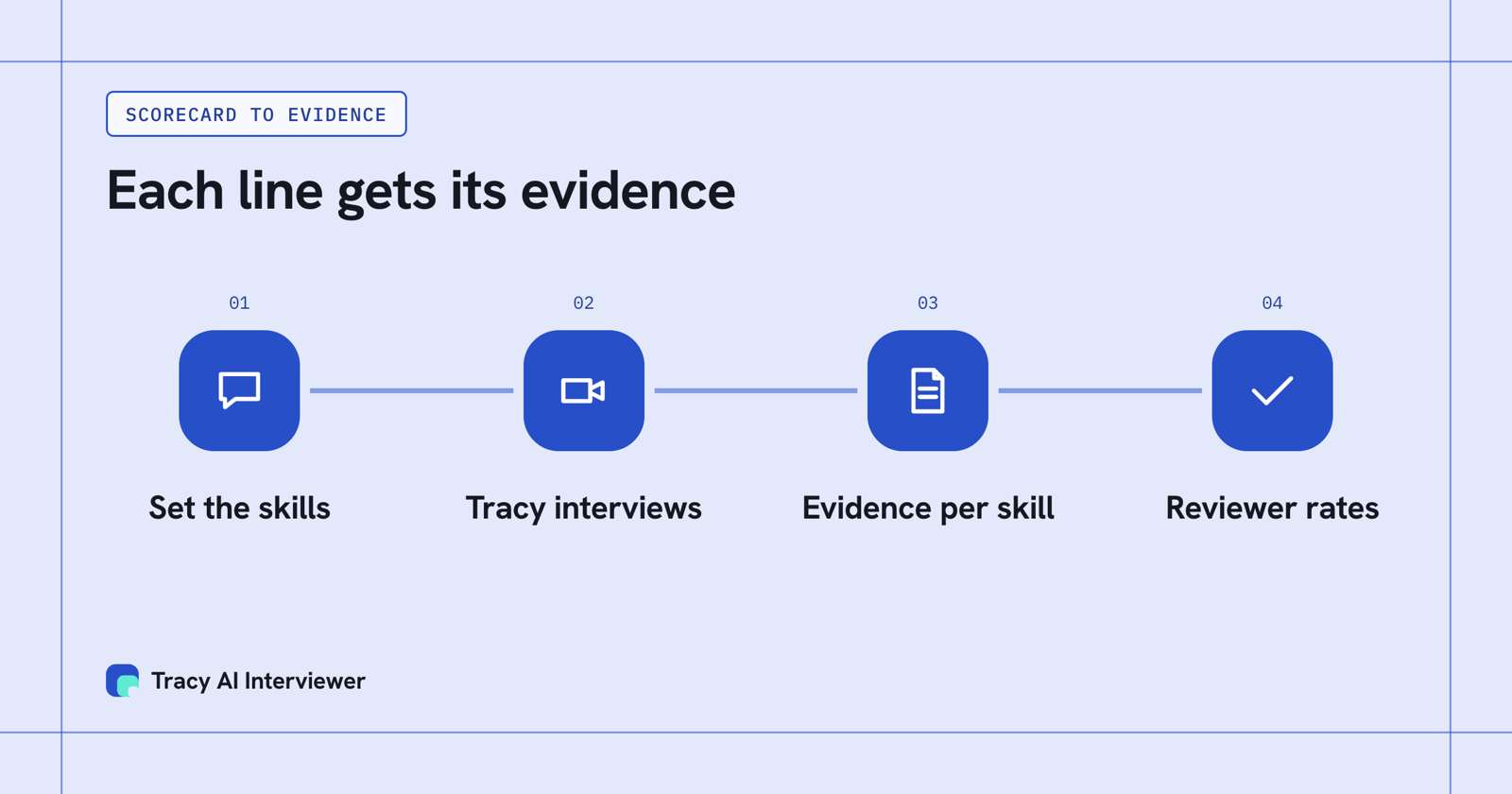
Each scorecard line gets evidence from the interview, and the reviewer does the rating.
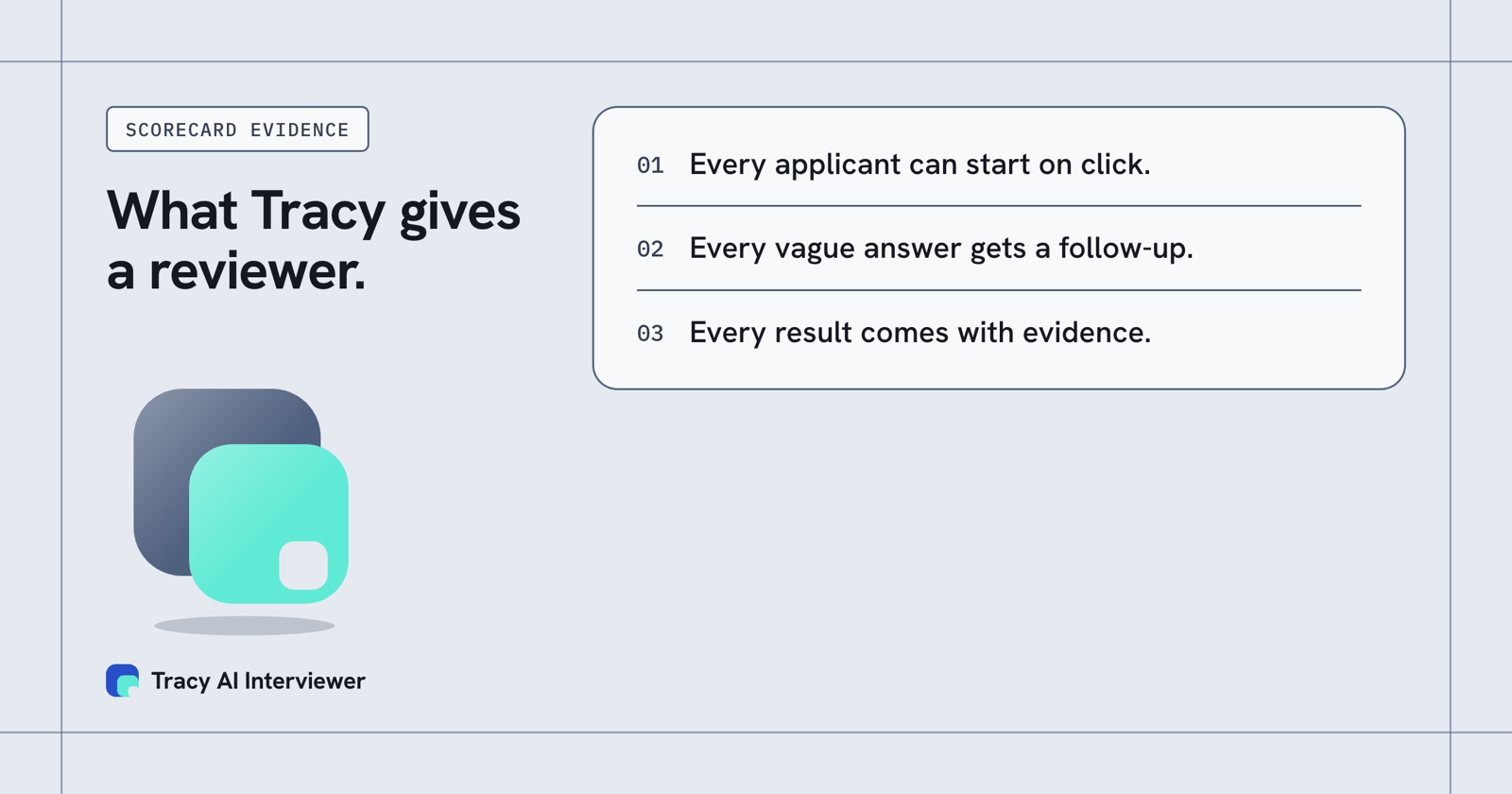
Three things Tracy gives a scorecard: reach, follow-up, evidence.
Related terms
- Structured interview: every candidate gets the same questions, scored the same way.
- Rating scale: the levels used to rate a criterion, each with a meaning.
- Job scorecard: the outcomes and competencies a role must deliver. See the job scorecard template.
- Interview debrief: the meeting where interviewers compare scorecards.
- Rubric: another word for the anchors that define each level.
- Evaluation form: a looser version of a scorecard.
Which path fits you:
- Many applicants: see screening interviews for high-volume roles.
- Technical roles: see interviews for technical hires.
- Reading the output: see the evidence a reviewer rates from.
Common questions
What is an interview scorecard?
What goes on an interview scorecard?
How do you use an interview scorecard?
What is the difference between a scorecard and a rating scale?
Can AI fill in an interview scorecard?
Run one role, then rate from evidence
Read what your reviewer would rate from: recording, transcript and a written assessment per question. The first 3 results are free.
Try it free (opens in a new tab) Book a demo (opens in a new tab)
Your first 3 results are free. No card needed.
Sources
- Sackett, Zhang, Berry and Lievens (2022), Revisiting meta-analytic estimates of validity in personnel selection, Journal of Applied Psychology 107(11), retrieved 9 Nov 2026.
- Greenhouse, What is an interview scorecard?, retrieved 14 Nov 2026.
- Tracy AI Interviewer home page, retrieved 14 Nov 2026.
- Tracy AI Interviewer pricing, retrieved 14 Nov 2026.