In short
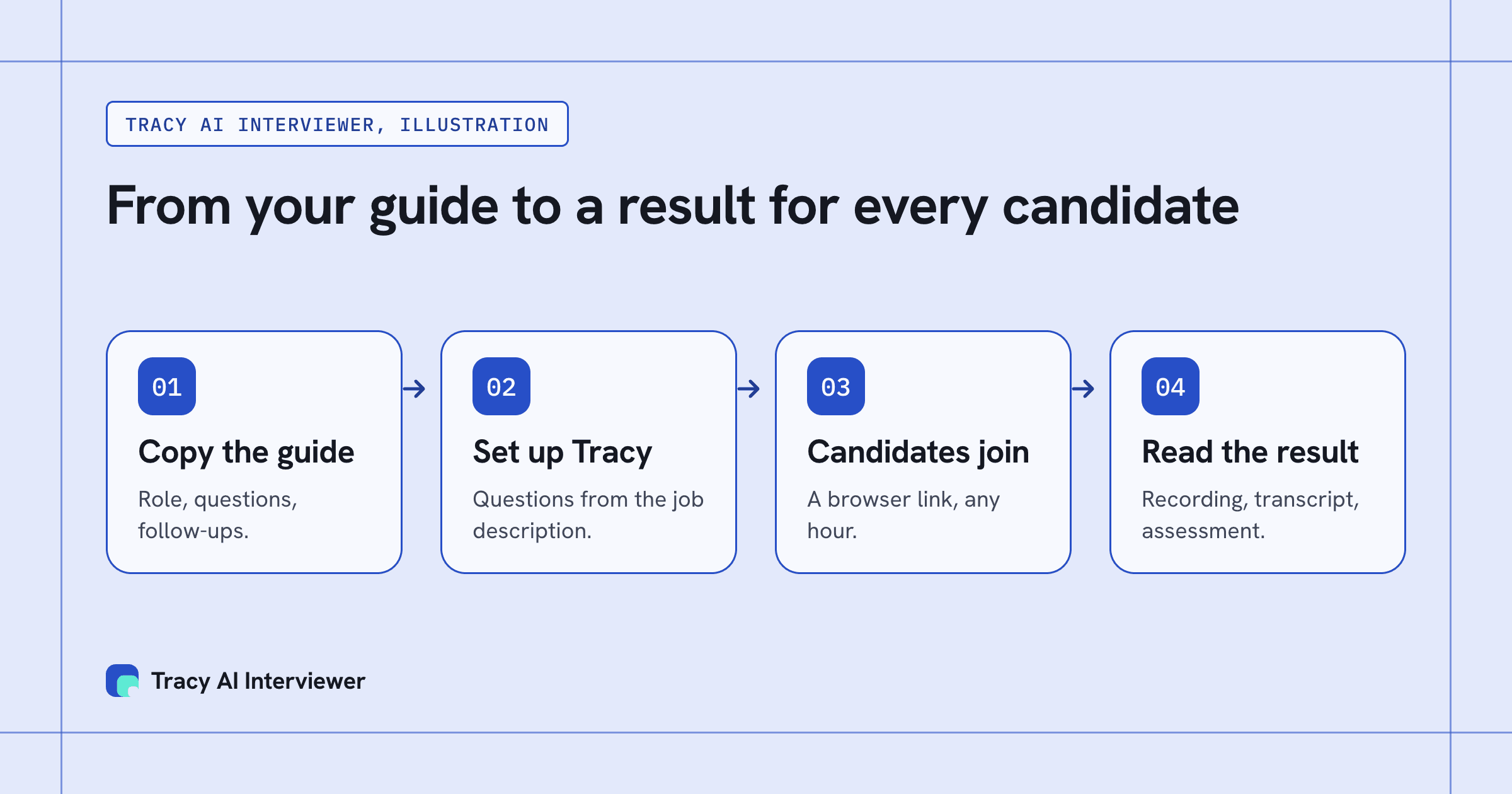
Tracy AI Interviewer runs the first-round interview for every applicant and gives you a written assessment per question, with a recording and timestamped transcript behind each result.
Below: a copy-ready interview feedback form, a filled example and rules for feedback that holds up in a debrief.
A person reads the evidence and decides.
Next step: copy the form, then run one role as a Tracy interview.
We make Tracy AI Interviewer.
A hiring manager opens three pieces of feedback on one candidate. The first says "great communicator". The second says "not sure". The third says "thumbs up". None of them can be compared with the others. An interview feedback form template fixes that by asking every interviewer the same things in the same order: what they asked, what they heard, how it rates and what they recommend. Copy the form below, read the filled example, then see how Tracy AI Interviewer runs the first round and reports on it.
What an interview feedback form is for
An interview feedback form is the note an interviewer files right after one interview. It records what was asked, what the candidate said and did, how that rates against the role, and what the interviewer recommends. A scorecard adds scores across criteria so you can rank candidates; the feedback form keeps the reasoning in words, which a debrief needs when two interviewers disagree.
Three rules shape the template. Every interviewer answers the same fields. Every rating sits beside a quote or a moment. The recommendation comes last, after the evidence.
The interview feedback form template
Copy each table into a document, a form builder or the feedback field of your applicant tracking system. Each interviewer files one form per candidate.
Table 1: header fields
| Field | Entry |
|---|---|
| Candidate | |
| Role | |
| Stage | First round, second round or final |
| Interviewer | |
| Date and length | |
| Recording or notes link |
Table 2: questions covered
| Question asked | Answered fully? (yes, partly, no) | Notes |
|---|---|---|
| Question 1 | ||
| Question 2 | ||
| Question 3 | ||
| Anything asked outside the plan |
Table 3: ratings sheet
| Competency | Rating (1 to 5) | What I heard or saw (quote or moment) |
|---|---|---|
| Competency 1 | ||
| Competency 2 | ||
| Competency 3 | ||
| Competency 4 |
Rate on this scale, and write what it means for your role before the first interview.
Table 4: the 1 to 5 scale
| Rating | Meaning |
|---|---|
| 1 | Evidence against the skill, or none. |
| 2 | Thin once pushed for detail. |
| 3 | Does what the role needs. |
| 4 | Above that, with specifics. |
| 5 | Exceptional and consistent under follow-up. |
Table 5: summary and recommendation
| Field | Entry |
|---|---|
| Strengths (up to three) | |
| Concerns (up to three) | |
| What I could not assess | |
| Candidate's questions and interest | |
| Recommendation | Strong yes, yes, no or strong no |
| What would change my mind | |
| Probe in the next round | |
| Written before reading other feedback | Yes or no |
Use three to five competencies, the ones the role needs. The recommendation has no middle option on purpose: "maybe" hands the decision to the debrief without adding information.
How to write feedback that holds up in a debrief
- File it the same day. Do it while the details that justify a rating are still fresh.
- Evidence before verdict. Write the quote or the moment, then the rating. If you cannot point to something said or done, the rating is a guess.
- Rate against the scale, not the last candidate. A strong answer after a weak one is still a 3 if it meets the bar.
- Say what you could not assess. A blank is not a pass. The gap tells the next interviewer what to ask.
- Replace trait words with behaviour. "Polished", "energy" and "culture fit" say nothing. "Explained the error in two sentences and checked I had followed" does.
- Leave out what is not about the job. Age, family, accent and where someone went to school are not evidence.
- Write it before you read anyone else's. Independent feedback lets the debrief compare evidence.
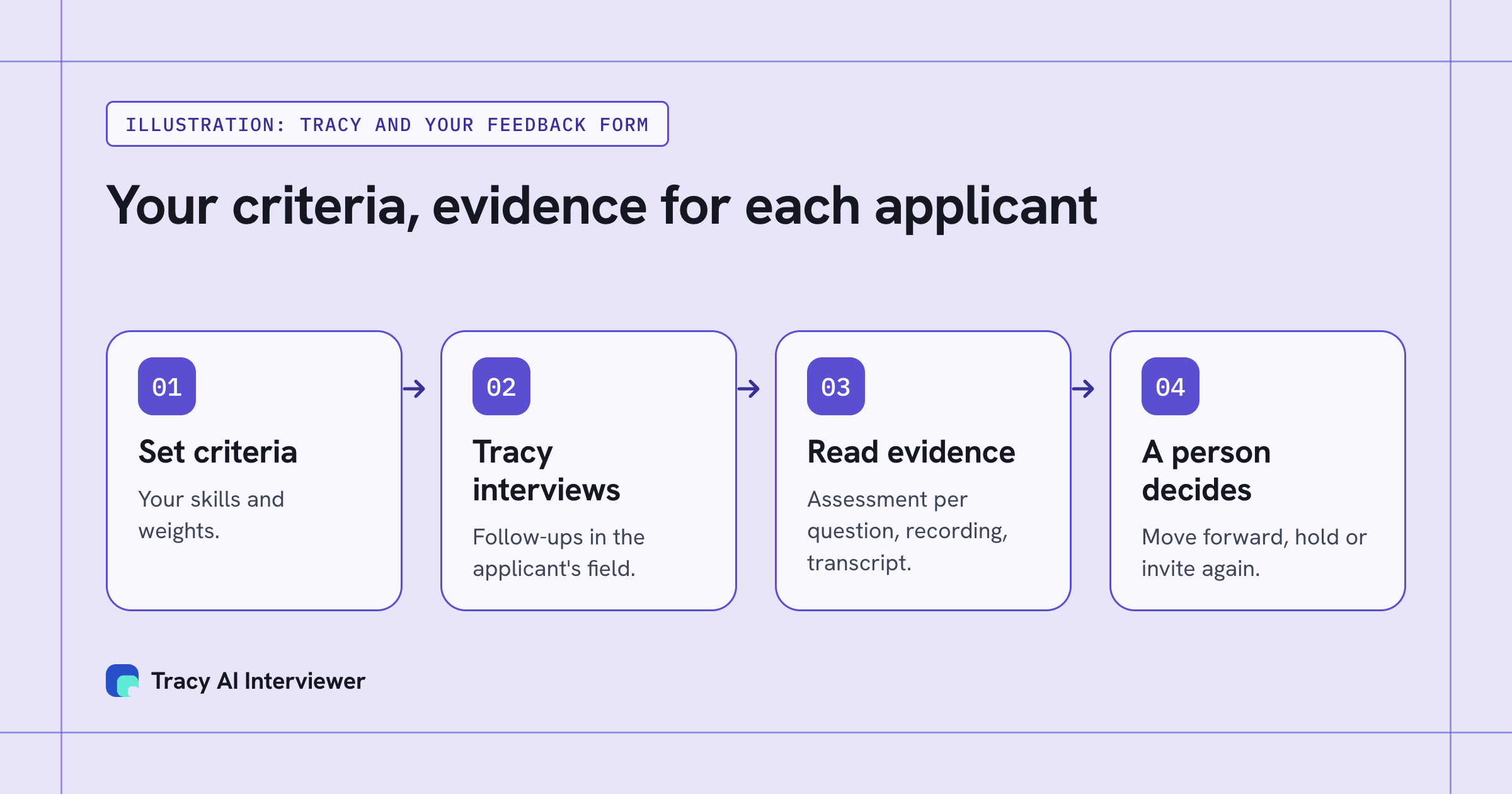
Tracy gives the reviewer your criteria, an assessment per question, the recording and transcript, and a person decides.
A filled example: operations analyst, first round
A fictional first-round interview. The candidate and the evidence are written for this page.
Table 6: filled example, ratings (fictional)
| Competency | Rating | What I heard or saw |
|---|---|---|
| Data analysis | 4 | Described removing duplicates from a monthly export before building a pivot table. Asked what could still be wrong, named date formats and checked them. |
| Process thinking | 3 | Mapped a refund process step by step but did not say where it usually breaks. |
| Communication | 5 | Explained a reconciliation error in two sentences without jargon and checked I had followed. |
| Ownership | 3 | Said "the team missed it" twice about a late report. No example of fixing the cause. |
Table 7: filled example, summary (fictional)
| Field | Entry |
|---|---|
| Strengths | Clear explanations. Checks own work before sharing it. |
| Concerns | Few examples of owning a miss. Process answers stop at the happy path. |
| What I could not assess | Experience with the reporting tool named in the job description. |
| Candidate's questions and interest | Asked about reporting cadence and team size. Keen. |
| Recommendation | Yes |
| What would change my mind | A second example of a missed deadline where the candidate changed the process. |
| Probe in the next round | A process they designed that failed, and what they did next. |
| Written before reading other feedback | Yes |
Each 3 and 4 points at something said, and the concerns become the next round's questions.
Run the first round as a Tracy interview
The form works for interviews a person has time to run and write up. For the first round of a role with many applicants, Tracy AI Interviewer runs the interview, and her report covers much of the same ground.
- Questions covered. Tracy generates the questions from the job description. Edit them or use your own, from quick to deep, technical to behavioural.
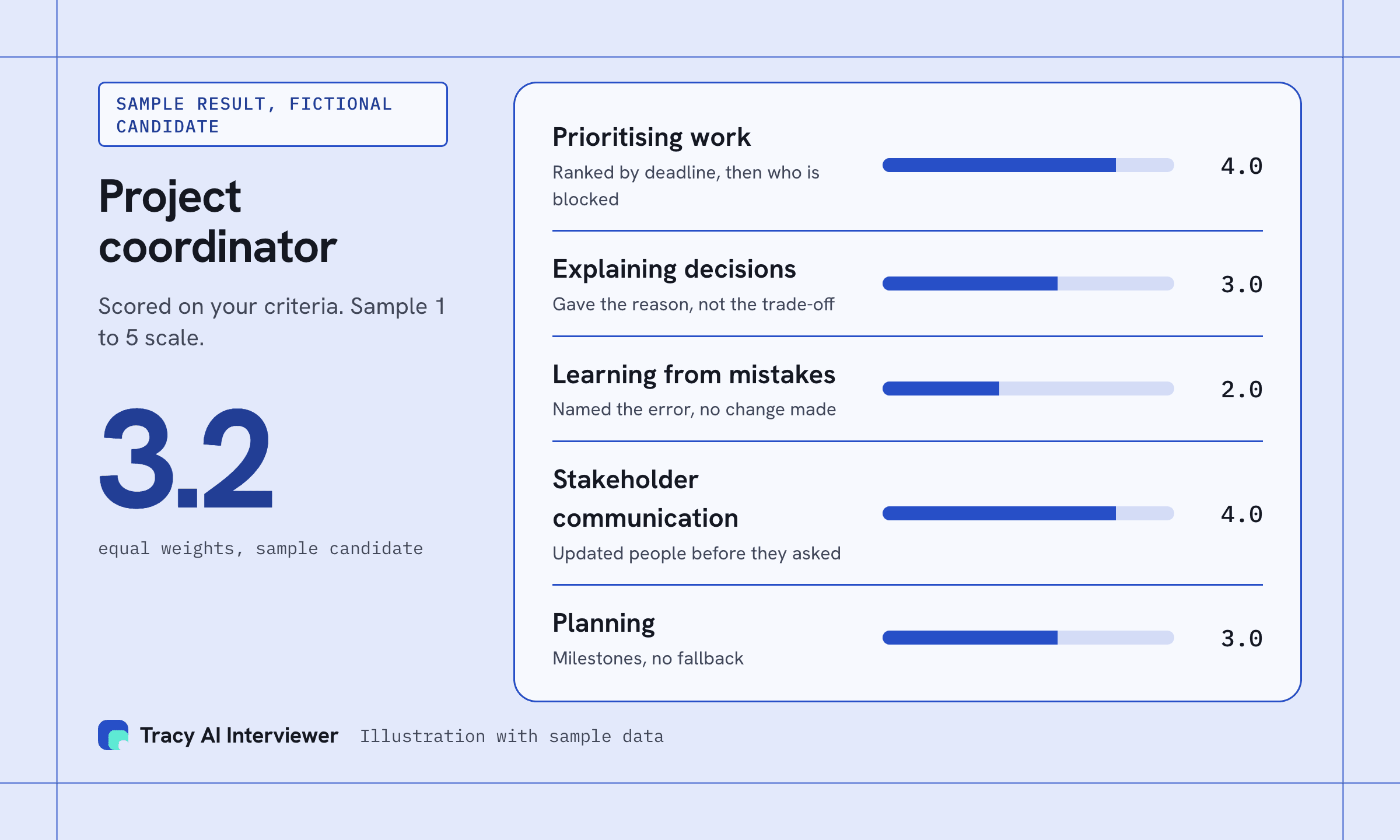
- Ratings on your criteria. You set the skills and their weights for each role or role family. Your competency rows become the skills.
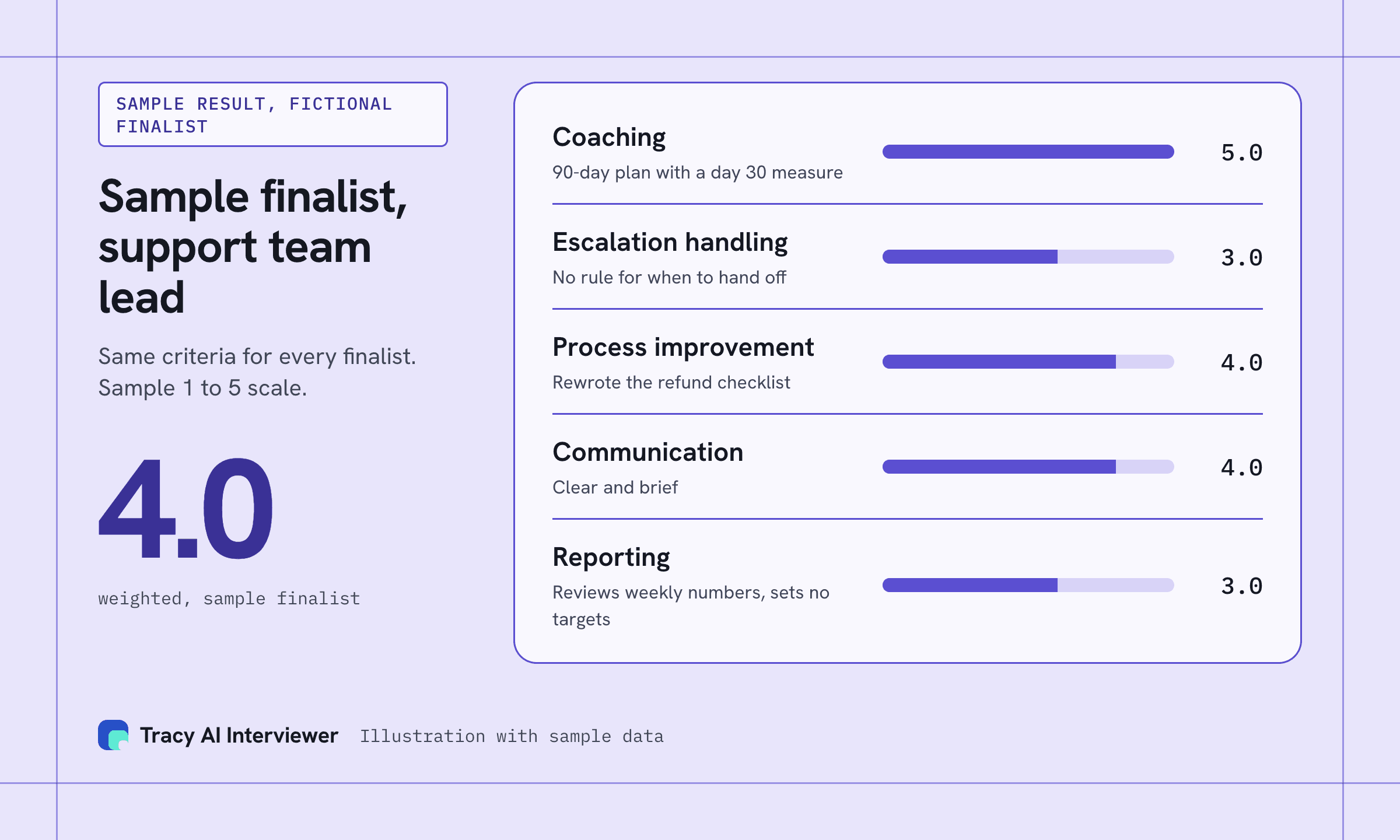
- What I heard. Each result has a written assessment per question with its reasoning, a recording of both sides and a timestamped transcript, so a reviewer can check a rating against what was said.
- Strengths and gaps. The report holds strengths and gaps, the recording and the fit rationale in one record, shareable by link or PDF.
- Follow-ups. She asks in the candidate's own field, follows up on what they said and waits for the answer. A Director at a top-tier early-stage VC says: "Tracy sometimes brings up exactly those questions I might have forgotten to ask, which has been a pleasant surprise."
- The recommendation stays with a person. A recruiter can move a candidate forward, override a rejection or invite someone to interview again, and the full history stays on the record. See how an AI interview report reads.
The first 3 results are free with no card. After that it costs $1 per credit, one credit per started 20 minutes of an interview that produced a result, with no seats and no upfront cost. See pricing. To try it, paste your competencies into one role and run three real interviews.
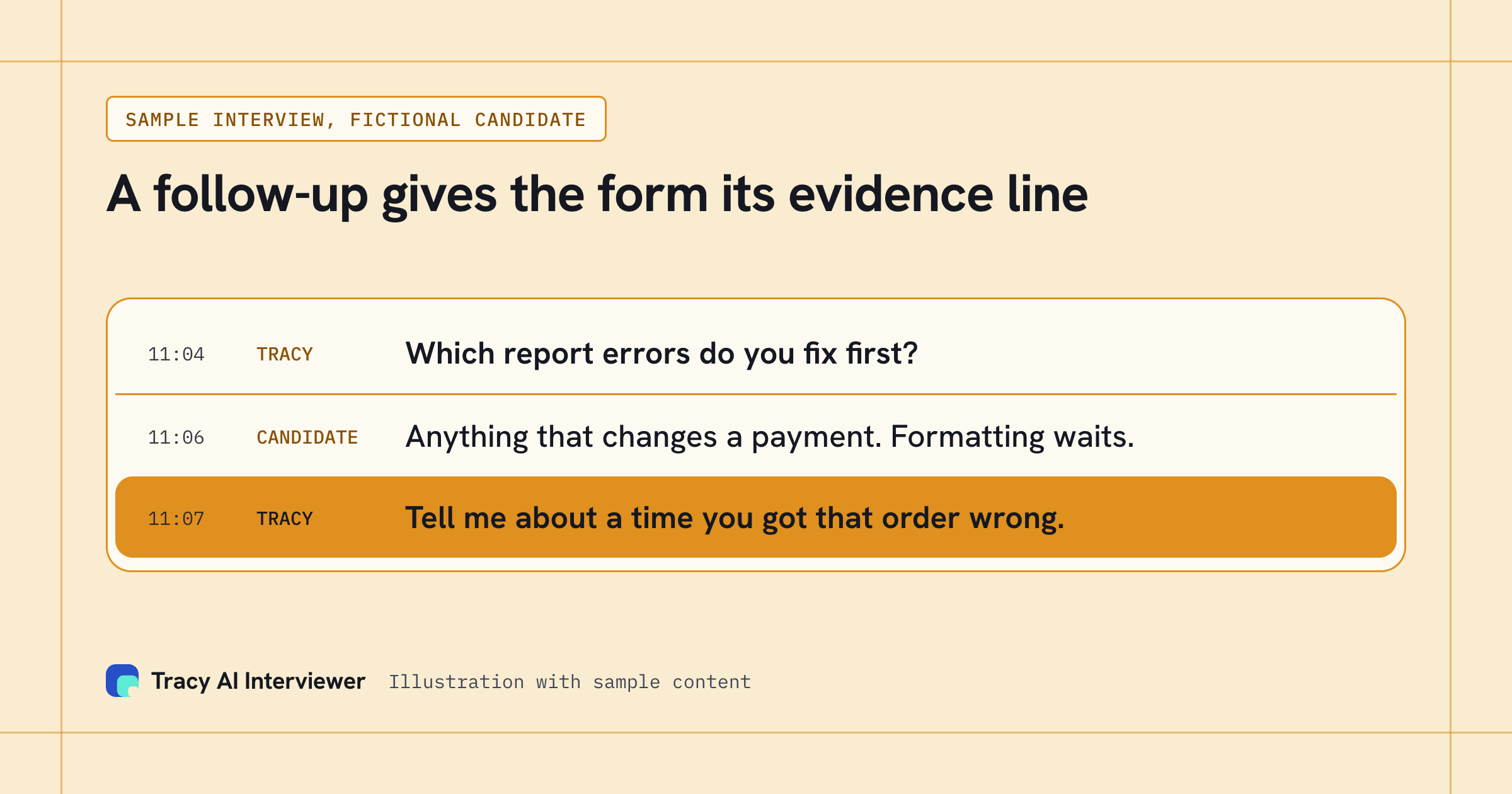
A follow-up gives the evidence line something to quote.
Which path fits you
- Screening many applicants for the same role: volume hiring.
- Engineering and other technical roles: technical interviews.
- Deciding how to screen before you write the form: how to screen candidates.
Common questions
What should an interview feedback form include?
How long should interview feedback be?
What is the difference between an interview feedback form and a scorecard?
When should interviewers submit feedback?
What does good interview feedback look like?
Try Tracy on your next role
Tracy interviews every applicant, asks follow-up questions and sends you a ranked shortlist.
Try it free (opens in a new tab) Book a demo (opens in a new tab)
Your first 3 results are free. No card needed.
Sources
- Tracy AI Interviewer home page, customer quotes, retrieved 9 Nov 2026.
- Tracy AI Interviewer pricing, retrieved 9 Nov 2026.
- Tracy AI Interviewer Connect page, retrieved 9 Nov 2026.