In short
A job scorecard fixes what the role needs before anyone is interviewed: outcomes, weighted competencies and which of them are must-haves. In Tracy AI Interviewer you set the skills Tracy covers for the role, and every applicant is interviewed on them, with a recording and an assessment per question behind each result. Your team applies the weights and decides.
What a job scorecard does well
A hiring manager writes a job description, the team posts it, and three weeks later five interviewers judge candidates on five different things. A job scorecard is written before all of that. It says what the job must achieve, which skills it takes and how much each one weighs, so the posting, the interview and the decision all measure the same thing. Copy the job scorecard template below and see it filled in for a fictional platform engineer.
A scorecard only governs the candidates who were interviewed on its skills. If half the pool is never interviewed, half the pool is never measured. Tracy AI Interviewer closes that gap, and the section after the example shows how.
What is a job scorecard?
A job scorecard is a short document, written before hiring starts, that says what a good hire looks like: the outcomes the job must deliver and the competencies it takes, with weights. It is for the hiring team, and it keeps every interviewer judging the same job.
Three documents get confused, and they are written in this order:
- The job scorecard comes first.
- The job description tells applicants about the job. It is built from the scorecard.
- The interview scorecard is the form an interviewer fills in for each candidate. Its criteria are the scorecard's competencies.
Write the job scorecard first and the others stay consistent. Skip it and each interviewer brings their own idea of the job.
The job scorecard template
Copy the tables into a document or a sheet. Fill in Table 2 before you write the job description, and agree the weights in Table 3 with the hiring manager before the first interview.
Table 1: the role
| Field | Entry |
|---|---|
| Role | |
| Hiring manager | |
| Team and level | |
| Why this role exists, in one sentence |
Table 2: outcomes
| Outcome in the first 12 months | How we will know |
|---|---|
| Outcome 1 | |
| Outcome 2 | |
| Outcome 3 |
Table 3: competencies
| Competency | What good looks like | Weight | Must-have? | How it is assessed |
|---|---|---|---|---|
| Competency 1 | 30 | |||
| Competency 2 | 25 | |||
| Competency 3 | 20 | |||
| Competency 4 | 15 | |||
| Competency 5 | 10 |
Scroll the table sideways to see all 5 columns.
Table 4: hiring plan
| Stage | What it checks | Who runs it |
|---|---|---|
| Screen | ||
| Interview | ||
| Work sample or final |
Use three outcomes and four or five competencies, with weights that add up to 100. Mark the must-haves, because those are pass or fail and the weights only rank candidates who clear them.
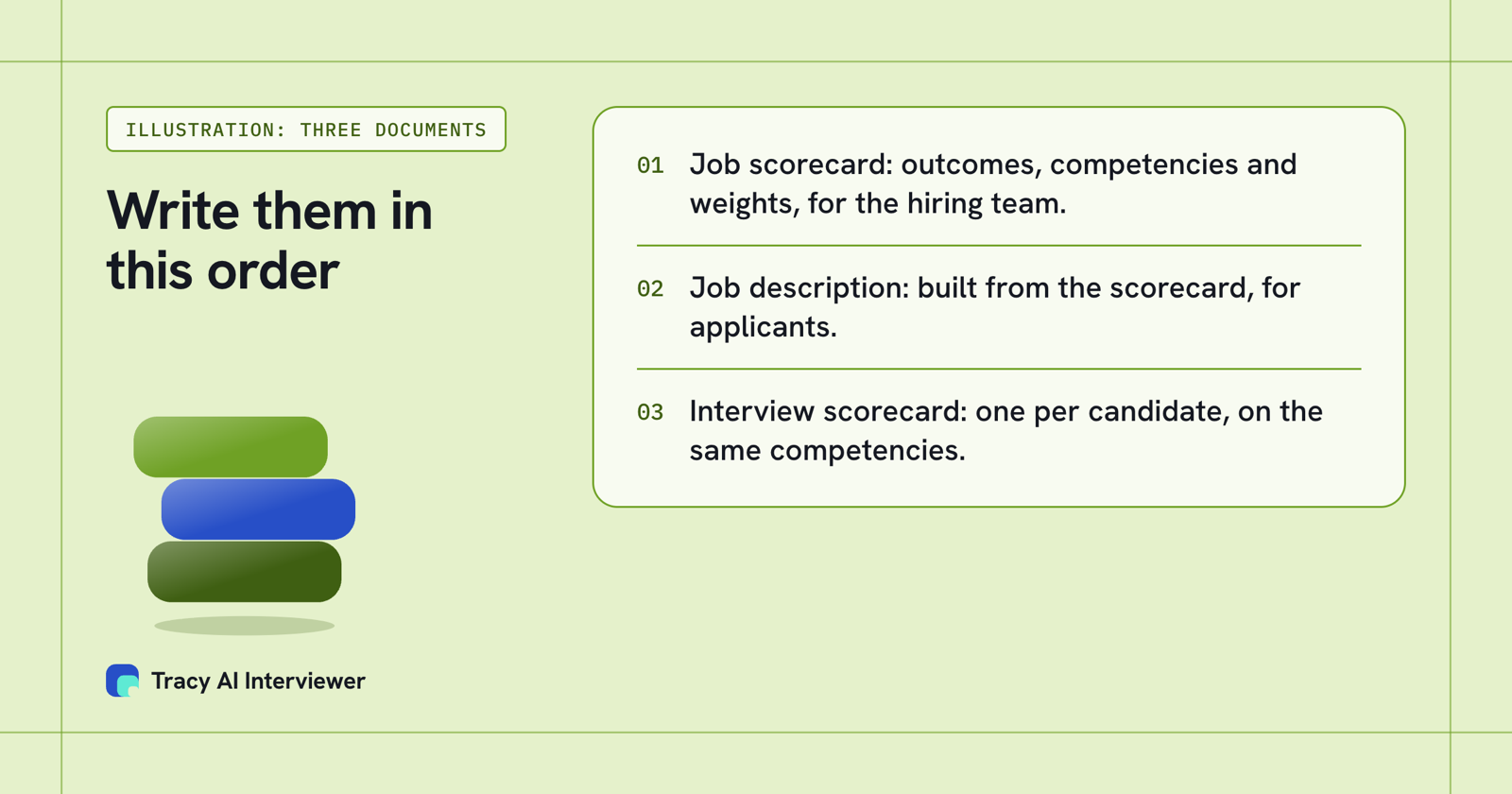
Three documents, written in one order: scorecard, job description, interview scorecard.
From the scorecard to a job description
The scorecard turns into a job description in five parts. Copy this skeleton into a Word or Google document.
- Title and mission: the role name and the sentence from Table 1.
- What you will deliver: the three outcomes from Table 2, in plain words.
- What we are looking for: the must-haves from Table 3, five at most, with the weights left out.
- How we hire: the stages in Table 4, so applicants know what is coming.
- Practical details: location, hours and the pay range where you publish one.
A description built this way stays short, and every line on it can be tested at interview.
A filled example: platform engineer
A fictional platform engineer role. The content is written for this page.
Table 5: filled example, outcomes
| Outcome in the first 12 months | How we will know |
|---|---|
| Deploys reach production in under 30 minutes. | Median deploy time from the pipeline dashboard. |
| On-call pages drop by a third. | Pages per week, compared with the quarter before. |
| Two teams run on the shared service template. | Number of teams using it. |
Table 6: filled example, competencies
| Competency | What good looks like | Weight | Must-have? | How it is assessed |
|---|---|---|---|---|
| Infrastructure as code | Builds and reviews environments from code and explains the trade-offs. | 30 | Yes | Interview |
| Debugging production | Finds a cause from logs and metrics and says how the fix was checked. | 25 | Yes | Interview |
| Automation and pipelines | Designs a deploy pipeline with rollbacks. | 20 | No | Work sample |
| Working with developers | Moves a team to a shared template without a mandate. | 15 | No | Interview |
| Writing and documentation | Writes a runbook another engineer can follow. | 10 | No | Work sample |
Scroll the table sideways to see all 5 columns.
Two competencies are must-haves, so a candidate who does not show infrastructure as code or production debugging stops there, whatever they score on the rest. The weights then rank the candidates who clear both.
What the filled scorecard shows that blank fields do not
The weights in Table 6 add up to 100, and the two must-haves, infrastructure as code (30) and debugging production (25), carry 55 of them. Weights alone would let a candidate weak on both still collect 45 points from the other three. The must-have column stops that: if a candidate does not show either one, your reviewer stops there, whatever they show on the rest, and the weights rank only those who clear both.
Interviewed on the same competencies, every applicant arrives with comparable evidence for the reviewer to weigh.
Using one scorecard when you scale up
Once the scorecard is written, the same scorecard serves every hire for the role, and a role family can share most of it. Keep the competencies and change the weights. A platform engineer and a site reliability engineer might share four of five competencies and weigh them differently.
- Version it. Date the scorecard and note what changed, so earlier hires can be judged against the one in force then.
- Do not change weights mid-search. Changing them after you have met candidates defeats the point.
- Review after the first hires. Compare what the scorecard asked for with what the new hires needed in their first months, and adjust the next version.
- Reuse the interview, not only the document. If every applicant gets the same interview, the scorecard scales with volume.
What Tracy adds to the job scorecard template
Three things change when Tracy does the interviewing.
01 Set the skills Tracy covers
The competencies in Table 3 are the place to start. Describe the role and Tracy drafts the questions, and you edit them or bring your own.
02 Reach every applicant
Each applicant starts on click, at any hour, with no scheduling, so the scorecard covers everyone and not only the shortlist.
03 Keep the evidence
The result holds what each person said to each question, with a recording of both sides and a timestamped transcript.
Tracy does not weigh, rate or rank. The weights in Table 3 are applied by your reviewer, and a person decides.
To see what a result holds per question, read what a Tracy result shows for each question. The interview guide template and the candidate evaluation template pick up from there. To try it, set the competencies from Table 3 as the skills for one role and run three real interviews.
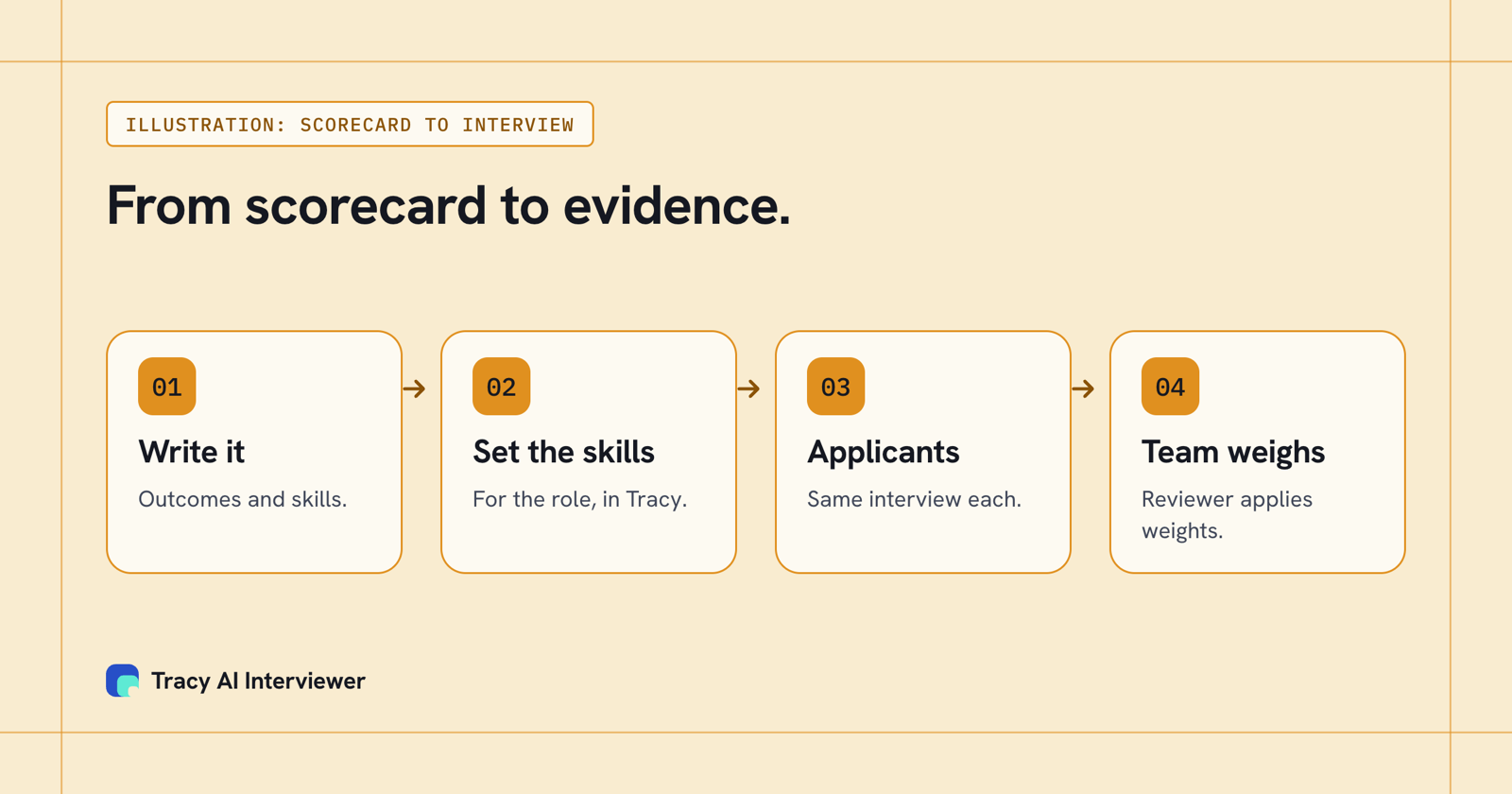
Interviewing on the scorecard's skills turns its competencies into evidence your team can weigh.
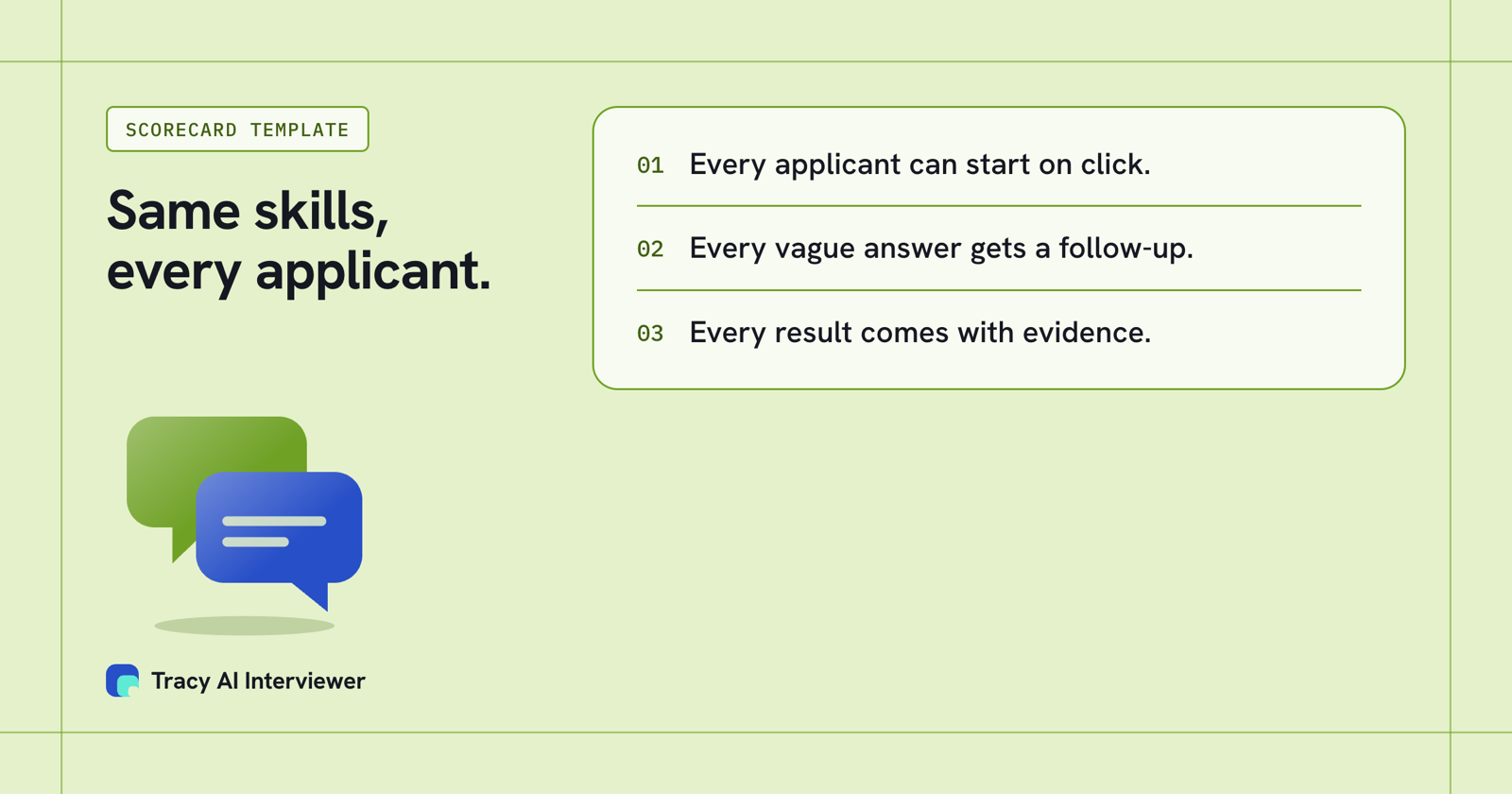
Every applicant can start on click, every vague answer gets a follow-up, every result comes with evidence.
Which path fits you
- Hiring many people into one role: interviewing at volume for one role.
- Engineering roles: interviewing for engineering teams.
- Choosing questions for the competencies you listed: first-round interview questions.
Common questions
What is a job scorecard?
What should a job scorecard include?
How is a job scorecard different from a job description?
Is there a job description template for Word?
How do you use a job scorecard when you are scaling up?
Run this template as a Tracy interview
Copy the template, set its skills for one role and let Tracy interview every applicant. The first 3 results are free.
Try it free (opens in a new tab) Book a demo (opens in a new tab)
Your first 3 results are free. No card needed.
Sources
- Tracy AI Interviewer Connect page, retrieved 11 Nov 2026.