In short
What is quality of hire? A measure of the value a new hire brings, read some months after they start, best compared across cohorts at 90 days or 12 months because no single formula exists. Tracy AI Interviewer keeps what each person said to every question, with a recording and a timestamped transcript, so a weak hire can be traced back to the screen. Your team reads the evidence and decides what to change.
What is quality of hire?
Quality of hire is a measure of the value a new hire brings to the organization. Workable's guide puts it the same way: it "measures the value new hires bring to a company". SHRM's 2025 benchmarking brief asks whether organizations "track the value a new hire provides to the organization". The number is also called a quality of hire score or QoH.
It is the one recruiting metric that asks whether the hire worked out, where time to fill and cost per hire measure speed and spend. It can only be read after the fact: a hire has to work for a few months before anyone can say how it went, which is why the metric is hard to use and easy to skip.
At 90 days the manager's review says how the hire went. Only a kept record says what the screen heard. If you ask every candidate the same questions, the early evidence stays comparable when the review comes.
Quality of hire is the value a new hire brings, measured after they start.
How do you measure quality of hire?
Workable's guide names three indicators: new hire performance, turnover and retention, and hiring manager satisfaction. A team can combine indicators into one score. For example, score each from 0 to 100 and average them, as the table below does. That is one convention, not a standard.
A worked example for one hire, with three indicators averaged (fictional example).
| Indicator | How it is read | Score |
|---|---|---|
| Performance | Manager's rating at 90 days, converted to 0 to 100 | 80 |
| Manager satisfaction | Survey: would you hire this person again | 90 |
| Retention | Still in the role at 12 months counts as 100 | 100 |
| Quality of hire | Average of the three | 90 |
Choose the indicators before you hire. Choosing them once the results are in lets the answer shape the measure.
What is a good quality of hire score?
There is no universal good score. Quality of hire has no single standard formula, so a figure from another company measures something else. The useful comparison is inside your own data: the same formula, the same roles, hires from one period against hires from another.
SHRM's 2025 recruiting benchmarking data brief, from a survey of its members fielded 9 January to 3 March 2025, lists "Few organizations measure the quality of hiring in 2025" among its key findings. Start with one role and one cohort: pick the indicators, the formula and the review date, record the result for the first group of hires, then compare the next group against it. After two or three cohorts you can see whether a change to screening, sourcing or onboarding moved the number.
What affects quality of hire?
Quality of hire is decided over the whole process: who applies, how people are screened, who is hired, how they are onboarded and who manages them in the first months. The screen matters most for what you can learn later.
If each candidate was asked different questions and the notes are a line or two, a weak hire cannot be traced back to what was said. If everyone answered the same questions on the same skills and the evidence was kept, you can go back at 90 days and ask whether the early signals matched the work.
Structured interviews are built for this, and skills-based hiring starts from the same idea.
What Tracy adds to quality of hire
01. Reach every applicant
Each applicant starts on click, at any hour, with no scheduling and no recruiter on the call, so the cohort you review at 90 days was screened in the same way.
02. Ask the next question
Tracy asks about the detail that is missing and waits for the answer, so the record holds how the person thinks, not only the answer. Questions come from the job description or your own list, and you set the skills Tracy covers for the role.
03. Keep the evidence
Each record holds both sides on video, the timestamped transcript and a written assessment per question with its reasoning, ready to set beside the 90-day review. A person reviews the evidence and decides who to invite again.
What does a 90-day check look like with the record?
Say a team hires a support engineer, and the manager's 90-day review notes weak debugging. The team opens the record from the screen. The recording shows what the person said when asked about a recent outage, and which follow-ups they were asked.
If they described the fix in detail, the screen had the evidence and the gap came later, in onboarding or in the fit with the team. If the answer stayed vague and nobody pressed, the screen missed it, and the questions for that role need a sharper follow-up. Either way the team changes something specific. Take the fictional hire in the table above: the three indicators average 90, and that average hides the 80 the manager gave at 90 days. The record is where you check whether that 80 was visible in the screen. See what an interview report contains for how a record reads. This is a made-up example to show the method; it does not come from a customer.
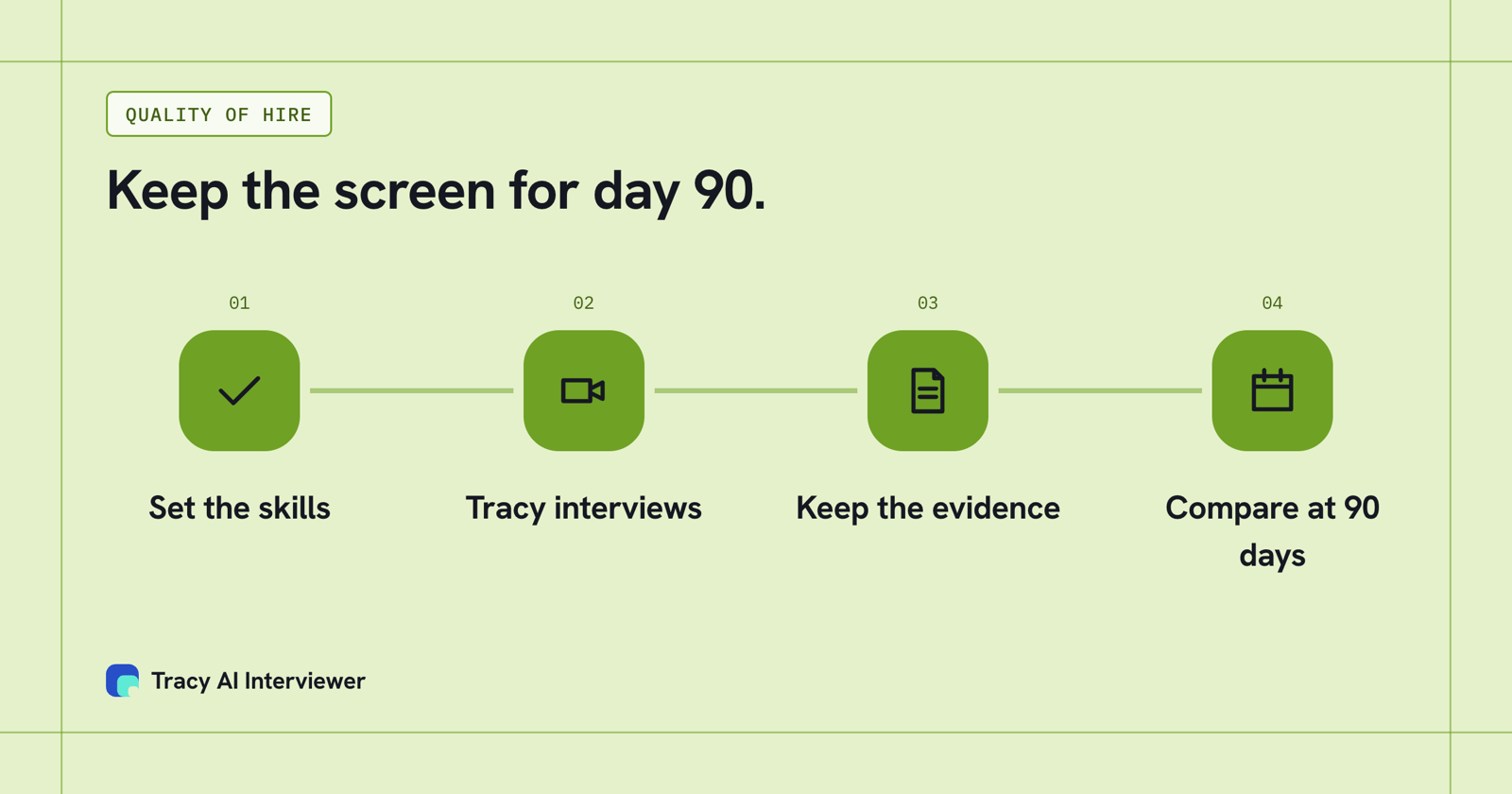
Keep the screen's evidence with each hire so it can be read beside the 90-day review.
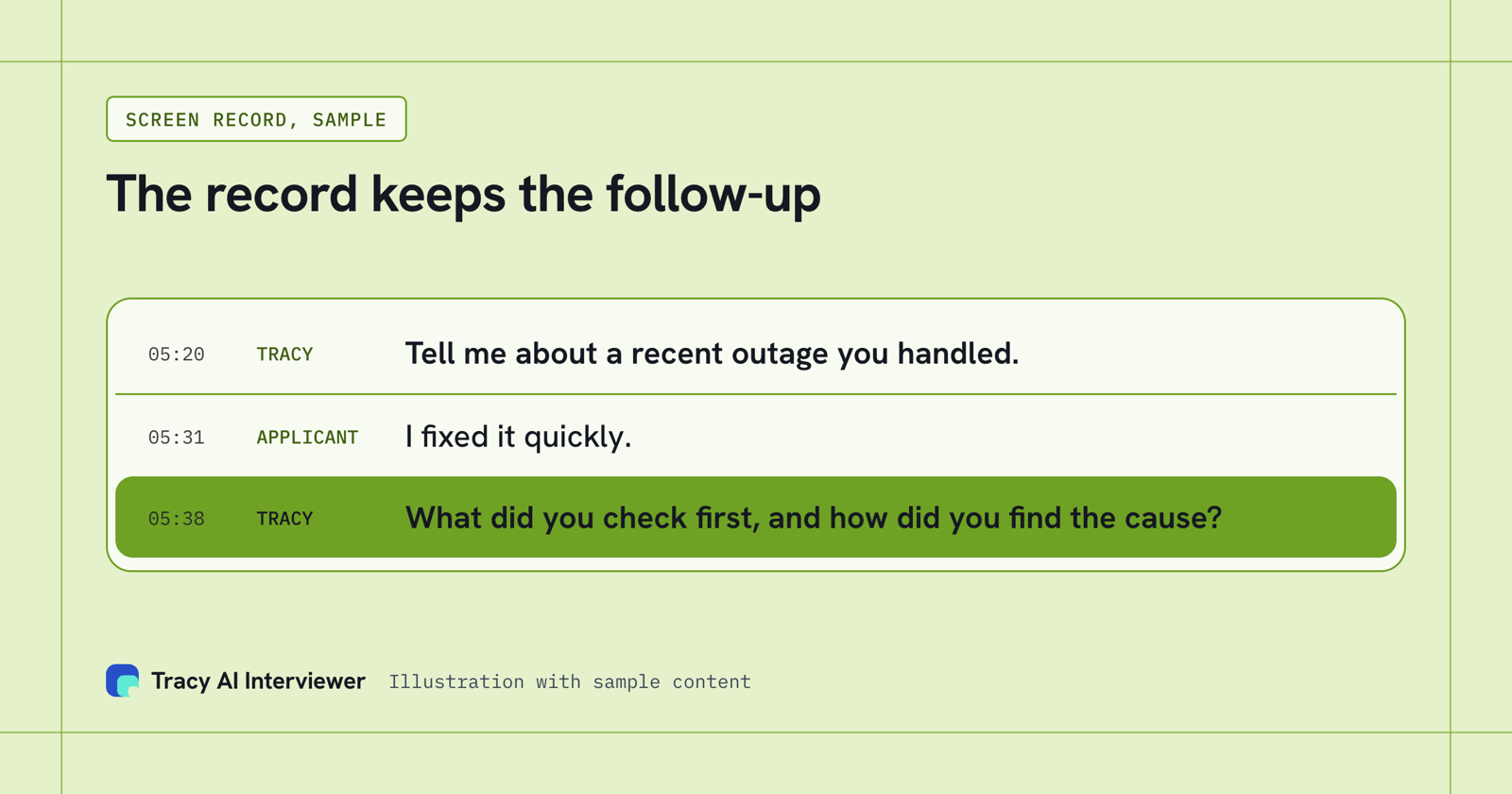
The record keeps the follow-up, so a vague answer shows up as vague.
Related terms
- Time to fill. Days from requisition opened to offer accepted. A speed metric, where quality of hire is a value metric.
- Time to hire. Days from a candidate entering the process to accepting; a speed measure, not a value measure. See the time to hire benchmark.
- Cost per hire. What a hire costs to recruit, in total.
- Retention. Whether a hire stays. One input to quality of hire, and also affected by the manager and the workplace.
- Hiring manager satisfaction. A survey of the manager who hired.
- Source of hire. The channel a hire came from. Splitting quality of hire by source shows which channels deliver.
Which path fits you:
- Hiring many at once: see hiring at volume.
- Technical roles: see technical interviews.
- How a record reads: see what an interview report contains.
Common questions
What is quality of hire?
What is the quality of hire metric?
What is quality of hire in recruitment?
What is a good quality of hire score?
Does an AI interview improve quality of hire?
Keep the evidence behind every hire
Run one role as a Tracy interview and read the record you would keep. The first 3 results are free.
Try it free (opens in a new tab) Book a demo (opens in a new tab)
Your first 3 results are free. No card needed.
Sources
- SHRM (2025), 2025 Recruiting Executives Benchmarking: Insights to Maximize Recruitment, data brief, retrieved 9 Nov 2026.
- Workable, How to measure quality of hire, retrieved 14 Nov 2026.
- Tracy AI Interviewer home page, retrieved 14 Nov 2026.
- Tracy AI Interviewer pricing, retrieved 14 Nov 2026.