
TLDR Tracy AI Interviewer generates the questions from your job description, follows up on each answer in the candidate's own field and scores on the skills and weights you set, with evidence per result.
A structured interview asks every candidate the same questions and scores each answer against criteria set in advance.
In a 2022 re-analysis, structured interviews had a mean validity of .42 for predicting job performance, against .19 for unstructured.
Next step: send us one role and we build the interview plan.
We make Tracy AI Interviewer.
What is a structured interview?
A structured interview is an interview in which every candidate for a role is asked the same questions, in the same order, and each answer is scored against criteria written before the interviews began. The structure sits in two places: the questions and the scoring. The structured interview process takes the interviewer's mood, memory and chemistry with the candidate out of the decision as far as a conversation can.
The opposite is an unstructured interview, where the interviewer picks questions as the conversation goes and ends with an overall impression. Most real interviews sit somewhere between the two. Moving toward the structured end is the point.
How a structured interview process works
Three parts make an interview structured.
- Job-related questions. Each question comes from what the role needs, such as the job description and the work the person will do. Every candidate for the role gets the same core questions.
- Scoring anchors. Before the interviews, write what a weak, an adequate and a strong answer sounds like for each question, on a scale such as 1 to 5. Interviewers score against the anchors, not against each other.
- Consistent conditions. Same questions, same order and the same scale for every candidate. Each interviewer scores alone before the debrief, with one piece of evidence for each score.
Structure is a matter of degree. Some versions fix the follow-up questions too. Others let the interviewer follow up on what the candidate said, as long as the scoring stays tied to the criteria.
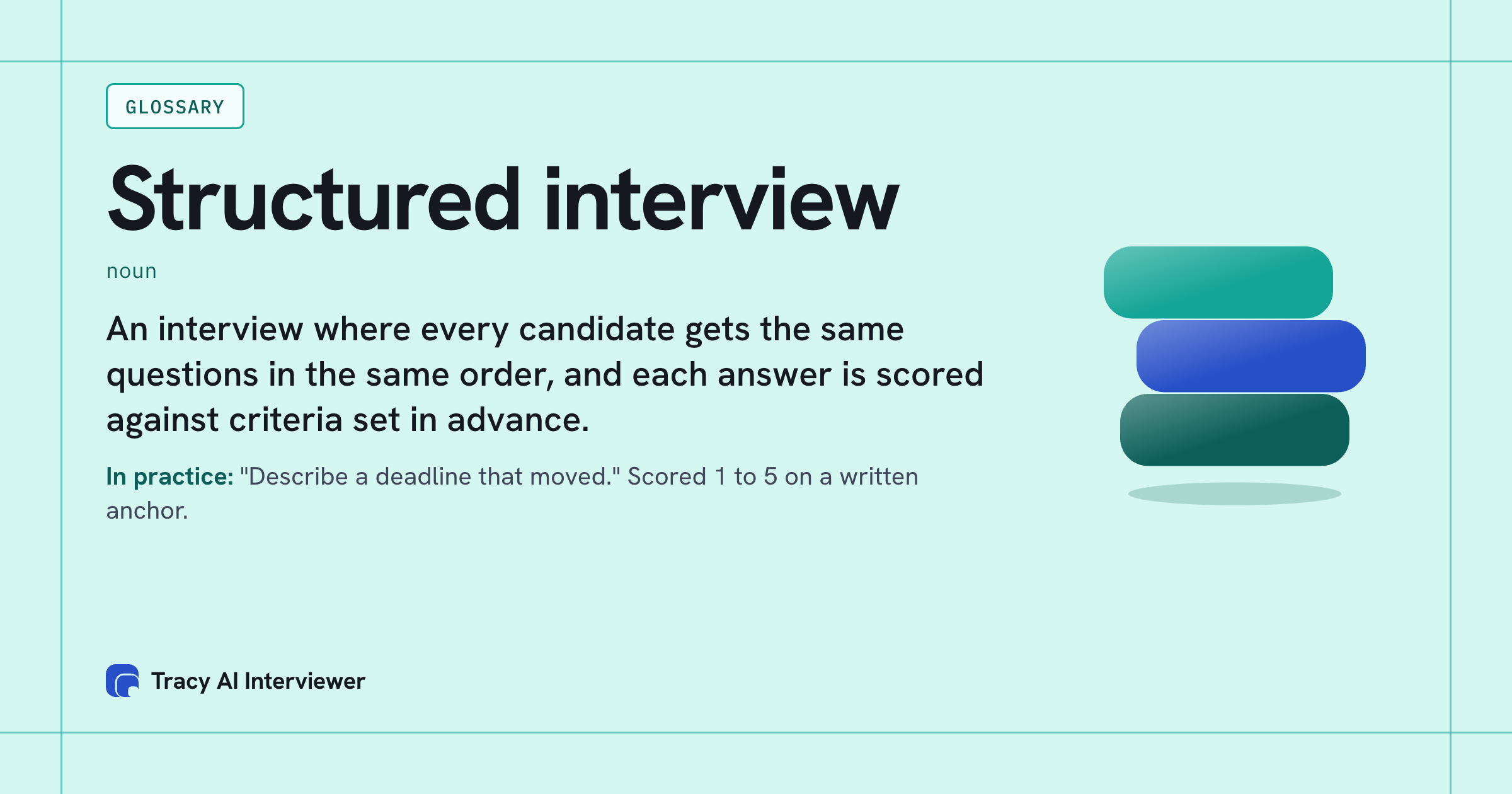
A structured interview is defined by shared questions and scoring set in advance, not by a form.
A structured interview example
A hiring team for a customer success manager chooses three questions and writes the anchors first. Every candidate gets all three.
| Question | 1: weak | 3: adequate | 5: strong |
|---|---|---|---|
| Tell me about a customer you nearly lost. What did you do? | Cannot give a real case, or blames the customer. | A real case with the action they took and an outcome. | A real case, the early signal they saw, what they changed afterwards and the result. |
| How do you decide which accounts get your time this week? | No method, or "the loudest first". | A method with a stated criterion, such as renewal date or risk. | A method they have adjusted after a miss, with an example. |
| Describe a time you had to say no to a customer. | Avoids the question. | A case where they said no and kept the account. | A case with the reason, the alternative they offered and what the customer said. |
Each interviewer writes a score and a quote for every row, then the team compares. Nobody argues about whether a candidate had "good energy". They argue about whether a quote meets the 3 or the 5. Our AI behavioral interviews guide covers how to write the situation-and-result questions.
Structured vs unstructured interviews
| Structured | Unstructured | |
|---|---|---|
| Questions | The same core questions for every candidate | Chosen as the conversation goes |
| Scoring | Against anchors written in advance | An overall impression |
| Evidence | One note or quote per score | Memory and general notes |
| Comparing candidates | Row by row, on the same criteria | Hard, because the questions differed |
| Effort to set up | Hours, once per role | None |
The evidence favours structure. Sackett and colleagues' 2022 re-analysis in the Journal of Applied Psychology put the mean validity of structured interviews for predicting job performance at .42 and of unstructured interviews at .19. It re-analysed earlier published meta-analyses: 105 studies and 7,864 people for structured interviews and 32 studies and 3,125 people for unstructured ones. Validity here is a correlation between the interview rating and job performance ratings, so it describes how strong the link is and says nothing about how often a hire works out (source). The authors also lowered earlier estimates for most selection methods, and structured interviews still ranked first.
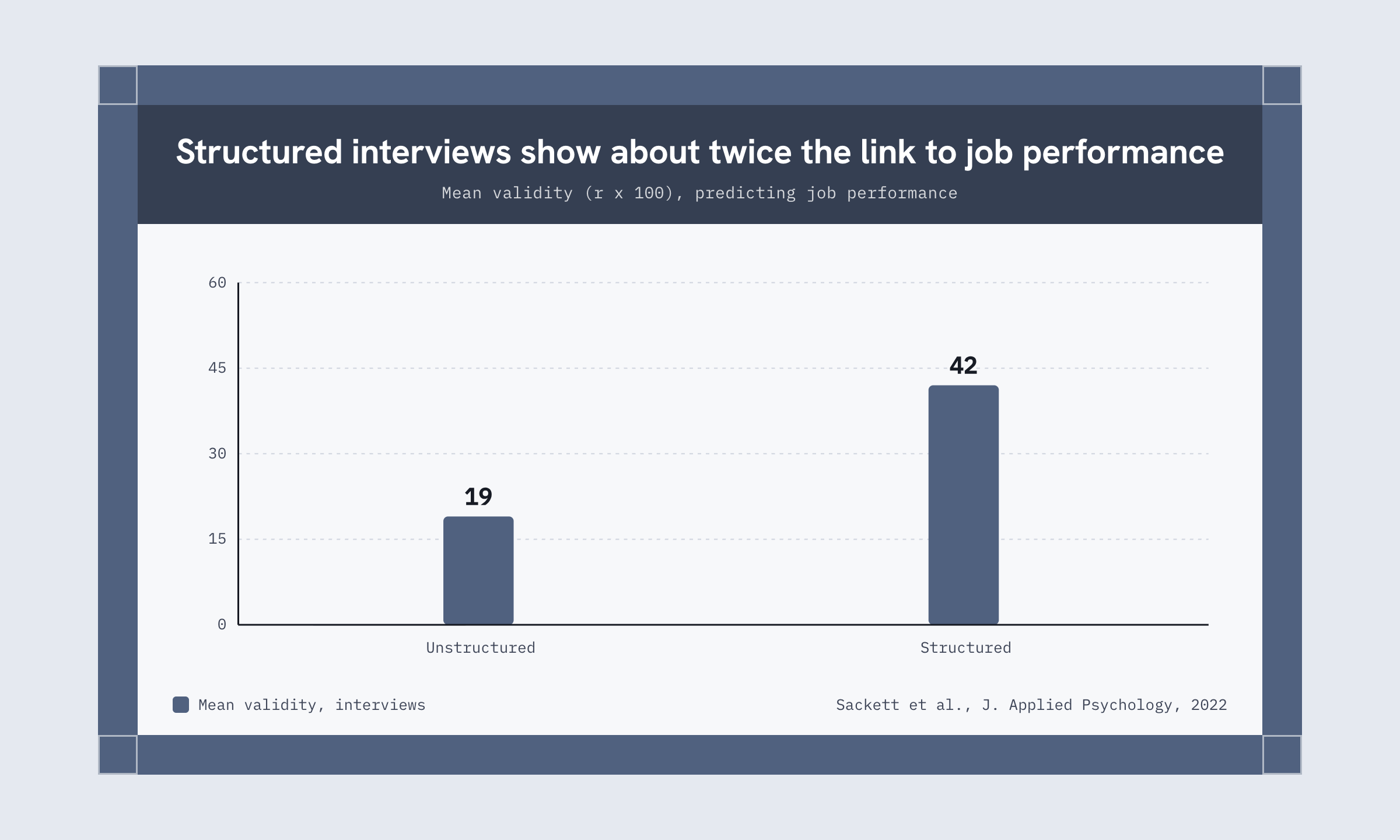
The link between interview rating and job performance is about twice as strong when the interview is structured.
What a structured interview does not do
Structure narrows how much the interviewer's mood decides the outcome. It does not make the criteria correct, and it does not remove bias. A badly written question or an anchor that rewards one background still scores badly, now consistently. The people who write the criteria should be the people who know the job, and someone outside the hiring team should read them.
A structured interview also does not replace the decision. A person still weighs the scores, the evidence and the parts of the role no interview can test. See how that works when the first round is run by an AI interviewer, and how AI and human interviews compare.
Running a structured interview with Tracy
Keeping an interview structured across many candidates is the hard part.
- Questions from the job description. Tracy generates them from the role. Edit them or use your own.
- Scored on your criteria. You set the skills and their weights per role or role family, and each result is scored on them.
- Follow-ups. She asks in the candidate's own field and follows up on what they said. Roy Junyoung Jang, Director, Residency & Investment at Antler Korea, said: "Tracy sometimes brings up exactly those questions I might have forgotten to ask, which has been a pleasant surprise."
- Evidence per result. A recording of both sides, a timestamped transcript and a written assessment for each question with its reasoning, so a reviewer can check the evidence behind a result.
A person decides from the evidence. Tracy's role is the interview and the report. Learn the mechanics in how AI interviews work and see how to screen candidates for the steps around it.
The first 3 results are free with no card. After that it is $1 per credit, one credit per started 20 minutes of an interview that produced a result, with no seats and no upfront cost. See pricing. To see the method applied, set up one role and read the evidence from its first interviews.
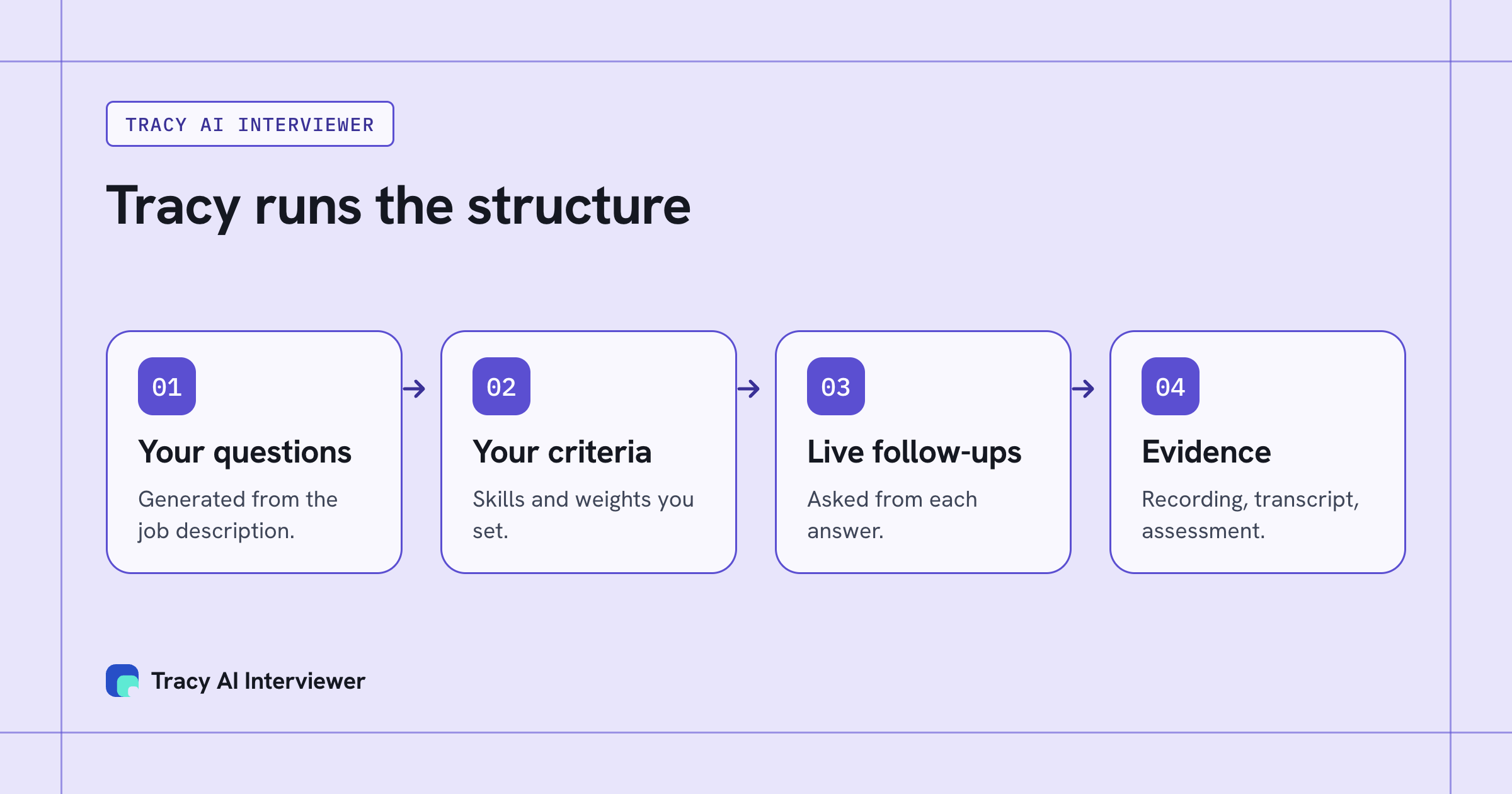
Tracy generates the questions from your job description, scores on your criteria and follows up on each answer.
Related terms
- Behavioral interview. Questions about what the candidate did in a past situation. It can be structured or not.
- Situational interview. Questions about what the candidate would do in a described situation.
- Scorecard. The sheet where scores and evidence are written down, one row per criterion.
- Scoring anchor. The written description of what a 1, a 3 and a 5 sound like for a question.
- Follow-up question. A question that builds on the answer just given.
Which path fits you:
- Screening applicants: start with applications.
- Hiring at volume: see hiring at volume.
- Vetting specialists: see expert vetting.
Questions
What is a structured interview process?
Is a structured interview better than an unstructured one?
Can you ask follow-up questions in a structured interview?
How many questions should a structured interview have?
Does a structured interview remove bias?
Can an AI interviewer run a structured interview?
See the method applied in one interview for your own role. Send us one role and we will build the interview plan in days, with a recording and report you can check. Try it free · Book a demo
Sources
- Sackett, Zhang, Berry and Lievens (2022), Revisiting meta-analytic estimates of validity in personnel selection, Journal of Applied Psychology 107(11), retrieved 9 Nov 2026.
- Tracy AI Interviewer home page, customer quotes, retrieved 9 Nov 2026.
- Tracy AI Interviewer pricing, retrieved 5 Nov 2026.
- Tracy AI Interviewer Connect page, retrieved 5 Nov 2026.