In short
A debrief goes wrong when the panel argues from memory, and an interview debrief template fixes the order of the meeting: a 30-minute agenda, a disagreement log and a decision record. Tracy AI Interviewer gives every interviewer the same record, with the recording, a timestamped transcript and an assessment per question. The panel settles each disagreement from that evidence, and a person decides.
What a debrief template does well
Debriefs often run on memory. Five people join, the most senior opinion lands first, and scores written alone get revised in the room. An interview debrief template gives the meeting a shape: evidence in before anyone speaks, a fixed order, a place to log disagreements and a decision written down. Copy it below and see it filled in for a fictional data analyst.
The agenda keeps the meeting orderly, but only a shared record keeps it honest. A template cannot give five interviewers the same thing to look at. Tracy AI Interviewer can, and the section after the example shows how.
What is an interview debrief?
A debrief is a short meeting that turns separate interview evidence into one decision. Opinions should arrive in writing before it starts. The meeting has four jobs: find where interviewers disagree, settle each disagreement with evidence, decide, and write down the risk the team accepts. Thirty minutes is enough for one candidate when everyone has submitted feedback beforehand.
A debrief differs from an interview feedback template, which one interviewer fills in alone, and from a candidate comparison, which sets finalists against each other. The debrief is the meeting between the two. If you have only the first, interviewers bring impressions. If you have only the second, you compare before you have settled what each person saw.
The interview debrief template
Copy the tables into a document or a sheet. Send Table 2 to the panel the day before, and keep Tables 3 to 5 open during the meeting.
Table 1: setup
| Field | Entry |
|---|---|
| Role | |
| Candidate | |
| Decision owner | |
| Interviewers | |
| Date and time | |
| Link to feedback, recording and notes |
Table 2: before the meeting
| Step | Who | Due |
|---|---|---|
| Submit written feedback and ratings alone | Every interviewer | Before the meeting |
| Send a one-page summary of the evidence | Recruiter | The day before |
| Confirm the must-haves and the decision | Decision owner | The day before |
Table 3: agenda, 30 minutes
| Minutes | Step | Output |
|---|---|---|
| 0 to 5 | Restate the must-haves and what is being decided | Everyone works from the same criteria |
| 5 to 10 | Read everyone's written feedback in silence | No new opinions yet |
| 10 to 20 | Go criterion by criterion, least senior first | Disagreements logged |
| 20 to 25 | Settle each disagreement with evidence | Evidence checked |
| 25 to 30 | Decide, and write the reason | Decision record |
Table 4: disagreement log
| Criterion | Interviewer A says | Interviewer B says | Evidence checked | Settled how |
|---|---|---|---|---|
Scroll the table sideways to see all 5 columns.
Table 5: decision record
| Field | Entry |
|---|---|
| Decision | Advance, hold or stop |
| Reason, in two sentences | |
| Risk accepted and plan | |
| Dissent noted | |
| Next step, owner and date |
Rules for a debrief that decides
- Collect feedback in writing before the meeting. People who write first do not copy the first speaker.
- Speak in a fixed order, least senior first. Otherwise the most senior view anchors the room.
- Take one criterion at a time. Hearing every opinion on SQL depth, then every opinion on communication, keeps the evidence side by side.
- Settle by evidence. The question is "where is that in the recording or the notes?", never "who is more sure?".
- Keep must-haves separate, so a candidate who misses one is not rescued by strength elsewhere.
- The decision owner decides, after hearing everyone. A debrief is not a vote.
- Record dissent. A sentence on who disagreed and why helps when the hire is reviewed later.
- Do not interview in the room. If the panel needs more evidence, log the question and settle it in the next round.
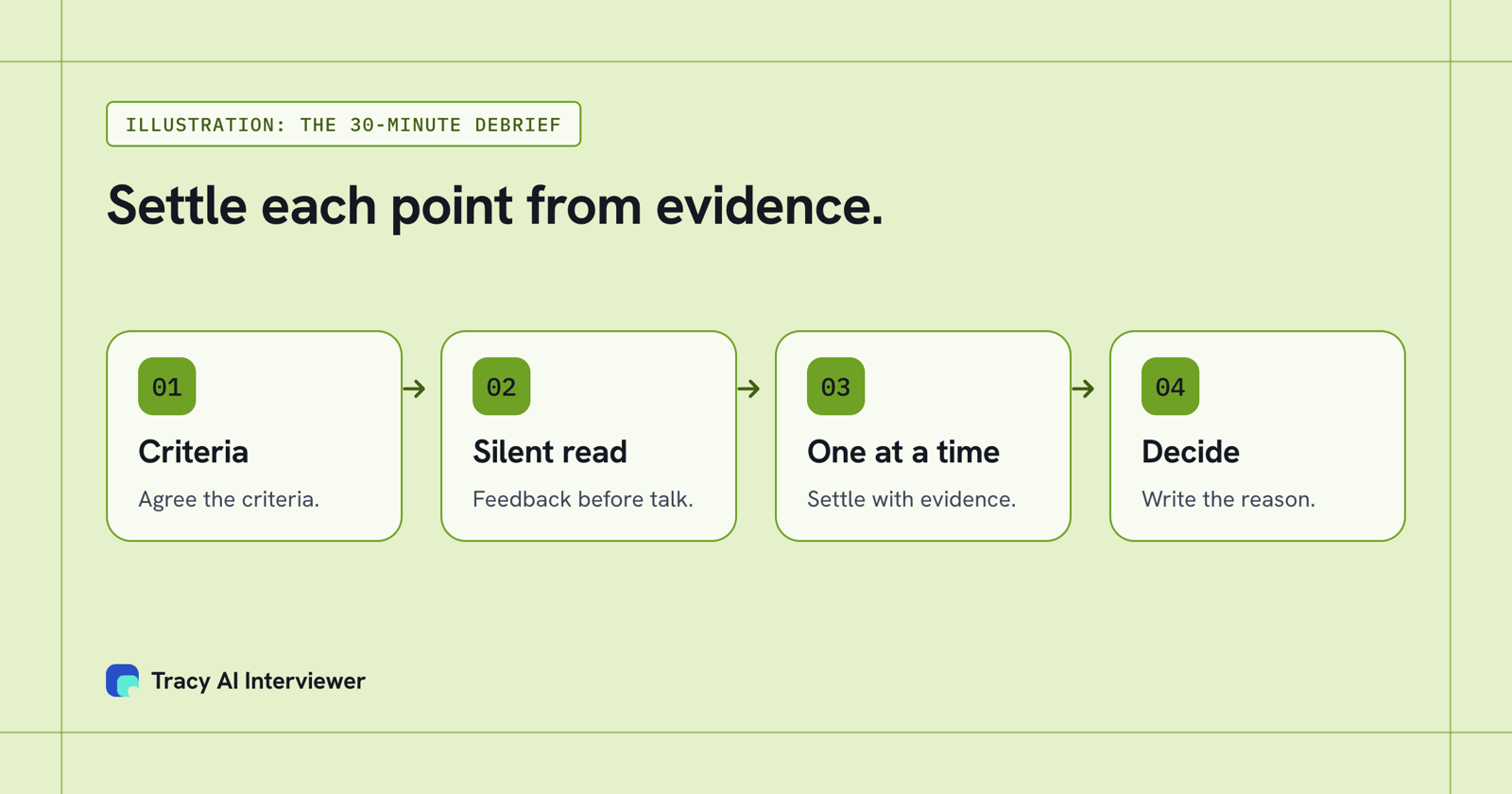
Settling each criterion from evidence is the step that turns opinions into a decision.
A filled example: data analyst
A fictional panel of three for a data analyst role. The evidence is written for this page.
Table 6: filled example, disagreement log
| Criterion | Interviewer A says | Interviewer B says | Evidence checked | Settled how |
|---|---|---|---|---|
| SQL depth | Strong, joined three tables cleanly. | Could not explain the join. | Recording 14:10: correct join, no explanation of duplicates. | Partly shown. Probe window functions in round two. |
| Stakeholder communication | Clear. | Clear. | Both cite 22:30. | No disagreement. |
| Ownership of mistakes | Good example. | Vague. | Transcript 27:05: named a wrong dashboard, fixed it in a day, added a check. | Shown. |
Scroll the table sideways to see all 5 columns.
Table 7: filled example, decision record
| Field | Entry |
|---|---|
| Decision | Advance |
| Reason, in two sentences | Two of three criteria were shown directly and the SQL question is narrow enough to settle in one more round. The disagreement was about explanation, not skill. |
| Risk accepted and plan | SQL depth stays open until round two, with a window functions question. |
| Dissent noted | Interviewer B would hold until round two. |
| Next step, owner and date | Round two with the analytics lead, booked by the recruiter by Thursday. |
What the filled example shows that blank fields do not
The blank log has a column called Evidence checked. The filled one shows what goes in it. On SQL depth, Interviewer A said strong and Interviewer B said they could not explain the join. The recording at 14:10 settled it: a correct join, with no explanation of duplicates. So the criterion was only partly shown, and the panel moved the open part to round two with a window functions question.
Across the three criteria, one was shown, one had no disagreement and one was partly shown, and the decision was still Advance with the risk written down. A blank table cannot show that a disagreement can end in a smaller question instead of a vote.
What Tracy adds to the interview debrief template
Three things change when Tracy does the interviewing.
01 Keep the evidence
The whole panel gets one record: a recording of both sides, a timestamped transcript and what the person said to each question. For "where is that?", the answer is a moment in the recording the panel can play, and people who missed the call read the same thing.
02 Ask the next question
Tracy asks every applicant the same questions and follows up in the person's own field, then waits for the answer, so the panel compares like with like.
03 Set the skills Tracy covers
You name the skills for the role, so the criteria in the debrief are the ones every interview covered.
A Director at a top-tier early-stage VC said: "Tracy makes it much easier to share their responses ... with other team members for further discussion." Tracy reports what was said and does not rate or rank. The panel decides.
For how a finished result reads, see a Tracy result a panel can debrief from. The interview report template and the candidate evaluation template cover what to send on afterwards. To try it, run one role with three real interviews and debrief from the results using the template.
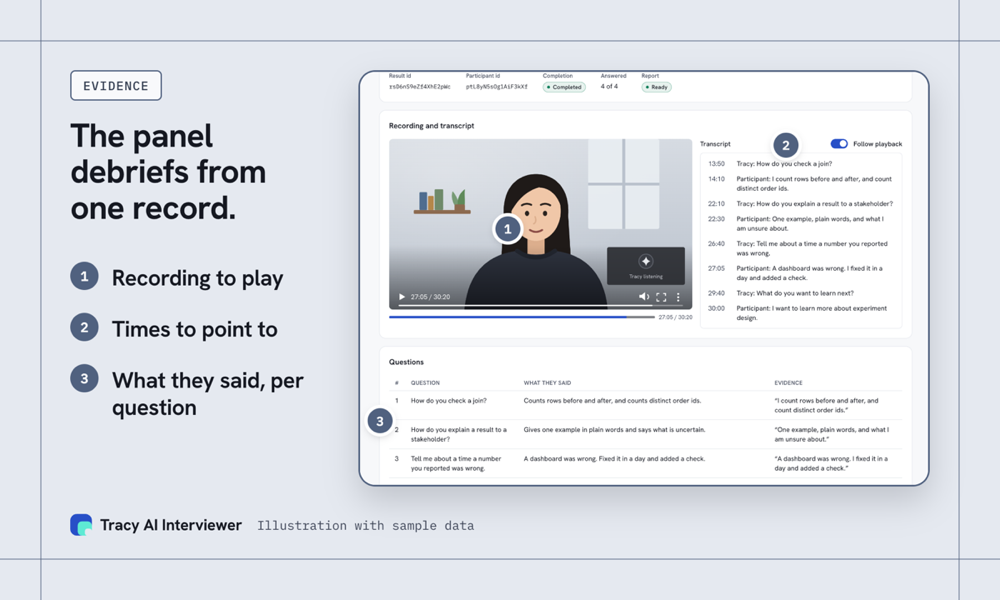
A timestamp turns a disagreement into something the panel can play.
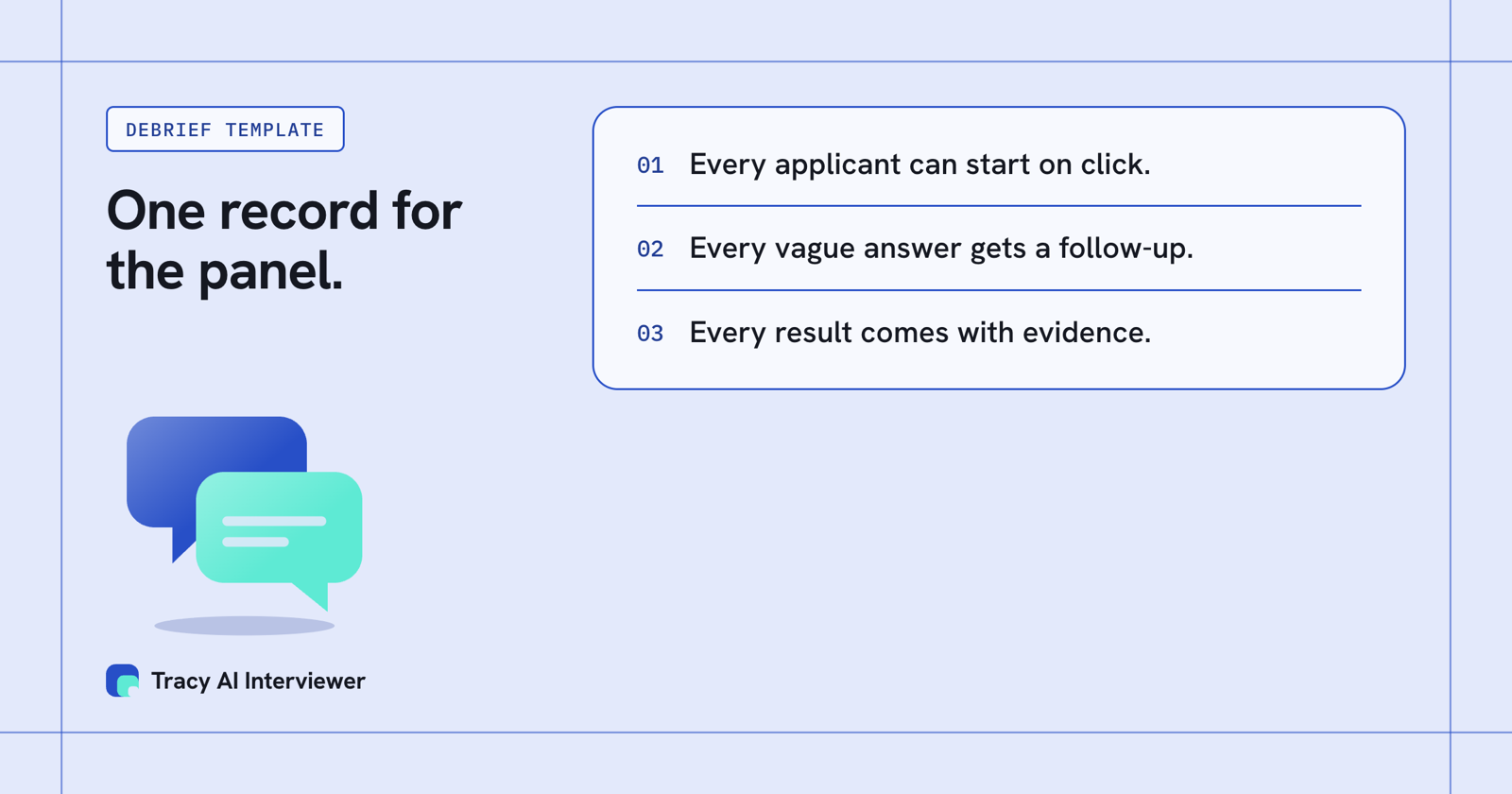
Every applicant can start on click, every vague answer gets a follow-up, every result comes with evidence.
Which path fits you
- Many applicants and a panel to debrief: volume interviewing for a panel.
- Engineering panels: technical hiring interviews.
- Setting criteria before the first interview: the interview scorecard template.
Common questions
What is an interview debrief?
How long should an interview debrief take?
What should an interview debrief template include?
Is a debrief template the same as an interview feedback template?
Who decides at the end of a debrief?
Can a debrief use an AI interview result?
Run this template as a Tracy interview
Copy the template, then run one role as a Tracy interview. The panel gets one record. The first 3 results are free.
Try it free (opens in a new tab) Book a demo (opens in a new tab)
Your first 3 results are free. No card needed.
Sources
- Tracy AI Interviewer Connect page, retrieved 11 Nov 2026.
- Tracy AI Interviewer home page, customer quotes, retrieved 9 Nov 2026.