In short
Candidate screening is how employers check applicants against a role's requirements to decide who moves on, and application review and a screening call do it well while the pool is small. Tracy AI Interviewer extends the interview stage to every applicant, who starts on a click, answers follow-ups in their own field and leaves a recording and what they said to each question. A person picks the shortlist. Background checks are a later, separate step.
What is candidate screening?
Candidate screening is the process of checking applicants against the requirements of a role to decide who moves on to a full interview. It runs from the application to the shortlist and usually has more than one step: a review of applications, a short screening conversation and sometimes a skills check.
Done well, screening gives every applicant the same checks and hands a hiring manager a shortlist they can trust. Screening decides who gets more of the team's time, and the hiring decision comes later. Its weak point is the screening call: the stage that needs an interviewer is the stage that queues behind calendars, and that is the step Tracy takes over.
Candidate screening checks applicants against a role's requirements and ends in a shortlist.
What are the stages of candidate screening?
Most processes use some mix of four stages, in this order.
Four screening stages, what each checks and who or what usually does it.
| Stage | What it checks | Who or what does it |
|---|---|---|
| Application review | Must-haves: location, work authorization, qualifications | A recruiter, or filters in the applicant tracking system |
| Screening interview | Basics, fit and the skills the role uses | A recruiter on a call, or an AI interviewer |
| Skills check | Whether they can do the task | A test, a work sample or an engineer |
| References and background checks | Whether what they said is true | The employer or a screening provider |
The screening interview is the stage that queues behind calendars. Indeed describes phone screening as "usually the first stage of the interviewing process". See what a phone screen is and what a first-round interview is.
What is employment screening?
Employment screening, also called employee screening, usually means background checks: identity, work history, education, criminal record and similar. It is run by the employer or a screening company, and often late in the process, when one candidate is close to an offer. The employment screening process covers which checks to run, when to run them and how to get the candidate's consent.
In the United States, the Fair Credit Reporting Act sets rules for it. A joint guide from the Equal Employment Opportunity Commission and the Federal Trade Commission (February 2014) says that before getting a background report from a screening company, an employer must tell the applicant in writing, in a stand-alone notice, and must "get the applicant's or employee's written permission to do the background check". Rules differ by country, state and city, so take legal advice before you build the process.
Tracy covers the interview stage of candidate screening. Background checks are a separate service, run by providers who specialize in them.
How do you screen candidates well?
Five habits make screening hold up.
- Write the criteria first: three or four skills and the must-haves, before you read any application.
- Ask everyone the same core questions. It lets you compare people on the same ground.
- Follow up on what they say. Ask why, what it cost, what changed.
- Write down evidence, one line or quote per skill, so a second person can check the decision.
- Keep a person in the decision. Tools can read and ask, but someone accountable decides.
The candidate screening questions page has a set of questions you can use, and how to screen candidates goes through the process step by step.
At volume, screening becomes a queue
Screening works until applicants outnumber the hours. At 100 applicants and 20 minutes each, calls alone come to about 33 hours; at 1,000 they come to about 333. A recruiter who calls everyone who looks good keeps up while the pile is small. When it grows, one of two things happens: the calls queue and the best candidates take other jobs, or the recruiter cuts the list on a quick skim and misses people.
A reviewer who has to check a skimmed shortlist has nothing to open. A screening interview leaves a recording, a timestamped transcript and what the person said to each question. The repeatable part, the same questions with a follow-up, can run without a person on the call, which keeps the recruiter's time for the shortlist. See AI candidate screening tools for the options.
What Tracy adds to candidate screening
01
Reach every applicant
Each applicant starts on a click, at any hour, with no scheduling and no recruiter present. Everyone in the pool is screened the same way.
02
Ask the next question
Tracy asks in the applicant's field about the detail that is missing and waits for the answer. A vague claim becomes something a reviewer can check.
03
Keep the evidence
Each applicant gets a recording of both sides, a timestamped transcript and what the person said to each question, with its reasoning.
The questions come from the job description. Edit them or bring your own. A person decides: applicants are told on the join screen that the interview is recorded and transcribed, and nothing is decided automatically. Steven Perry, Account Executive at IT Resources, an IT staffing firm in Tampa, US, says: "By the time they finish with this platform, they're even laughing and joking." More on screening at high volume.
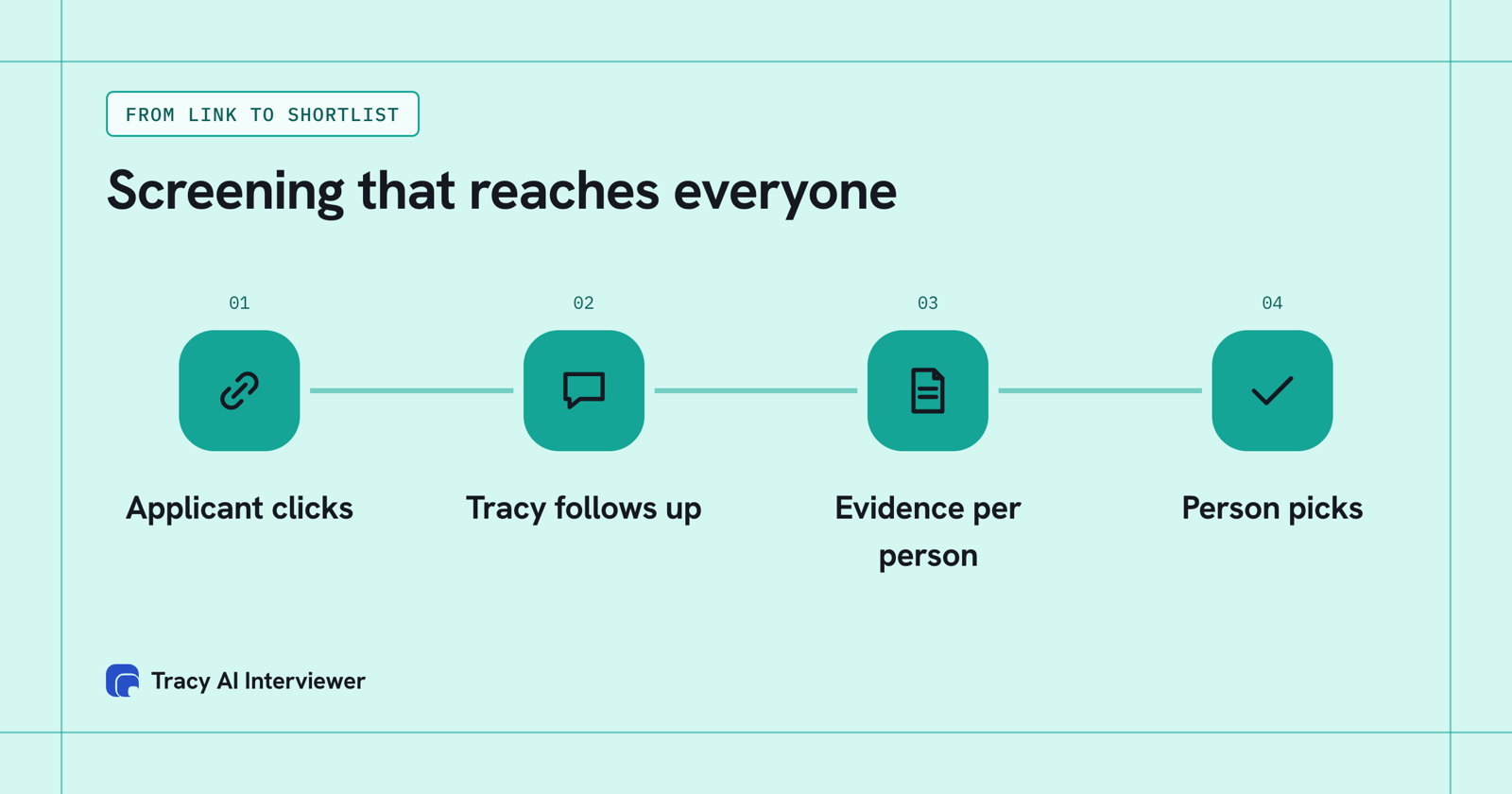
Applicants start from one link, and a person picks the shortlist from the evidence.
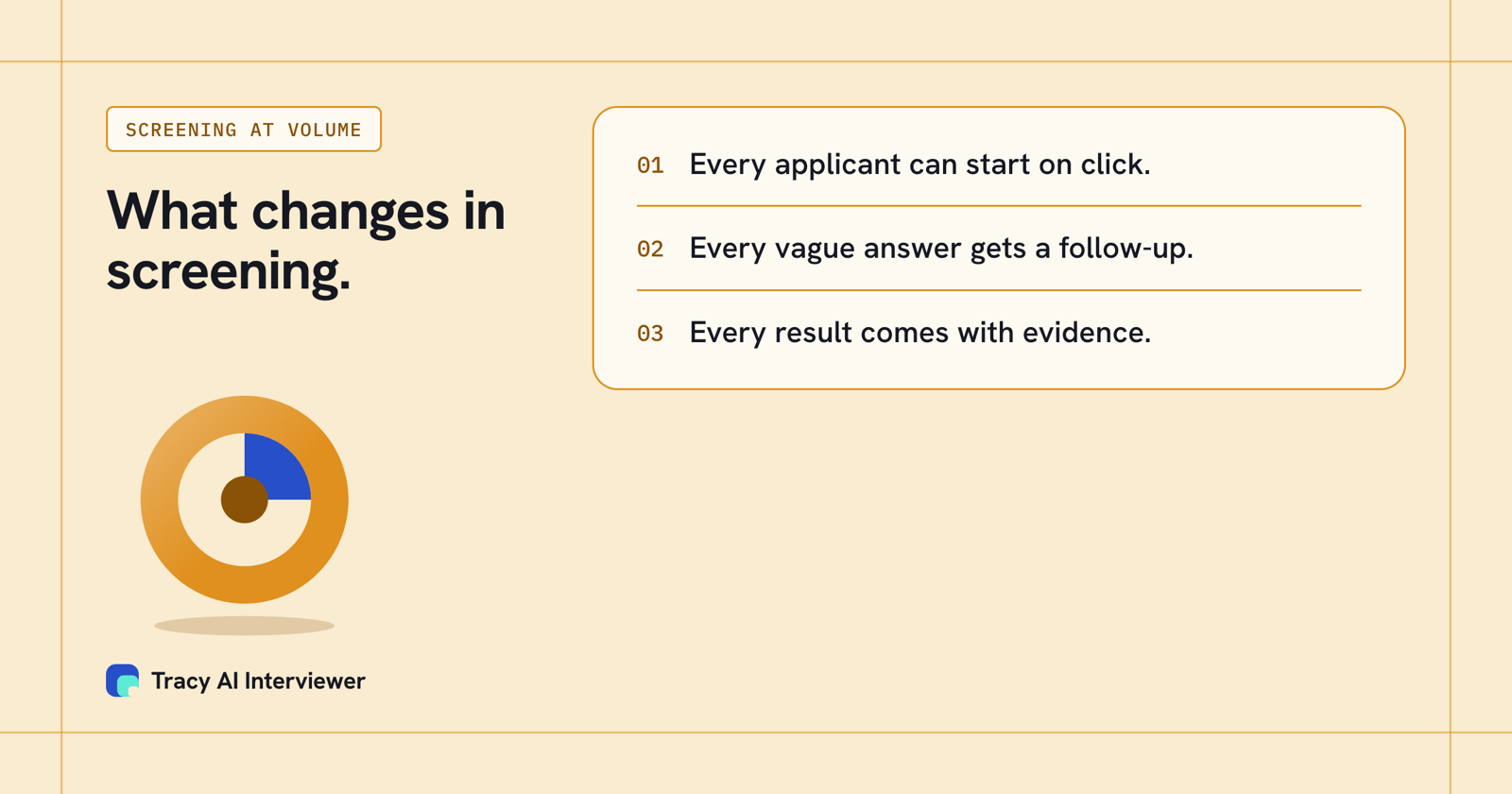
Three changes screening gets with Tracy: reach, follow-up, evidence.
Related terms
- Screening interview: an early interview that filters applicants.
- Pre-screening interview: a short first conversation on the basics. See what a pre-screening interview is.
- Résumé screening: reviewing applications against the must-haves.
- Knock-out question: a yes or no check that ends the process if it fails.
- Background check: verification of identity, history and records, run late in the process.
- Applicant tracking system: the software that holds applications and moves candidates between stages.
Which path fits you:
- Many applicants: see one screening interview per applicant.
- Technical roles: see screening for technical roles.
- Reading the output: see what a screening result contains.
Common questions
What is candidate screening?
What is employment screening?
What is employee screening?
What is the employment screening process?
What are employment screening services?
Screen your next role on click
Run one role as a Tracy interview and read the recording, transcript and written assessment per question. The first 3 results are free.
Try it free (opens in a new tab) Book a demo (opens in a new tab)
Your first 3 results are free. No card needed.
Sources
- EEOC and FTC, Background Checks: What Employers Need to Know (February 2014), retrieved 14 Nov 2026.
- Indeed, Phone screening, retrieved 14 Nov 2026.
- Tracy AI Interviewer home page, retrieved 14 Nov 2026.
- Tracy AI Interviewer pricing, retrieved 14 Nov 2026.