AI Interview Reports: What Reviewers Should See
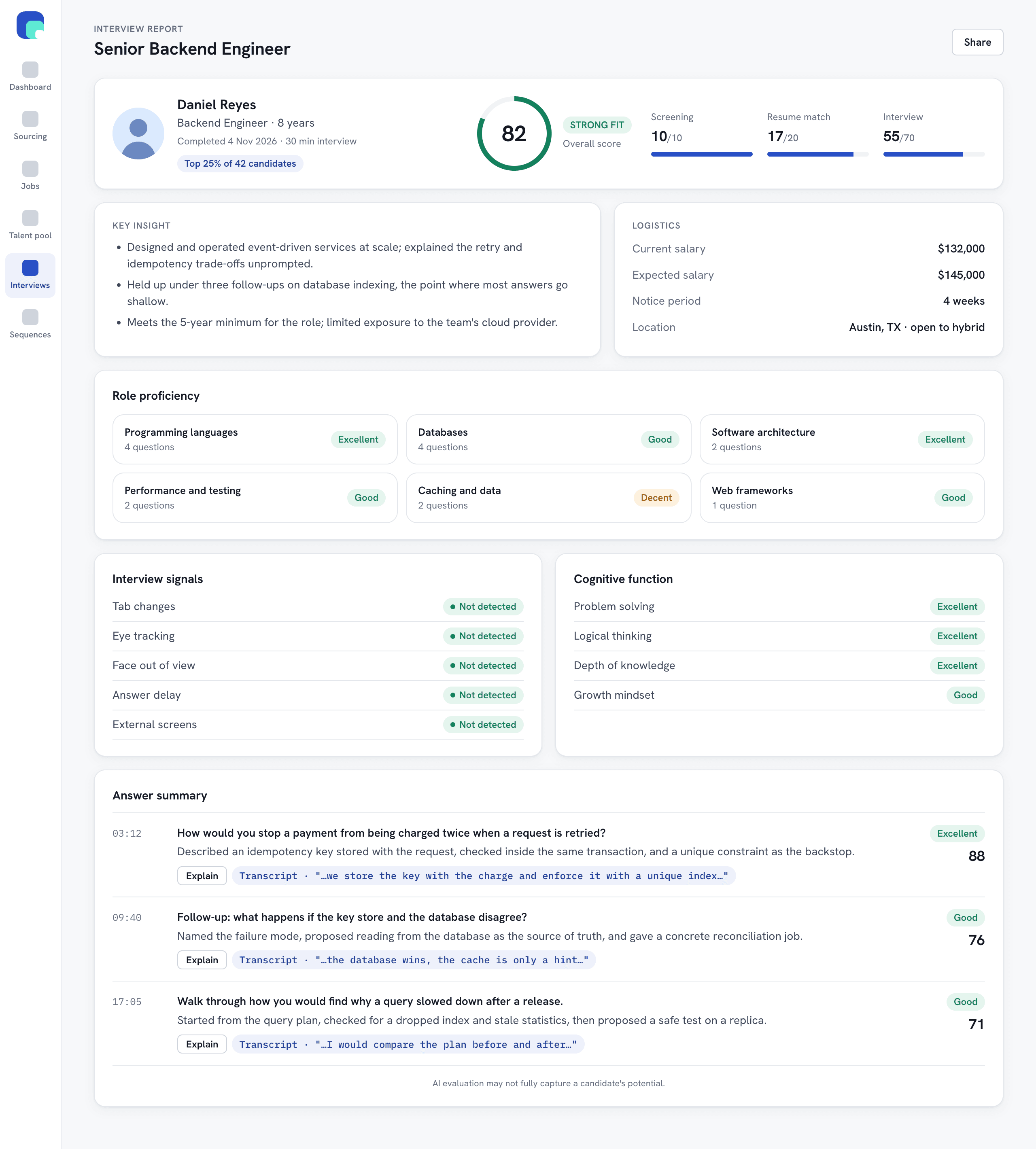
An AI interview report is useful when a reviewer can move in both directions: from the candidate's answer to the summary, and from any summary or score back to the exact answer that supports it.
If the report only says "communication: 82," the reviewer has a number but no evidence. If it contains a two-hour recording with no structure, the evidence exists but is expensive to use. A good report puts the decision fields first and keeps the candidate's words one click away.
The minimum AI interview report
Every report should answer six questions before a reviewer decides who moves forward.
- What was this interview meant to learn? Show the role, brief, competencies and any must-have requirements.
- What was asked? Keep the opening questions and the follow-ups in order.
- What did the candidate say or do? Preserve the transcript, recording and any work sample.
- What did the system conclude? Show structured fields, summaries, scores and flags.
- Why did it reach that conclusion? Attach a quote, timestamp, code sample or explanation.
- Who decided what happened next? Record the reviewer and outcome separately from the AI output.
The sixth question is not administrative decoration. Greenhouse's 2026 candidate research found 38% of US candidates wanted confirmation that a person reviews AI output before decisions. Pew's US survey, fielded in December 2022, found 71% opposed AI making a final hiring decision.
1. Interview brief and version
Put the job of the interview at the top. Include:
- role or programme;
- fields the team asked the interviewer to collect;
- competencies and scoring anchors;
- required questions;
- interview language and format;
- the brief version and date.
Versioning matters. If the team changes the system-design prompt halfway through a hiring round, the reports should show which candidates received which version. Reviewers can then avoid comparing unlike evidence as if it were identical.
2. Question and answer trail
A two-way interviewer may ask each candidate a different follow-up. The report should show the full sequence alongside the prepared questions.
For example:
Question: Tell me about the payment migration you led.
Answer: I moved our checkout from a legacy gateway to a new provider over three months.
Follow-up: Which part did you own personally, and what failed during the rollout?
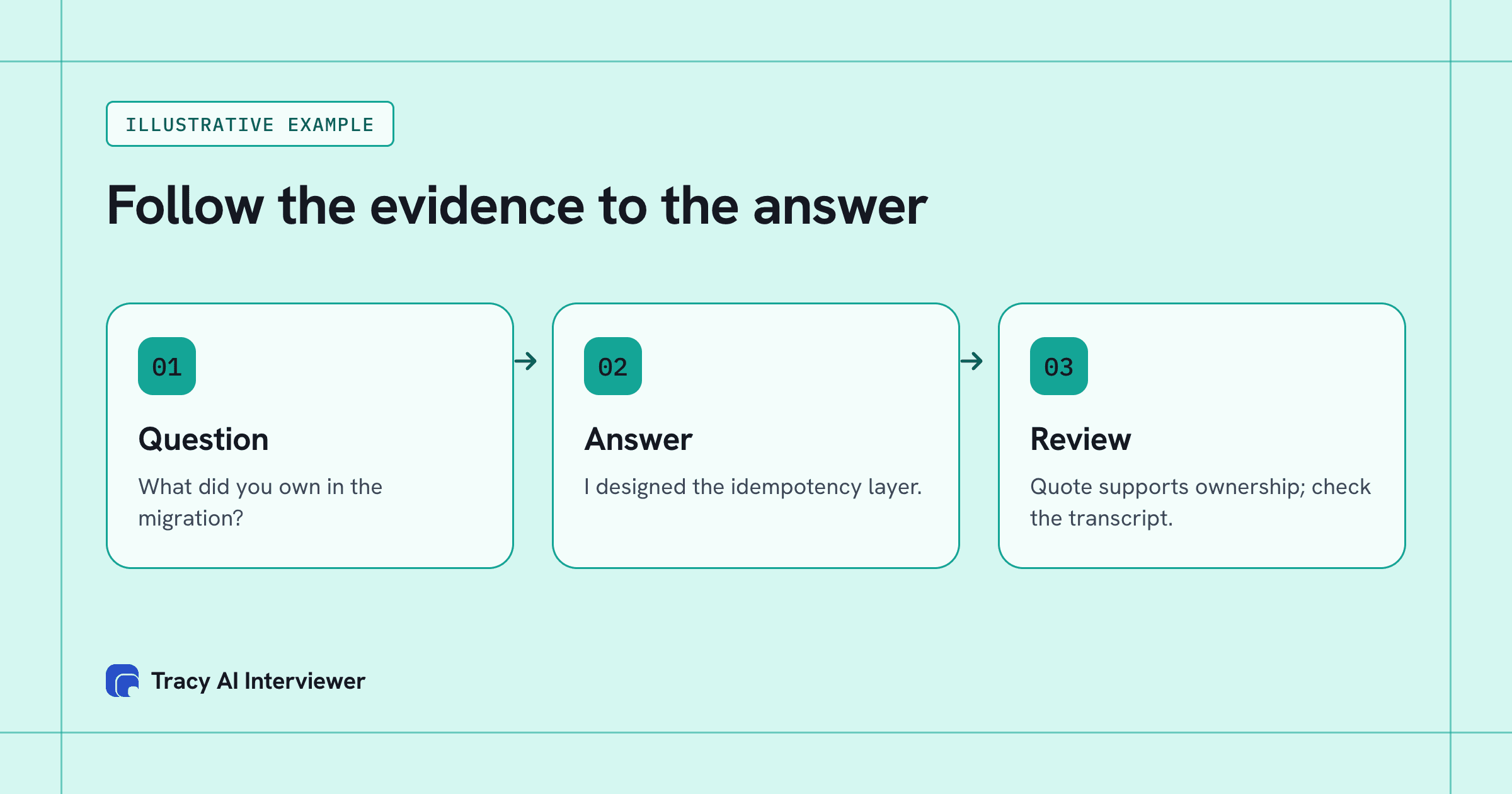
Answer: I designed the idempotency layer and rollout flags. Our first one-percent release exposed duplicate webhook processing, so I stopped the rollout and added a unique event constraint before resuming.
The first answer states a project. The follow-up supplies ownership, a failure and the response. A summary that says "owned idempotency design and corrected duplicate webhook processing during staged rollout" can now cite the second answer.
3. Structured fields tied to the brief
Turn the conversation into the fields a hiring manager actually needs. For a backend engineer, that could be:
| Field | Evidence in the report |
|---|---|
| Relevant scale | Traffic, data volume and team context quoted from the answer |
| Personal contribution | What the candidate designed, built or decided |
| Technical reasoning | Options considered and why one won |
| Failure handling | What went wrong, how it was detected and what changed |
| Availability | Notice period or start date, when appropriate to collect |
Avoid generic generated paragraphs that repeat the CV. A field should either change the decision or disappear from the report.
Tracy AI Interviewer's current product page describes structured results backed by the participant's words and direct quotes. This description comes from Tracy's own page.
The report-v3 example we reviewed includes an overall score, key insights, role proficiency, interview signals, video chapters, answer summaries and a transcript tab. The illustration above is a recreation; its labels and layout may differ from the live product.
4. Quotes, timestamps and source labels
Each material conclusion should carry a short route to its source. Useful patterns include:
- a direct quote with its timestamp;
- a link to the relevant transcript turn;
- a marker on the recording;
- the submitted code or file;
- a label that separates candidate-provided facts from system interpretation.
Quotes need context. A five-word fragment can reverse the meaning of a longer answer. Let the reviewer expand the surrounding exchange without hunting through the recording.
The report should also distinguish three layers:
- Observed: what the candidate said or did.
- Derived: a calculation or structured extraction from the answer.
- Interpreted: the system's judgement about strength, risk or fit.
That separation prevents a generated interpretation from looking like a candidate quote.
5. Scores with reasons
A score is useful only if the reviewer knows the scale and can inspect the reason.
Instead of:
System design: 4/5
Use:
System design: 4/5. The candidate separated ingestion from delivery, used idempotency keys at the payment boundary and described a rollback. They did not address cross-region state until prompted.
Then link the explanation to the relevant answers. HackerRank describes a clear "why" for its Chakra scores, and other vendors make similar claims. Buyers should test the path in a real demo: click a low score, inspect the evidence and see whether a reviewer can disagree or override it.
Use anchored scales. A practical four-point version is:
| Score | Meaning |
|---|---|
| 1 | No relevant evidence, or the approach would fail the stated requirement. |
| 2 | Some relevant evidence, with an important gap or untested assumption. |
| 3 | Sound evidence that meets the requirement and explains the trade-off. |
| 4 | Strong evidence that also anticipates failure modes and adapts when challenged. |
Do not hide separate competencies inside one overall number. Reviewers need to know whether the gap is technical depth, communication, domain knowledge or a must-have constraint.
6. Recording, transcript and work sample
The summary helps the reviewer scan. The source material lets them verify.
Keep the recording and transcript aligned by timestamp. Let reviewers search the transcript and jump to the matching video or audio. For technical interviews, keep the submitted code, output and task version beside the conversation.
Retention should be deliberate. The candidate invitation should explain what is recorded and how it is used. The organisation should delete material according to its policy rather than keeping every interview indefinitely because storage is cheap.
7. Integrity signals with context
An integrity section should report observations, not pronounce guilt. A tab change, long pause, second screen or unusual gaze can have an innocent explanation. A candidate may be reading the task, using an approved accommodation or dealing with a connection problem.
For each flag, show:
- the signal name;
- time and duration;
- the relevant recording or transcript moment;
- whether the behaviour was allowed under the interview rules;
- space for a reviewer note and outcome.
Never turn one signal into an automatic rejection. Use it to direct a person's attention to a moment worth checking. The same principle applies to a suspected copied answer: ask a follow-up about the candidate's reasoning and review what follows.
8. Human review and audit trail
Keep AI output and human action separate. The report should show:
- who opened or reviewed it;
- any score the reviewer changed and why;
- the decision, such as progress, hold or decline;
- the date and responsible person;
- the candidate communication sent after the decision.
An audit trail makes calibration possible. If reviewers repeatedly override one competency, the team can inspect the question or rubric instead of assuming the people are inconsistent.
Greenhouse reported that 51% of surveyed US candidates who completed an AI interview never heard back. The report workflow should end in a candidate response as well as an internal status.
A review workflow that takes five minutes
For a first-round report, a hiring manager should be able to review in this order:
- Read the brief and must-have fields.
- Scan the structured results.
- Open the evidence behind any very strong, very weak or surprising point.
- Check follow-ups for ownership and reasoning.
- Review integrity signals in context.
- Record the decision and reason.
- Trigger the next-step or decline message.
The five-minute target is not a promise for every role. A regulated, senior or technical decision may deserve longer. The design principle is progressive detail: the report is scannable first and verifiable when needed.
AI interview report buyer test
During a vendor demo, ask to use a brief you wrote. Give one complete answer and one vague answer. Then inspect the report.
- Did the interviewer ask a relevant follow-up?
- Did the summary preserve the meaning of the answer?
- Can you click from a conclusion to the source?
- Does each score have a scale and explanation?
- Are quotes clearly separated from generated text?
- Can a reviewer correct the report or override a score?
- Does a flag show the underlying moment?
- Is the human decision recorded separately?
- Can the team export or delete the data?
- Does the workflow send an outcome to the candidate?
If the demo cannot answer those questions with a real result, the product is asking you to trust its output before it has made that output reviewable.
For question design, use the 25 software engineer interview questions or the broader AI technical interview guide. For format choice, compare one-way and two-way video interviews.
Questions
What is an AI interview report? It is the reviewer-facing record created after an AI interview, usually containing the questions, answers, transcript or recording, summary fields and any scores or flags.
What should an AI interview report include? Include the interview brief, questions, candidate answers, traceable summary fields, direct evidence, score rationales, recording or transcript, integrity signals and the human decision.
Should recruiters trust an AI interview score? Treat it as a review aid, not a fact. A reviewer should be able to see the reason, inspect the underlying answer and change the outcome.
How long should an interview report be? Make the first screen scannable, then let reviewers open the evidence. Length should follow the decision, not the interview duration.
Can an integrity flag reject a candidate automatically? It should not. A flag can be caused by benign behaviour or technical conditions. Show the relevant moment and require a person to interpret it.
See how Tracy works with structured results backed by the participant's own words.
Sources
All sources retrieved 2 Nov 2026.
- Tracy AI Interviewer, product page: structured results, direct quotes, video and audio interviews, adaptive follow-ups and human decision.
- Greenhouse, 2026 Candidate AI Interview Report release: candidate expectations for human review and post-interview outcomes.
- Pew Research Center, AI in hiring and evaluating workers: attitudes to final AI hiring decisions from a December 2022 survey.
- HireVue, AI Interviewer: current vendor description of two-way interviews, criteria and recruiter review.
- Alex, AI Interviewer: current vendor description of interview formats and reviewer output.
- HackerRank, Chakra: current vendor description of score explanations and follow-up questions.