In short
Claude for product managers works well on the writing and the thinking: the question, the interview guide and a first read of themes. It cannot hold the conversations. Tracy AI Interviewer holds them: customers join from one link, Tracy asks the follow-up a short answer needs, and each result links to the recording. You read the first ten and decide what to build.
What Claude for product managers does well
Claude drafts the interview from your question, rewrites a weak question in plain words, groups answers into themes with a quote under each, and tells you which answers disagree. Skills and project instructions shape what it writes, such as a discovery guide. This page lays out a weekly routine for a product manager at a scheduling tool who wants to know how customer teams reschedule today.
Claude can sharpen the question and read the answers. The conversations in the middle used to cost one calendar slot each, and that is the part Tracy takes over.
Which conversations should a PM hand off?
Hand off the conversations where you know what to ask and need many voices. Keep the ones where the relationship or the surprise matters more than the count. The grid sorts them on two things: how high the stakes are, and how well you know the question. Low stakes and a known question go to Tracy. Low stakes with an unknown question start with Tracy, then you call whoever surprises you. High stakes with a known question are yours, after you read what other customers told Tracy. High stakes with an unknown question you run yourself.
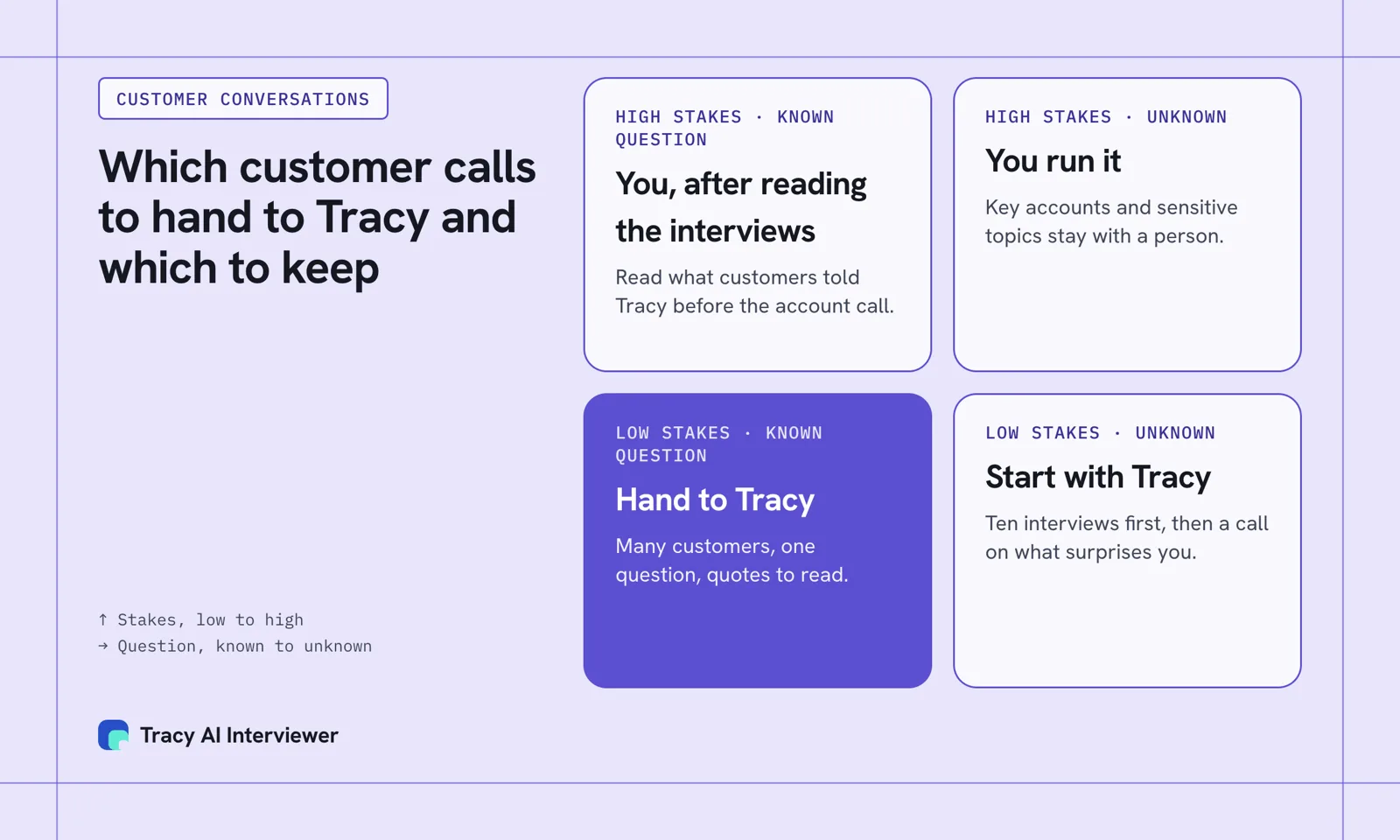
Hand Tracy the conversations with a known question and many people; keep the high-stakes ones for yourself.
What Tracy adds to Claude for product managers
- Reach every customer you invite. Each person starts on click, at any hour, with no scheduling and no PM on the call. Ten customers in a week stops depending on ten calendar slots.
- Ask the next question. Tracy follows the answer in the customer's own field and waits for it, so a short answer gets the missing detail.
- Keep the evidence. Each result has a recording, a timestamped transcript and a written assessment per question with its reasoning, so a quote in a roadmap review traces to a moment.
A first round of ten is small. At volume the same flow has delivered 100K+ interviews, with a reported 99% completion rate.
What does a PM's week in Claude look like?
One question a week, with a small first round of ten.
- Monday: write the question, ask Claude for the draft and approve it.
- Tuesday: send the link to ten customers.
- Wednesday: read the first three results and fix any question that was misread.
- Thursday: customers keep finishing; read each as it lands.
- Friday: bring the clearest themes, with quotes, to planning and decide.
The routine repeats the next week with a new question.
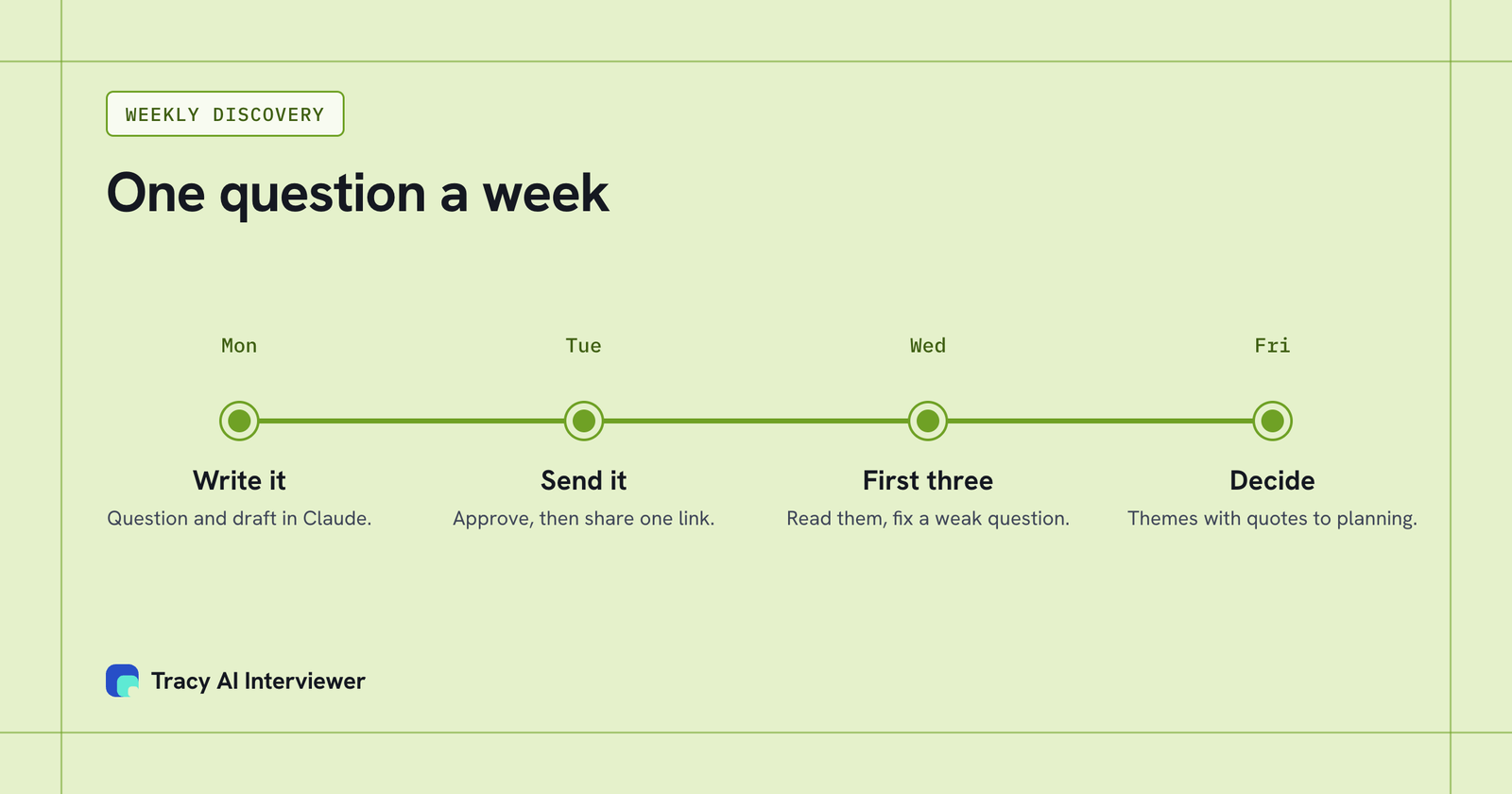
One question a week: draft it Monday, let customers answer through the week, read on Friday.
How do you set up the interviews in Claude?
Add Tracy AI Interviewer once as a custom connector, using the address https://tracyinterview.ai/mcp. Anthropic's help page says custom connectors work in Claude, Cowork and Claude Desktop on the Free, Pro, Max, Ultra, Team and Enterprise plans, with one connector on Free, and that on Team only Owners can add them. Claude asks before it uses a tool. The steps are in the Claude setup guide, and the first-prompt walkthrough shows it end to end.
Then ask in plain words:
Use Tracy AI Interviewer to set up a discovery interview for customer success managers at our accounts. I want to learn how they reschedule a meeting today and what goes wrong. Ten minutes. Show me the draft.
What does a discovery interview draft look like?
Claude returns the title, the questions and the fields the results report on. A draft for this question might read like the one below. It is a sample, so edit it the way you would your own notes.
- Tell me about the last time you had to move a meeting with a customer.
- What did you use, and who else was involved?
- What happened next, and what did you do about it?
- What is the part you dread most?
- If you could change one step, which would it be?
The questions ask about the last time, not what people usually do, because Nielsen Norman Group notes that people asked what they usually do describe an idealised workflow. A recent event gives you something specific to follow up. Tracy adds the follow-ups, so "I just email around" gets "who do you email first, and what do they usually reply?" Ask for a deeper or quicker style, or bring your own questions. More starting points are in this set of discovery questions.
What a short answer costs you
A PM on a call hears "I just email around" and asks who they email first. Across ten customers that is ten calls, about 3 hours of 20-minute conversations, and the follow-up has to land every time.
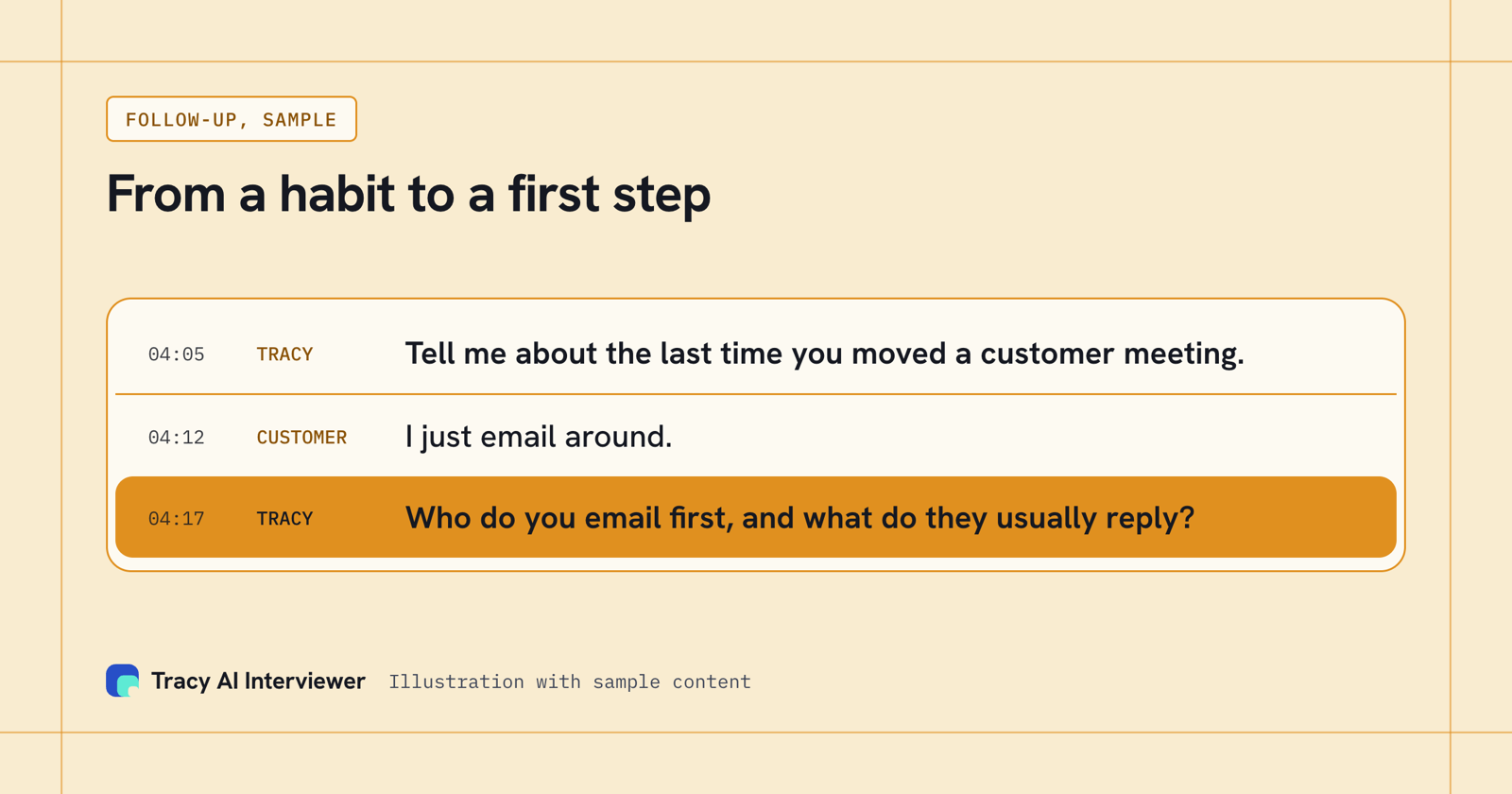
A short answer becomes a first step and a person once Tracy follows up.
Tracy asks that follow-up in each interview, so the ten answers compare. The theme you take to planning then has a quote and a recording behind it, not one call's memory.
How do you read what customers said?
Ask Claude for themes with a quote under each, then ask which answers disagree. Tracy keeps a recording and a timestamped transcript behind every result, with what each customer said to each question, so open the recording before you quote a customer in a roadmap review. Grouping answers into themes is done by Claude or by you. Tracy reports what people said and does not score or rank them. You decide what to build. Here is what a first read could look like. This is a sample we wrote with invented answers, not a captured Claude run:
Theme: rescheduling happens in email threads (3 of 10 customers). Quote: "I email everyone and wait for the first reply" (04:12, customer 3). Disagreement: 2 customers use a shared calendar and say email is the fallback.
Turning many interviews into a short list of themes explains the method, and the same approach on lost deals applies it to buyers who said no.
What do you do after the first round?
Read the first three results before you widen. If two of three customers misread a question, change it and send the next batch the corrected version. Then read all ten for themes and bring the two or three clearest, each with a quote, to your weekly planning. If a theme surprises you, book a call yourself with someone who raised it, since a person on the call is the better choice for chasing a surprise. When two customers disagree, do not average them. Ask Claude whether the two differ by role or account size, then send the next batch only to the group that disagrees. When the reasons stop repeating, stop collecting. What a reviewer reads in each result shows the report behind a quote.
What does it cost?
$1 per credit, one credit per started 20 minutes, with the first 3 results free and no card. A hundred 20-minute interviews come to $100, and a session with no answers is never charged. See the pricing page.
Which path fits you?
- The same flow for researchers: Claude for UX research.
- First time connecting: run one interview from a Claude chat.
- Lost deals to explain: interviewing buyers who said no.
- Looking at the market, not one product: Claude for market research.
- The whole flow in one place: the customer research use case.
Common questions
How can a PM use Claude for customer interviews?
Are there Claude skills for product managers?
Does the Tracy connector work in Claude Cowork?
How many customers can I talk to each week?
What do customers see before they start?
Does Tracy tell me what to build?
Send one question to ten customers
Connect Claude, draft the interview and send one link. You read what customers said. The first 3 results are free.
Try it free (opens in a new tab) Book a demo (opens in a new tab)
Your first 3 results are free. No card needed.
Sources
- Add Tracy AI Interviewer to Claude (public guide), retrieved 9 Nov 2026.
- Tracy AI Interviewer customer research use case, retrieved 9 Nov 2026.
- Tracy AI Interviewer pricing, retrieved 11 Nov 2026.
- Anthropic: Get started with custom connectors using remote MCP, retrieved 14 Nov 2026.
- Nielsen Norman Group: Interviewing Users (25 Jul 2010), retrieved 14 Nov 2026.