In short
For customer research, Tracy AI Interviewer runs the interviews from your guide, asks follow-ups on what each person says and leaves a recording and timestamped transcript for every result.
Below: six steps from recording to themes, and a theme table that carries quotes, counts and timestamps.
In customer research use, each Tracy finding links back to the words and the moment in the recording.
Next step: see Tracy run one interview from your guide.
You have a folder of recordings and a deadline. Interview transcript analysis is the work of turning them into a short list of themes, each with the exact words behind it and a count of how many people said it. Done well, anyone can open a theme, find the quote, hear the moment and judge whether the theme is fair.
Below is a method for interview transcript analysis you can run in a spreadsheet, the theme table to copy, and how Tracy AI Interviewer produces transcripts that are ready for this work in customer research.
Interview transcript analysis in six steps
The steps are adapted from the six phases Braun and Clarke describe in a 2006 paper in Qualitative Research in Psychology: familiarise yourself with the data, generate codes, search for themes, review them, define and name them, then write up (source). In a spreadsheet it looks like this.
| Step | What you do | What you end up with |
|---|---|---|
| 1. Prepare | Fix obvious transcription errors, remove names, label each speaker and keep the timestamps. | A clean transcript per participant |
| 2. Read | Read each transcript once, start to finish, before tagging anything. | A page of first impressions |
| 3. Code | Tag each meaningful passage with a short label, in the participant's own words where you can. | A list of codes, each with the line it came from |
| 4. Group | Cluster related codes and name each cluster with a sentence, not a topic. | Draft themes |
| 5. Test | For each theme, find two or three quotes, count how many participants said it and look for a participant who said the opposite. | Themes with evidence and a count |
| 6. Write up | State each finding as a claim, then the quotes, then the count. | A report someone can check |
A code is a label for one passage. A theme is a claim about what the passages mean together. "Pricing" is a topic. "Buyers cannot tell what they will pay until the quote arrives" is a theme.
A theme table with the words behind each theme
Copy this layout into a sheet. It is the part of the work other people will read, so keep one row per theme and never a theme without a quote.
| Theme | Said by | Quote | Participant and time |
|---|---|---|---|
| Reports take most of the week | 5 of 6 | "Most of the week goes on pulling the same export by hand." | P2, 02:20 |
| Someone senior waits on the numbers | 4 of 6 | "The finance lead waits on me every Monday, and I am rarely ready." | P2, 06:10 |
| Home-made fixes break | 3 of 6 | "I built a spreadsheet template, but it breaks when a column moves." | P2, 09:05 |
Scroll the table sideways to see all 4 columns.
Every row has a count, a quote and a place to find the moment. The counts and quotes are fictional.
Where interview transcript analysis goes wrong
- Themes that are topics. A list of subjects is not a finding. Write each theme as a sentence someone could disagree with.
- One loud participant. Count participants, not mentions. Five mentions from one person is one voice.
- Quotes without a place. A quote with no participant and time cannot be checked, and nobody can hear the tone.
- Leading follow-ups. "Was it frustrating?" gives you the word you hoped for. "What happened next?" gives you the story.
- Guides that drift. If each interviewer asks different questions, the transcripts cannot be compared. Fix the core questions first; see how to screen candidates for the same idea applied to hiring.
- Reading the summary instead of the transcript. A summary can drop the exceptions, so read the transcript before you rely on it.
Interview transcript analysis software and AI: what to look for
Software and AI can do the slow parts: transcribing, suggesting codes, grouping similar passages and drafting a summary. Treat each as a first draft. The test for any tool is whether a theme leads you to the exact words and the moment in the recording, so you can check it in seconds. A summary that you cannot trace back is a guess you cannot defend.
Where Tracy fits: run the interviews and keep the evidence
Analysis is easier when every transcript follows the same shape. In customer research use, Tracy runs the interviews so that it does.
- A guide from what you want to learn. Tracy drafts an interview guide from what you want to learn, or uses yours, for discovery, concept tests and win-loss interviews.
- Participants join when it suits them. They open a link in the browser, with no scheduling. Participants answer the guide you set, and Tracy follows up on what each one says, so the transcripts share a spine you can compare.
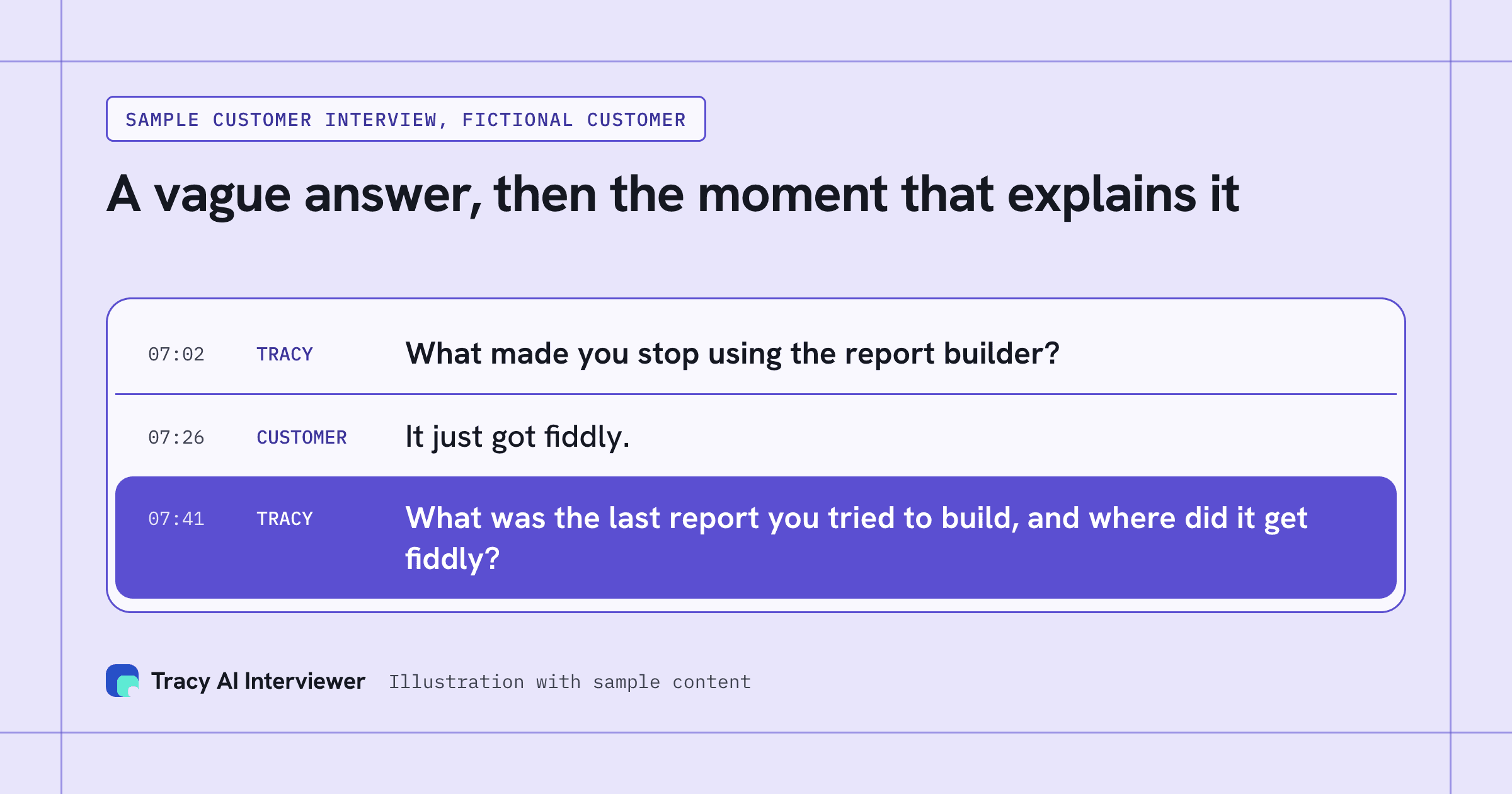
- Follow-ups on what was said. She follows up and waits for the answer, which is where a vague first reply turns into a reason. A Director at a top-tier early-stage VC says: "Tracy sometimes brings up exactly those questions I might have forgotten to ask, which has been a pleasant surprise."
- Evidence per result. A recording of both sides, a timestamped transcript and a written assessment per question with its reasoning.
- Findings you can check. For customer research use, each Tracy finding links back to the words and the moment in the recording, so each row of your theme table has its quote and its time.
A person still decides what the findings mean. See the customer research page, how an AI interview report reads and what participants see in the participant experience.
To try it, describe what you want to learn in one study and run the first interviews.
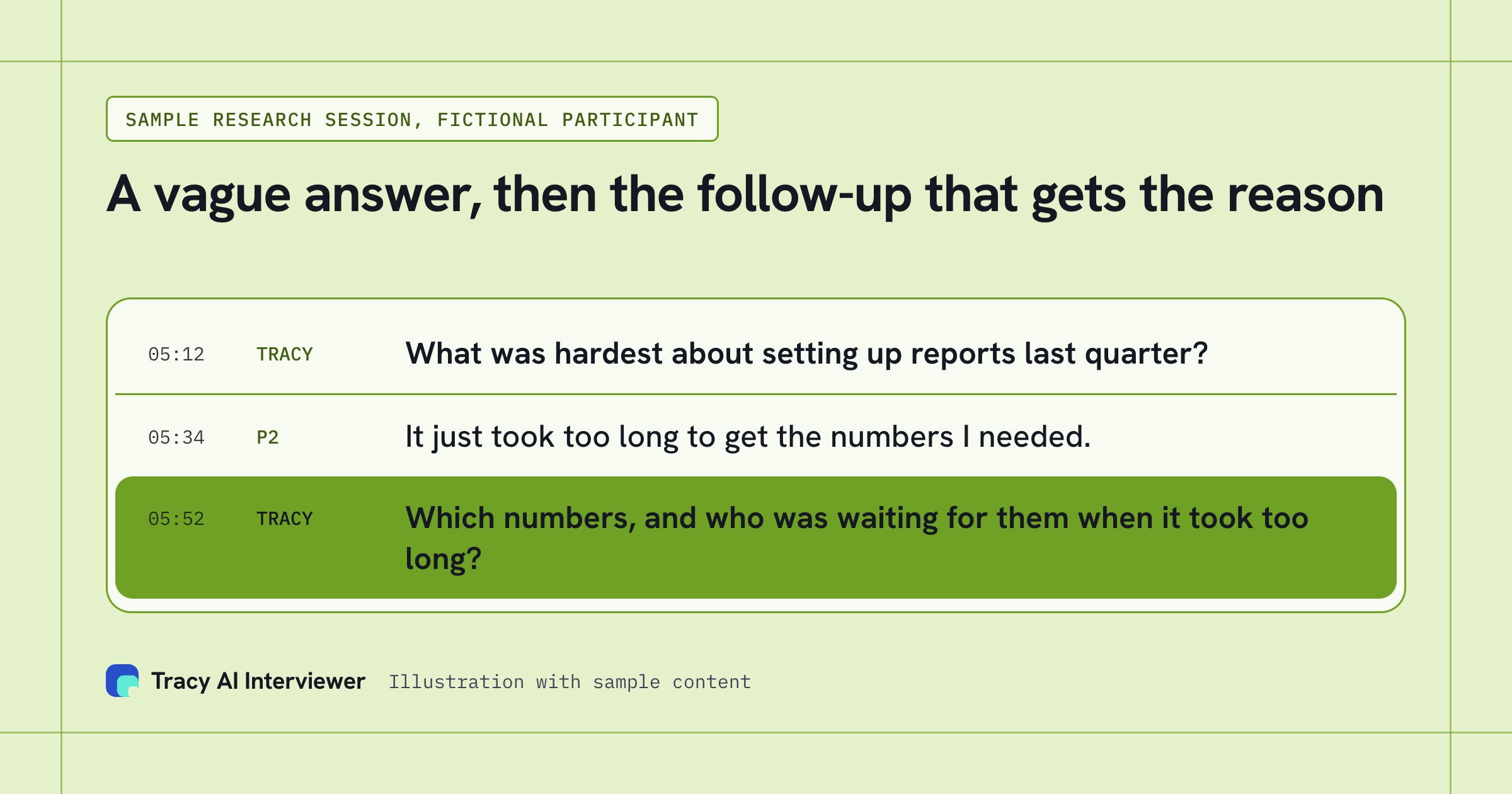
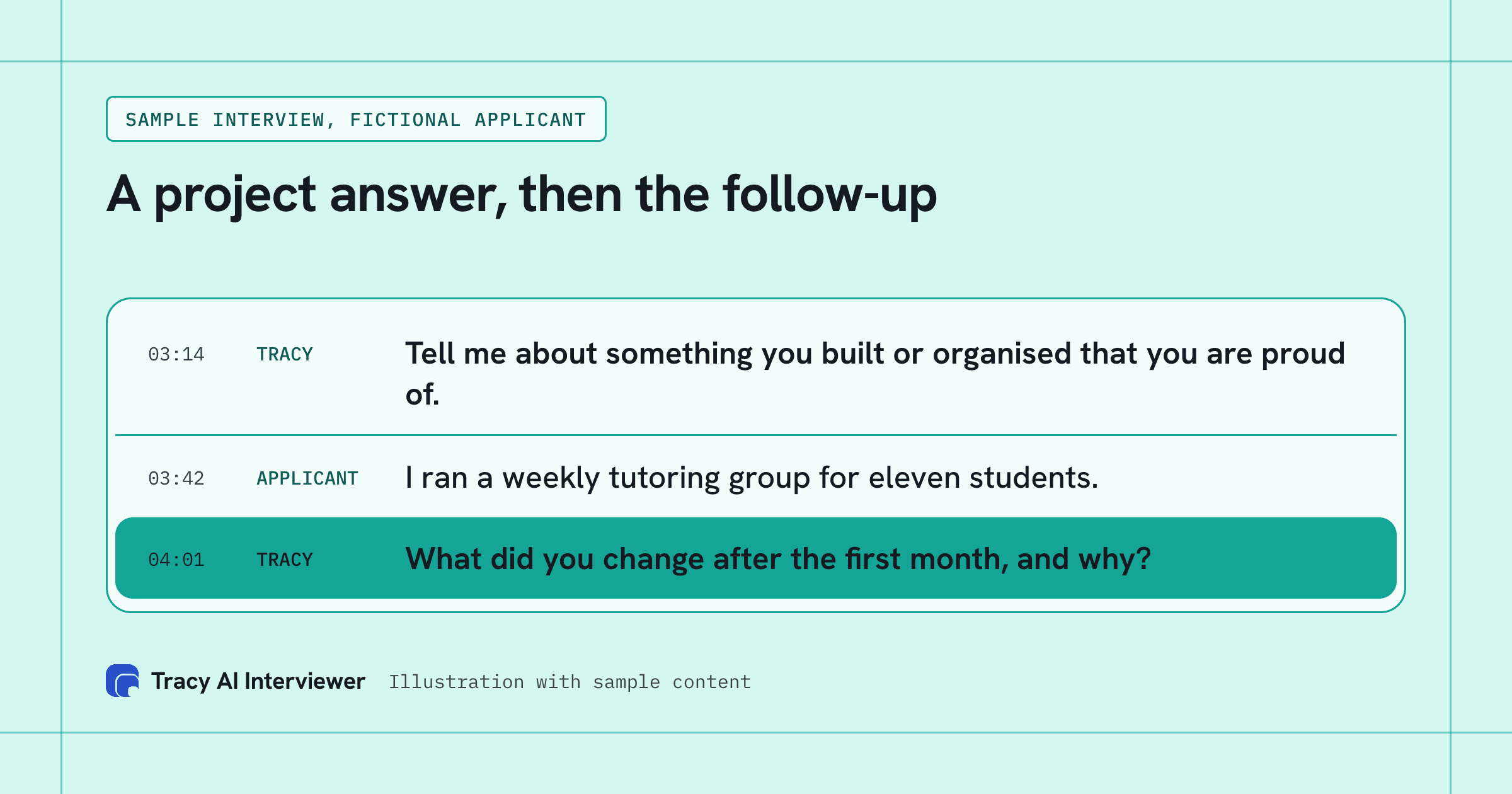
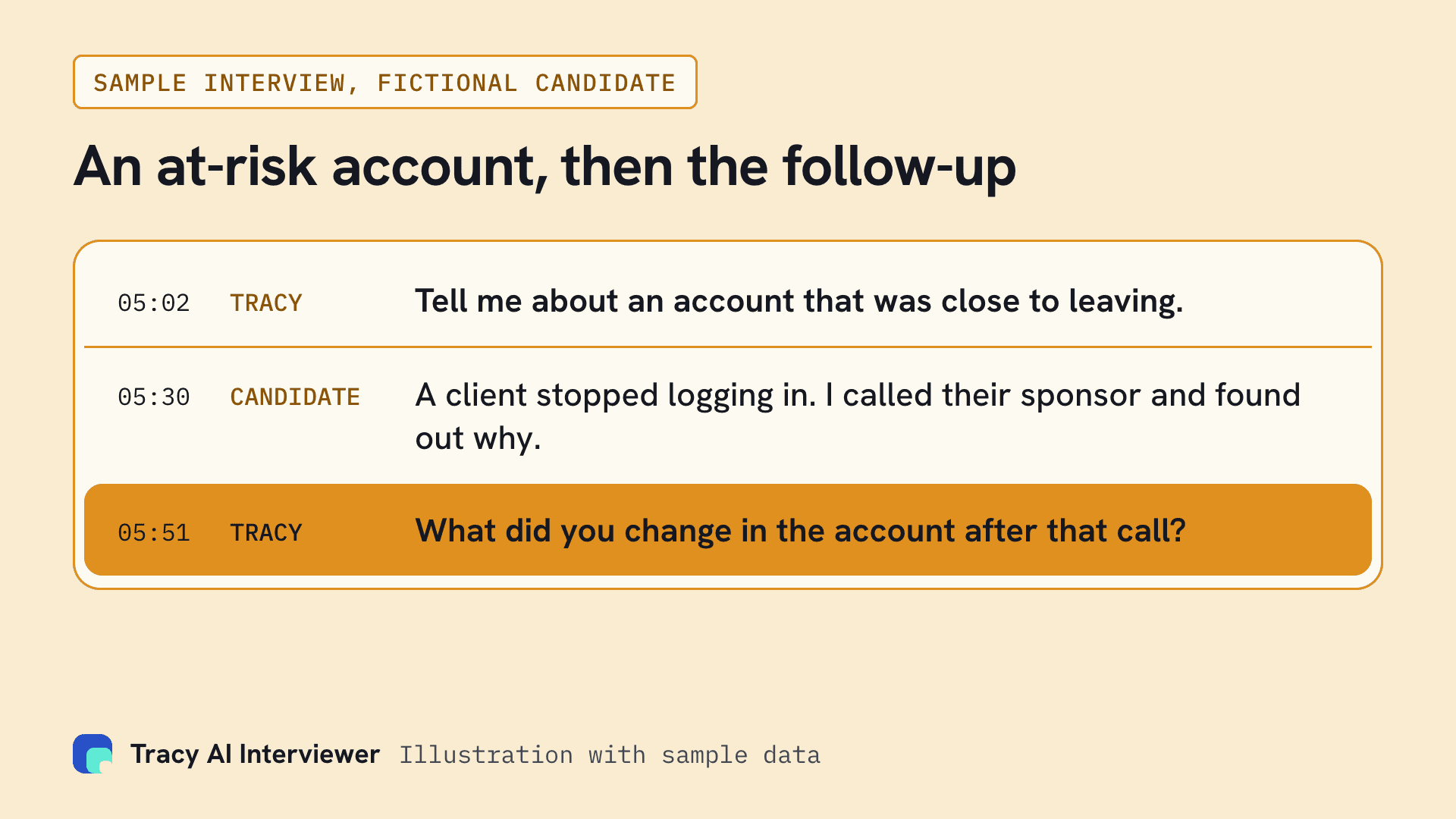
The follow-up turns a vague answer into a reason you can quote.
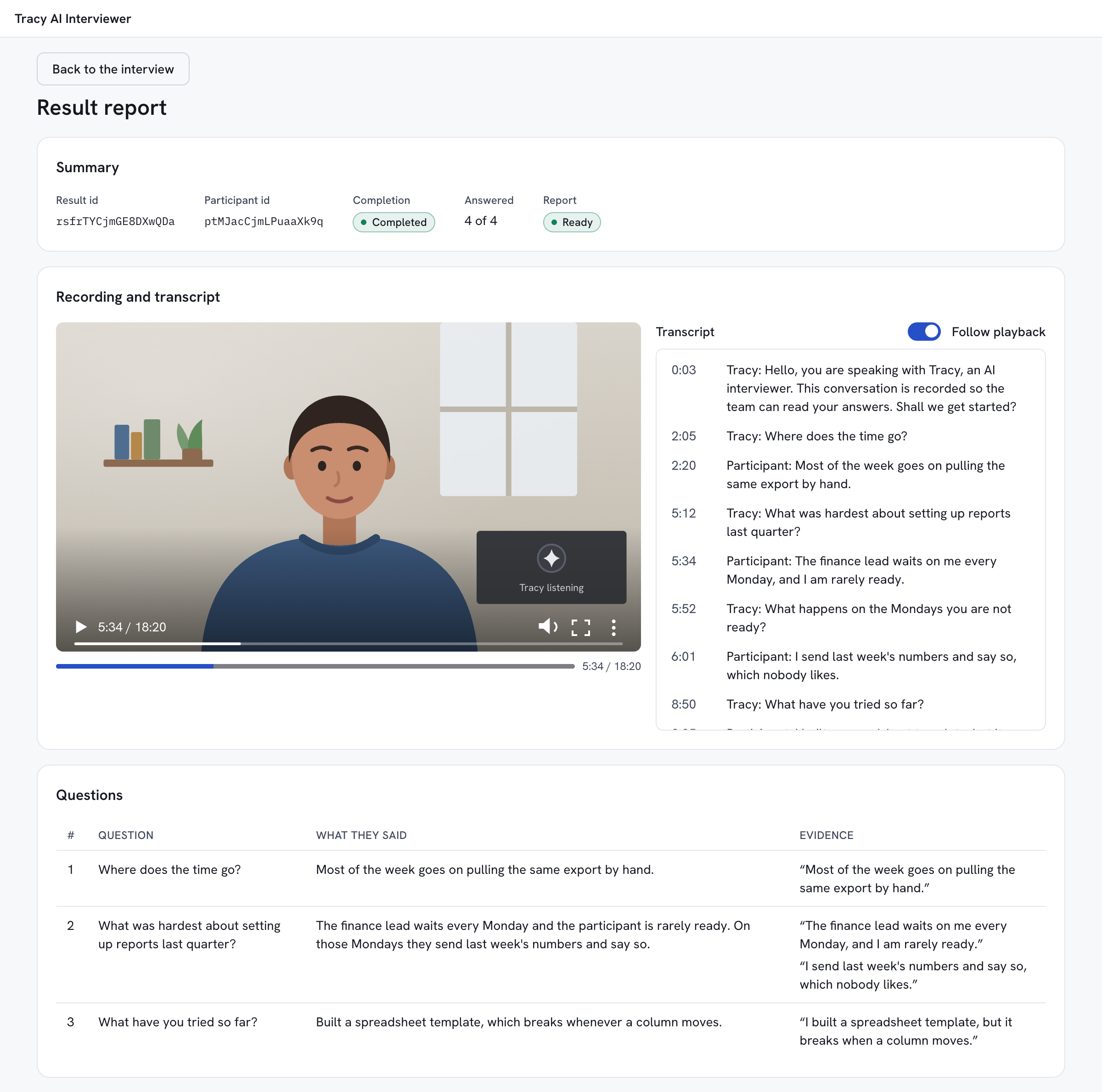
Each quote sits beside its timestamp in the transcript, next to the recording.
Which path fits you
- Discovery, concept tests and win-loss interviews: customer research.
- Check-ins and exit interviews: people teams.
- Cost before you start: pricing.
Common questions
How do you analyse interview transcripts?
What is the difference between a code and a theme?
Can AI do interview transcript analysis?
How many interviews do you need?
How do you write a good interview transcript summary?
Try Tracy on your next role
Tracy interviews every applicant, asks follow-up questions and sends you a ranked shortlist.
Try it free (opens in a new tab) Book a demo (opens in a new tab)
Your first 3 results are free. No card needed.
Sources
- Braun and Clarke (2006), Using thematic analysis in psychology, Qualitative Research in Psychology 3(2), 77-101, retrieved 9 Nov 2026.
- Tracy AI Interviewer home page, customer quote, retrieved 9 Nov 2026.
- Tracy AI Interviewer customer research use case, retrieved 9 Nov 2026.