In short
Customer discovery interview questions work when they ask about the last time something happened, and the ten below come with the follow-up to ask and what to listen for. Tracy AI Interviewer runs the same guide: customers join from one link with no calendar, and Tracy asks for the missing detail after a vague answer. Each finding links to the customer's words and the moment in the recording, and you decide what to build.
What customer discovery interview questions do well
Customer discovery interview questions find the real problem when they ask about the last time something happened. "Tell me about the last time you sent an invoice" gets a story. "Would you use an invoicing tool?" gets a polite yes. This page gives you ten questions with the follow-up to ask and what to listen for, a guide you can copy into any document, a filled example, and a script for the first and last minute. Method first? Read how to run customer interviews.
A guide holds the questions. It cannot ask them twenty times or notice which answer was thin, and that is the work Tracy takes.
What are good customer discovery interview questions?
Good questions ask about the past and the specific: the last time, the workaround, the cost, the other people involved. Jakob Nielsen of the Nielsen Norman Group wrote in 2010 that human memory is fallible and that people asked about typical behaviour often describe an idealised workflow, so a question about one recent, real event gets closer to what happened. Asking people to recall a particularly difficult or particularly good experience, he added, gives more vivid detail.
Two habits keep a guide honest. Ask about what people did, not what they would do. And ask for one story at a time, then follow up on it.
What does a customer discovery interview template look like?
Copy the structure into a document and write your own questions for each part. The example column is a fictional guide for freelancers who send invoices.
| Part | What it finds | Filled example |
|---|---|---|
| Context | The last real event, told as a story | Tell me about the last time you sent an invoice. |
| Today | The current workaround | How do you track who has paid you? |
| Pain | The hardest part, in one recent case | What is the hardest part of chasing a late payment? |
| Attempts | What was tried and dropped | What have you tried so far to get paid faster? |
| Cost | Time or money lost | How much was the last late invoice worth? |
| Close | What you missed | What should I have asked that I did not? |
Which ten questions should a discovery interview ask?
Use these in order. They move from the last real event to the cost of the problem to who else is involved, and end by asking what you missed. Reword the brackets for your market and keep the follow-ups.
1. Tell me about the last time you [did the job].
Follow up with: What did you do first? What happened next?
Listen for: The real steps, tools and people, not the tidy version.
2. How do you handle [the job] today?
Follow up with: Walk me through the last one.
Listen for: Workarounds, spreadsheets and manual steps that signal a gap.
3. What is the hardest part of that?
Follow up with: When did that last get in your way?
Listen for: One recent event with a cost attached.
4. What have you tried to fix it?
Follow up with: What happened, and why did you stop?
Listen for: Tools bought and dropped, and the reason each failed.
5. What did that cost you in time or money?
Follow up with: How did you work that out?
Listen for: A number, or a named consequence.
6. Who else is involved when this happens?
Follow up with: What does each of them care about?
Listen for: The buying group and who can say no.
7. Where does this sit among the things on your plate this month?
Follow up with: What is above it?
Listen for: A priority, as opposed to a complaint.
8. What would have to be true for you to change how you do this?
Follow up with: What has stopped you so far?
Listen for: Switching cost and the real trigger.
9. Who else should I talk to?
Follow up with: Would you introduce me?
Listen for: A name and a commitment.
10. What should I have asked that I did not?
Follow up with: Why does that matter?
Listen for: The thing you did not know to ask.
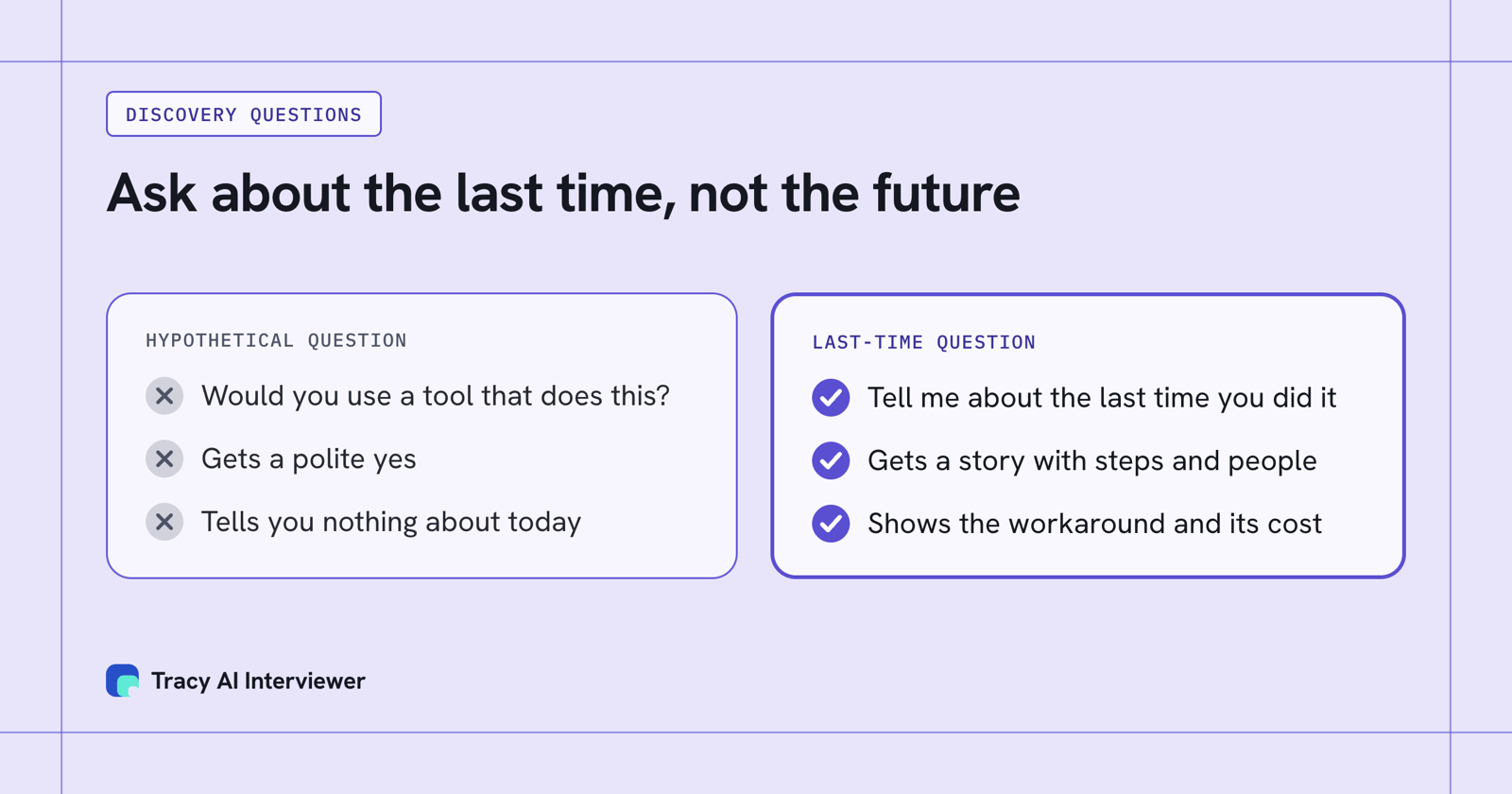
A question about the last time something happened gets a story, while a question about the future gets a polite opinion.
What do you ask after a vague answer?
Vague answers are normal. The follow-up turns each one into an example you can use.
| They say | Ask next | Why it helps |
|---|---|---|
| It is fine, I guess. | Tell me about the last time it was not fine. | Swaps a mood for an event. |
| We would probably use that. | When did you last look for something like it? | Past action says more than a forecast. |
| It depends. | Take the last time. What did it depend on? | Pins the answer to one case. |
| Everyone has that problem. | What happened to you, the last time? | Moves from everyone to one person. |
| I would pay for that. | What do you pay for today that does this? | Shows spend that already exists. |
What a list of questions cannot do alone
The table above helps only if someone asks the follow-up every time. A blank guide does not hold the moment a customer says "it got fiddly" and the next question has to be about the last time it happened. Say you run twenty calls of 20 minutes: that is about 7 hours of live calls,. Tracy asks it on every interview, so your hours go to reading across what customers said.
What should a customer interview script say?
Open with the purpose, permission to record and a promise not to sell. Close by asking what you missed and who to talk to next.
Opening. Thanks for making time. I am trying to understand how people handle [the job]. I am not selling anything, there are no right answers, and you can skip any question. Can I record so I can listen instead of typing?
Closing. That is everything I wanted to ask. What should I have asked? Who else would you suggest I talk to? Thank you. I will share what I learn.
When Tracy runs the interview, the join screen tells each customer that the conversation is recorded and transcribed, so the permission is built in.
How does Tracy run a customer discovery guide?
Describe what you want to learn and Tracy drafts the interview guide, or paste the questions above and edit them (how interview guides are set up). You send one link. When an answer is thin, Tracy asks for the last time it happened (how to write questions an AI can follow up on). Each interview ends with a recording of both sides, a timestamped transcript and what the customer said to each question, and each finding links back to the words and the moment in the recording (how reports read). The customer research page shows the whole flow.
Paste the ten questions into a new interview and send the link to five customers.
What Tracy adds to customer discovery
Three things change when the interview moves from you to Tracy.
01
Reach every customer
Each customer can start on click, at any hour, with no scheduling and nobody from your team on the call. The same first round reaches the whole list.
02
Ask the next question
Tracy follows the answer in the person's own field and waits for the end of the thought. A polished headline has to survive a specific follow-up.
03
Keep the evidence
Every interview has a recording, a timestamped transcript and what the customer said to each question, and each finding links back to the moment.
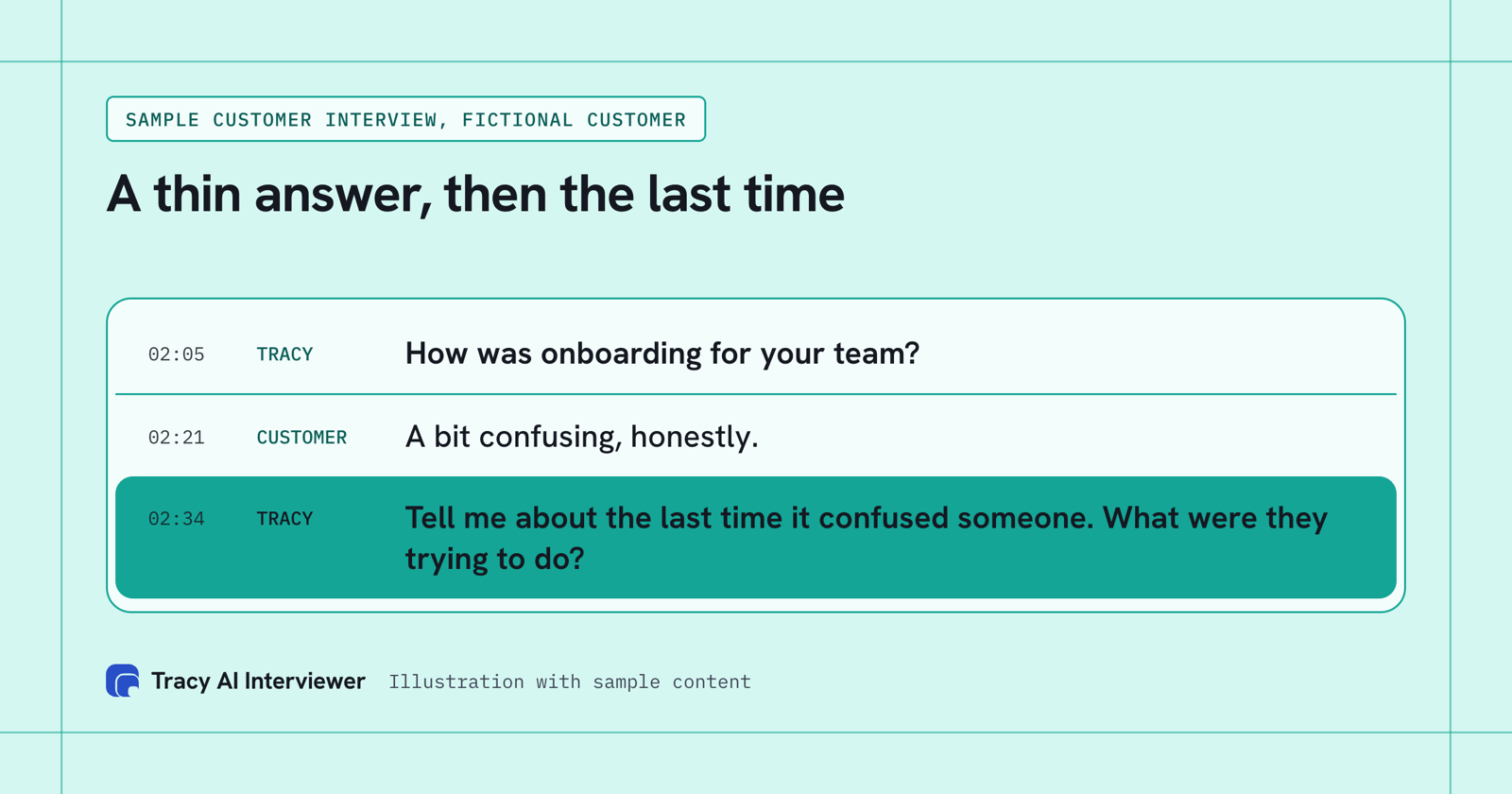
Tracy follows a thin answer with a question about the last time it happened, and each line is timestamped.
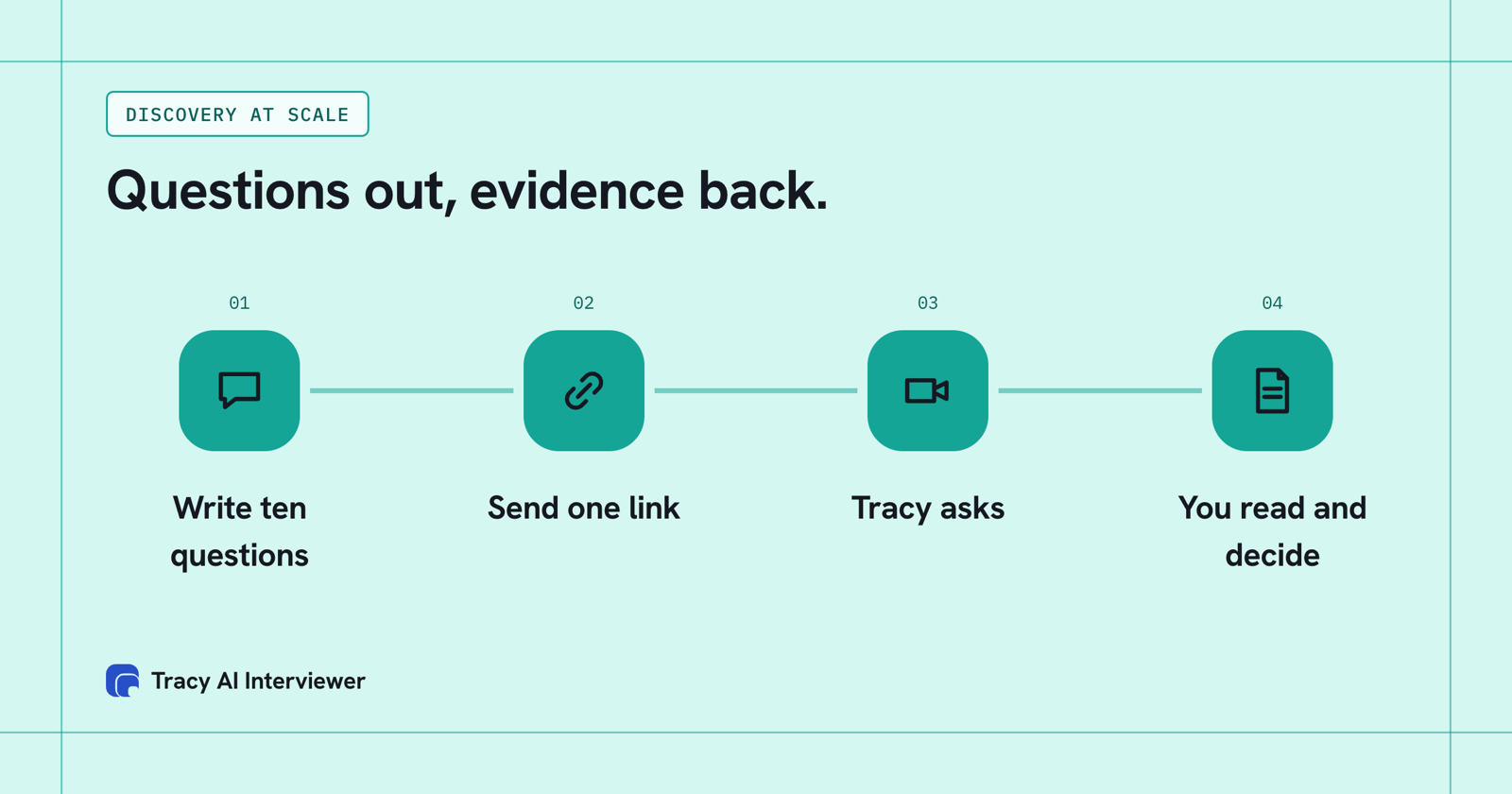
You write the questions, Tracy asks them, you read the evidence.
What mistakes spoil discovery interviews?
- Pitching. Once you describe your idea, people react to it politely. Describe the problem instead.
- Leading questions. "Would a faster export help?" invites a yes. Ask what they do after the export.
- Solving too early. If you are designing in your head, you have stopped listening.
- Counting compliments. A kind word is not a commitment. Look for time, money or an introduction.
The Mom Test, a book by Rob Fitzpatrick on talking to customers without collecting biased feedback, is a good next read. For notes, a plain interview notes template keeps quotes next to the question that produced them.
Which path fits you
- Turning the ten questions into a reusable guide: the interview guide template.
- Running them across a list of customers from one link: customer research with Tracy.
- Cost before you start: Tracy's pricing.
Common questions
What is a customer discovery interview?
What are customer development interview questions?
How many questions should a discovery interview have?
What is a customer interview script?
Can an AI interviewer run customer discovery interviews?
Run these questions with Tracy
Paste the ten questions into a Tracy interview and send one link. The first 3 results are free.
Try it free (opens in a new tab) Book a demo (opens in a new tab)
Your first 3 results are free. No card needed.
Sources
- Jakob Nielsen, Interviewing Users, Nielsen Norman Group, retrieved 14 Nov 2026.
- Tracy AI Interviewer: Customer research, retrieved 9 Nov 2026.
- Tracy AI Interviewer: Pricing, retrieved 11 Nov 2026.