In short
Tracy AI Interviewer interviews every buyer from one link, asks the follow-up when the answer is "price", and ties each finding to the buyer's words and the moment in the recording. Win loss analysis is strong because it asks buyers, where a CRM reason is a short list a seller picks from. Your team reads the findings and decides what changes.
Win loss analysis works best when buyers explain the decision themselves. The CRM says "lost on price"; the buyer, asked to walk through how the decision was made, can describe something else: nobody owned the rollout, a second team preferred another tool, a trial stalled.
The method needs a buyer who keeps talking past the first answer, and a person to ask for the missing detail every time. Tracy does that part from one link, so you do not book twenty buyer calls yourself, and each finding links to the buyer's words and the moment in the recording.
What win-loss analysis does well
Win-loss analysis is the practice of examining closed deals, wins, losses and no decisions, to learn why buyers chose a vendor or did not, according to Corporate Visions (Mar 2026). Its strength is the source. Forrester's analysts (Dec 2025) put the dependency plainly: win/loss analysis without buyer input is guesswork, because only the buyers can reveal the real drivers behind purchase decisions. A CRM field is usually a short list a seller picks from. An interview records what the buyer says in their own words.
The method then needs interviews at the buyer's pace and someone to ask the second question every time. That is the gap Tracy fills.
How do you interview buyers about a win or a loss?
Forrester (Dec 2025) suggests post-deal interviews of 15 to 30 minutes with buyers from both won and lost deals, focused on strategic or high-value deals, with open-ended questions, an incentive and a third party for objectivity. Here is a way to start:
- Pick the deals. Take last quarter's closed deals: lost, won and no decision. A mix shows what you did right as well as wrong.
- Pick the person. Ask someone who sat in the decision, not only the contact who liked you. If two people were involved, ask both.
- Keep the seller out of the call. A buyer may criticise a process more freely when the person who ran it is not listening.
- Ask open questions about what happened. "Walk me through how the decision was made" beats "Why did you not pick us?"
- Follow up on every short answer. The first answer is usually the easy one.
- Write the reason in the buyer's words, and keep the quote with it.
For the general method, see how to run customer interviews.
What does a win-loss interview template look like?
Copy the table into a document. Start with six questions; add one about the product only after the buyer has told the story.
| Step | Question | Follow up with | What it finds |
|---|---|---|---|
| Start | Walk me through how you made the decision. | Who was involved at each step? | The real process and the real people. |
| Trigger | What made you start looking? | What happened the week before? | The event that opened the deal. |
| Options | Which other options did you look at? | What did each do better than the others? | The real alternatives, including doing nothing. |
| Turning point | When did you know which way it would go? | What was said or shown that day? | The moment the deal moved. |
| Doubt | What nearly changed your mind? | What would have had to be different? | The objection that was never raised. |
| Close | What should we have asked that we did not? | Why does that matter? | The thing you did not know to ask. |
Scroll the table sideways to see all 4 columns.
How do you get past "it was the price"?
Price is an easy answer to give someone you do not know, and it ends the conversation. Treat it as the start. Ask what the buyer compared it with, who raised the number internally and what they would have paid for if the price had been the same. If the reason changes after two follow-ups, the CRM entry held a summary and the follow-ups found the cause.
That follow-up is where an interview earns its time, and it is the step a form or a short survey cannot take. Twenty buyer calls of 15 to 30 minutes are 5 to 10 hours on the call before any booking or write-up, which is why teams ask the follow-up of a few buyers and skip the rest. Jakob Nielsen of the Nielsen Norman Group wrote in 2010 that people asked leading questions or pressed for answers can produce opinions that do not reflect what they would do, so ask about events, not verdicts: "what happened next" rather than "was it too expensive?"
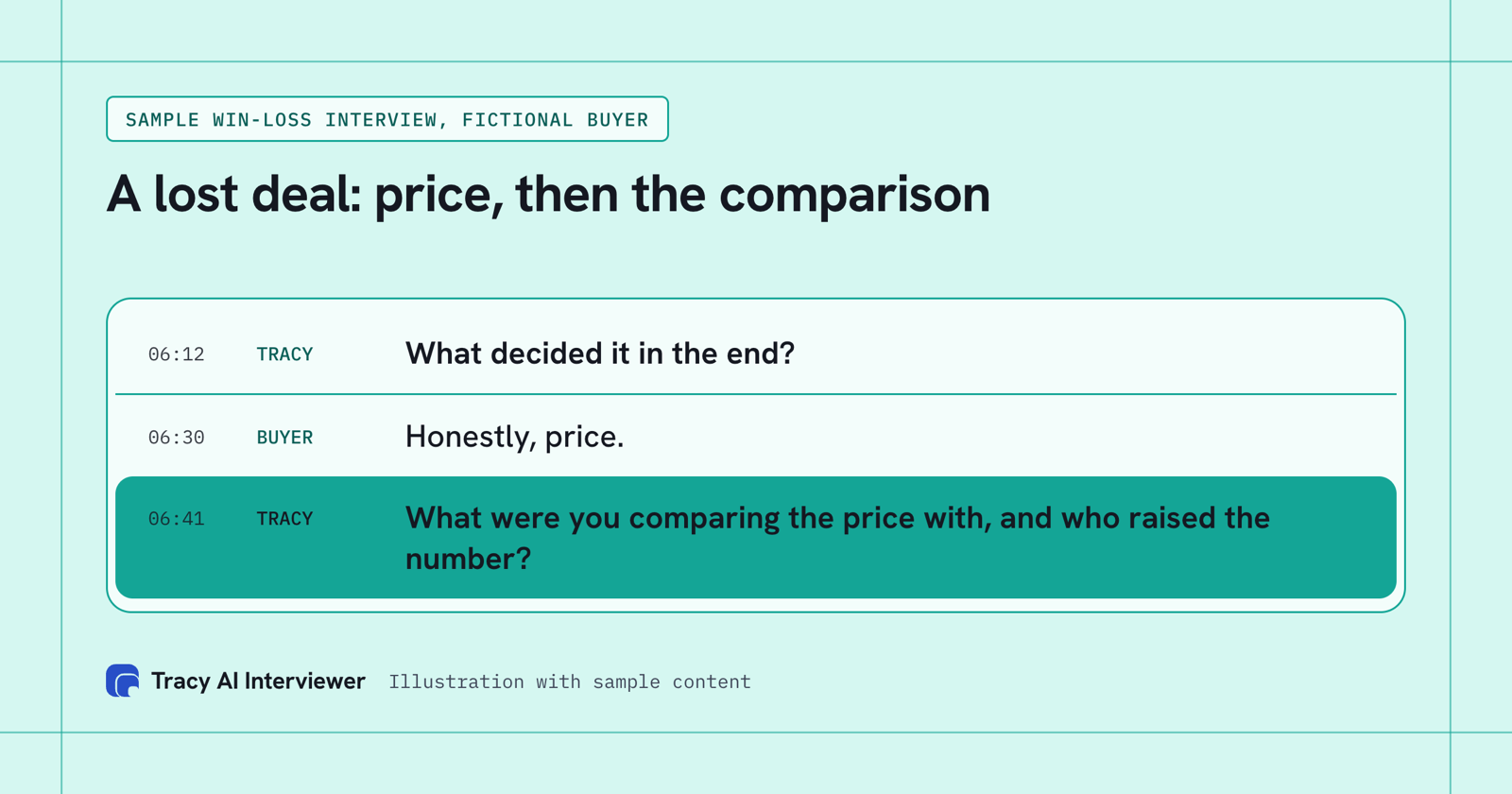
A buyer's first answer is often price, and one follow-up asks what the price was compared with.
What Tracy adds to win-loss interviews
01 Reach every buyer
Each buyer gets one link and joins in the browser when it suits them, with no account, no calendar and no salesperson on the call. Won, lost and no-decision buyers all get asked.
02 Ask the next question
When the answer is "price", Tracy asks what it was compared with and waits. The first answer stops being the last one.
03 Keep the evidence
Each interview gives you a recording of both sides, a timestamped transcript and what the buyer said to each question. Each finding links back to the words and the moment, so a doubter can listen.
What do you do with the answers?
Read the first three interviews slowly and write each reason in the buyer's words. Then group the reasons that repeat and count how many buyers gave each. Keep a quote and its timestamp beside every group, so a product lead who doubts a finding can listen to the moment. Compare each group with the CRM reason for the same deals: where they differ, look into why: the CRM entry may be a summary, and the interview may be one buyer's view.
Send each team what it can act on: product gets the missing capability, sales gets the moment the deal turned, marketing gets the words buyers used. Interview transcript analysis covers turning recordings into themes, and AI interview summaries shows what a short write-up with quotes looks like.
How do you set up win-loss interviews in Tracy?
Write your questions or describe what you want to learn and Tracy drafts the interview guide (how guides are set up). Send one link to each buyer; the join screen tells them the conversation is recorded and transcribed. See how reports read for what comes back.
The customer research page lists win-loss next to discovery calls and concept tests. If you are choosing between tools, the platform shortlist compares how each runs interviews.
Take last quarter's lost deals, put the six questions into a new interview and send ten buyers the link.
Which path fits you
- Still writing the questions: customer discovery interview questions.
- Ready to run buyer interviews from one link: customer research with Tracy.
- Cost before you start: Tracy's pricing.
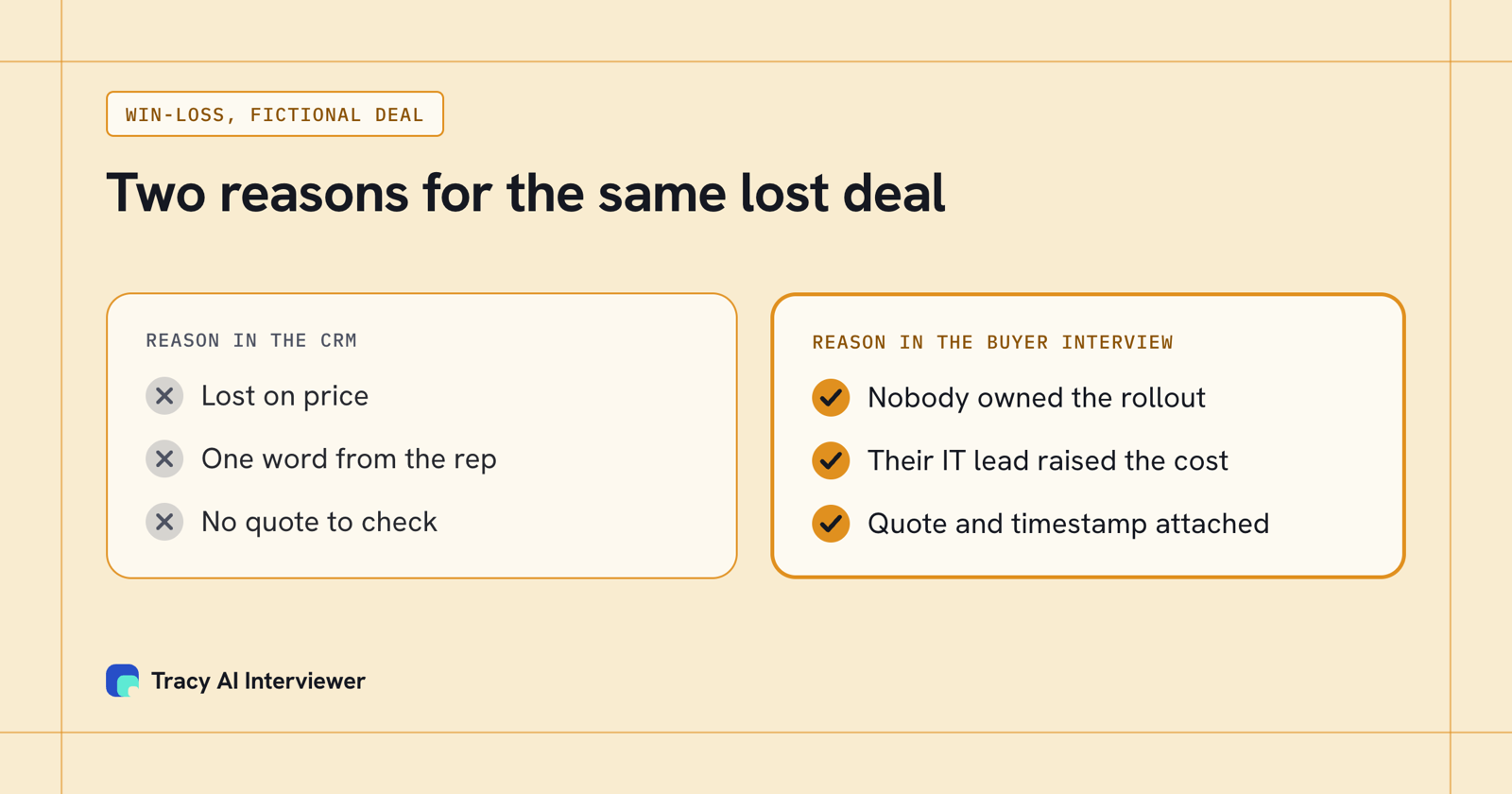
The reason in the CRM is a summary the seller chose, and the interview gives the story behind it.
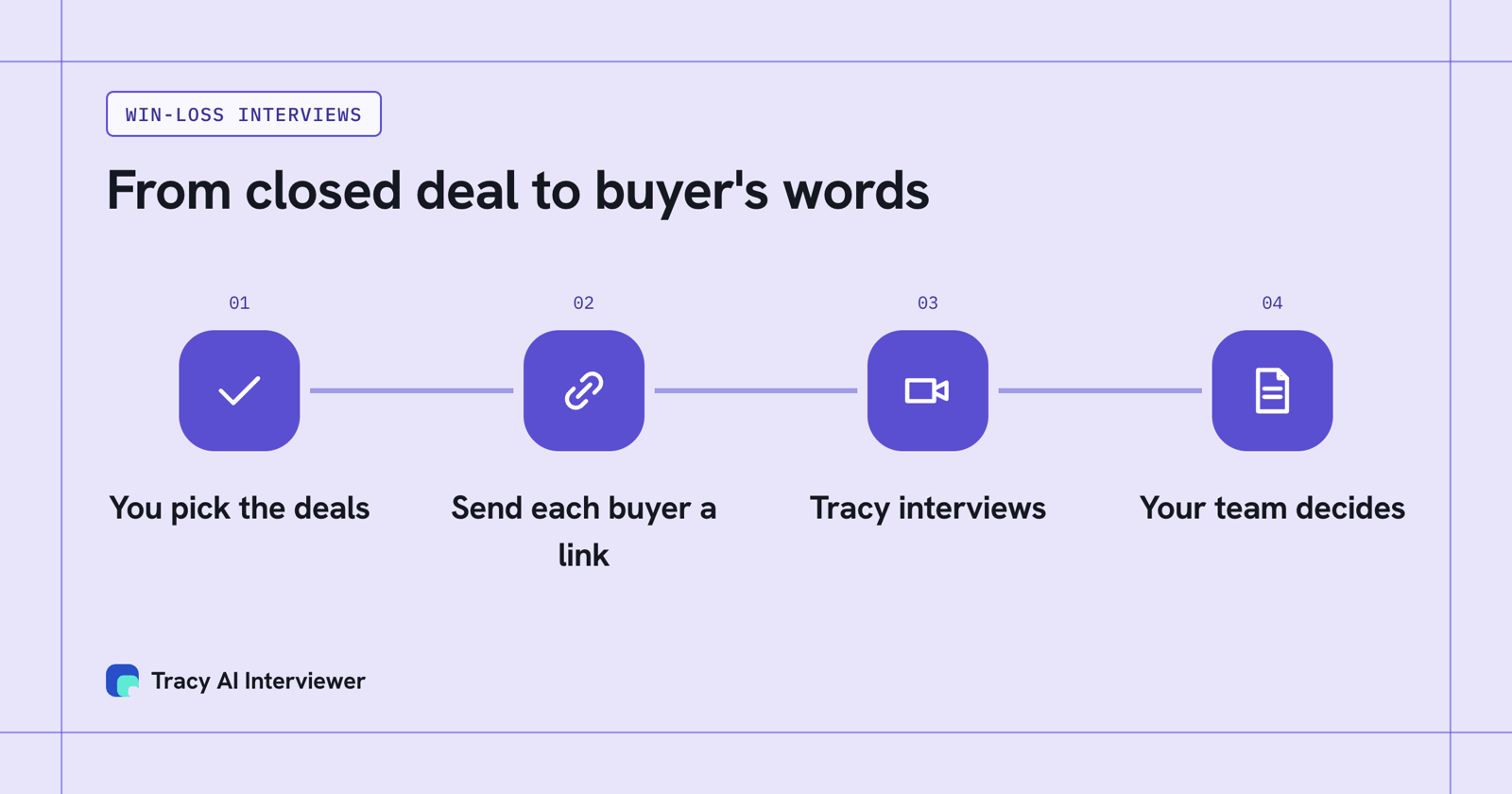
You choose the deals and read the findings; Tracy holds the buyer conversations in between.
Common questions
What is win loss analysis?
What is a win loss analysis template?
What is a win loss analysis example?
Who should run win-loss interviews?
How long should a win-loss interview be?
Run one win-loss interview
Use your own questions, send ten buyers one link and read the findings. The first 3 results are free.
Try it free (opens in a new tab) Book a demo (opens in a new tab)
Your first 3 results are free. No card needed.
Sources
- Forrester, Your Secret Weapon For Your Win/Loss Program (5 Dec 2025), retrieved 14 Nov 2026.
- Corporate Visions, What Is Win-Loss Analysis (16 Mar 2026), retrieved 14 Nov 2026.
- Jakob Nielsen, Interviewing Users, Nielsen Norman Group, retrieved 14 Nov 2026.
- Tracy AI Interviewer: Customer research, retrieved 9 Nov 2026.