In short
ChatGPT for market research is strong on the desk work: framing the question, scanning sources you approve and drafting screeners. It does not ask your customers anything. Tracy AI Interviewer joins the same chat and interviews each customer on video, following up in their own field. Every result links to their words and the recording, and your team decides what the round means.
What ChatGPT for market research does well
ChatGPT does the reading and the structuring: it frames the question, plans a source scan, summarises what you give it and drafts the instruments you will use with people.
- Frame the question. A vague "what is the market for X" becomes a decision, a segment and a list of what would change your mind.
- Scan sources. With deep research, ChatGPT lets you curate and approve sources before it starts and says it prioritises those over general web results. You review its plan, adjust the scope, and can stop or redirect it. OpenAI describes the output as 30-minute reports you can share or download as PDF or DOCX. The feature page lists no plans, so check yours.
- Read your own files. Upload survey exports and old interview notes and ask for themes. File uploads are limited on the Free plan and included in Go, Plus and Pro, and projects are in all four plans, so one study's files and instructions can live together.
- Draft instruments. Screeners, discussion guides, survey wording.
- Code open-ended answers. A first pass at themes that you then check against the raw text.
It cannot vouch for its own numbers, so treat every figure it returns as a lead until you have opened the source. And none of it comes from your customers.
Which ChatGPT prompts work for market research?
Prompts that name the decision, the audience and the output format beat prompts that name a topic. Six to start from. Swap the brackets, and do the check under each one.
- Frame the decision. "I am deciding whether to [decision]. List the three questions whose answers would change that decision, and the evidence that would answer each." Check: keep only the questions you can tie to a source or a person.
- Plan the desk scan. "Draft a research plan to answer [question] for [segment] in [region]. Name the source types to check, such as analyst reports, public filings, pricing pages, job posts and reviews, and what each can and cannot show." Check: approve the plan and the sources before the run starts.
- Map competitors from public pages. "From these pages [paste text], build a table of plans, prices and stated target customer. Write 'not stated' where a page is silent." Check: open every page, because prices change.
- Write the screener. "Write five screener questions to find [customers who did X in the last Y months]. Add one question that would catch someone who did not." Check: run it on a colleague first.
- Draft the discussion guide. "Write a guide for 20-minute interviews with [segment] about the last time they [did the job]. Ask about behaviour, not opinions, and add one follow-up for each question." Check: this is the guide you carry into the interview below.
- Code what people said. "Here are [N] open-ended answers. Group them into themes, give the shortest supporting quote for each, and list the answers that fit no theme." Check: read the unmatched list first, because that is where the surprises are.
Where desk research stops, and who asks why
A desk scan tells you who sells what, at what price, with what claims. It cannot tell you why your last customers chose, stayed or cancelled, because nobody published that.
The desk scan shows what the market publishes. Only your customers can tell you why they left, and Tracy asks them for you.
Nielsen Norman Group's guidance on interviewing users makes the point about people: asked about typical behaviour, they often describe an idealised workflow, and asked to recall a particular difficult or good experience they give more vivid detail. So the question for primary research is "tell me about the last time you...", followed by whatever the answer leaves out. A survey cannot ask that second question; an interview can. A guide to running customer interviews covers how to word the first one.
The cost is hours. A hundred 20-minute interviews run by a person are about 33 hours of live calls, before anyone books a slot. With Tracy, each customer starts from one link at any hour, so you spend those 33 hours reading results.
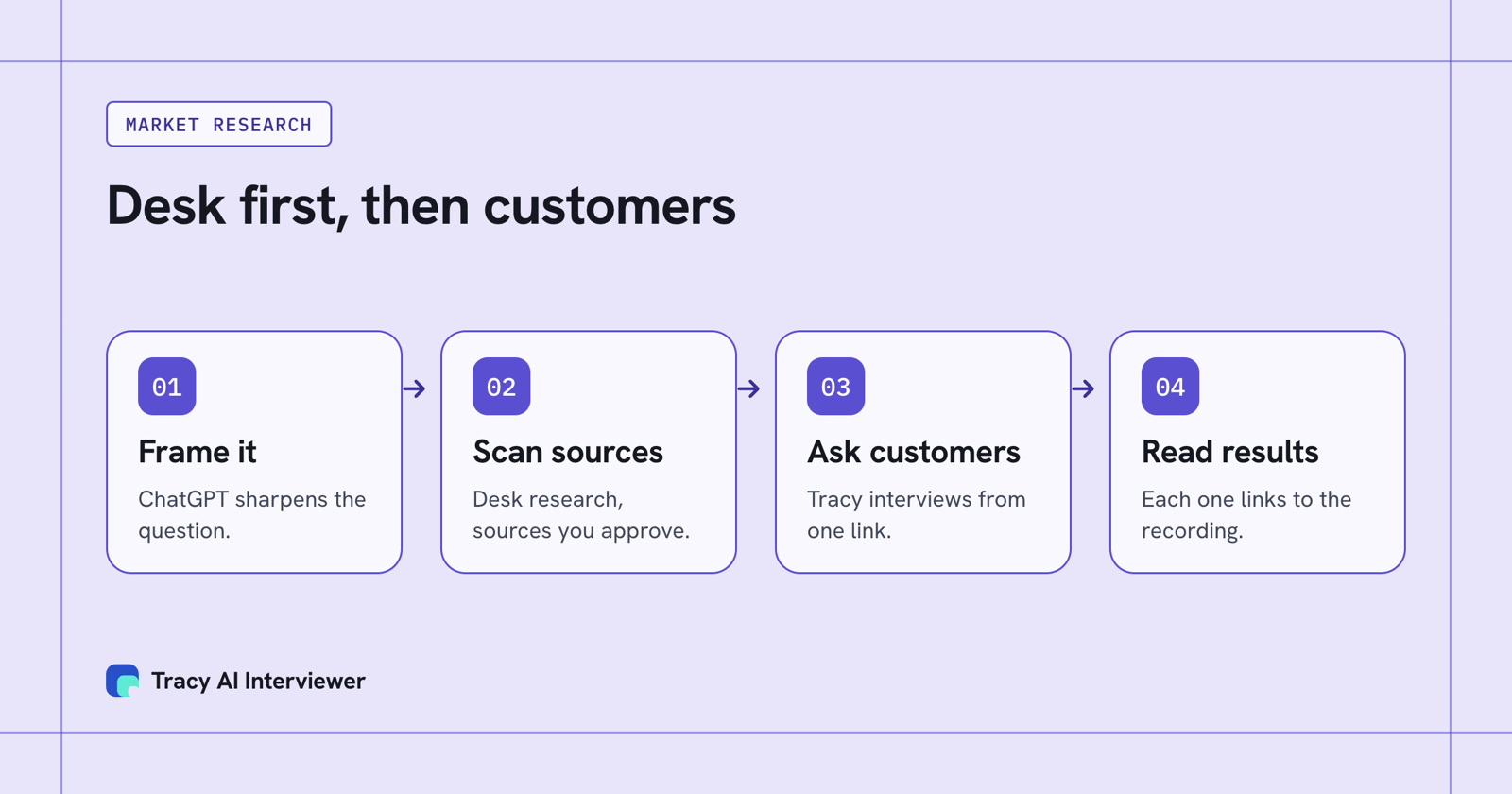
ChatGPT scans the desk, Tracy interviews the customers, and every result links to the recording.
What Tracy adds to ChatGPT market research
- Reach every customer you invite. Each person starts on click, at any hour, with no scheduling and no researcher on the call. Your sample stops depending on calendars.
- Ask the next question. Tracy follows the answer in the customer's own field and waits for it. "It depends" becomes the last time it happened.
- Keep the evidence. Each result has a recording, a timestamped transcript and a written assessment per question with its reasoning, so you can quote a customer and open the moment.
At scale this holds: 100K+ interviews delivered, with a reported 99% completion rate.
How do you run customer interviews from ChatGPT?
Add Tracy AI Interviewer to ChatGPT once: open it in ChatGPT's Plugins, click Install plugin, finish the Tracy sign-in and click Allow. On a work or school workspace, an admin may need to allow custom plugins first, because your workspace permissions apply. If you do not see the option to add a custom MCP server, check your plan and your ChatGPT settings for Developer mode. The setup walkthrough has every step, and a short explainer on MCP servers covers the term. Then, in a new chat, type @, pick Tracy AI Interviewer and paste your guide from prompt 5, or start from Tracy's own example: "Use Tracy AI Interviewer to set up a customer discovery interview for people who cancelled in the last month, then give me the public link."
- Read the preview. ChatGPT shows the interview as a preview: an opening, each question and the report field it fills. Nothing exists yet.
- Approve it. Approving creates the interview. Nobody is invited until you approve an invitation preview as well.
- Choose who gets it. Invite customers by email from the list you hold, or share the public link. A new interview starts with the link on (anyone with the link can join, up to 20 people for 14 days) and nobody invited, and you can turn the link off in chat.
- Customers join when it suits them. One link, in a browser, at any hour, with no account. The join screen tells them the conversation is recorded and transcribed.
- Ask for the results. "Who has finished?" gets you the results in the chat: what each customer said to each question and the result fields. In Tracy you also get the recording of both sides and a timestamped transcript.
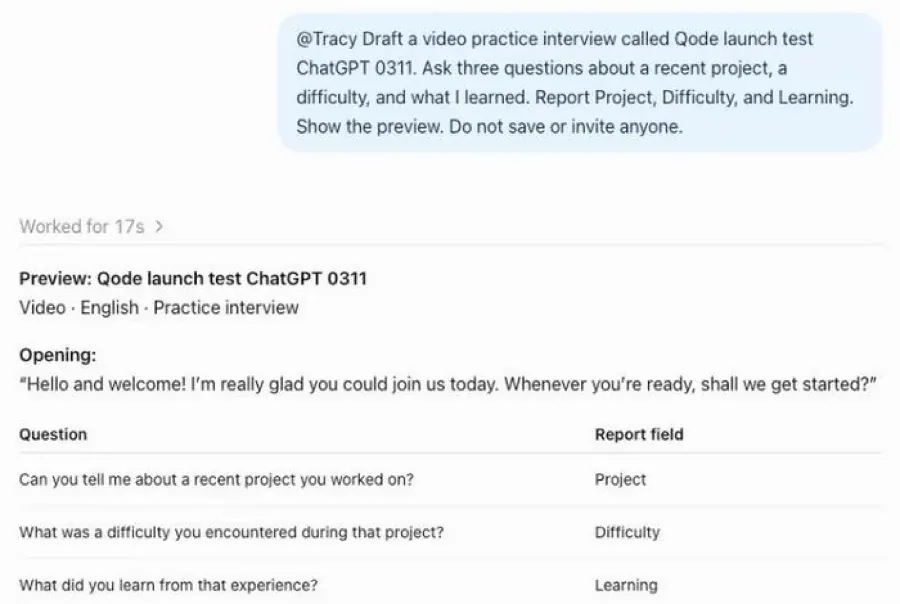
ChatGPT shows the drafted interview as a preview before anything is created.
What the evidence looks like
Tracy listens, waits for the end of the thought and asks for the missing detail in the customer's own field: after "it depends" it asks for the last time it happened. Every customer gets the same guide, so answers compare across the round.
Each result links back to the words and the moment in the recording, which means you can quote a customer exactly and check what they meant. Reading across interviews shows how to compare them.
Tracy reports what each customer said, with the evidence. It does not score or rank customers, and a person decides what the round means.
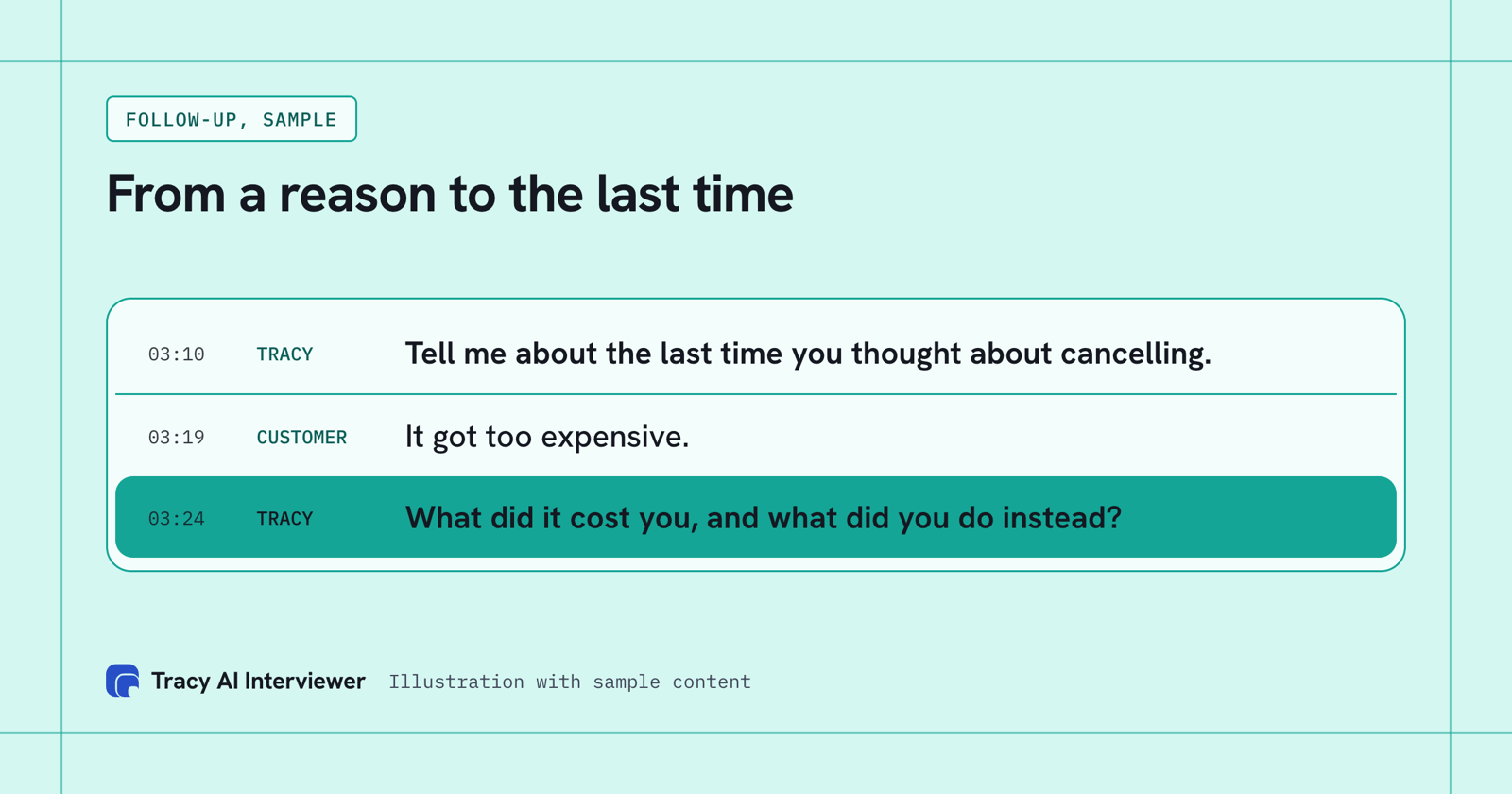
A stated reason becomes a specific event once Tracy asks about the last time.
What stays with you?
- Who to ask. Tracy invites the people you supply; it does not look up or collect addresses.
- What to ask. Your questions, or a draft you edit. The guide decides what you learn.
- What it means. Tracy gives the evidence. You decide what the round says about the market.
- Your own checks. Treat any figure from the desk scan as unverified until you have opened its source.
Start small: one segment, one question, a first batch you read before you add more. At $1 per credit and one credit per started 20 minutes, ten 20-minute interviews cost $10, and the first 3 results are free; the pricing page has the current plan. A set of discovery questions is a good place to start.
Which path fits you?
- Prefer Claude: Claude for market research.
- Installing Tracy in ChatGPT: the step-by-step guide.
- The whole flow in one place: customer research use case.
- Checking cost first: the pricing page.
Common questions
Can ChatGPT do market research?
What is a good ChatGPT prompt for market research?
How accurate is ChatGPT for market research?
Can ChatGPT interview customers?
Does Tracy find the customers to interview?
Run one customer interview from ChatGPT
Connect Tracy, approve one preview and send customers a link. You read what they said. The first 3 results are free.
Try it free (opens in a new tab) Book a demo (opens in a new tab)
Your first 3 results are free. No card needed.
Sources
- ChatGPT deep research, retrieved 14 Nov 2026.
- ChatGPT pricing, retrieved 14 Nov 2026.
- Nielsen Norman Group: Interviewing Users (Nielsen, 25 July 2010), retrieved 14 Nov 2026.
- Tracy AI Interviewer: ChatGPT guide, retrieved 14 Nov 2026.
- Tracy AI Interviewer: Pricing, retrieved 11 Nov 2026.