In short
Neither assistant is better for market research as a whole. ChatGPT shows you an editable research plan before it starts; Claude is the one to pick when the work ends in spreadsheets, charts or slide files.
Both read what already exists. Tracy AI Interviewer connects to either chat and interviews your customers on video, following each vague answer up and linking every finding to the recording.
Use an assistant for the desk work and Tracy for the why. Start with one segment: the first 3 results are free.
Which is better for market research, ChatGPT or Claude?
It depends on the step. For planning a study, ChatGPT's deep research lets you edit the plan before it starts. For analysis that ends in a file, Claude writes and runs code on your data and builds the spreadsheet or deck. On the rest the two are close enough that your existing subscription, and where your files already live, should decide.
The comparison below follows the order of a study instead of a feature list. It states what Anthropic and OpenAI say on their own help pages and does not rank the two outputs; a fair ranking needs your own question and your own files.
What OpenAI's and Anthropic's own pages state, read on 22 and 23 November 2026.
| Study step | ChatGPT | Claude |
|---|---|---|
| Plan the study | Deep research shows an editable plan before it starts | Research decides its next search from what it finds |
| Scan the market | Web, chosen domains or your files, with source links | Web plus connected tools such as Google Workspace; paid plans |
| Analyse survey data | Upload a spreadsheet to explore trends or make charts | Writes and runs Python on CSV files and makes PNG charts |
| Read interviews | Projects keep a study's files and instructions together | Cowork lists themes from interviews as an example task |
| Write it up | Work builds documents, decks and sheets on eligible paid plans | Creates .xlsx, .pptx, .docx and PDF files up to 30 MB |
Where each one earns its place
ChatGPT first. OpenAI describes deep research as drawing on uploaded files, the web or chosen domains and eligible connected apps, with citations or source links, and with a plan you can edit before it starts. That plan step matters on a research brief, because a bad scope costs a whole run. Longer jobs that end in a document, presentation or spreadsheet go to Work, which OpenAI describes as an agent for multi-step work with a finished deliverable. Work is on eligible paid plans, and longer tasks count toward your usage limits.
Claude second. Anthropic says Research runs several searches that build on each other and decides what to look into next, and that it can use connected tools such as Google Workspace. Research sessions can use up your limits faster than ordinary chats. On a survey export, the useful detail is code execution: Claude can process CSV and TSV files, make PNG charts and create .xlsx, .pptx, .docx and PDF files on every plan. Anthropic warns that instructions hidden in external files or websites can steer the model, so check what it produced against the raw data, whichever tool you use.
For the details of research modes and file limits, Claude vs ChatGPT for research goes deeper; the Claude-only version of this job is in Claude for research.
What does a market research prompt look like in each?
Same study, two openings. Each puts the decision in the first line, so the tool does not answer a broader question than yours.
- In ChatGPT, for the plan: "I am deciding whether to enter [segment] in [region] next year. Draft a research plan with the five questions that would change that decision, the source types for each, and what each source cannot tell us. I will edit the plan before you start."
- In Claude, for the data: "Here is a CSV of 800 survey responses. Group the open-text answers into themes, count how many responses fall in each, make a bar chart as a PNG, and list the responses that fit no theme. Show the code you ran."
In both cases, read the leftovers first. The answers that fit no theme, and the sources the plan marked as silent, are where the next question comes from, and the next question is usually one for a person.
Can either replace market research tools?
For the reading and structuring, partly. Both can scan public sources, summarise files you supply and draft screeners, guides and reports, which used to be an analyst's first week. Neither can vouch for its own figures, so a number from a scan stays a lead until you have opened the source. Perplexity for market research and the research-tool roundup cover the alternatives.
What they do not replace is asking people. Neither help page describes interviewing your customers, so the question "why did we lose that deal?" stays unanswered by a scan, however good.
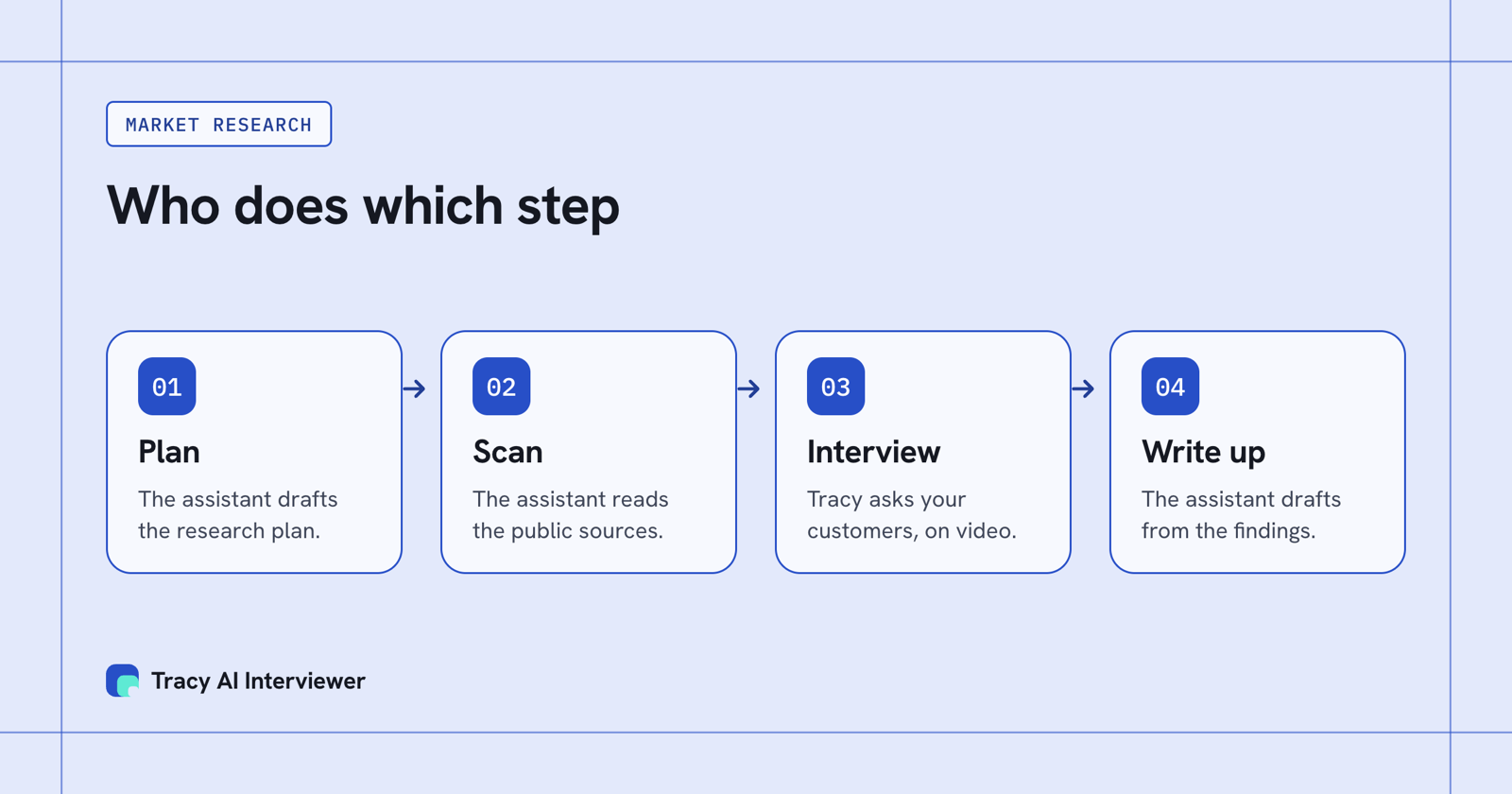
The assistant does the desk steps; Tracy does the asking.
How does Tracy add customer interviews to either chat?
Tracy AI Interviewer is a remote MCP connector. In ChatGPT you add it under Plugins and approve the sign-in; in Claude you add it as a custom connector from the connectors settings, and Anthropic notes that on Team and Enterprise plans only an Owner can add one. Claude's connector steps are on Tracy's Claude guide and ChatGPT's on Tracy's ChatGPT guide.
Then the chat does the set-up. You describe what you want to learn, for example why last quarter's lost deals went elsewhere, and Tracy drafts an interview guide you can edit or replace with your own. Creating the interview and inviting anyone each need your approval of a preview. Customers get a link, join in a browser when it suits them and need no account. You ask for results in the chat and see what each person said to each question, plus the result fields.
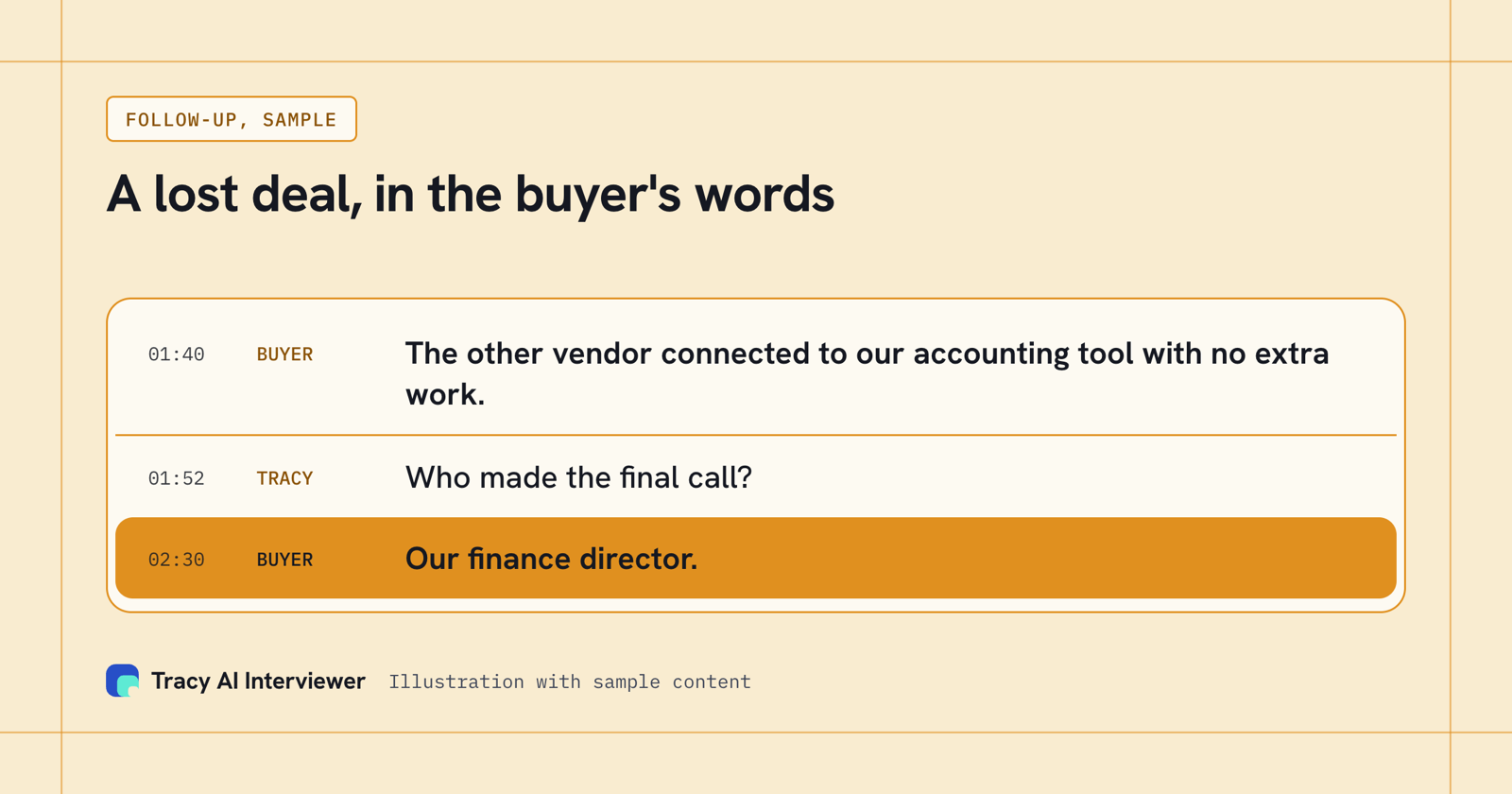
A stated reason for a lost deal becomes a named decision maker after one follow-up.
What you read afterwards
That answer arrives as two report fields: reason given, "accounting integration", and decision maker, "finance director", each with the question and the time it came from (01:40 and 02:30 in the sample). Behind each field sit the recording and a transcript with timestamps, so you can quote the buyer exactly. Because every buyer gets the same guide, the answers compare across the round. For reading across many of them, see how to analyse interview transcripts.
Tracy reports what people said and does not score or rank them. Your team decides what the round means, and the assistant you already use can help you write it up.
Which path fits you?
- You already pay for one assistant: stay with it for the desk work and add the interviews.
- Your study is mostly survey exports: try Claude's code execution first, or ChatGPT for survey analysis.
- Your question is about lost deals: win-loss interview questions gives you the guide.
- Choosing the interview tool itself: best customer interview software.
Common questions
Is ChatGPT or Claude better for market research?
Can ChatGPT or Claude replace market research tools?
Is this page about stock market analysis?
Can I use both?
Does Tracy find the customers to interview?
Interview your customers from the chat you use
Connect Tracy to ChatGPT or Claude, approve one interview preview and send customers a link. You read what each one said.
Try it free (opens in a new tab) Book a demo (opens in a new tab)
Your first 3 results are free. No card needed.
Sources
- OpenAI: Deep research, retrieved 23 Nov 2026.
- OpenAI: ChatGPT Work and Codex, retrieved 23 Nov 2026.
- Anthropic: Using Research on Claude, retrieved 23 Nov 2026.
- Anthropic: Create and edit files with Claude, retrieved 23 Nov 2026.
- OpenAI: File uploads FAQ, retrieved 22 Nov 2026.
- Tracy AI Interviewer: Claude guide, retrieved 14 Nov 2026.