In short
Concept testing shows an early idea to the people it is for before you build it, and asks what they make of it. As an interview it tells you why people react as they do; Tracy AI Interviewer runs those interviews from one link and follows up on each answer.
Surveys test concepts in four formats: monadic, sequential monadic, comparative and proto-monadic. A usability test comes later and checks whether people can complete tasks on a design.
Each Tracy interview returns a recording, a timestamped transcript and a summary of what the person said to each question.
Start with one concept and a handful of customers. The first 3 results are free.
Concept testing is how a team finds out whether an idea is worth building before it spends months on it. You show a rough version of the idea to the people it is meant for, ask what they make of it and read the reasons behind their answers. This guide covers what it is, the four formats surveys use, how it differs from usability testing, an example of the follow-up question and the report note that comes back, and how Tracy AI Interviewer runs the interview version. The questions to ask in the interview itself are on a separate page, five concept-test interview questions.
What is concept testing?
Concept testing is a way to evaluate an idea before it exists as a product. Wikipedia defines it as using surveys, and sometimes qualitative methods, to "evaluate consumer acceptance of a new product idea prior to the introduction of a product to the market." Design writers use the same term for earlier, smaller tests: Victor Yocco, in Smashing Magazine in 2021, calls it "a research method that involves getting user feedback during the upfront part of the design process."
The two definitions describe two jobs. A market team wants to know how many people would accept a product, or which of several ideas is more popular. A product team wants to know why an idea lands or falls flat, so it can change the idea. Surveys suit the first job; Wikipedia says qualitative research "cannot provide an indication of the likely success of the new concept", which it calls "better left to quantitative concept-test surveys." Interviews suit the second, because a person can explain a reaction that a rating scale only records.
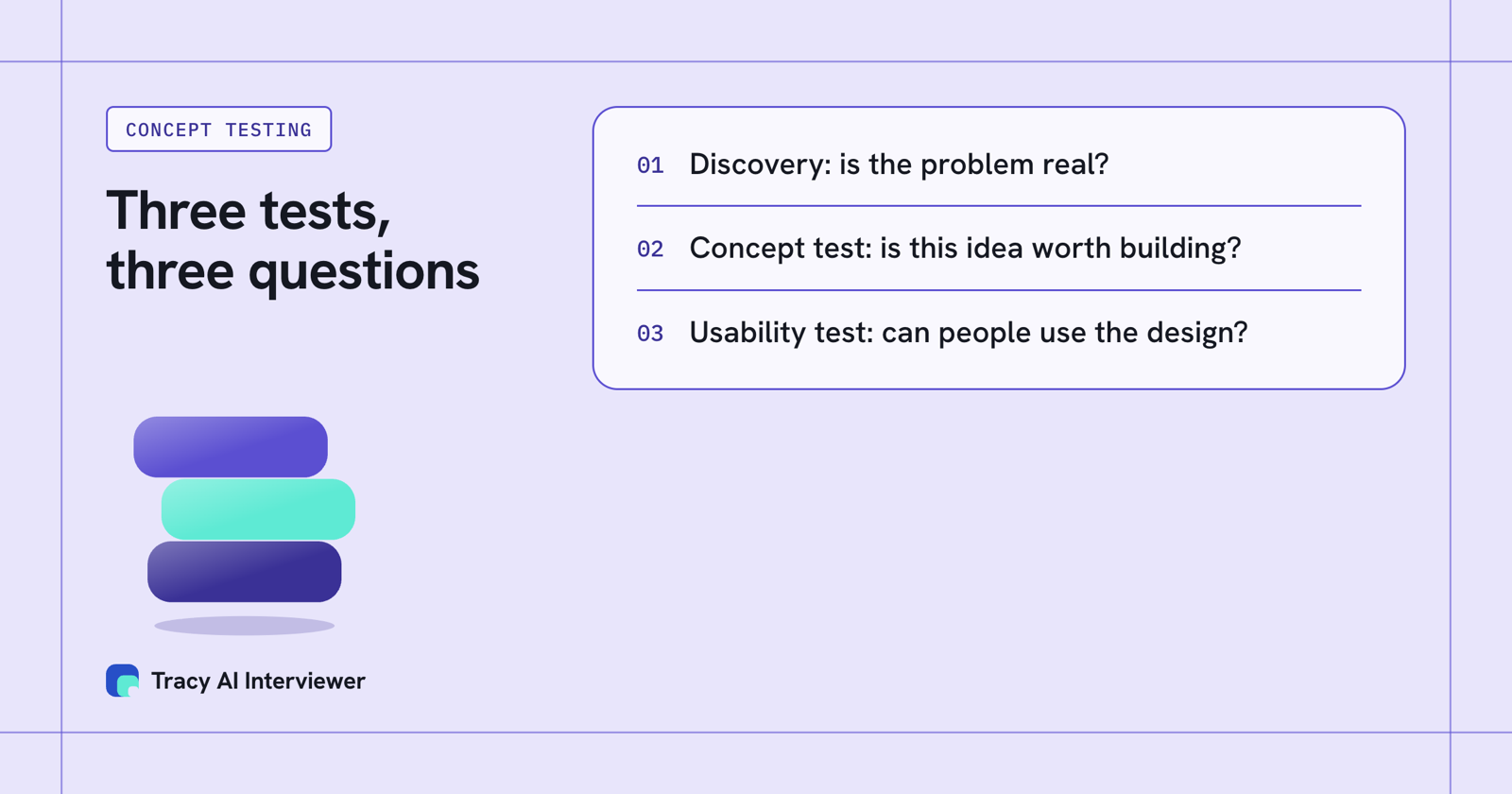
Discovery, concept testing and usability testing each answer a different question, in that order.
What are the types of concept testing?
Surveys use four presentation formats: monadic, sequential monadic, comparative and proto-monadic. They differ in how many concepts a respondent sees and whether the respondent sees them one at a time or side by side.
For UX work, Yocco names a different list of methods: interviews, A/B testing, co-design and surveys. A/B testing needs at least two versions of an idea, and co-design lets users keep building the idea out. A survey, he writes, "allows broader feedback without the depth of an interview." The interview is the method that gives reasons, which is why the rest of this guide leans on it.
How do the four survey formats differ?
Definitions follow Wikipedia's Concept testing article, read 23 Nov 2026. The last column is reasoning, not a sourced claim.
| Format | How concepts are shown | Fits |
|---|---|---|
| Monadic | One concept, evaluated in isolation | A clean read on one idea |
| Sequential monadic | Several concepts in sequence, often random order | Several ideas, each judged alone |
| Comparative | Concepts shown next to each other | A direct choice between options |
| Proto-monadic | Shown in sequence, then next to each other | Both a separate read and a choice |
What is the difference between a concept test and a usability test?
A concept test asks whether an idea is worth building, and a usability test asks whether people can use a design. In a usability test, Nielsen Norman Group explains, a researcher asks a participant to perform realistic tasks and observes what happens, with goals that include "Identifying problems in the design of the product or service." Yocco says the two do not substitute for each other: "Concept testing does not serve as a replacement for usability testing," because "Concepts aren't meant to be of the fidelity that you are testing task completion."
The order follows from that. Discovery comes first, then the concept test, then usability testing on a design. Yocco calls concept testing "a great next step once you've done basic discovery work" and warns that there is "such a thing as too early to concept test." If you are still at discovery, start with customer discovery interview questions.
What is concept testing in UX?
In UX, concept testing happens before detailed design, on an idea rough enough that nobody is judging polish. Yocco says testing ideas "before moving into a detailed design is good UX practice" and gives two examples: a bank that wants to make direct deposit enrolment easier, and a zoo that is considering touch screen kiosks in an existing exhibit. Either idea can be described in a few sentences and put in front of the people it is for before anyone designs a screen.
What does a concept test look like in practice?
Here is an invented example. A delivery app team has an idea: let customers change a delivery date after they order. Before it shows the idea, the interview asks about the last time a customer tried to do it. This customer wanted to change the date and looked under Orders first. Tracy asks where they expected to find it, so the answer names a place and not just a feeling.
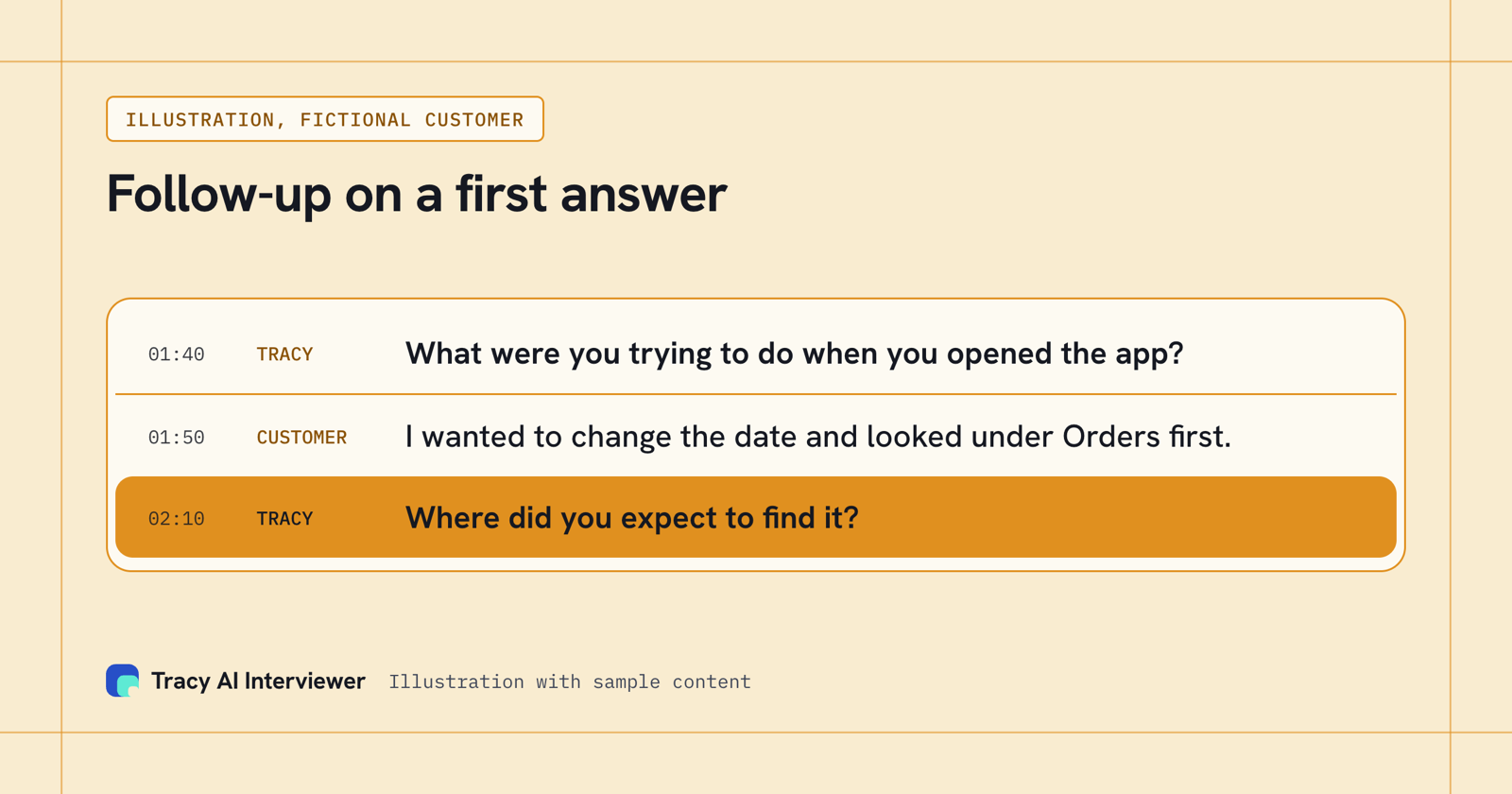
A first answer about a delivery date gets a follow-up on where the customer expected to find the option.
The reviewer's note for that interview reads like this. It is an invented sample.
Question 1, 01:50. What were you trying to do when you opened the app? The participant wanted to change a delivery date and could not find it under Orders. Quote: "I wanted to change the date and looked under Orders first." Follow-up asked: Where did you expect to find it?
Question 2, 03:30. What did you do when you could not find it? The participant gave up and phoned support. Quote: "I gave up and phoned support."
The team can then describe the idea in plain words and ask the next customer the same questions, comparing the answers side by side. A problem that several customers describe the same way tells you more than one customer's praise for the idea.
How does Tracy run a concept test?
Write the concept as a few plain sentences in the interview guide, or say what you want to learn and Tracy drafts the guide for you to edit. Send one link. Customers open it in a browser when it suits them, with no account, and Tracy asks your questions and a follow-up when an answer is thin. Each interview returns a recording of both sides, a timestamped transcript and a short written summary of what the person said to each question. Tracy reports what was said; your team reads it and decides whether the idea goes forward.
This covers the "why" half of concept testing. To learn how many people prefer concept A to concept B, a survey is the better tool, and interviews can come first so the survey asks about what customers actually care about. Tracy costs $1 per credit, one credit per started 20 minutes, with no seat fees. To see the method on your own idea, set up one concept interview and read the first results before sending it to more customers.
Which path fits you?
- You want the interview script: the five-question concept testing interview.
- The idea is still vague: customer development interviews to find the problem first.
- You were considering a group session: alternatives to focus groups.
- You want a model to draft ideas first: what synthetic users can and cannot replace.
- You want software to run the interviews: automated customer interview tools.
Common questions
What is concept testing?
What are the types of concept testing?
What is the difference between a concept test and a usability test?
See a concept test run in one interview
Describe the idea, send one link and read what each customer said about it. First 3 results free.
Try it free (opens in a new tab) Book a demo (opens in a new tab)
Your first 3 results are free. No card needed.
Sources
- Wikipedia: Concept testing, retrieved 23 Nov 2026.
- Victor Yocco, The Value Of Concept Testing As Part Of Product Design, Smashing Magazine (5 Nov 2021), retrieved 23 Nov 2026.
- Nielsen Norman Group: Usability Testing 101 (reviewed 15 Jul 2026), retrieved 23 Nov 2026.
- Tracy AI Interviewer: Customer research, retrieved 14 Nov 2026.
- Tracy AI Interviewer: Pricing, retrieved 11 Nov 2026.