In short
Use Perplexity to map what is already public: market size, competitors, pricing pages and buyer language. Deep Research does the wide sweep and a Project keeps your sources together.
Public sources cannot say why your own customers behave as they do. Tracy AI Interviewer fills that gap from a Claude, ChatGPT, Gemini or Copilot Studio chat, with customers joining in a browser when it suits them.
Each finding links to the words behind it. Start with the five prompts below.
To use Perplexity for market research, ask it a narrow question, let Deep Research sweep the web, and check every number at its original source before it goes in a deck. At its launch on 14 Feb 2025, Perplexity said Deep Research "performs dozens of searches, reads hundreds of sources" and finishes most tasks in under three minutes. That makes it a fast first pass on what is already published, and its help pages are the place to check what your plan includes today.
It cannot tell you why a customer left or what they tried first. Tracy AI Interviewer adds that layer: it drafts the interview guide from what you want to learn, runs each conversation with follow-ups, and ties every finding to the words behind it. Claude for market research and ChatGPT for market research describe the same hand-off in those apps.
How to use Perplexity for market research
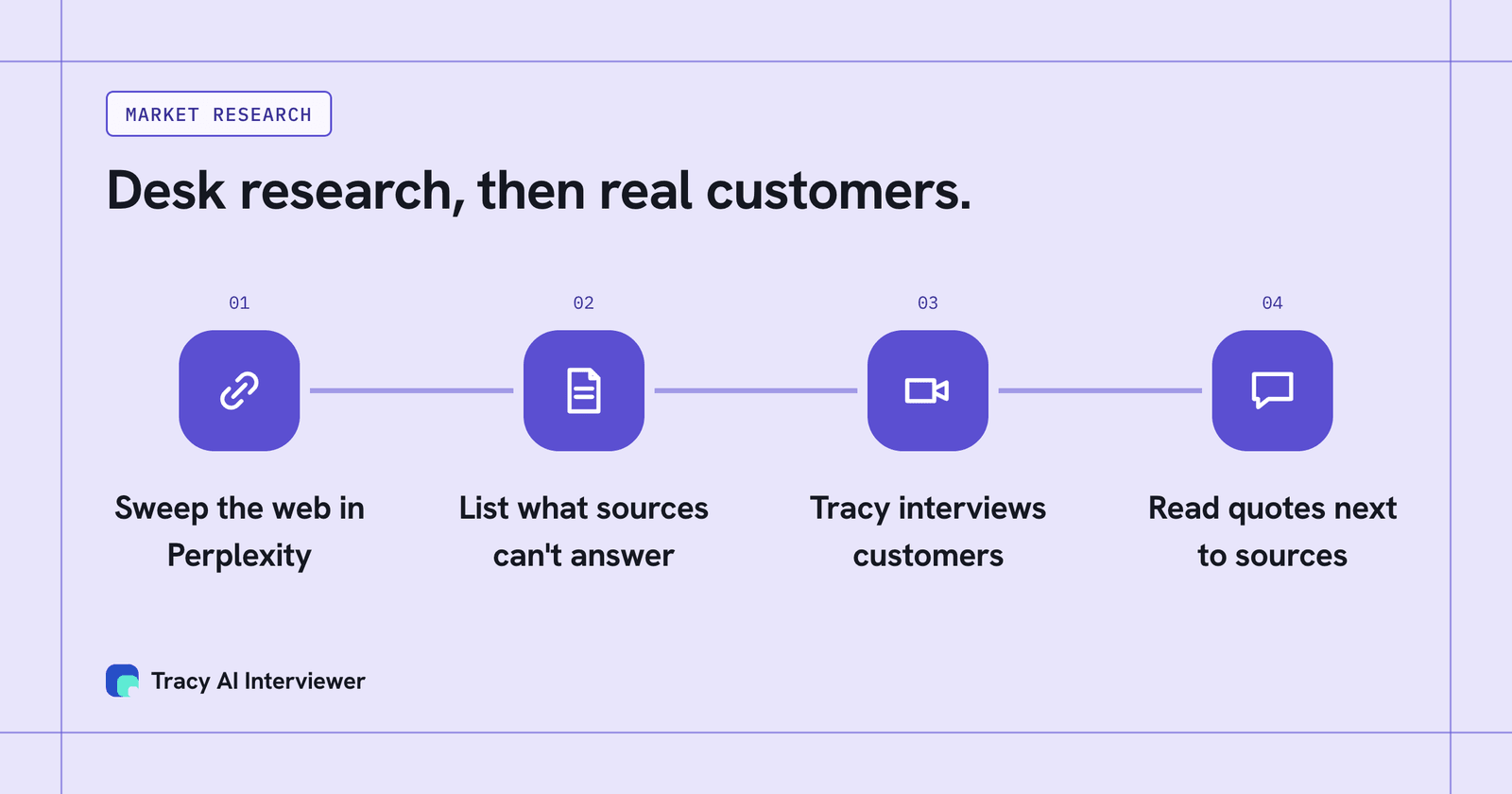
Work in six steps.
- Write the decision first, for example "Should we add a smaller plan for teams under five people?"
- Run Deep Research on one question at a time: market size, who sells what, how they price, what buyers complain about.
- Put the best sources, your instructions and your notes into a Project. Perplexity describes Projects as persistent, shareable workspaces, with instructions of up to 8,000 characters and uploaded files.
- Open the original source for every figure you will quote. Treat a number you cannot trace as a lead.
- List what the sources cannot answer. These become the questions for customers.
- Interview the customers, then bring their quotes back into the Project next to the desk research.
Perplexity covers steps 1 to 4, and primary research starts at step 5.
Perplexity prompts for market research
Copy these and replace the brackets.
- Market size: "What do published sources say about the size and growth of [market] in [region]? Give each figure with the year, the publisher and what it measures."
- Competitor map: "List the vendors selling [category] to [buyer]. For each, give the headline promise on its homepage, the pricing model and the plan names."
- Buyer language: "What phrases do buyers of [category] use in public reviews and forum posts when they describe the problem it solves?"
- Pricing scan: "Compare the public pricing pages of [vendor A], [vendor B] and [vendor C] by unit, minimum and what is free."
- Gaps: "What questions about [category] do these sources leave unanswered? Write them as interview questions for customers."
The fifth prompt feeds the interview step, because its output is a first draft of the questions you take to customers.
Take an invented example. Say prompt 2 shows that all three rivals sell per seat from five seats. Prompt 5 then returns "Why do teams of four cancel instead of downgrading?" If no source answers it, it becomes the first question you put to a customer.
Perplexity vs AlphaSense: which one for what?
They draw on different sources. Perplexity searches the web and the files you upload. AlphaSense describes itself as a research platform with "500M+ premium documents," premium expert interviews through Tegus, and financial data, built for financial services, corporations and consulting firms.
If the question is about listed companies, filings or expert calls, a premium library is the natural fit. If it is about what buyers say in public or how rivals present themselves, web search covers it. Neither one talks to your customers. That interview layer is the same whichever you choose.
Perplexity covers what is public; Tracy collects what only your customers can say.
Add real customer interviews to the research
Tracy runs discovery, concept tests and win-loss interviews. You describe what you want to learn, or paste your own guide, and Tracy drafts the questions for you to edit. Each customer opens a browser link when it suits them, with no calendar and no account, and is told on the join screen that the conversation is recorded and transcribed. Where an answer stays thin, the next question asks for the example or the reason behind it.
Start from a chat. Tracy runs as an MCP server, so a chat in Claude, ChatGPT, Gemini or Copilot Studio can set up the interview, invite customers by email and read results back. The chat shows a preview first, and nothing goes out until you approve it. Connecting Tracy to Claude and connecting it to ChatGPT take a few minutes each, and how to run customer interviews covers the method.
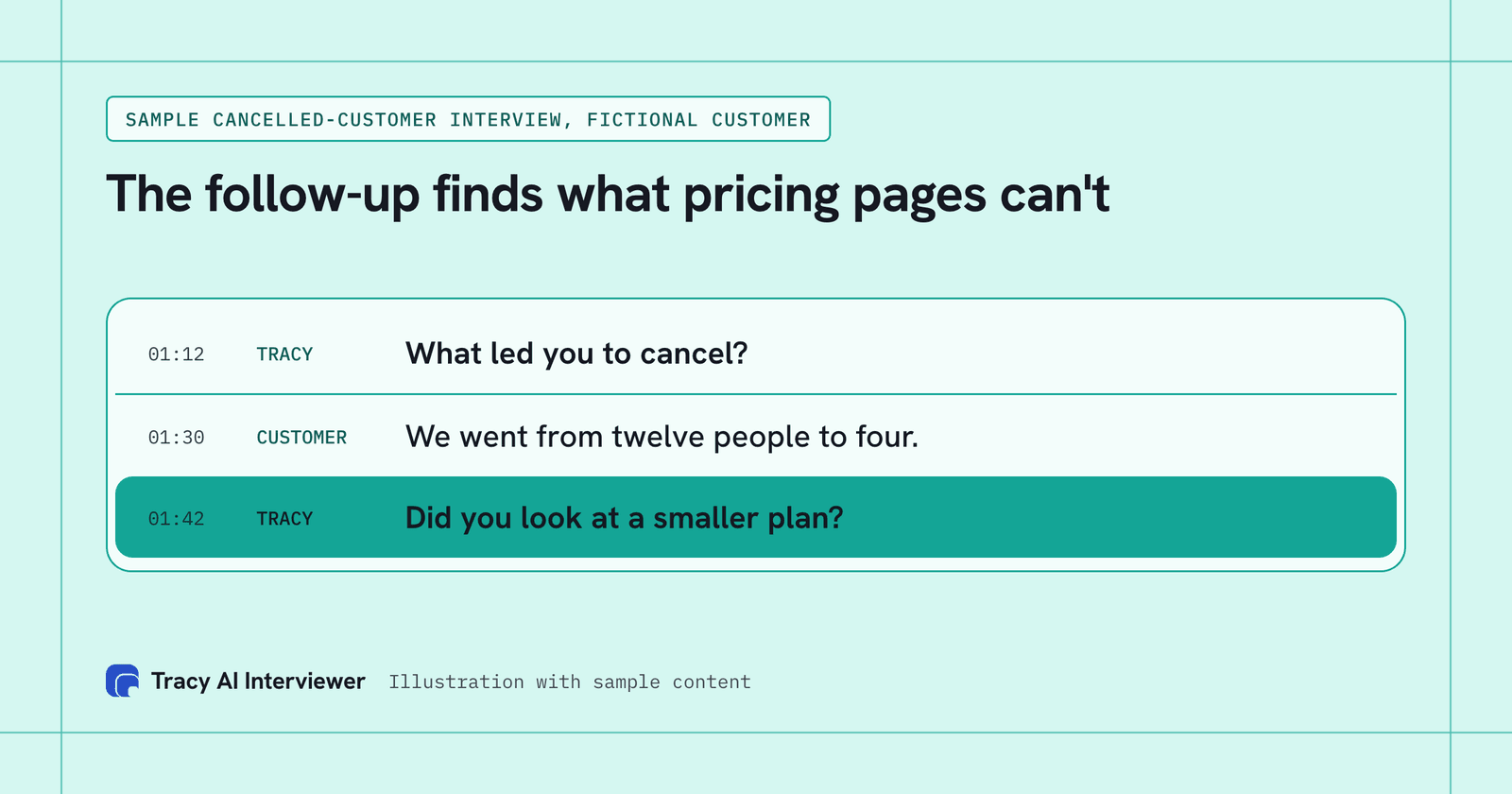
A pricing page would not tell you the customer never knew about the smaller plan; the follow-up does.
What you read after the interviews
In the sample, the reviewer sees two fields with their evidence: Stated reason (team size reduced; Q1, 01:30) and Aware of smaller plan (no; Q1 follow-up, 02:10). Desk research could have shown the plan tiers, and the customer was the one who could say they never saw them.
Ask the chat to read back each customer's answers to one question, with the result fields beside them. What the findings mean is your team's call, because Tracy does not score or rank anyone. Paste the quotes into your Project and read them beside the Perplexity sources. For a full win-loss method, see win-loss analysis.
Common mistakes
- Quoting a market-size figure without its year, publisher and what it measures.
- Asking one broad question, such as "tell me about the market," instead of one narrow question per run.
- Stopping at desk research when the decision depends on why customers act as they do.
- Writing interview questions from the sources alone, so they confirm what you already read.
- Running the interviews in a different place from the research, so the quotes never meet the sources.
If your team also uses Claude for synthesis, Claude for qualitative research shows how.
Common questions
How do I use Perplexity for market research?
What are good Perplexity prompts for market research?
Perplexity vs AlphaSense: what is the difference?
Can Perplexity replace customer interviews?
Add customer interviews to your research
Connect Tracy to your AI chat, describe what you want to learn and send the first interview. First 3 results free.
Try it free (opens in a new tab) Book a demo (opens in a new tab)
Your first 3 results are free. No card needed.
Sources
- Perplexity: Introducing Perplexity Deep Research (14 Feb 2025), retrieved 22 Nov 2026.
- Perplexity Help Center: What are Projects?, retrieved 22 Nov 2026.
- AlphaSense: Platform, retrieved 22 Nov 2026.
- Tracy AI Interviewer: Connect, retrieved 22 Nov 2026.