
In short
AI helps UX research at four points: drafting the plan and guide, running interviews, reading transcripts and drafting the readout. It should not stand in for participants or make the final call.
The interviewing step is where an AI interviewer fits. Tracy AI Interviewer interviews real participants from one link, asks a follow-up when an answer is thin, and keeps a recording and timestamped transcript behind each result.
You read the evidence and decide. Tracy passes on what people said and never scores or ranks them.
AI UX research means using AI for parts of a study: drafting the plan and the discussion guide, running or supporting interviews, reading what came back and drafting the readout. In the User Interviews State of User Research 2025, a survey of 485 people who do or support user research, 80% of respondents said they use AI, up 24 points on the year before.
The same survey shows the worry that comes with it: 91% worry about the accuracy of AI output and hallucinations, and 63% fear that AI could devalue human insight and critical thinking. A useful guide therefore says where AI earns its place and where it does not. Tracy AI Interviewer sits at one point in that map: it asks real participants the questions, with follow-ups, and hands you the evidence to read.
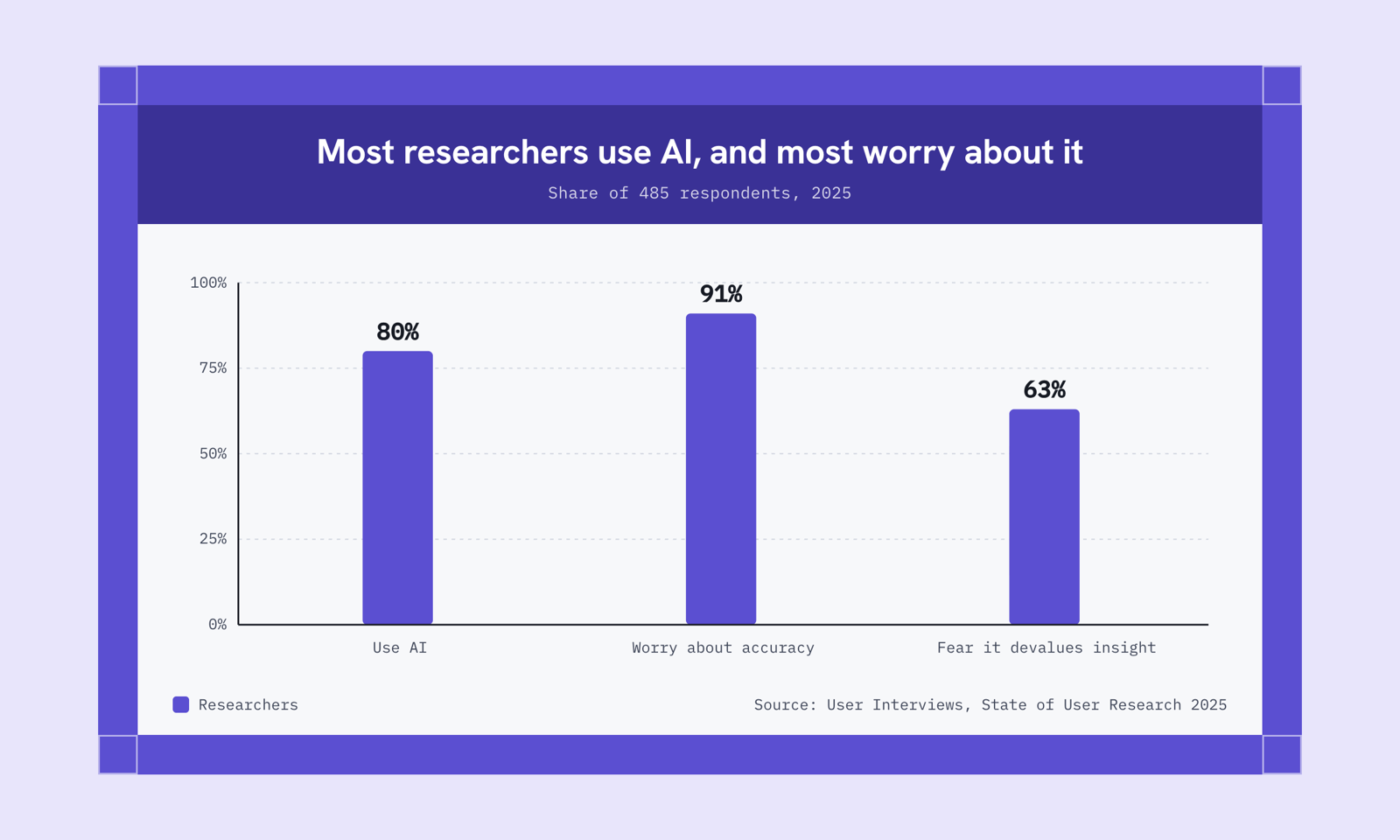
Most researchers use AI and most worry about its accuracy, so every output needs a human check.
How is AI used in UX research?
In four places, and each has its own risk: the plan, the interviews, the reading and the report.
Where AI helps at each stage of a UX study and what stays with the researcher.
| Stage | What AI does | What you keep |
|---|---|---|
| Plan | Drafts the plan and interview guide from your goal | The decision the study serves and the final questions |
| Interview | Runs conversations and adapts follow-ups to each answer | Choosing who is asked, and which sessions need a person |
| Read | Codes transcripts and proposes themes | Checking each theme against the quotes |
| Report | Drafts the readout from findings you checked | The call on what changes |
Where should AI not be used in UX research?
Do not use it to replace the participants. Nielsen Norman Group's piece on synthetic users, published 21 Jun 2024, says they "cannot replace the depth and empathy gained from studying and speaking with real people" and that synthetic research "cannot produce behavioral data". Its tests found AI "have a tendency to want to please": in one, synthetic users claimed to have finished all their courses while real learners did not. Its advice is to avoid synthetic users when your population is niche or specialised, and to use them for desk research and hypotheses, not for final decisions.
Do not use it to settle a theme without a human read. A 2024 viewpoint in the Journal of Medical Internet Research tried ChatGPT on one podcast transcript and concluded that human researchers must stay involved, because the tool "may give different answers to the same questions" and may not capture every nuance. That was one transcript and no participants, so read it as a caution, not a measured error rate.
What an AI interviewer adds to a study
An AI interviewer takes over the step that eats calendars, which is talking to the participants. Anthropic describes its own Anthropic Interviewer as a tool that runs conversational interviews at scale, with researchers helping validate and interpret the findings. Tracy AI Interviewer works on the same split for customer and user research. Give Tracy your research goal or your own guide and it drafts questions you can edit. Each participant opens one browser link when it suits them, with no account and no calendar, and the join screen tells them the conversation is recorded and transcribed.
When an answer is thin, the next question asks for the example or the reason, and every result has a recording and a timestamped transcript behind it. You can start from a chat in Claude, ChatGPT, Gemini or Copilot Studio, and creating or inviting needs your approval of a preview first. Claude for UX research walks through the Claude route.
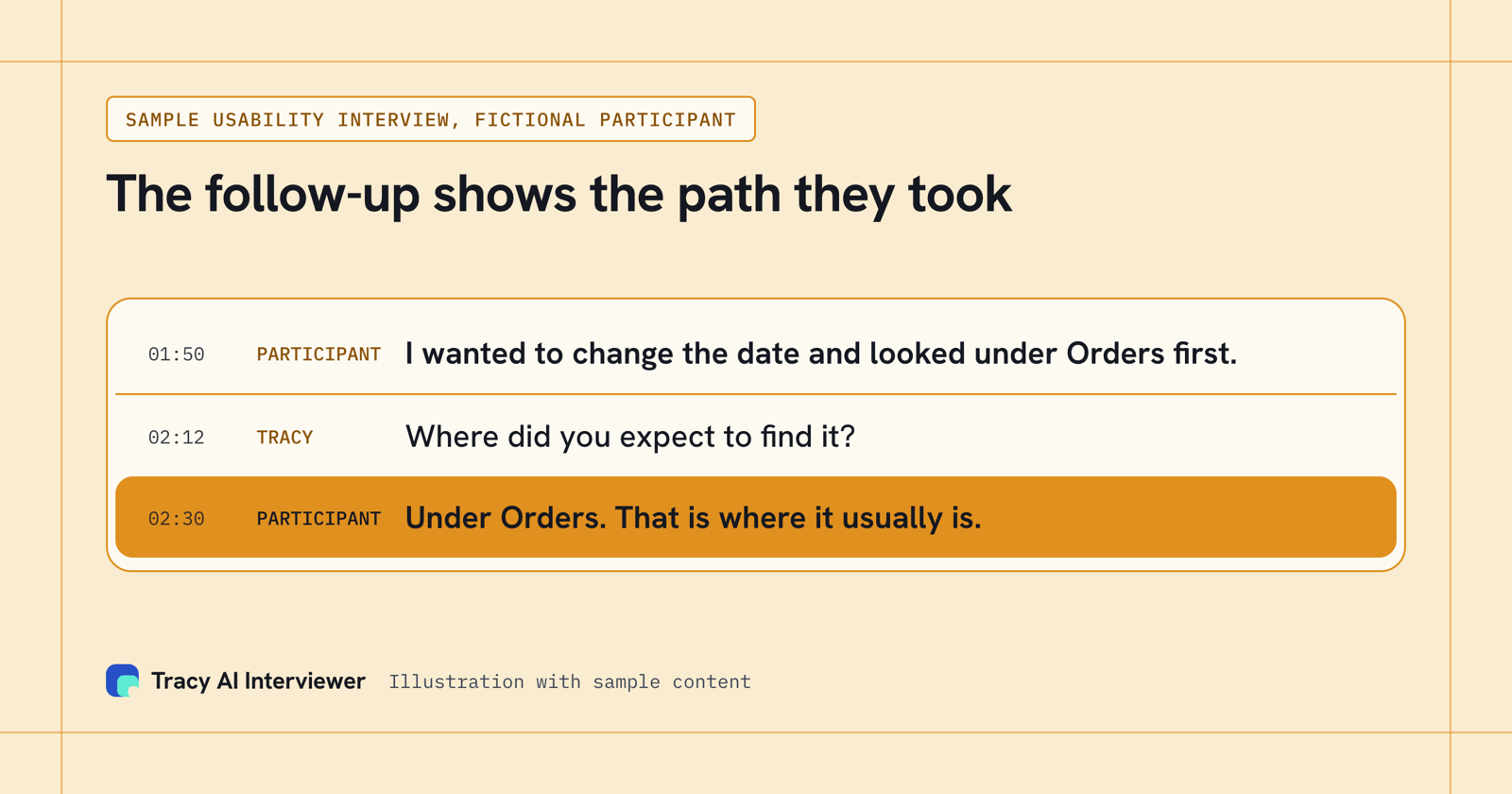
One follow-up shows where the participant looked and what they expected to find.
What you read after the interviews
In the sample, the reviewer reads two fields with their evidence: Task attempted (change delivery date; Q1 at 01:50) and Where they looked (Orders menu; Q1 follow-up at 02:30). A second answer says the participant gave up and phoned support (Q2 at 03:30), with the quote beside it.
Ask the chat to read back what each participant said to each question, then group the answers yourself or with an assistant and open the recording before a quote goes into a readout. Tracy does not score or rank participants, so the grouping and the decision stay with you.
Which path fits you?
- Reading transcripts you already have: NotebookLM for user research.
- Planning the study in an assistant: ChatGPT for UX research.
- Weighing synthetic participants: synthetic users in research.
- Comparing tools: best AI tools for user research.
- Looking for numbers behind the case: user research statistics.
The customer research use case covers the same flow end to end.
Common mistakes
- Letting an AI summary stand as the finding, with no quote opened.
- Using synthetic participants for a decision that depends on real behaviour.
- Running AI on a transcript with names and contact details still in it.
- Adopting a tool before naming the stage of the study it is meant to speed up.
- Treating a theme as proven because the tool found no exceptions.
Common questions
How is AI used in UX research?
Where should AI not be used in UX research?
What are AI UX research tools?
Can AI replace a UX researcher?
Does an AI interviewer talk to real participants?
Hear the reason behind every answer
Send one link and Tracy interviews your users when it suits them, with each finding tied to their words. First 3 results free.
Try it free (opens in a new tab) Book a demo (opens in a new tab)
Your first 3 results are free. No card needed.
Sources
- User Interviews: The State of User Research 2025 (10 Sep 2025), retrieved 23 Nov 2026.
- Nielsen Norman Group: Synthetic Users (21 Jun 2024), retrieved 23 Nov 2026.
- JMIR 2024: Harnessing ChatGPT for Thematic Analysis: Are We Ready?, retrieved 15 Nov 2026.
- Anthropic: About Anthropic Interviewer, retrieved 14 Nov 2026.
- Tracy AI Interviewer: Connect, retrieved 22 Nov 2026.