In short
Claude and ChatGPT both run a research mode that searches the web and writes a cited report, and both read files you upload, so the choice comes down to your largest file and which plan you pay for. Claude lists PDFs up to 1,000 pages, 20 files per chat and 500MB per file; OpenAI sizes text files in tokens, so the two limits are not directly comparable.
Both work on evidence that already exists. For what customers have not said yet, Tracy AI Interviewer runs the interviews from either chat, asks the follow-up a vague answer needs and keeps a recording and transcript behind each result.
Use an assistant for desk research and Tracy for first-hand research. The first 3 Tracy results are free.
Which is better for research, Claude or ChatGPT?
The answer depends on the files you upload and the plan you are on. The two have matching features: a research mode, uploads, Projects and connectors. They differ in limits and in what each plan includes, and those limits are stated in different units. Test your own largest file in each before you commit a team to one. The table shows what each vendor's pages say, and Claude for research covers the Claude side of the workflow in full.
What Anthropic's and OpenAI's own help pages state, read 14 and 22 November 2026.
| Research job | Claude | ChatGPT |
|---|---|---|
| Research mode | Research: multiple searches that build on each other; paid plans | Deep research: report with citations or source links; plan and country dependent |
| Long documents | PDF, DOCX, CSV; 20 files per chat; PDFs up to 1,000 pages | Text files up to 2 million tokens each; 80 files every 3 hours |
| Spreadsheets | CSV among supported types; Claude can create .xlsx files up to 30 MB | CSV and spreadsheets about 50 MB, depending on row size |
| Projects | Workspaces with chat histories and knowledge bases; on every plan, five projects on Free | Projects on every plan, Free included; check your plan on OpenAI's pricing page |
| Team plan | Team standard seat: $20 per month billed annually, $25 monthly | Business standard: $20 per month billed annually, $25 monthly |
Does Claude have deep research?
Yes. Claude's Research feature gathers information over five or more tool calls in 1 to 3 minutes from the web and connected tools, then writes a report with citations. It is on paid plans (Pro, Max, Ultra, Team and Enterprise), it can use Google Workspace and other connectors, and Anthropic says research sessions can use up your limits faster. ChatGPT's deep research includes citations or source links in every output, and it reads from connected apps without write actions. Treat either report as a lead list: open the sources behind the three claims you plan to repeat, as the steps for Claude in qualitative research also advise.
Claude vs ChatGPT for long documents?
Anthropic counts pages and files: PDFs up to 1,000 pages, 20 files per chat, 500MB per file. OpenAI counts tokens and time: 2 million tokens per text file, 80 files every 3 hours. You cannot convert one into the other without knowing your files, so run your longest report through both and ask each to quote the page that supports every point.
What does a research prompt look like in each tool?
In Claude, turn on Research and ask: "What do customers of mid-market scheduling tools say about the cost of switching? Give every claim a source link and mark any claim you found in only one source." Put your own interview notes in a Project first, so the question and the notes sit together. Anthropic says research sessions can use up your limits faster, so run the long ones once.
In ChatGPT, start deep research and ask the same question in one message, attaching the notes to the same chat. OpenAI says every output includes citations or source links, and that connected apps are read and never written to.
In both, finish with the same check: "List the three claims that carry the most weight and quote the passage each one rests on." Open those three sources before anything goes into a deck.
When does each fit?
Choose Claude when:
- your sources are PDFs, DOCX and CSV files, in batches of up to 20 per chat, with PDFs up to 1,000 pages;
- you want a Project that holds your research question and screening notes, and you can work within five projects on a Free account.
Choose ChatGPT when:
- your documents are text files, which OpenAI sizes at up to 2 million tokens each, and you can fit the job inside its 80 files every 3 hours;
- you want to record a meeting with ChatGPT Record on the macOS app and keep it with the research, a feature OpenAI lists for ChatGPT.
If you already pay for one of them, start there and test your largest file.
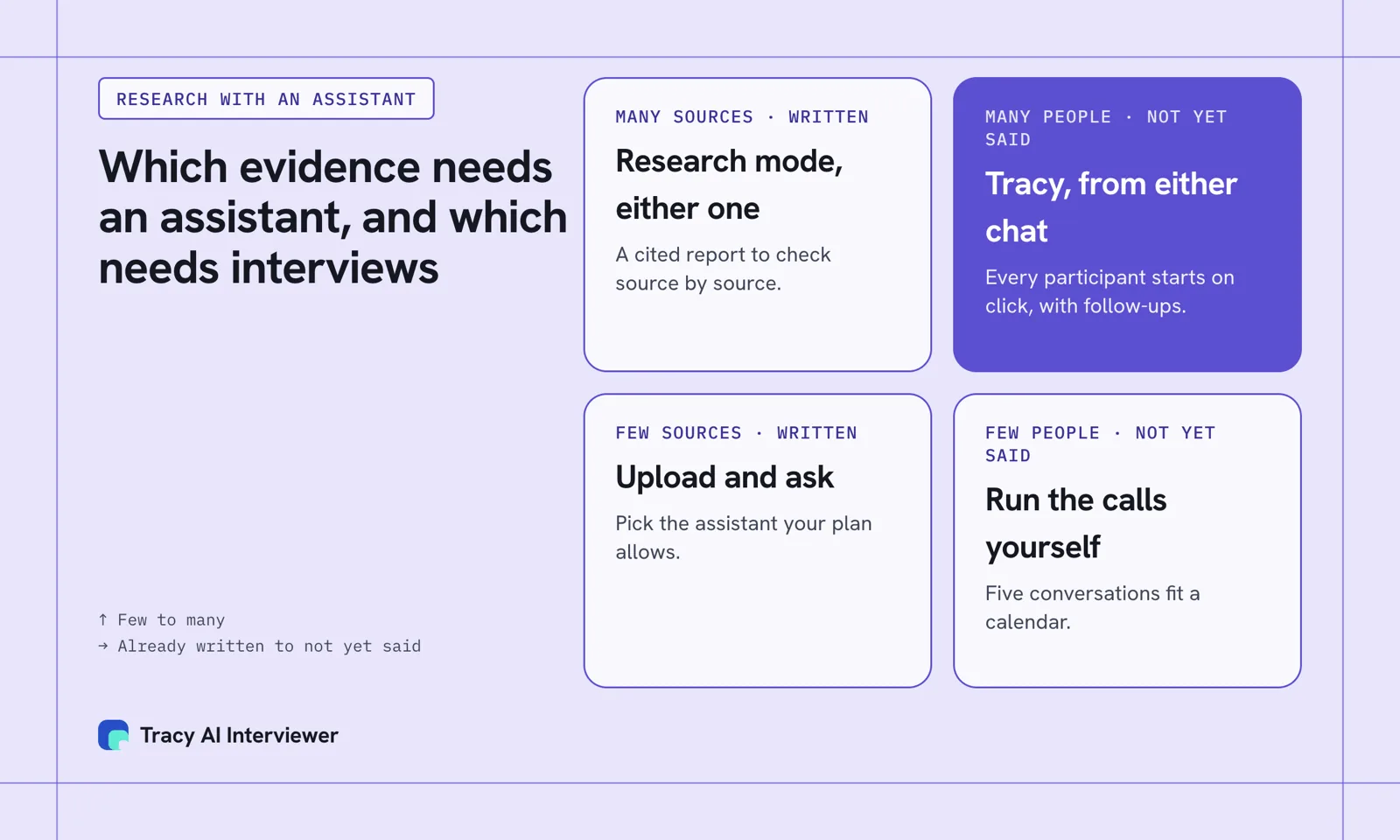
Written sources go to an assistant; what people have not said yet needs interviews.
Where do both assistants stop?
A research report can tell you what competitors charge. Why your customers picked one takes first-hand conversations, and a calendar limits how many you hold. Tracy connects to both Claude and ChatGPT, so you describe what you want to learn, approve the interview preview and send participants a link. Each person starts on click, in a browser, with no account. The results come back into the same chat: what each participant said to each question, with the result fields. Claude for qualitative research walks through that workflow in Claude.
Here is a sample from a consumer study with an invented participant. Asked how they decide which brand of coffee to buy, the participant answered at 01:50, "On offer, unless I have guests. Then a known brand." Tracy followed up with "What counts as a known brand for you?"
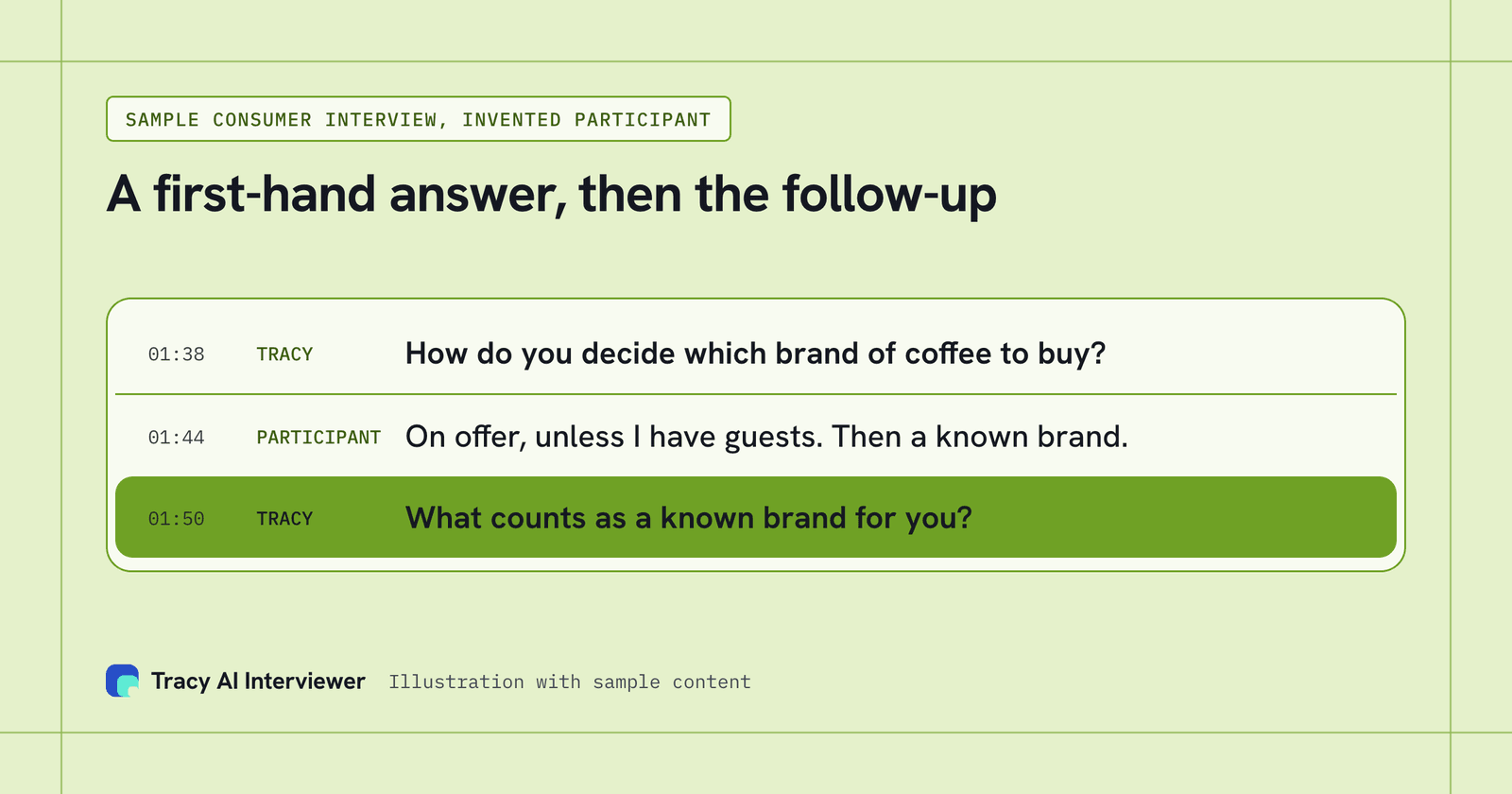
Tracy follows the first answer with a question that gets the reason.
What Tracy adds to either assistant
Either assistant can work with the interviews Tracy runs. Participants start on click, at any hour, so a study is not held up by calendars. When an answer is thin, Tracy waits for the end of the thought and asks for the reason, so the assistant has more than a one-line answer to work from. Every result carries its recording and a timestamped transcript, and the report sticks to what each person said, with no score or ranking added.
Which path fits you?
- Claude for the whole research workflow: Claude for research and Claude for qualitative research.
- ChatGPT instead: ChatGPT for qualitative research and ChatGPT for market research.
- Choosing for a business: Claude vs ChatGPT for business.
- Adding Tracy: to Claude or to ChatGPT.
Common questions
Which is better for research, Claude or ChatGPT?
Claude vs ChatGPT for long documents?
Does Claude have deep research?
Can either assistant interview my customers?
What does Tracy cost for a research study?
Add first-hand answers to your research
Connect Tracy to Claude or ChatGPT, describe the study and send participants a link. First 3 results free.
Try it free (opens in a new tab) Book a demo (opens in a new tab)
Your first 3 results are free. No card needed.
Sources
- Anthropic, Using Research on Claude, retrieved 22 Nov 2026.
- Anthropic, Research on Claude, retrieved 22 Nov 2026.
- Anthropic, What kinds of documents can I upload to Claude?, retrieved 14 Nov 2026.
- Anthropic, Create and edit files with Claude, retrieved 22 Nov 2026.
- OpenAI, Deep research, retrieved 22 Nov 2026.
- OpenAI, File uploads FAQ, retrieved 22 Nov 2026.
- OpenAI, ChatGPT Record, retrieved 22 Nov 2026.
- Anthropic, Claude pricing, retrieved 22 Nov 2026.