How to Screen Candidates When There Are Too Many Applicants
TLDR
- Interview before you filter. Tracy AI Interviewer gives every applicant a two-way first interview, follows up on their answers and returns a summary tied to what they actually said.
- This moves the shortlist from AI-polished CVs toward evidence of how people did the work. Recruiters and hiring managers check the answers, video and transcript, then make the decision.
On this page
- Why are there too many applicants for every job now?
- Why doesn't screening applicants for a job faster fix it?
- How to screen candidates so you see who they really are
- How do you screen candidates effectively when every CV looks good?
- Won't candidates drop out of an AI interview?
- How to screen candidates for one role, step by step
- Questions
- Sources
Why are there too many applicants for every job now?
If you're working out how to screen candidates for a skilled role today, the pile is bigger and harder to read than it was. A candidate can tailor a CV and cover letter to your job description in minutes with an AI tool, then do the same for dozens of other jobs. Robert Half's March 2026 release, based on a survey of more than 2,000 US hiring managers in November 2025, reports:
- 67% of US HR leaders say reviewing AI-generated applications has slowed hiring, and 20% report delays of more than two weeks.
- 84% of HR teams report heavier workloads as AI-tailored applications increase.
- 65% of hiring managers say AI-enhanced resumes make skills harder to verify.
The last number matters most. A big pile would be manageable if the CVs told you who could do the job. When every CV reads well, you can't sort the pile however hard you cut it.
Why doesn't screening applicants for a job faster fix it?
The usual answer is a faster filter: stricter knock-out questions, a keyword score, a one-way video, a quicker skim. Each one shortens the list without telling you more about the person.
Among the steps employers took to validate candidates, the same release lists spending more time reviewing applications (42%) and increasing the number of interviews per candidate (38%). They added conversations because a candidate in a conversation has to explain their own work. They can't afford that conversation with everyone.
How to screen candidates so you see who they really are
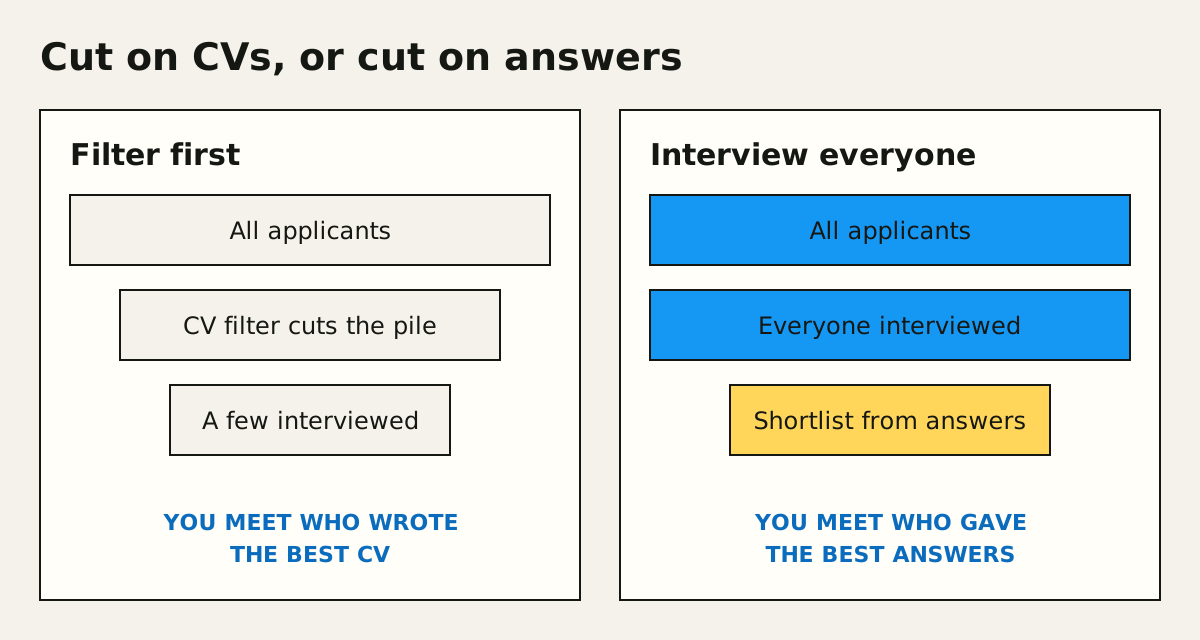
Keep the conversation and change who runs the first one. Each applicant opens Tracy's link in the browser and joins with no sign-up, whenever it suits them, so you can give the whole pile the conversation you used to save for the top ten. Three things make that first round worth reading.
1. Interview everyone, before you cut. If you filter first, the filter still decides who you meet, and the filter reads CVs. Send the interview link with the application confirmation, so the candidate with a plain CV and real experience gets the same look as the one whose CV was polished by AI.
2. Ask the follow-up on their own answer. A fixed question gets a prepared answer; the second and third questions can't be rehearsed because they're built on what the candidate just said. Tracy asks role-specific questions and follows up on vague answers, "a real follow-up, not a rigid script", so a thin answer shows up in the first round instead of the final one. For engineers it can introduce a coding task and probe the trade-offs behind an answer, as AI technical interviews shows. For specialist roles, see our interview questions for AI trainers and domain experts.
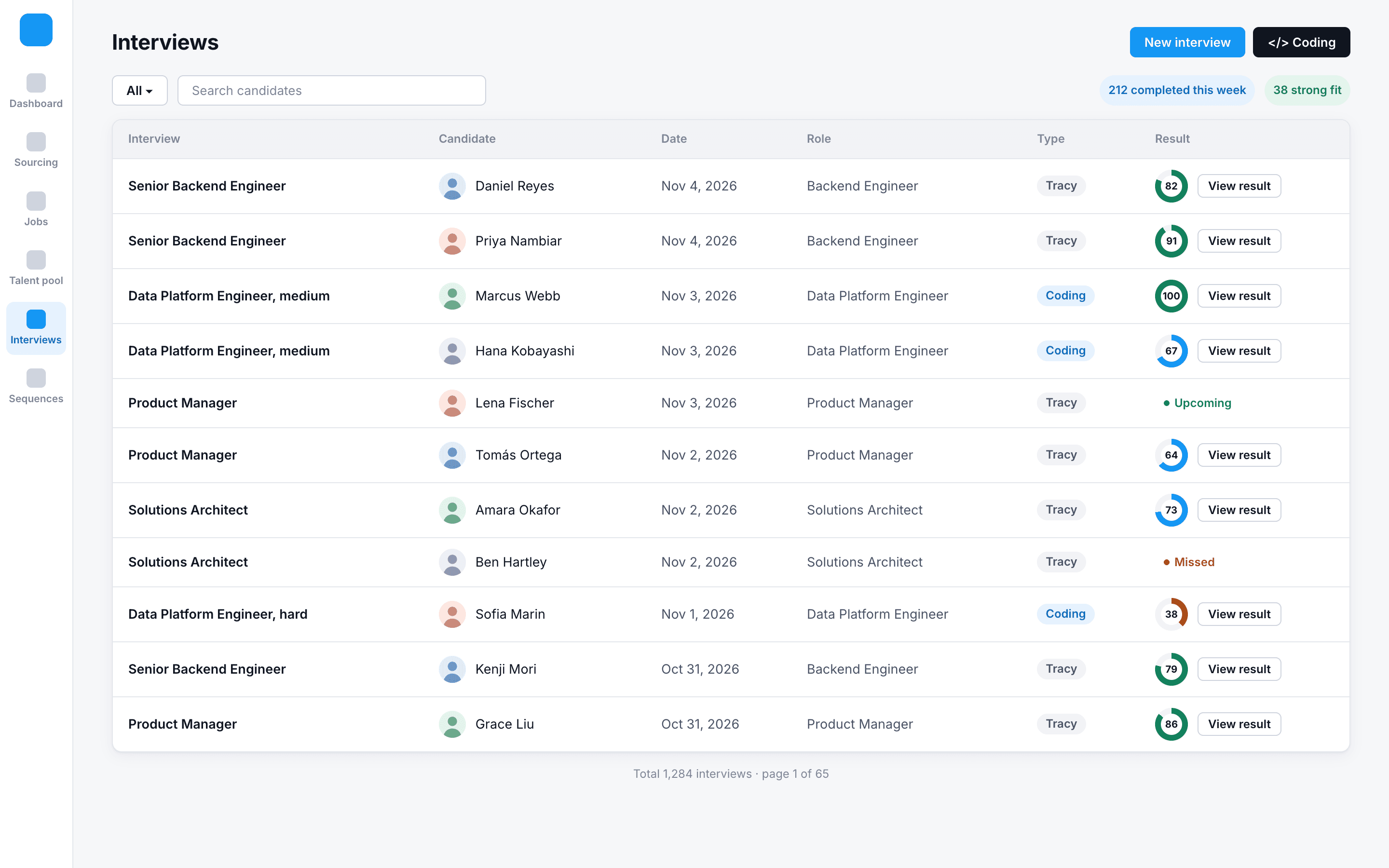
3. Read a summary you can check. Each interview becomes a readable summary "with the participant's own words attached", with every answer organised around the fields you define and the video and transcript beside it. Direct quotes give context and the AI explains each answer score, so a hiring manager can confirm a strong answer, or catch a thin one, without rewatching the whole interview. Your team makes the decision.
Tracy's interview integrity detection flags tab changes, abnormal eye tracking, live face detection, average delay before an answer, external screens and other unusual patterns, so a candidate getting outside help doesn't reach your shortlist unseen. See how to detect AI cheating in interviews.
How do you screen candidates effectively when every CV looks good?
Two applicants for an analytics engineer role can both write "owned the revenue dashboard". The follow-up chain separates them.
Example: a first-round chain Tracy could run. Illustration, not a real candidate.
Tracy: Tell me about a metric you built that other teams relied on.
Candidate: Weekly active accounts. Sales and finance both used it.
Tracy: Sales and finance often count "active" differently. Did they agree on your definition?
Candidate: Not at first. Finance wanted paying accounts only, so I split it into two metrics and documented which dashboard used which.
Tracy: What happened to the old numbers when you split it?
Candidate: The historic chart dropped by about 30% overnight. I backfilled both series and warned the two leads before they saw it.
The first answer is what every CV says. The second shows the candidate knew a metric definition is a decision between teams, and the third shows they thought about the people reading the numbers.
Example: part of the Tracy summary for that candidate. Illustration with test data.
| Field | What the candidate said |
|---|---|
| Metric design | "I split it into two metrics and documented which dashboard used which." |
| Handling change | "I backfilled both series and warned the two leads before they saw it." |
Because the summary quotes the answer, two reviewers can argue about what the candidate said instead of about a number.
Won't candidates drop out of an AI interview?
Some will, and the reasons are known. Greenhouse's 2026 survey covered 2,950 job seekers in five countries. Among US respondents, 63% had already had an AI interview and 38% had withdrawn from a hiring process because it included one. The top reasons US candidates gave were pre-recorded video interviews scored by AI with no human present (33%) and companies failing to disclose how AI would be used (27%). Another 38% want confirmation that a person reviews AI output before decisions are made.
Each of those is a setup choice. Run a two-way interview that responds to what the candidate says. Tell candidates up front that an AI runs the first round, what it looks at, including the integrity signals, and that a person reads every summary and decides. Tracy reports a 72% candidate completion rate and a 4.7 out of 5 average candidate rating. Measure completion in your own hiring process, too.
How to screen candidates for one role, step by step
Pick the role with the most applicants and the shortlist you trust least.
- Write down what your best interviewer for that role wants to know after a first call. Four to six fields is enough.
- Turn the fields into questions, or tell Tracy who you want to speak with and what you need to learn, and the questions are drafted for you.
- Take the interview yourself, the way a candidate would, and change anything that feels off.
- Add the link to your application confirmation, so every applicant gets it.
- Read the summaries field by field and invite the strongest candidates to your next round.
- Run it next to your current screen for two weeks and compare who each method would have shortlisted.
Tracy works inside tools your team already uses, such as Slack, Workable and HubSpot, so the trial needs no new system. Pricing is per result: $7 per credit; one credit covers up to 20 minutes, which fits a first round of five or six questions. A session with no answers is never charged, so a two-week trial costs only the interviews candidates finish. At high volume, enterprise pricing is custom, based on your volume, as low as $1 per credit.
Questions
What should I do with too many applicants for a job? Give every applicant the same short first interview, then read the summaries instead of the CVs. Applicants take Tracy's interview whenever it suits them, so the bottleneck moves from scheduling calls to reading answers.
Is it fair to interview every applicant with AI? Everyone gets the same questions and the same chance to explain their work, which is fairer to the candidates a CV filter would have cut unseen. Tell candidates an AI runs the first round and that a person makes every decision. This isn't legal advice; check the rules where you hire.
Can candidates use AI to answer an AI interview? Some try. Follow-ups on their own answers make it harder, because a prepared script doesn't cover the third question, and Tracy flags tab changes, abnormal eye tracking, live face detection, average delay before an answer, external screens and other unusual patterns to your reviewer.
We already use a one-way video tool. Why change? One-way video records a prepared answer and asks no follow-up, and Greenhouse found pre-recorded video scored by AI with no human present was the top reason US candidates walked away (33%). A two-way interview asks about what the candidate just said, and a person reviews the result.
Does this work for staffing agencies? Yes, though agencies care most about speed to submit. Our guide to AI interview tools for staffing agencies compares the options.
Read next: Best AI interview software for hiring teams
Watch a Tracy interview from the candidate's side and see the summary your team would read: See how it works
Sources
All retrieved 29 Oct 2026.
- Robert Half, "Robert Half survey: 67% of HR leaders report AI-generated applications are slowing hiring", press release, 10 Mar 2026: press.roberthalf.com. Quotes: "67% of U.S. HR leaders say reviewing AI-generated applications has slowed the hiring process" / "20% reporting delays of more than 2 weeks" / "Increasing the number of interviews per candidate (38%)" / "Spending more time reviewing applications (42%)" / "84% of HR teams report heavier workloads as AI-tailored applications increase." / "65% of hiring managers say AI-enhanced resumes make skills harder to verify." / "The survey contains responses from more than 2,000 hiring managers in the United States." / "conducted by an independent research firm in November 2025."
- Greenhouse, 2026 candidate AI interview report, 29 Apr 2026: greenhouse.com. Quotes: "nearly two-thirds of US job seekers (63%) say they've already experienced one" / "38% of US candidates have already withdrawn from a hiring process because it included an AI interview" / "based on a survey of 2,950 job seekers across the US, UK, Ireland, Germany and Australia" / "pre-recorded video interviews scored by AI with no human present (33%)" / "companies failing to disclose how AI would be used (27%)" / "38% of US candidates want confirmation that a person reviews AI output before decisions are made"
- Tracy AI Interviewer, pricing: "$7 per credit, in USD. Credits never expire." / "1 credit for each started 20 minutes, charged when the result is ready" / "A session with no answers is never charged."
- Tracy AI Interviewer, tracyinterview.ai: "Tracy AI Interviewer runs natural two-way video interviews, follows up on vague answers, digs into the interesting ones" / "A real follow-up, not a rigid script." / "Each person opens a link in their browser and joins with no sign-up." / "People join in their browser whenever it suits them." / "Tracy AI Interviewer can ask role-specific questions, introduce a coding task, and probe the trade-offs behind an answer" / "Each interview becomes a readable summary with the participant's own words attached" / "Direct quotes for context" / "your own repeatable interview, with every answer organized around the fields you define." / "Your questions are drafted for you."
- Qode, qode.world/tracy: "4.7/5 average candidate rating across interviews" / "72% candidate completion rate for Tracy interviews"
- Qode, qode.world/pricing: "Interview integrity detection: Tab changes, Abnormal eye tracking, Live face detection, Average delay time before answer, External screens, Other unusual patterns" / "Video & chapter breakdown", "Transcript", "Answer summary & score", "Explain answer score by AI Agent" / Enterprise: "Custom based on volume"
- Qode, 28 Oct 2026: enterprise pricing can go as low as $1 per credit, custom based on volume.
- Qode, 29 Oct 2026: Tracy works inside Slack, Workable and HubSpot, among other named tools.