In short
AI candidate screening tools run the first check with a form, a skills test, a chat or an interview, and each hands the reviewer something different. Tracy AI Interviewer screens by interview: every applicant starts from one link, gets follow-ups on what they say, and leaves a recording and transcript. Tracy does not score, rank or reject. Your reviewer opens the evidence and decides.
Every screening tool answers one question: what does your reviewer see before choosing who goes on? Start there. AI candidate screening tools can screen with a form, a skills test, a chat or an interview. Tracy AI Interviewer screens by interview: each applicant opens one link, talks on camera when it suits them, gets follow-up questions on their answers, and leaves a recording and transcript for your team. This list compares seven AI candidate screening tools by the style of screen, what the reviewer receives and what each costs where the price is public.
What AI candidate screening does well
A form, a skills test, a chat or an interview each runs the same first check for every applicant and gives a reviewer the results. The team stops reading every CV cold or booking a call with everyone.
What differs is what lands in front of the reviewer. Some tools hand over a score or a ranked list, and Tracy hands over what each person said, with a recording and transcript behind it.
What is candidate screening?
Candidate screening is the first check that sorts applicants before a hiring team spends interview time. It can be a resume review, a short questionnaire, a skills test, a phone call or a recorded interview. AI candidate screening tools run that check for every applicant and give a reviewer the results. For the basics, read how to screen candidates and what a pre-screening interview is.
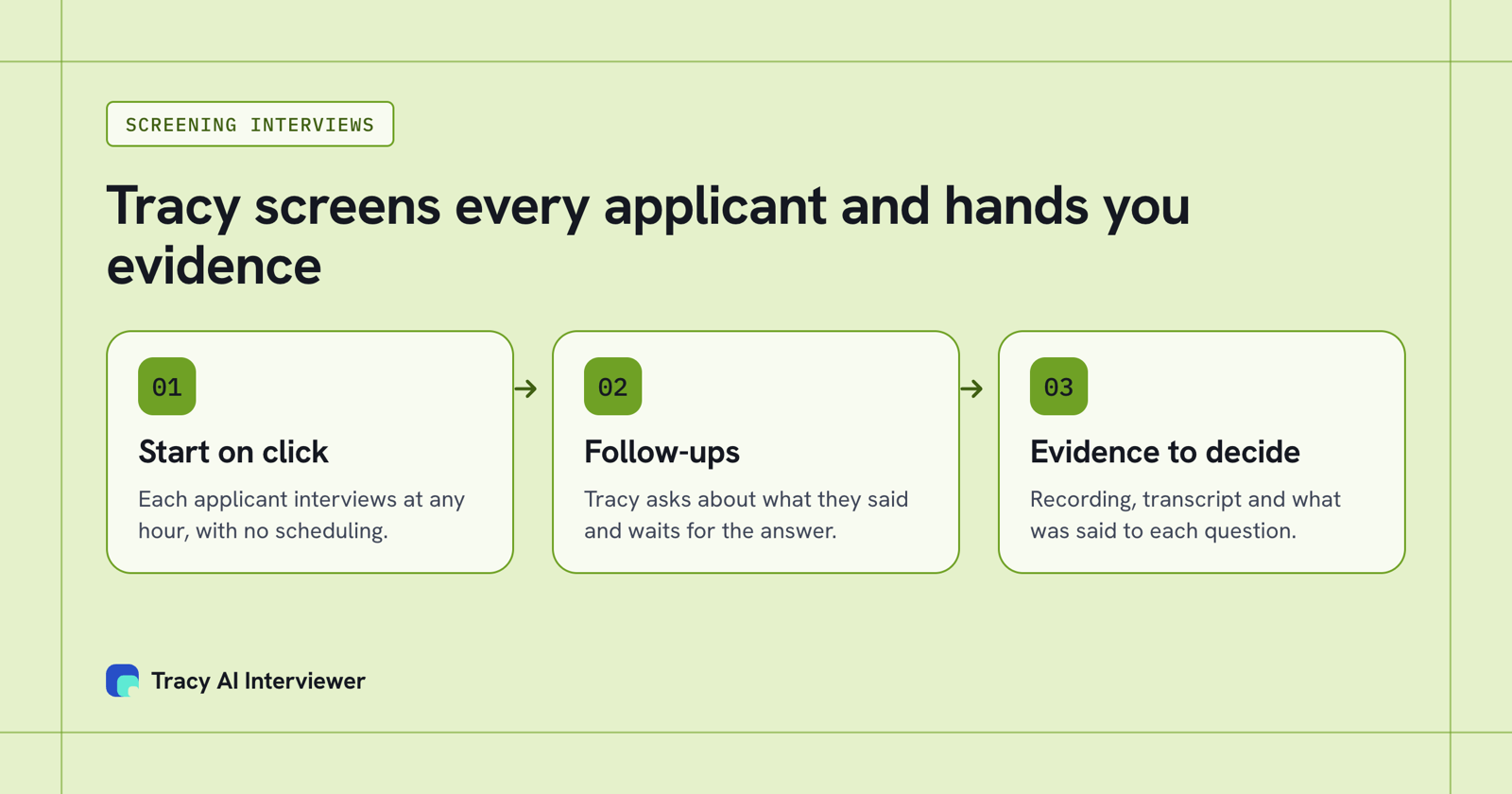
One link replaces the scheduling, and the reviewer receives evidence to decide from.
What should an AI candidate screening tool do?
A screening tool earns its place by what lands in front of the reviewer. Look first at evidence: can a person check a result against what the applicant said? Then at depth, meaning a follow-up on a vague answer instead of the next scripted question. After that, can an applicant start without waiting for a slot, and do results reach your ATS and chat tools? Price breaks ties.
A screen should hand a person evidence, and the decision stays with that person. Integrity signals follow the same rule: they are shown to a reviewer with their evidence and are never proof.
How do the AI candidate screening tools rank, and why in this order?
This ranking suits teams screening engineers and other skilled applicants at volume, and weighs evidence, depth, volume and stack. Places run top to bottom as the table does, and each one has a reason.
- Tracy is first because the screen is an interview that follows up on answers, starts on click and leaves a recording and transcript behind every result.
- HireVue is second: its AI Interviewer builds questions and rubrics from the job description, asks probing follow-ups and shows scores in the ATS, but it publishes no price.
- HeyMilo is third: it offers voice, video, SMS and form interviews and a demo form for price, with 20+ ATS partners on its integrations page (read 3 Nov 2026).
- Alex is fourth: it screens by structured video interview and lists 33+ ATS integrations (as of 9 Nov 2026), and the pages reviewed do not mention follow-ups.
- Sapia is fifth: it runs a five-question text chat with no camera, which suits a different job from a video interview with follow-ups.
- TestGorilla is sixth because it screens with skills tests first and offers AI interviews at 2 credits per candidate.
- Paradox is last for interview depth because its job is chat screening and scheduling.
Each row is what the vendor's own pages state. Prices as published on the vendors' pages on 9 November 2026 (HeyMilo, 3 November); Alex's figure is from its 17 February 2026 blog, whose table says $30K+.
| Tool | Style of screen | What the reviewer gets | Price |
|---|---|---|---|
| Tracy AI Interviewer | Video interview with follow-ups | Recording, transcript, what was said per question | First 3 results free, then $1 per credit |
| HireVue | AI interview with probing follow-ups | Scores against role criteria, explained, in the ATS | Not published |
| HeyMilo | Voice, video, SMS or form | Per-question score with rationale, transcript, recording | Not published; demo form |
| Alex | Structured video interview | Recorded, transcribed and scored | Demo form; Feb 2026 blog: from $36K a year (table: $30K+) |
| Sapia | Five-question text chat | Ranked shortlist with fit score and evidence | Per hire; no rate published |
| TestGorilla | Skills tests, video questions, AI interview | AI interview scores come with reasoning | From $215 a month billed annually |
| Paradox | Apply and screen by chat | Screen answers and a booked time slot | Not published; demo |
Scroll the table sideways to see all 4 columns.
What Tracy adds to AI candidate screening
- Reach every applicant. Each applicant starts on click, at any hour, with no scheduling and no recruiter on the call. The whole pool gets the same screen.
- Ask the next question. Tracy asks about the CV when that check is on, follows what the person said in their own field and waits. A polished claim meets a specific follow-up.
- Keep the evidence. Every result includes a recording, a timestamped transcript and a written assessment per question with its reasoning. Your reviewer checks it and decides.
Every applicant can start on click, every vague answer gets a follow-up, every result comes with evidence.
Which screen fits calls you would otherwise make
Say 100 applicants each need a 20-minute screen. If recruiters phone-screened them, that is about 33 hours of calls; at 1,000 applicants it is about 333 hours. Which tool fits depends on what you want in front of the reviewer afterwards. TestGorilla's skills tests give results on skills, Paradox's chat and Sapia's five-question text chat give written answers, and an interview gives the applicant's own words. Tracy, HireVue, HeyMilo and Alex all screen by interview, and Tracy's report holds what was said with a recording and transcript, and no score. One customer cut its average time to hire from 44 days to 7, and Tracy did the work of 53 full-time recruiters in one month.
Tracy AI Interviewer: screening by interview
Tracy screens each applicant from one link. The applicant opens it in a browser, with no account, and can rejoin within 10 minutes if the connection drops. With the CV check on, Tracy goes through the CV, asks about it and keeps asking about whatever the person just said. For technical roles the interview can include a coding task.
Your reviewer gets video of both sides, the transcript timestamped line by line and the person's answers under the question that prompted each. Integrity signals (tab changes, leaving full screen, gaze) arrive with the moment they happened. The join screen tells the applicant the conversation is recorded and transcribed. Tracy reports what was said and your team decides; she does not score, rank or reject anyone.
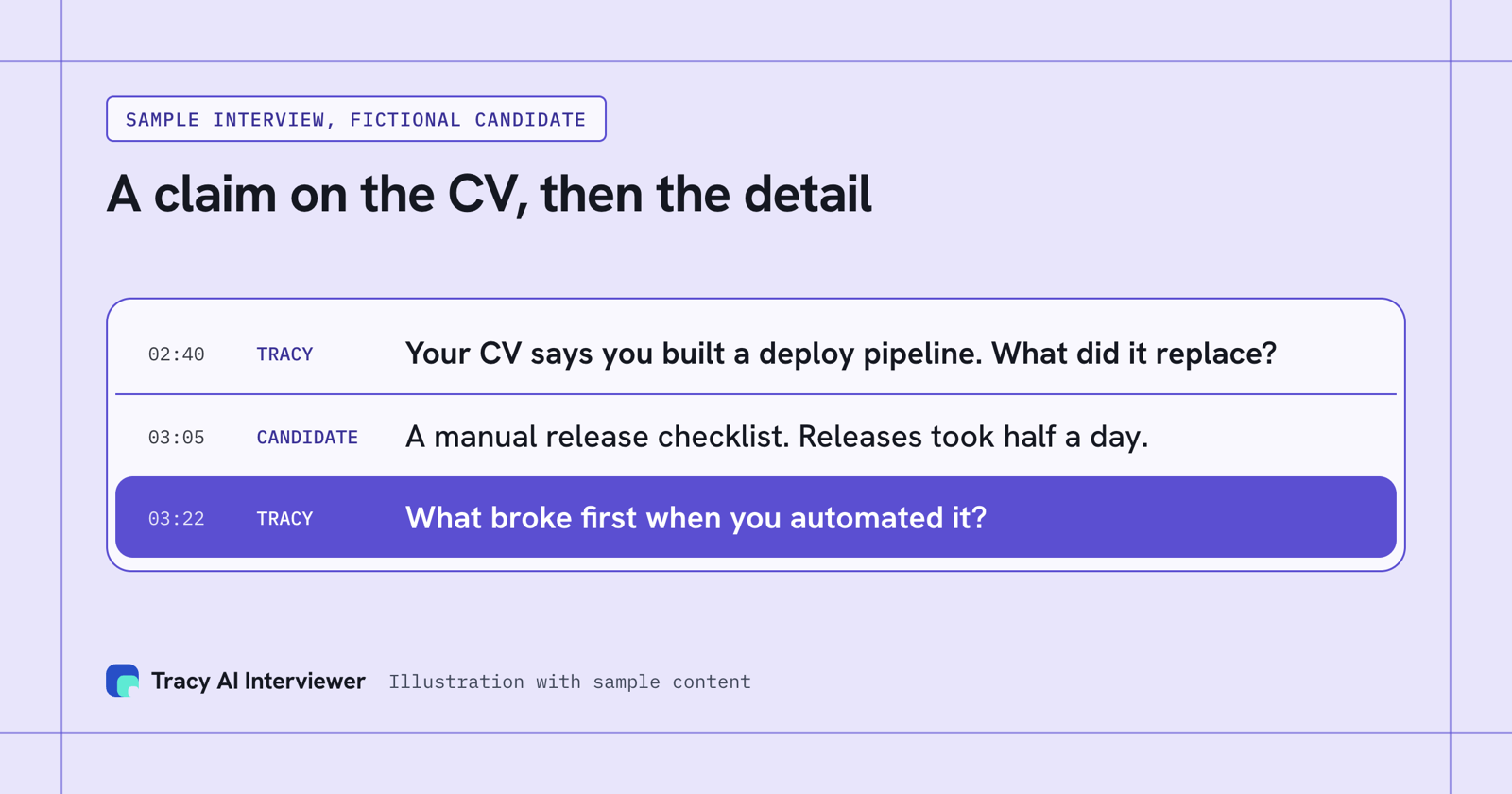
Tracy follows a claim on the CV with a question about the detail, and each line is timestamped.
Which tool fits which screening job?
- HireVue fits enterprise teams that want one suite. It says AI informs and humans decide, and it publishes no price.
- HeyMilo fits teams that want voice, video, SMS and forms in one screen, with two-way sync to 20+ ATS partners (read 3 Nov 2026).
- Alex fits teams that want outreach, screening and scheduling together.
- Sapia fits employers that hire more than 500 people a year and want a text-only screen with no camera (as of 9 Nov 2026).
- TestGorilla fits teams that start from skills tests: its Core plan lists 350+ tests (as of 9 Nov 2026), and ATS integrations and API access are Plus features.
- Paradox fits teams whose hours go on scheduling more than on interview depth.
Choose one of these when the job is the one it names. Choose Tracy when you want the screen itself to be an interview that asks follow-ups, for a technical or skilled role, with evidence a reviewer can open. For coding libraries, see the best technical interview platforms.
Which path fits you?
- Screening at volume: AI interview tools for high-volume hiring ranks tools by hiring volume.
- Recruiters comparing tools by job: best AI tools for recruiters.
- Weighing one tool against Tracy: Tracy vs HireVue, Tracy vs HeyMilo, Tracy vs Sapia and Tracy vs TestGorilla.
- Writing the questions first: candidate screening questions.
Common questions
What are AI candidate screening tools?
What is the best AI candidate screening software for technical roles?
Do AI applicant screening tools make the hiring decision?
How much do AI candidate screening tools cost?
Can candidates cheat an AI screen?
Screen one real role with Tracy
Create one screening interview for a role you are hiring now, then read the follow-ups and the report. The first 3 results are free.
Book a demo (opens in a new tab) Try it free (opens in a new tab)
Your first 3 results are free. No card needed.
Sources
- Tracy AI Interviewer: Pricing, retrieved 14 Nov 2026.
- Tracy AI Interviewer: Hiring at volume, retrieved 14 Nov 2026.
- TestGorilla: Pricing, retrieved 9 Nov 2026.