In short
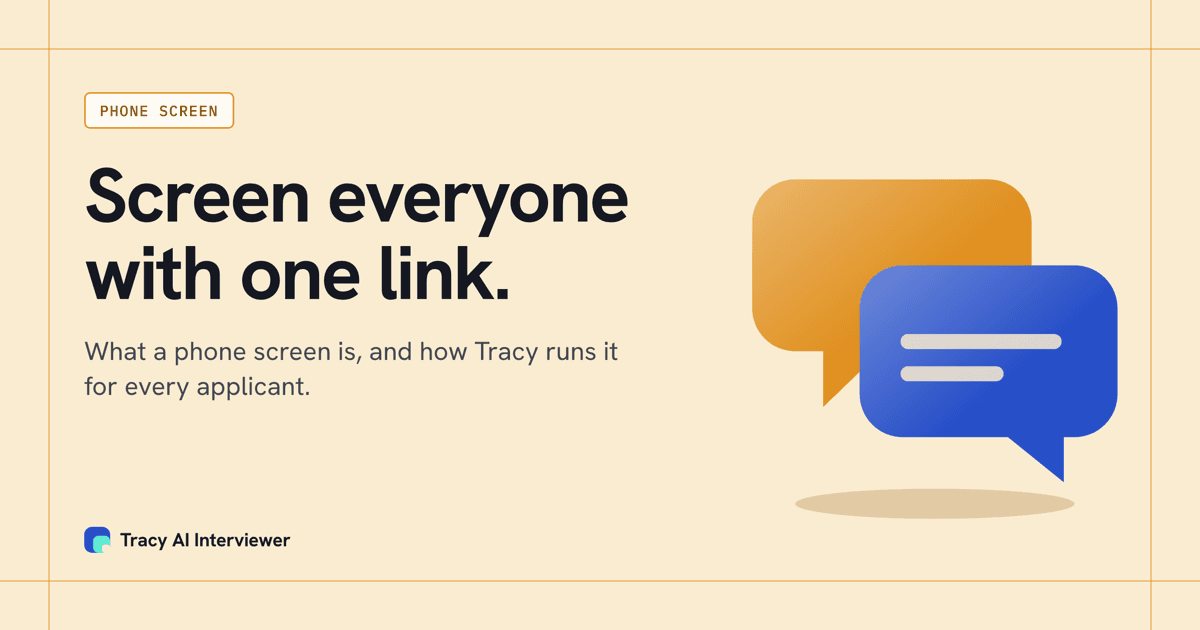
A phone screen is a short first call, usually under 30 minutes, that checks the basics and fit before a longer interview. It works well while the calls fit your recruiters' day. Tracy AI Interviewer runs the same screen for every applicant: each starts on a click at any hour and gets follow-ups in their own field, and a recruiter reads what each one said. A person decides who to call.
What is a phone screen?
A phone screen is a short first call between a recruiter and a candidate. It checks the basics and the fit for a role before anyone books a longer interview. Indeed describes phone screening as "usually the first stage of the interviewing process", run by a hiring manager, recruiter or HR representative. It is also called a phone screen interview, a screening call or a recruiter screen.
Done by a person, it settles the basics fast and builds rapport. The call ends in one of three outcomes: move the person forward, hold, or stop.
Calls fit a handful of candidates. Write the five questions once and a link gives every applicant the same screen, however many apply.
A phone screen is a short first call that decides who gets a longer interview.
How does a phone screen work?
A phone screen follows a fixed order: the recruiter opens, checks the must-haves, asks a few questions about the role, takes the candidate's questions and explains what happens next. The sample below fits a 20-minute call. The times are an example, not a standard.
A sample 20-minute phone screen: five parts, what each covers and how long it takes (fictional example).
| Part | What it covers | Minutes |
|---|---|---|
| Opening | Who is calling, the role, how the call runs | 2 |
| Knock-out checks | Location, work authorization, notice period, pay range | 4 |
| Role questions | Recent work, skills the job needs, one follow-up each | 10 |
| Their questions | What the candidate wants to know | 3 |
| Next steps | What happens and when they will hear back | 1 |
Ask each candidate the same role questions, so you can compare people on the same ground. Our phone screening script has the word-for-word version.
How long is a phone screen?
Most phone screens last under 30 minutes, according to Indeed's guidance. A call on a well-defined role can be shorter. Length mostly follows the number of role questions: each one with a follow-up takes two to three minutes.
A short call still costs the recruiter time per candidate, plus the time to book it. Assume 20 to 30 minutes a call: 50 applicants then take 17 to 25 hours of calls before any interview starts.
Phone screen questions to ask
Good phone screen questions are short and tied to the job. Five that fit most roles:
- "Walk me through your last role." Listen for what they owned, not the job title.
- "What drew you to this position?" Listen for a reason specific to the work.
- "Which of the skills in the job post have you used most recently?" Listen for a recent example with a result.
- "What are you looking for in your next role?" Listen for whether the job gives it.
- "What is your notice period and pay range?" Listen for a fit with the practical limits of the role.
Each one earns a follow-up: "What did you do?", "What happened next?", "How did you measure it?". The follow-up separates a rehearsed answer from real experience. See first-round interview questions for a longer set grouped by what they settle.
Phone screen vs pre-screening vs first-round interview
The three terms overlap, and teams use them loosely. A phone screen names the format, a call. A pre-screening interview names the purpose, a short conversation that decides who moves on, and it can run on a call, on video or in writing. The first-round interview comes next and usually goes deeper than a screen.
When should a team automate the phone screen?
Automate the first screen when applicants outnumber the call slots you have. Below that, a human call is fine and builds rapport. Four signs the calls have become the bottleneck:
- Calls fill most of a recruiter's day, and the next step waits on them.
- Candidates reply after the role is filled, or after another offer.
- Each recruiter asks different questions, so notes cannot be compared.
- The shortlist is a guess, because nobody had time to call everyone.
Automating the screen leaves the person in place. The repeatable questions move into an interview each applicant takes on their own time, and the recruiter's calls go to the people worth speaking to. See AI screening interviews for how that works.
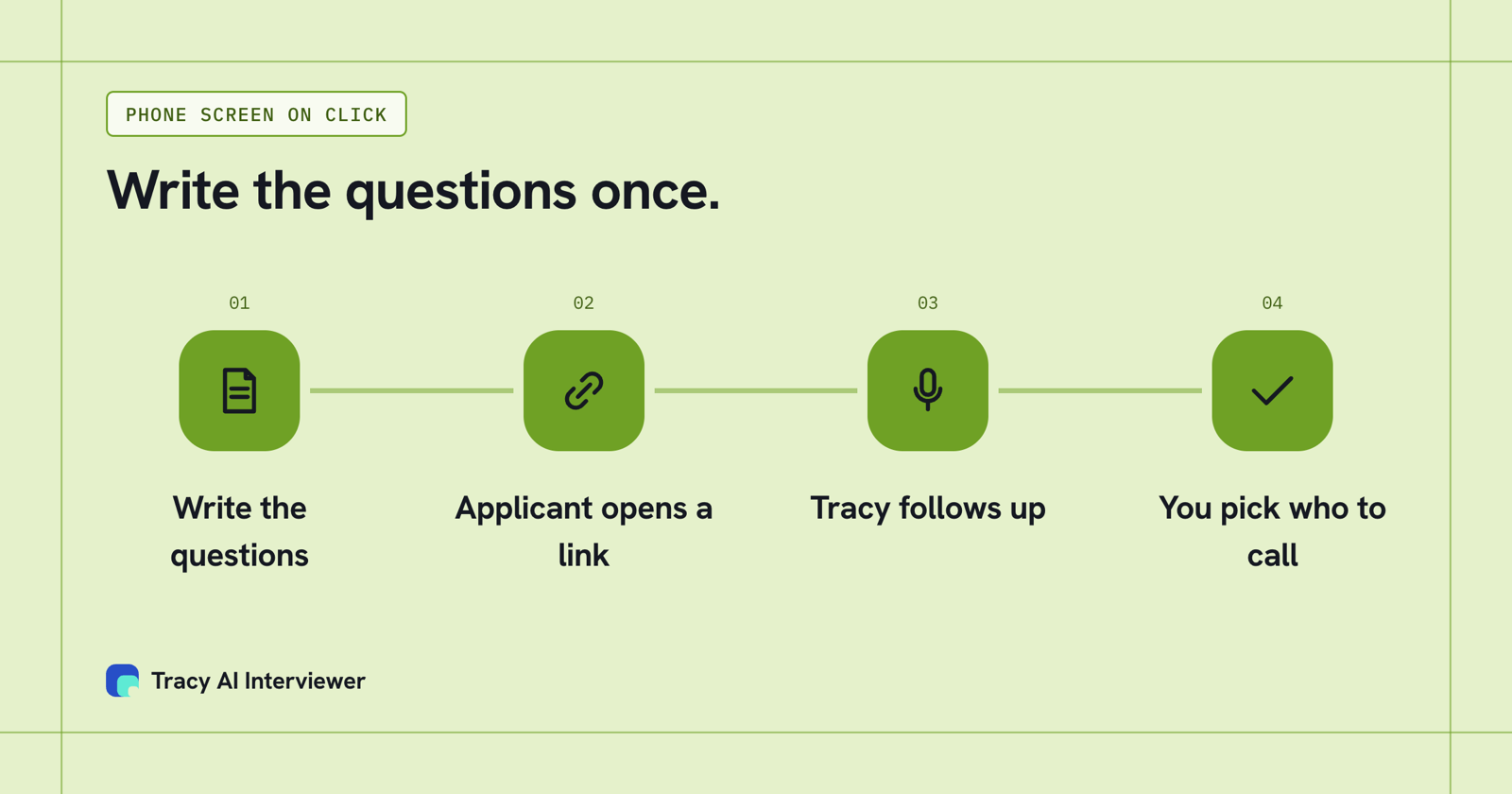
The same questions reach every applicant, and the recruiter reads before calling.
What Tracy adds to the phone screen
01
Reach every applicant
Each applicant starts the screen from a link on click, at any hour, with nobody scheduling and no recruiter on the line. A reminder can go out after a day.
02
Ask the next question
Tracy listens, waits for the end of the thought and asks for the missing detail, in the applicant's own field. Tell Tracy the role and it drafts the questions, which you edit or replace with your own script.
03
Keep the evidence
Before ringing anyone on the shortlist, a recruiter can listen back, read a timestamped transcript and see a written assessment per question with its reasoning. Applicants are told on the join screen that the interview is recorded and transcribed.
A customer's average time to hire fell from 44 days to 7. To see it, paste your screening questions into one role and read what comes back. More on the hiring at volume use case.
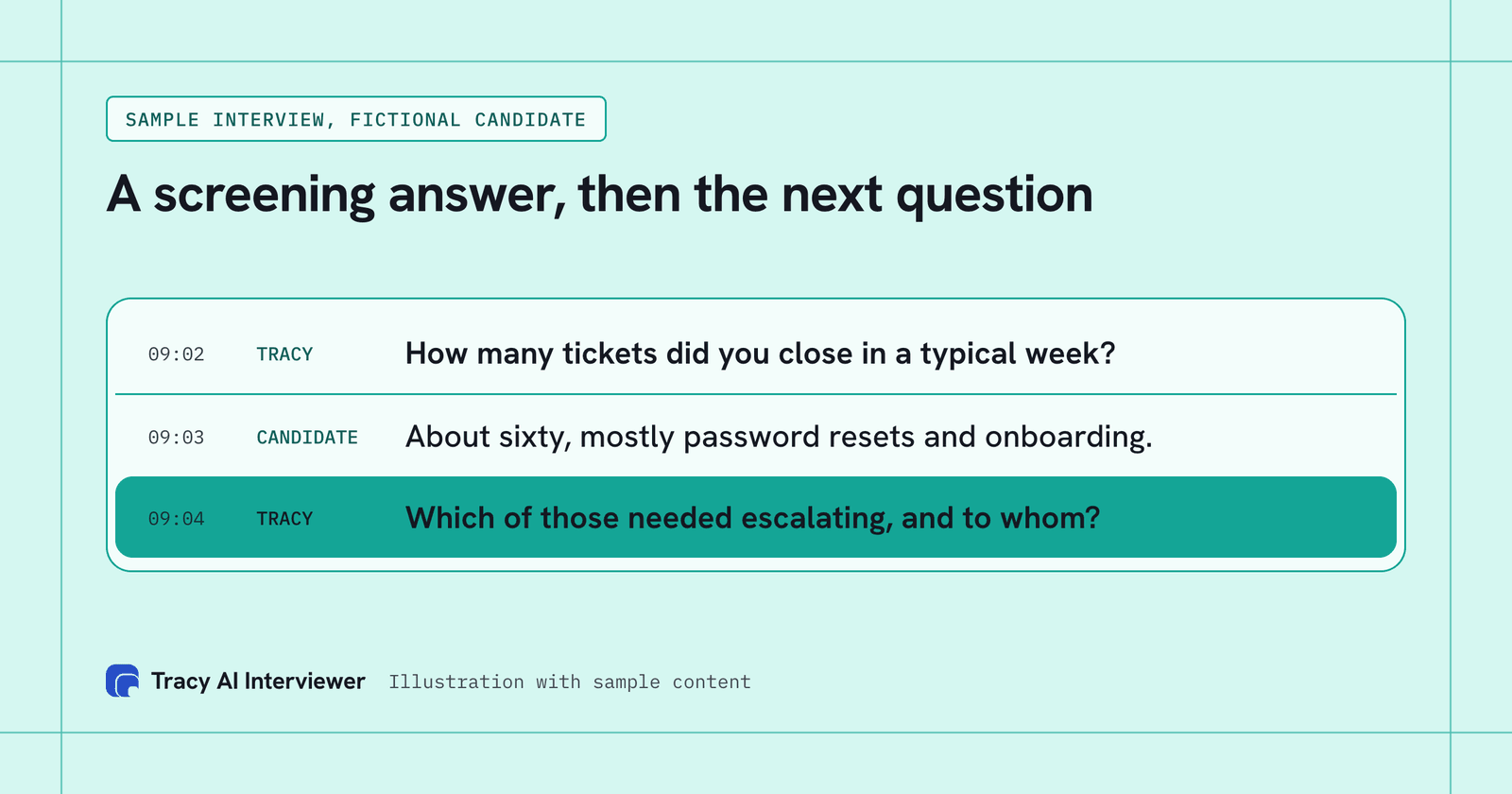
Tracy follows a screening answer with the question a recruiter would ask next.
What a phone screen leaves a reviewer to check
A phone screen ends in a note: forward, hold or stop. Whoever has to trust that note can believe it or call the candidate again. Say the note reads "handled tickets well". To check it, the reviewer needs the answer behind it, and a call that was not recorded cannot be reread.
Calling again does not scale: 50 applicants at 20 to 30 minutes a call already took 17 to 25 hours. A recorded screen with a transcript lets the reviewer read the sentence behind the note, and the follow-up that came after it.
Related terms
- Screening interview. The wider term for any early interview that filters applicants.
- Pre-screening interview. A short first conversation on the basics, in any format.
- First-round interview. The first full interview, after the screen.
- Knock-out question. A yes or no check, such as work authorization, that ends the process if it fails.
- Technical screen. A screen that tests skills for a technical role. See what a technical screen is.
Which path fits you:
- Applicants outnumber your slots: see hiring at volume.
- Engineering roles: see technical interviews.
- What comes back: what an interview report contains.
Common questions
What is a phone screen interview?
What is a phone screen for a job?
How long is a phone screen?
Who runs a phone screen?
Can an AI interviewer run a phone screen?
Run your phone screen on click
Paste your screening questions into one role, then read what each applicant said. The first 3 results are free.
Try it free (opens in a new tab) Book a demo (opens in a new tab)
Your first 3 results are free. No card needed.
Sources
- Indeed, Phone screening, retrieved 14 Nov 2026.
- Tracy AI Interviewer home page, retrieved 14 Nov 2026.
- Tracy AI Interviewer pricing, retrieved 14 Nov 2026.