In short
A first-round interview is the first formal interview after the application. It checks core skills and fit and decides who gets a longer one, which a recruiter-run call does well for a handful of people. For a hundred applicants, each call needs a booked slot. Tracy AI Interviewer runs the round for every applicant on click, follows up on what they say and leaves a recording and transcript. A person decides who moves on.
What is a first-round interview?
A first-round interview is the first formal interview in a hiring process. It comes after the application or résumé review, checks whether the candidate has the core skills and fit for the role, and decides who gets a longer interview. It is also called a first-stage interview or an initial interview.
The format varies. It can be a call, a video meeting, a meeting in person or a written one in which candidates answer questions on their own time. Whatever the format, the output is the same: a decision to move on, hold or stop.
The round earns its place because one conversation with the same questions settles who goes on. The strain is volume. The format suits a handful of candidates, so at a hundred it queues behind the diary until the person asking changes.
A first-round interview is the first formal interview and decides who goes on to a longer one.
What is a first-round interview like?
Expect one conversation, led by a recruiter or the hiring manager, covering your background, the skills the job needs and practical details such as start date and pay range. Length varies by employer. The sample below fits 30 minutes.
A sample first-round interview: four parts and what each one covers (fictional example).
| Part | What it covers |
|---|---|
| Role and motivation | Why this job, why now, what they know about the team |
| Core skills | Two or three skills the job uses, each with a follow-up |
| How they work | A recent project: what they owned, what went wrong, what they changed |
| Practical details | Start date, location, pay range, other processes |
The questions are the same for every candidate and the notes record what was said. Our first-round interview questions page lists sixteen, grouped by what each one settles.
What is a written first-round interview?
A written first-round interview asks candidates to answer in writing, or in recorded video, on their own time. Nobody is present, so no follow-up happens unless a reviewer sends one later. That scales: if a hundred candidates apply this week, all of them can answer this week. What it gives up is the follow-up question, where a screen learns the most. See what an asynchronous video interview is for the recorded version.
Who runs the first round?
Five setups are common.
Five ways to run a first-round interview, what each looks like and where it strains.
| Who runs it | What it looks like | Where it strains |
|---|---|---|
| A recruiter | A call or video meeting with a set of questions | Calendar time. Each candidate takes a slot, so the first round queues behind the diary. |
| The hiring manager | A conversation about the work | Manager hours, and the questions differ from one manager to the next. |
| A panel | Two or three people ask in turn | Hard to schedule, so it suits later rounds. |
| Written or one-way | Candidates answer alone | No follow-up on what they said. |
| An AI interviewer | A live video conversation with follow-ups | Needs clear criteria and a person to decide. |
Most teams mix them: a short screen to filter, then a first round that goes deeper.
First round vs phone screen vs second round
A phone screen is a short call that checks basics, while a first-round interview is the first full interview and goes further into skills and working style. A second round goes deeper still, usually with the team, and may add a task or a presentation.
Some employers treat the screen as the first round, and some run both. If you are the candidate, ask the recruiter what each step covers. If you are the employer, name each step by what it settles.
What a first round must settle
A first round has four jobs. Say a team is hiring a support agent. The first round settles whether the person can handle a customer problem, how they think when pressed and whether they can start in March. It leaves the pay negotiation, a work sample and a meeting with the team for round two.
- Can they do the work? Test the three or four skills the role uses, in the candidate's own field.
- How do they think? Follow up on each answer: why, what it cost, what changed.
- How do they work? Ownership, feedback and working with others.
- Can they start? Hours, time zone and start date.
Without follow-ups the round turns into a quiz, and without notes a second person cannot check the decision.
For the reviewer, a first round counts only if each of the four jobs can be checked afterwards: the question asked, the answer given, the follow-up that tested it and a record of both. Say 100 people apply and the round is the 30-minute call above: that is about 50 hours of calls, and a reviewer cannot recheck a call nobody recorded.
What Tracy adds to a first-round interview
Tracy gives the first round to every applicant as a video interview behind a link, so it does not wait on a diary.
- Reach every applicant. Applicants join from the link at any hour, with no scheduling and nobody in the room. The whole pool gets a round.
- Ask the next question. She asks about the detail that is missing and waits for the answer. A Director at a top-tier early-stage VC says: "Tracy sometimes brings up exactly those questions I might have forgotten to ask, which has been a pleasant surprise." Describe the role and Tracy drafts the questions; you edit them, then run it.
- Keep the evidence. Before round two, the hiring manager can open the recording, a timestamped transcript and a written assessment per question, with no call to sit in on.
A person weighs the evidence and chooses who goes to round two. One customer cut its average time to hire from 44 days to 7, and Tracy did the work of 53 full-time recruiters in one month. See the hiring at volume use case, or set up one role and open the first results. The first 3 are free.
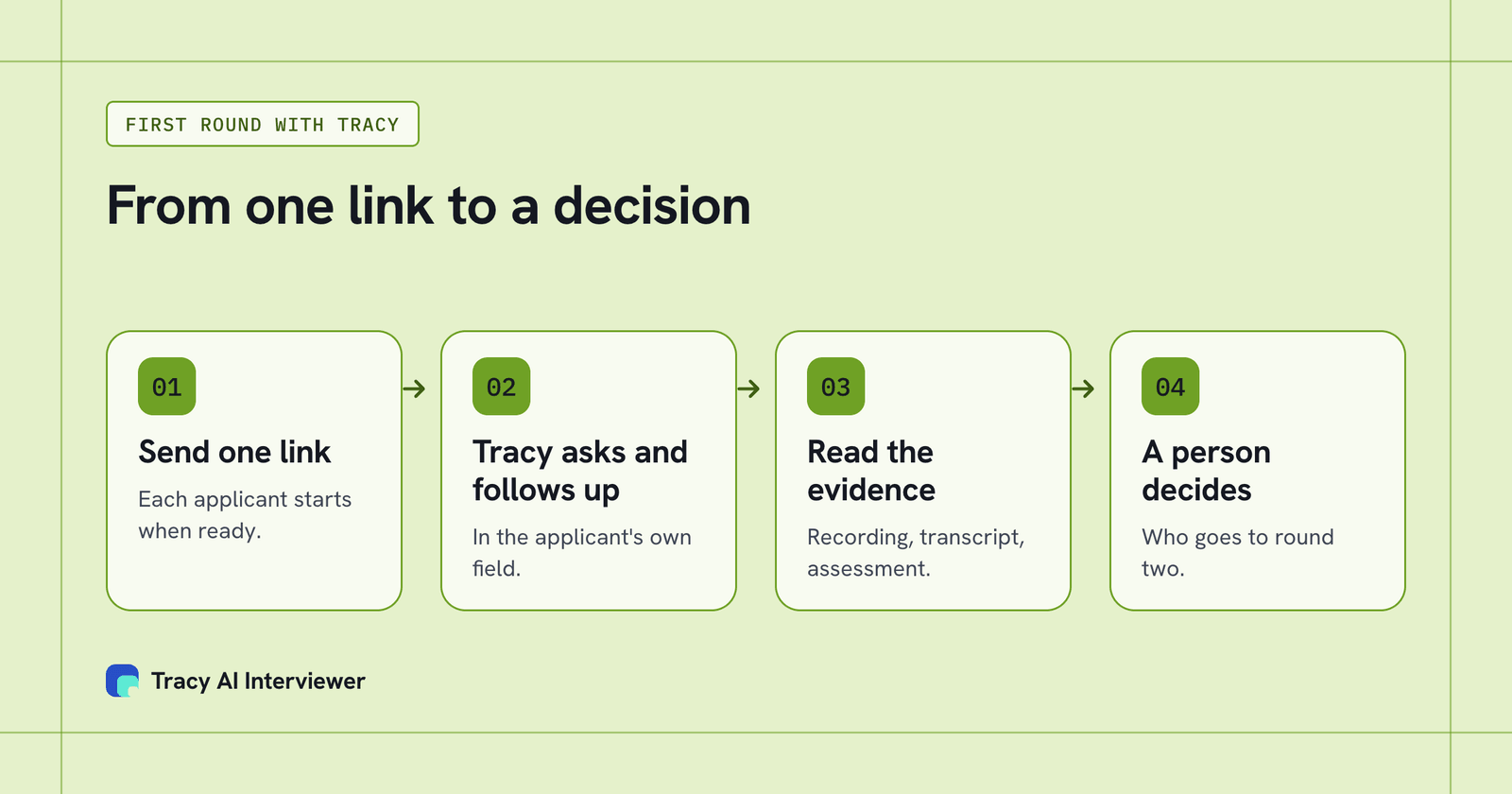
Every applicant takes the first round on a click, and a person decides from the evidence.
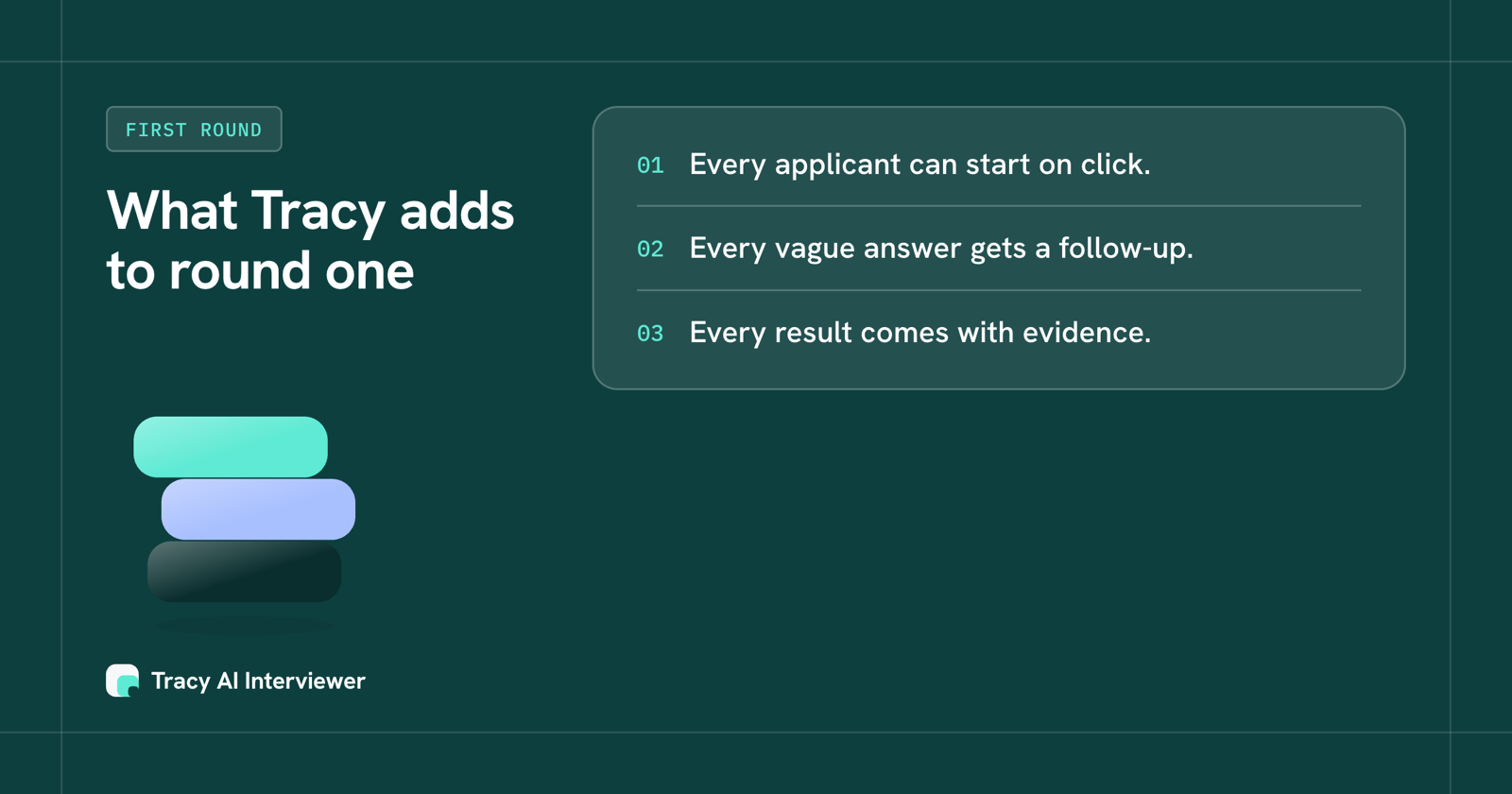
Three things Tracy adds to a first round.
Related terms
- Phone screen: the short call before the first round, or in place of it.
- Pre-screening interview: a short first conversation, in any format.
- Second-round interview: a deeper interview, usually with the team.
- Panel interview: several interviewers in one session.
- Technical screen: a first round that tests skills for a technical role.
Which path fits you:
- Hiring for many openings: see hiring at volume.
- Skills-heavy roles: see technical interviews.
- What the manager opens: what an interview report contains.
Common questions
What is a first-round interview?
What is a first-round interview like?
What is a first-stage interview?
What is a written first-round interview?
What does a first-round interview mean for the next step?
Run your first round on click
Set up one role as a Tracy interview and read what each applicant said. The first 3 results are free.
Try it free (opens in a new tab) Book a demo (opens in a new tab)
Your first 3 results are free. No card needed.
Sources
- Tracy AI Interviewer home page, retrieved 14 Nov 2026.
- Tracy AI Interviewer pricing, retrieved 14 Nov 2026.