In short
Perplexity is built around cited web answers, and its Pro Search combines several searches into one answer that names its sources. Claude's Research mode also writes a cited report, and Claude is the one to reach for when the work centres on long files you upload.
Either way, the citation is a pointer you still have to open. Neither tool can tell you what your own customers think. Tracy AI Interviewer runs those interviews from a Claude chat and keeps the words behind each finding.
The two work well together: Perplexity gathers published sources and Claude reads your files, and interviews cover whatever both leave open.
Is Perplexity better than Claude for research?
For finding and citing what is published, Perplexity is the more direct tool, because every answer is meant to arrive with its sources. For working through your own long documents in one thread, Claude states its limits in pages and files: PDFs up to 1,000 pages, 20 files per chat. Neither is better in general. Match the tool to the first job on your list, and read Claude for research if that job is Claude's.
How do Claude and Perplexity compare for research?
| Perplexity | Claude | |
|---|---|---|
| Research mode | Deep Research reads many sources and writes a detailed report | Research runs five or more tool calls over 1 to 3 minutes |
| Citations | Pro Search answers cite sources; open them to check | Reports carry citations |
| Your files | 40 MB per file; longer files are condensed | PDFs up to 1,000 pages, 500MB per file |
| Workspace | Projects hold files, links and instructions up to 8,000 characters | Chats with up to 20 files |
| Plans | Deep Research on Pro, Max, Enterprise Pro, Enterprise Max | Research on Pro, Max, Ultra, Team, Enterprise |
| Internal sources | Pro and Enterprise users can search internal files with the web | Connectors, including Google Workspace |
Each vendor's own description, read 22 Nov 2026.
When does each one fit?
Choose Perplexity when:
- the first job is a wide sweep of published sources, and you want the answer to arrive with its citations;
- you want a Project that holds sources, links and standing instructions of up to 8,000 characters;
- your recordings are audio or video, since Perplexity transcribes them with speaker labels.
Choose Claude when:
- the work centres on long reports, with PDFs up to 1,000 pages and 20 files in a chat;
- you want one thread where research, drafting and file creation happen together;
- the material sits in connected tools, since Research can use Google Workspace and other connectors.
Limits behave differently too. Perplexity's Deep Research has a monthly limit that resets on a rolling basis. Anthropic says research sessions can use up your Claude limits faster, so run the long ones once.
Which is better for citations?
Both cite, and both tell you to check. Perplexity's help page says to open the cited sources to check important claims. Claude's Research writes a report with citations. A link next to a sentence shows where the tool looked, and only the page can confirm that it says what the sentence claims. When Perplexity launched Deep Research on 14 Feb 2025, it said the feature performs dozens of searches and reads hundreds of sources. That is a lot of reading to audit, so audit the claims you plan to repeat.
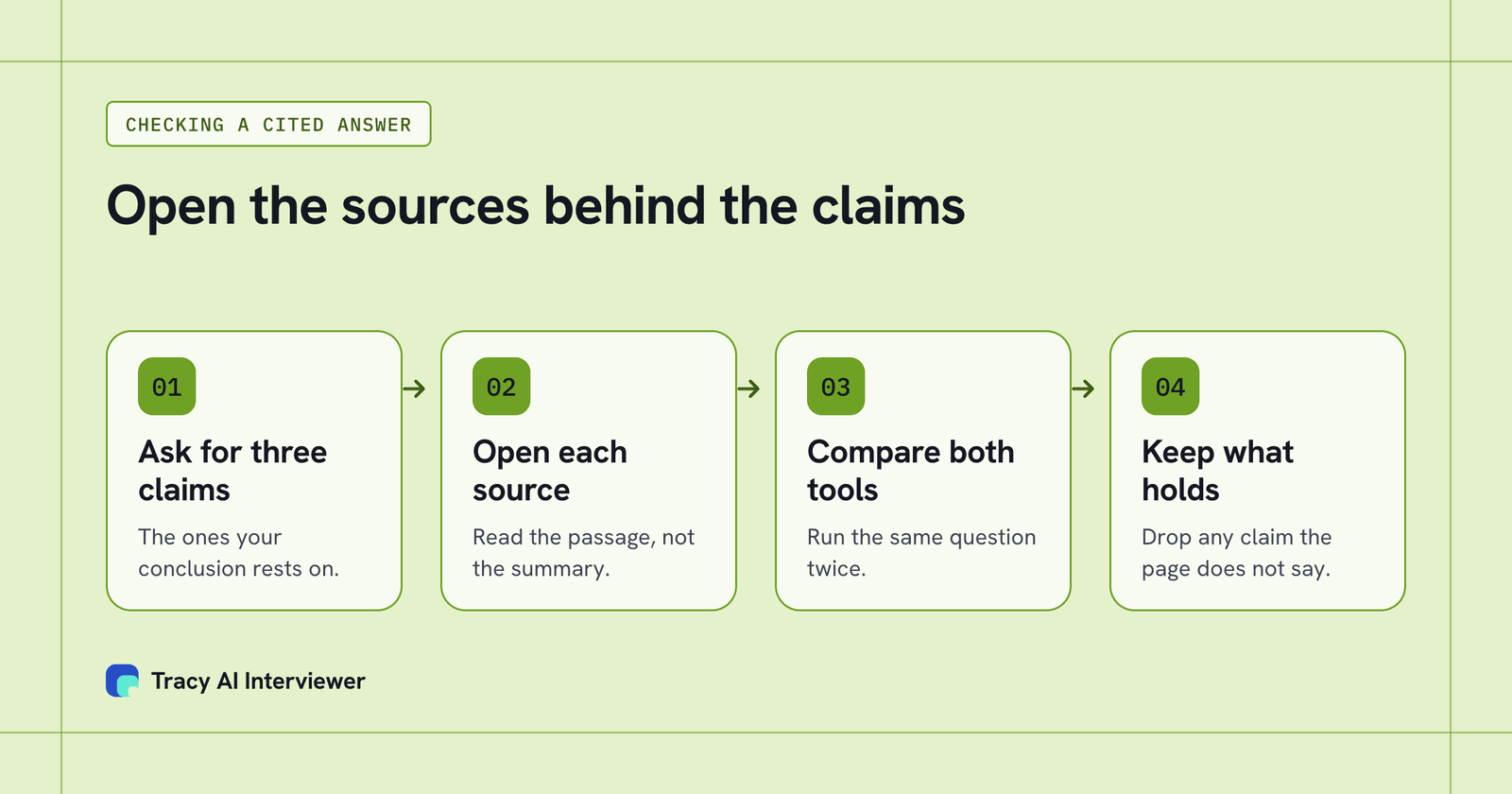
A cited answer is only as good as the three sources you open behind it.
The check takes ten minutes and works in both tools. Ask for the three claims that carry your conclusion, with the passage each rests on. Then open those pages yourself. If you are choosing between the two tools, run the same question through both and see whose claims survive. For a research paper, the same rule applies one level down: open the paper, not the summary of it.
Here is a starting prompt, written for this page: "What do published sources say about [topic]? Give each claim a source link and mark any claim that rests on only one source." The last clause tells you where to look hardest.
Can you use both?
Yes, and the division of labour is natural. Perplexity gathers published sources and keeps them in a Project. Claude reads the long files you added and writes up what they say. Both then stop at the same place: the questions the sources leave open. Perplexity for market research shows how to list those gaps, and Claude vs Gemini for research covers the third assistant people ask about.
What fills the gaps neither tool can read?
Why a buyer chose another vendor, or what they would have needed to see, sits in no document. Tracy AI Interviewer connects to Claude, so you describe what you want to learn and Tracy drafts the interview guide. You edit it, approve the preview, and send participants a link. Each person joins in a browser when it suits them, with no calendar and no account.
When an answer is thin, Tracy asks the next question to get the reason. In the sample below, an invented buyer gives a reason, and the follow-up finds who made the call.
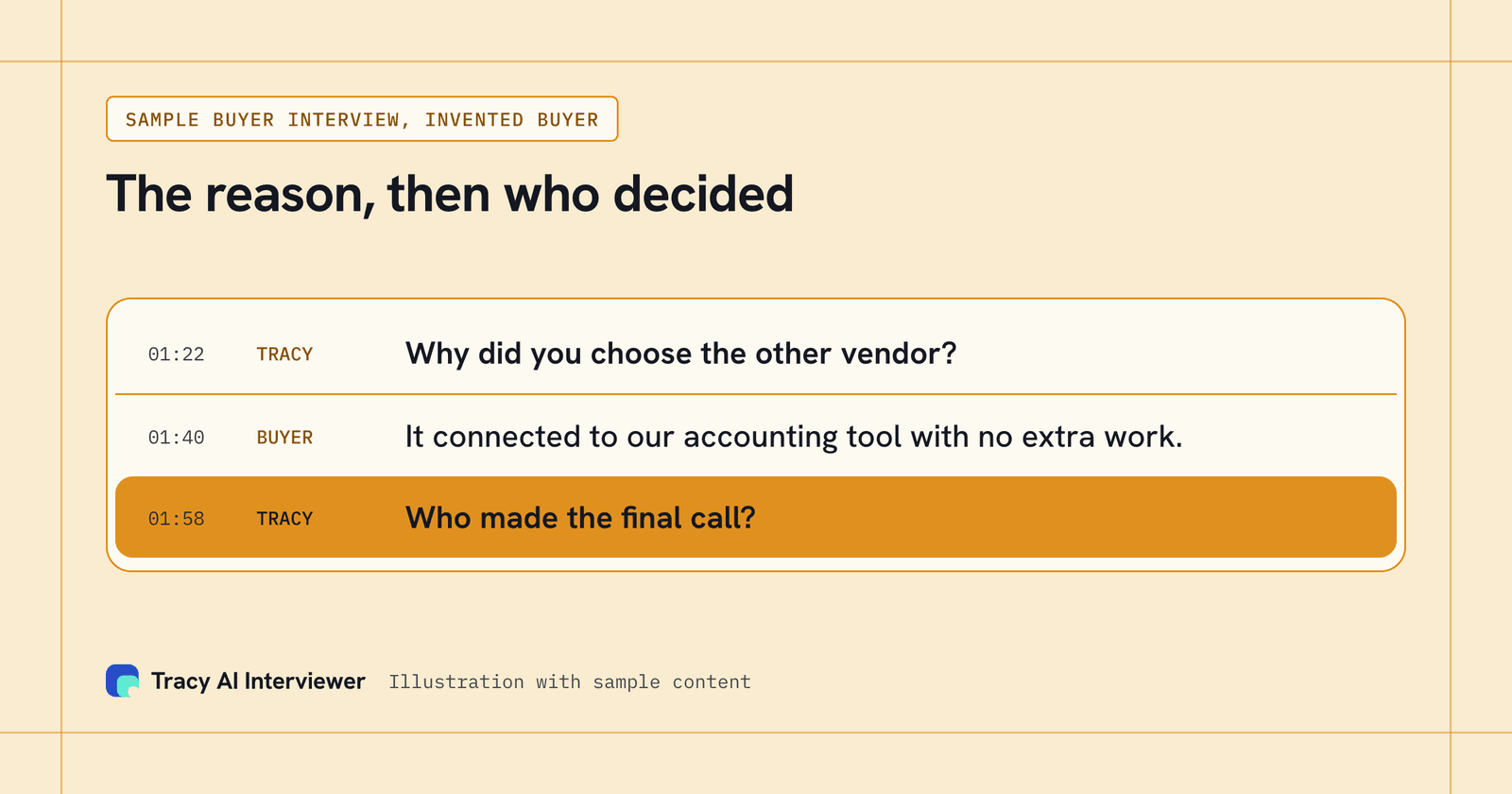
The follow-up finds who made the decision, a fact no search result holds.
Back in Claude, ask for the results. Each participant's answers return question by question with the result fields, and each finding links to the moment in the recording. Tracy does not score or rank anyone, so any grouping of themes is yours or Claude's to do. Claude for customer research walks through that step.
Which path fits you?
- Desk research with a Claude Project: Claude for research.
- Comparing the big two assistants: Claude vs ChatGPT for research.
- Running customer conversations next: how to run customer interviews.
- Setting Tracy up in Claude: add Tracy to Claude.
Common questions
Is Perplexity better than Claude for research?
Which is better for citations?
Can you use both?
Claude or Perplexity for a research paper?
Can Claude or Perplexity interview my customers?
Start an interview from your AI chat
Connect Tracy to Claude and describe what you want to learn. You approve the preview before anything is sent. First 3 results free.
Try it free (opens in a new tab) Book a demo (opens in a new tab)
Your first 3 results are free. No card needed.
Sources
- Perplexity Help Center: What is Pro Search?, retrieved 22 Nov 2026.
- Perplexity Help Center: What is Research mode?, retrieved 22 Nov 2026.
- Perplexity Help Center: File uploads, retrieved 22 Nov 2026.
- Anthropic help center: Using Research on Claude, retrieved 22 Nov 2026.
- Anthropic help center: What kinds of documents can I upload to Claude?, retrieved 14 Nov 2026.
- Tracy AI Interviewer: Connect, retrieved 23 Nov 2026.