In short
Claude can do the first pass of thematic analysis: read the transcripts, propose codes, group them into candidate themes and pull a quote for each. You decide which themes are real.
Claude codes what it is given, so a thin answer gives it one line. Tracy AI Interviewer runs the interviews from a Claude chat, asks the follow-up a vague answer needs and keeps a recording and timestamped transcript behind each one.
Start with five interviews and one written codebook. The first 3 Tracy results are free.
Can Claude do thematic analysis?
Yes, for the first pass. Claude reads a transcript, proposes codes, groups them and pulls the sentences that support each group. Deciding which theme answers your research question stays with you. The wider workflow, from collecting to checking, is in Claude for qualitative research. This page stays on the coding itself.
Which phases of thematic analysis can Claude help with?
Braun and Clarke's 2006 paper describes six phases. Claude is a fast first reader in the first three. The last three are judgement.
- Familiarise yourself with the data. Claude summarises each participant in a few lines. You still read some transcripts in full.
- Generate initial codes. Claude lists codes, each with a definition, a quote and a timestamp.
- Search for themes. Claude groups the codes and you ask which answers contradict each group.
- Review the themes. You open the quotes and drop the weak ones.
- Define and name the themes. This is your reading of the data.
- Write up. Claude can draft from the quotes only, and you edit.
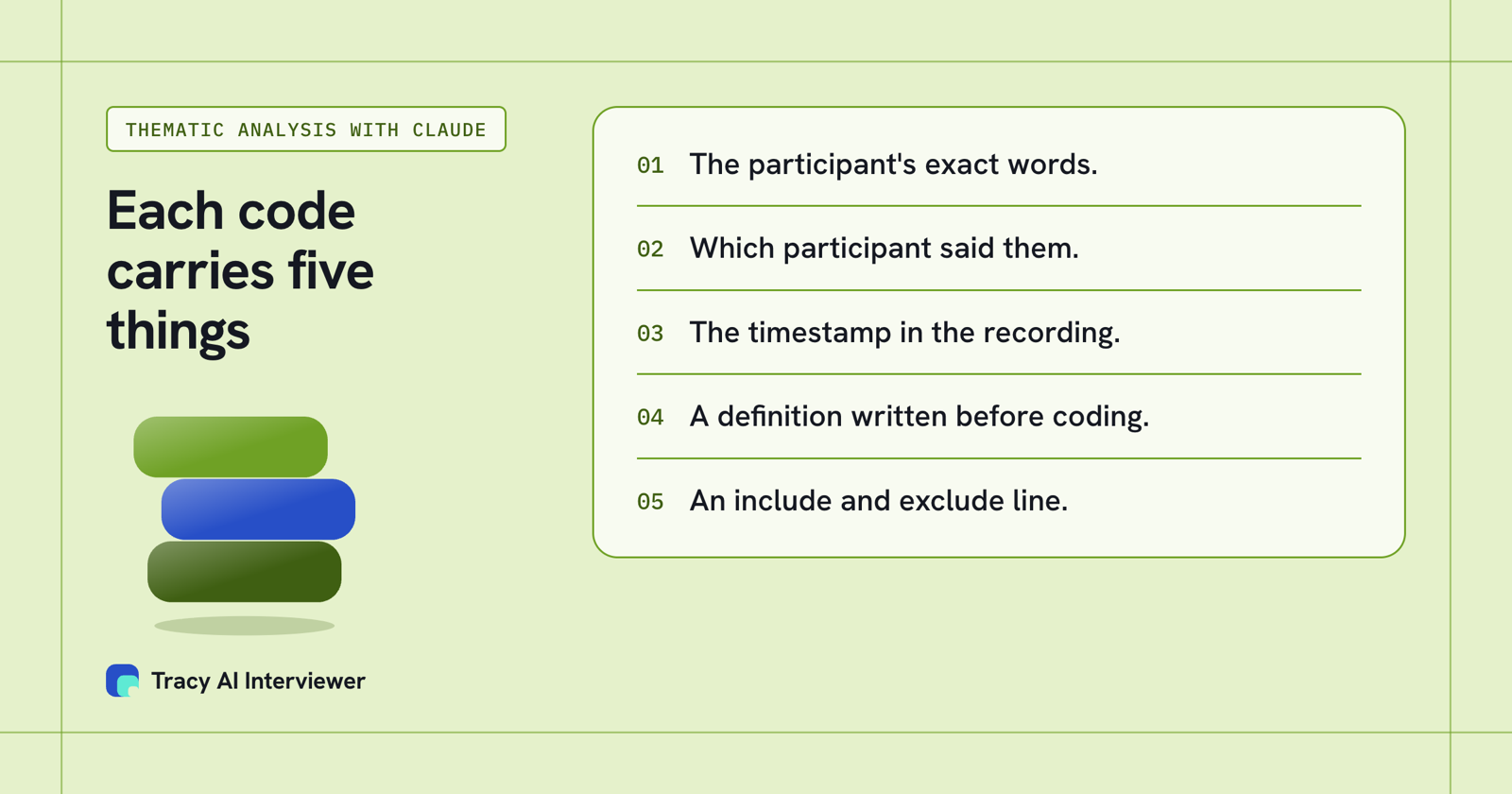
A code that carries the exact words, the participant, a timestamp, a definition and an include line can be checked in minutes.
How do you prompt Claude for thematic analysis?
Run two kinds of pass. An open pass lets Claude suggest codes. A fixed pass tags everything with a codebook you wrote.
For the open pass, try: "Read these six transcripts. List the codes you see. For each code give a one-line definition, one exact quote and the participant and timestamp. Do not group yet."
For the fixed pass: "Here is my codebook: code, definition, include when, exclude when. Tag each interview below with up to two codes. If no code fits, write NEW and propose one. Return a table with the participant, the code, the quote and the timestamp."
Then ask the test question: "Which answers contradict each theme, and which participants fit no theme?" Ask Claude for the table and count from it yourself, because counts typed into a chat reply are the ones that drift. Going from transcripts to themes gives the method behind these passes.
How do you tag survey feedback with Claude?
Use the fixed pass. Paste the comments with an id each, give the codebook, and ask for one row per comment: id, up to two codes, and the phrase that triggered each code. Open-text survey answers are short, so a code needs a clear include and exclude line or Claude will stretch it to cover anything near it. Run the same tagging in a second chat and list the comments that got different codes. Those comments show you which definitions are loose.
Is there a Claude skill for thematic analysis?
You can write one. A skill is a folder with a SKILL.md file. The name and description are required, and the description says what the skill does and when to use it. Anthropic describes skills as activating dynamically when needed, where Projects hold background knowledge that is always loaded. A codebook suits a skill: the definitions stay fixed and every chat tags the same way. A starting file:
name: thematic-tagging
description: Tags interview transcripts or survey comments with a fixed codebook and returns a table with a quote and timestamp for each tag. Use when asked to code, tag or analyse qualitative feedback.
# Codebook
- unaware-of-option: the person says they did not know an option existed. Exclude: they knew and chose not to use it.
- team-size-change: the person's team grew or shrank. Exclude: budget changes.
# Rules
- Tag only what the participant said. Quote exactly, with the timestamp.
- If no code fits, write NEW and propose one.
- Never state a count. The researcher counts from the table.
Skills need code execution switched on. Use only skills you wrote or trust: Anthropic warns that a malicious skill can direct Claude to call tools or run code against its stated purpose.
What does the data behind a code look like?
Take a cancelled-customer interview, a sample we invented. At 01:34 the customer says "We went from twelve people to four." Coded alone, that is a team-size theme. At 01:48 Tracy asks "Did you look at a smaller plan?" and at 02:10 the customer says they did not know there was one. The code is now unaware-of-option, a different theme with a different fix. Because each line sits at a timestamp, you can open the recording and hear it before the theme goes into a report.
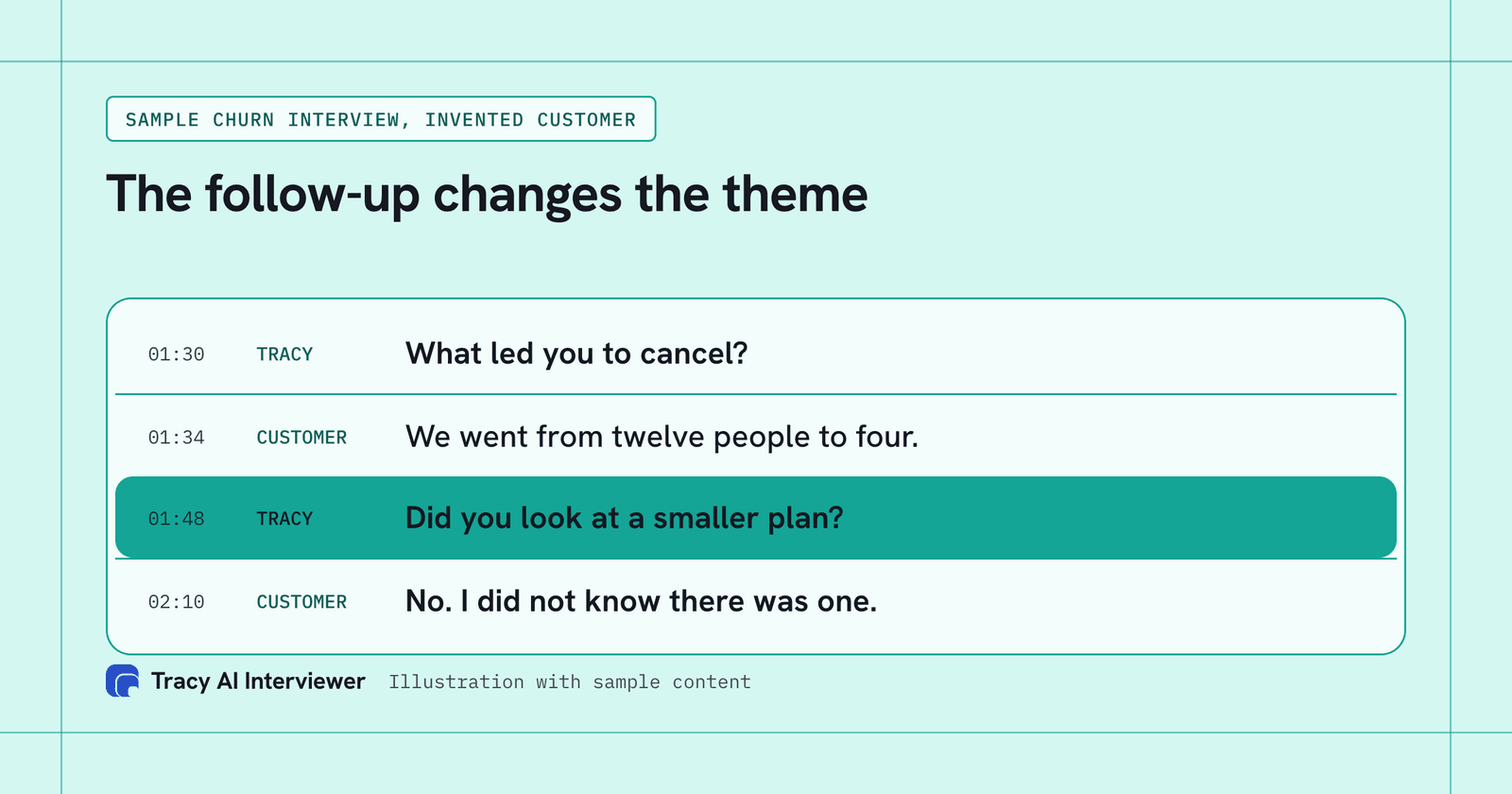
One follow-up turned a size-change code into a communication gap.
Where does the data come from?
The interviews can come from any you run, or from Tracy. Connect Tracy to Claude, describe what you want to learn, approve the preview and send participants a link. They join in a browser with no account and are told on the join screen that the conversation is recorded and transcribed. Ask Claude for the results and it returns what each participant said to each question, with the result fields, into the chat. Setup steps are in how to run interviews from a Claude chat.
What Tracy adds to Claude for thematic analysis
Claude codes the text it is given, so the codes are only as good as the interviews. Tracy runs those interviews: each person starts on click, at any hour, with nobody scheduling or sitting in on the call. When an answer is missing its detail, Tracy listens, waits until the person has finished and asks for it, so Claude gets a second line to code instead of one thin answer. A recording and a timestamped transcript sit behind every result, so a quote in your table can be opened at its source.
Where does Claude's thematic analysis need your check?
Check contradictions, counts and repeatability. Ask for contradictions in every pass, then read the answers yourself. Claude may write "most participants" when it means three of eleven, so count from the table. On repeatability, a 2024 JMIR viewpoint tried ChatGPT-3.5 on one podcast transcript and says it may give different answers to the same questions. That is not a test of Claude, but the habit carries over: run the coding twice and compare.
Which path fits you?
- Collecting and checking a whole study: Claude for qualitative research.
- Customer discovery calls: Claude for customer research.
- Survey comments in ChatGPT: ChatGPT for survey analysis.
- Adding Tracy to Claude: how to add MCP to Claude.
Common questions
Can Claude do thematic analysis?
Is there a Claude skill for thematic analysis?
How do I tag survey feedback with Claude?
Is Claude's thematic analysis repeatable?
What does Tracy cost for a small study?
Run five interviews from a Claude chat
Describe what you want to learn, approve the preview and send the link; the answers come back in your chat. First 3 results free.
Try it free (opens in a new tab) Book a demo (opens in a new tab)
Your first 3 results are free. No card needed.
Sources
- Add Tracy AI Interviewer to Claude (public guide), retrieved 14 Nov 2026.
- Braun and Clarke (2006), Using thematic analysis in psychology, retrieved 14 Nov 2026.
- Anthropic, Agent Skills overview, retrieved 14 Nov 2026.
- Anthropic, What are skills?, retrieved 14 Nov 2026.
- Lee et al. (2024), Harnessing ChatGPT for Thematic Analysis: Are We Ready? JMIR (a viewpoint on ChatGPT-3.5, one transcript), retrieved 14 Nov 2026.