In short
Claude for qualitative research does the repetitive first pass well: reading a transcript, proposing codes, grouping them and pulling supporting quotes. It cannot supply the interviews. Tracy AI Interviewer collects them from the Claude chat, asking the follow-up a vague answer needs, with a recording and timestamped transcript behind each. Claude proposes the themes, and you check each against the transcript and decide.
What Claude for qualitative research does well
Claude is good at the repetitive part: reading a transcript, proposing codes, grouping them and pulling the sentences that support each group. It is weaker at knowing which odd remark matters, so the analysis only holds up if you keep it tied to the participants' words. This page follows a study of how freelance designers handle client feedback.
Claude can code a transcript in one pass, but it can only code what a participant said. The follow-up asked during the interview decides how much there is to code.
Is Claude good for qualitative research?
Good for a first pass, with you in charge of the rest. Anthropic's own interview tool shows the intended split: Claude drafts the guide, interviews each participant with follow-ups, then identifies themes and pulls illustrative quotations, and researchers help validate and interpret the findings. Use the same division on your own study. Claude proposes. You confirm that each theme is in the data, that the quote says what the theme says, and that the theme matters to your question.
Where do the interviews come from?
From wherever you get them, and the quality of the analysis follows the quality of the data. A one-line answer gives Claude one line to code.
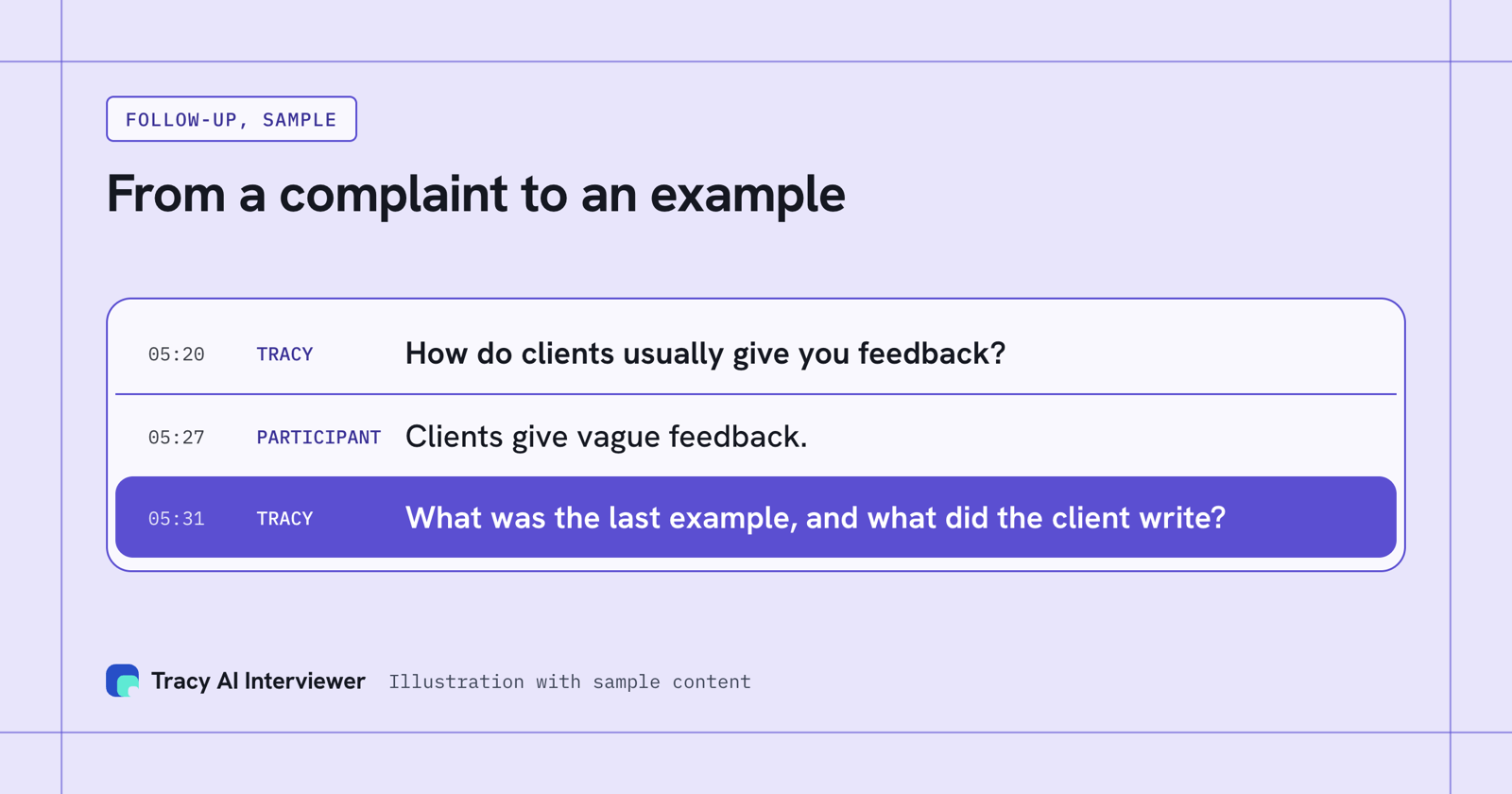
A vague answer becomes a concrete example once Tracy asks for the last time.
Tracy asks for the missing detail while the participant is still talking: a designer who says "clients give vague feedback" is asked for the last example and what the client actually wrote. Participants join from a link in a browser, with no account, and the join screen tells them the conversation is recorded and transcribed. Set the study up from the chat with the setup steps.
What Tracy adds to Claude for qualitative research
- Reach every participant you invite. Each person starts on click, at any hour, with no scheduling and no researcher on the call. Your sample stops depending on calendars.
- Ask the next question. Tracy follows the answer in the participant's own field and waits for it, so the data has detail worth coding.
- Keep the evidence. Each result has a recording, a timestamped transcript and a written assessment per question with its reasoning, so each theme can be checked at the source.
How do you code interviews with Claude, step by step?
Braun and Clarke's 2006 paper on thematic analysis describes six phases: familiarise yourself with the data, generate initial codes, search for themes, review them, define and name them, and write up. Claude can help with some of them. Use this split.
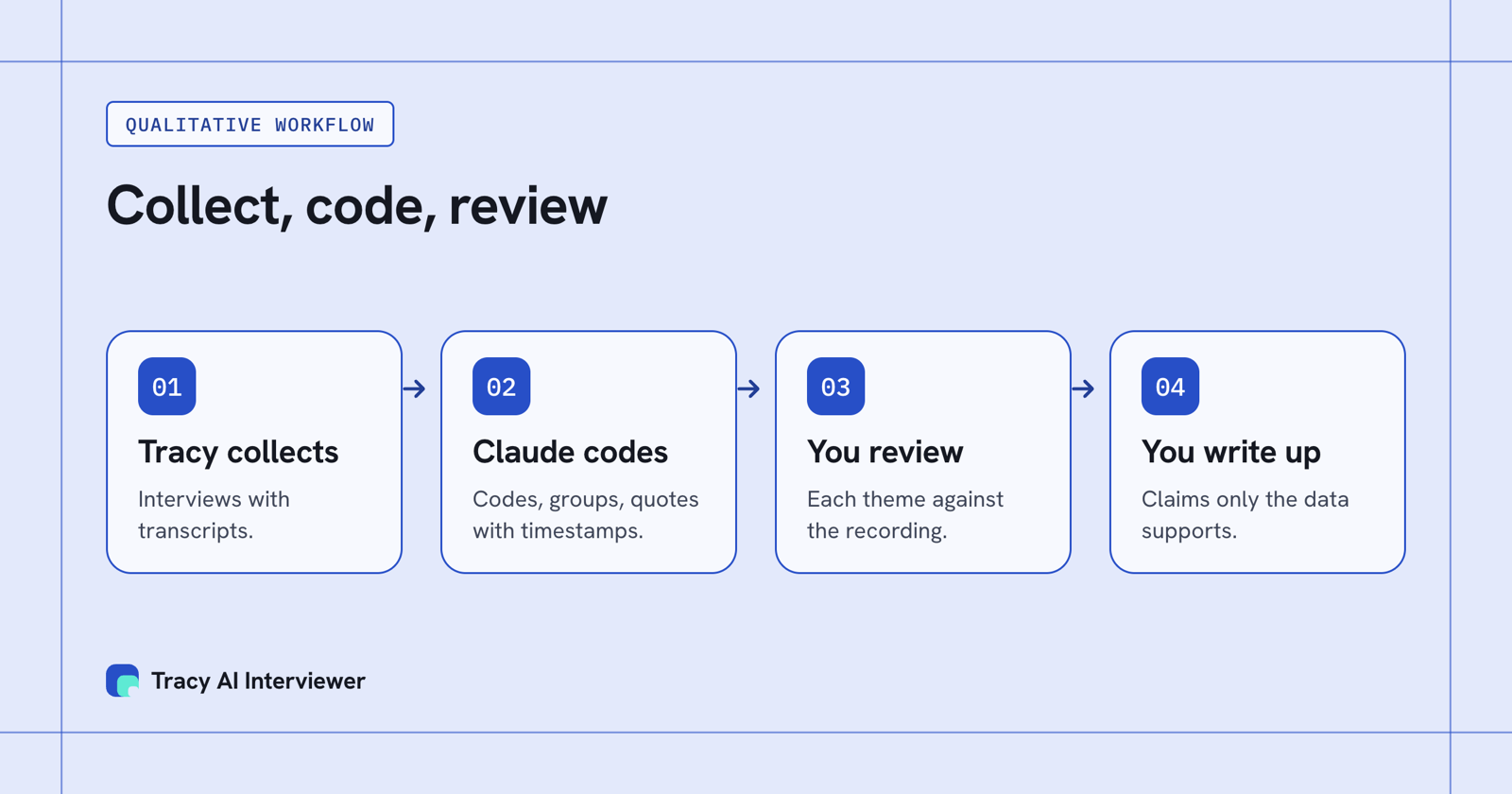
Tracy collects, Claude proposes codes, you review each theme against quotes and write up.
What should you ask Claude to do?
Ask in small steps, in this order:
- Read: "Summarise each participant in three lines. Do not interpret yet."
- Code: "List codes for how designers handle client feedback. Give a quote for each code, with the participant and timestamp."
- Group: "Group the codes into candidate themes and say which codes sit in each."
- Test: "Which answers contradict each theme? Which participants fit no theme?"
- Draft: "Write two sentences per theme from the quotes only."
A theme that no participant contradicts has not been tested. Ask the question in the chat, then read the contradicting answers yourself. Going from transcripts to themes gives the method behind the steps.
What does coded output look like?
A usable result shows the theme, what participants said and where to find it. Here is a short coded result for the freelance designer study, a sample we wrote with invented participants and timestamps:
Theme: feedback arrives without a goal.
- P3, 06:41: "They said 'make it pop' and nothing else."
- P7, 03:12: "I get a message at 11 pm saying it feels off."
- Contradicts: P5, 09:20: "My client sends a numbered list every time."
Then you check it. The card below lists four checks to run on Claude's pass, and they apply to any study.
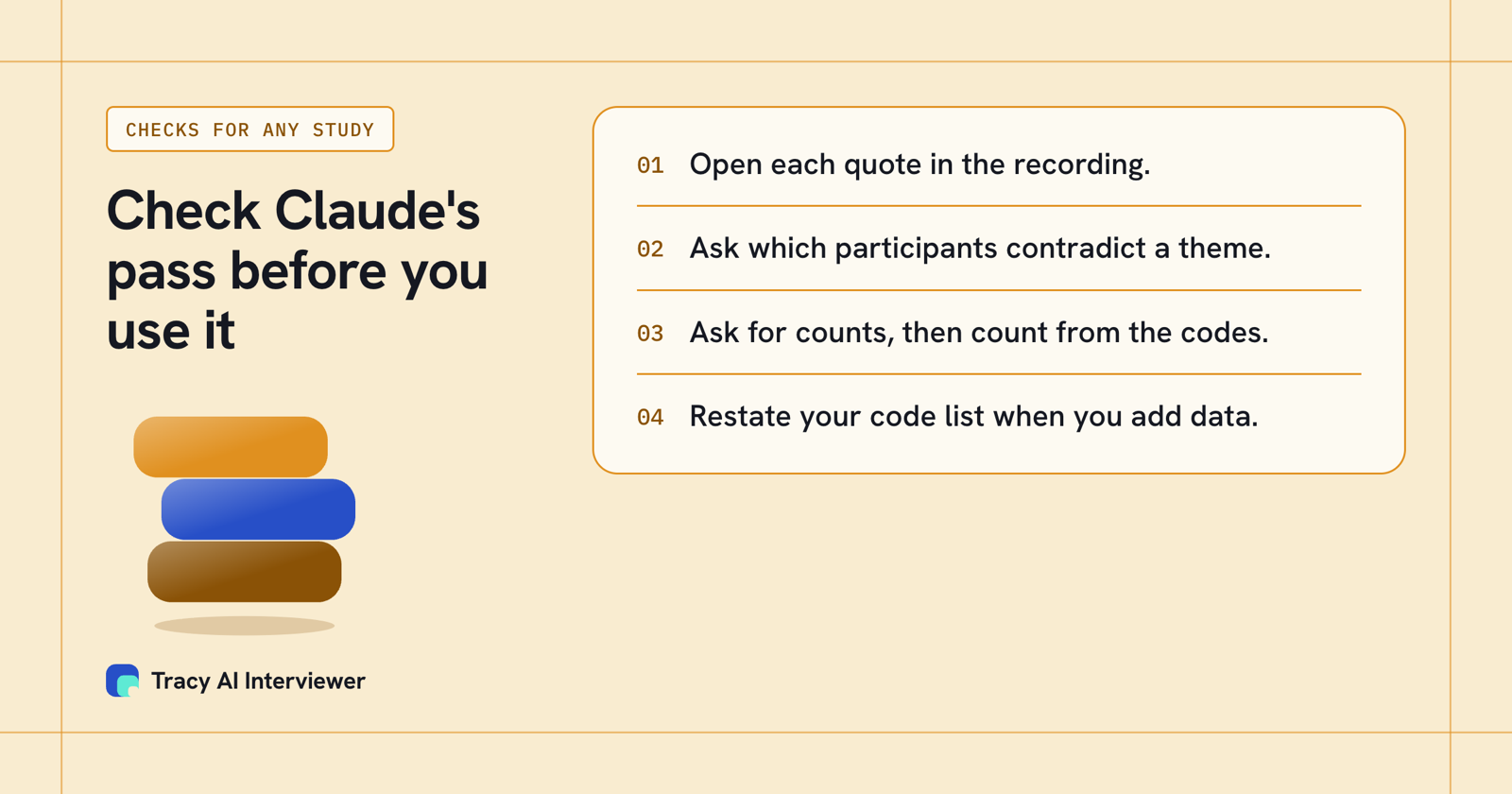
Four checks turn Claude's first pass into analysis you can defend.
Where does Claude's coding need your check?
Three places. First, nuance: a polite remark can carry the main point, and a model may treat it as filler. Second, drift: in a long chat, early decisions about what a code means can slip, so restate your code list when you add transcripts. Third, frequency: Claude may write "most designers" when it means three of eleven. Ask for counts, then count from the codes. Three of eleven designers is about 27%, and only a code tied to each participant lets you say so.
Tracy keeps a recording and a timestamped transcript behind each result, with what each person said to each question, so each claim can be checked at the source. Tracy reports what people said and does not score or rank them.
Where should the codebook live?
Keep it outside the chat. Anthropic describes Projects as self-contained workspaces with their own chat histories and knowledge bases, where you can add files and write project instructions. Put your code list and its definitions in the project instructions, so each new chat starts from the same codebook. Claude accepts PDF, DOCX and CSV among other file types, up to 20 files per chat, so a batch of transcripts fits in one conversation. Export the interviews, add them in batches and paste the code list again whenever you add a batch. When two chats disagree about a code, the instructions decide, and you decide whether the instructions were right.
What stays with the researcher?
The question, the sampling, the interpretation and the claim you make from it. If your study needs ethics review, consent beyond the join-screen notice or analysis that must follow a named method, those stay with you and your institution.
Which path fits you?
- Setting up a study: collect interviews from a Claude chat.
- Researcher end to end: Claude for UX research.
- On ChatGPT: ChatGPT for qualitative research.
- Getting summaries with quotes: AI interview summaries.
- Cost: the pricing page has the current plan.
Common questions
Can Claude do qualitative research?
Is Claude good for qualitative analysis?
Is Claude's coding repeatable?
Where do I get interview transcripts to analyse?
Does Claude invent quotes?
What does Tracy cost for a small study?
Collect one small study from Claude
Connect Claude, describe the study and send the link. You read what each person said. The first 3 results are free.
Try it free (opens in a new tab) Book a demo (opens in a new tab)
Your first 3 results are free. No card needed.
Sources
- Add Tracy AI Interviewer to Claude (public guide), retrieved 9 Nov 2026.
- Tracy AI Interviewer customer research use case, retrieved 9 Nov 2026.
- About Anthropic Interviewer, retrieved 14 Nov 2026.
- Braun and Clarke (2006), Using thematic analysis in psychology, retrieved 9 Nov 2026.
- Anthropic: What are projects?, retrieved 14 Nov 2026.
- Anthropic: What kinds of documents can I upload to Claude?, retrieved 14 Nov 2026.
- Lee et al. (2024), Harnessing ChatGPT for Thematic Analysis: Are We Ready? JMIR (a viewpoint, one transcript), retrieved 15 Nov 2026.