In short
ChatGPT is good at the repeated work in talent acquisition: briefs, search strings, CV comparisons with quotes, debriefs and funnel summaries. Tracy AI Interviewer adds the stage a chat cannot run: each applicant starts a video interview on click, answers get follow-ups in their field, and your team keeps a recording and transcript. Prompts 15 and 16 connect them. A person makes every hiring decision.
What ChatGPT prompts for talent acquisition do well
A talent acquisition team keeps many roles moving through one process, with hiring managers waiting on each stage, so these ChatGPT prompts for talent acquisition follow the funnel. The 20 prompts say what to ask ChatGPT at each stage and what a person keeps.
Most stages need a draft or a summary, and ChatGPT does that well. The interview stage needs a conversation with every applicant, so prompts 15 and 16 hand it to Tracy AI Interviewer.
The funnel at a glance
| Stage | Ask ChatGPT to | A person keeps |
|---|---|---|
| Plan | Turn intake notes into briefs and timelines | Headcount and priorities |
| Source | Draft searches and messages | Who to contact |
| Screen | Compare CVs with must-haves, with quotes | Who moves forward |
| Interview | Draft questions; set up Tracy interviews | Reading the results |
| Decide | Draft debriefs and offers from evidence | The decision |
| Report | Summarise funnel numbers you paste in | What to change |
Plan (1 to 4)
1. Intake brief
Turn these intake notes into a role brief with the business problem, 3 must-haves, 3 nice-to-haves, deal-breakers and interview stages. Mark anything missing "unknown". Notes: [paste]
2. Stage plan with owners
For [role], draft the stages from application to offer. For each stage give the owner, the output it produces and a target number of days. I will adjust the targets.
3. Hiring manager agreement
Write a one-page agreement a hiring manager and I can sign for [role]: the must-haves, who interviews, how fast feedback comes back, and what happens if the brief changes.
4. Workload across roles
Here are our open roles and recruiters: [paste]. Suggest how to split them, and list the three roles most at risk of slipping and why.
Source (5 to 7)
5. Search strings from a brief
From this brief write 3 search strings for [platform]: exact, wide and skills-led. Say what each will miss.
6. Outreach by segment
Write a first message for each of these three groups: [group 1], [group 2], [group 3]. Under 90 words. One specific hook each, and a one-word-answer question to end.
7. Check a job post for what it asks
Read this post and list requirements an interview could not check, such as "rockstar" or "10 years of a 5-year-old tool". Suggest a plain replacement for each. Post: [paste] The point of this one is skills-based hiring: ask only for what you can check.
Screen (8 to 11)
8. CV against must-haves
Compare this CV with these must-haves. For each write "shown", "partly shown" or "not shown" and quote the line. Do not score the person and do not recommend rejection. CV: [paste]
9. Fair-process check
Review the screening steps below and list any step where two reviewers could reach different answers from the same evidence. Suggest a fixed question or criterion for each. Steps: [paste]
10. Questions for a gap
From the comparison above, write 5 questions that check what the CV leaves open. Each one asks for a specific project.
11. Knockout questions
Suggest 4 yes or no application questions limited to legal and practical requirements. Leave out anything that could screen people out unfairly.
Interview (12 to 16)
12. Structured question set
From this brief write 8 interview questions, each tied to one must-have and asking for a specific past situation. Put what a thin answer sounds like beside each. Same questions for everyone is what makes it a structured interview.
13. Scorecard criteria
Suggest 5 criteria for [role] with a one-line description of what evidence for each looks like. The reviewer will mark them; you only propose the wording. Tracy does not mark criteria; your reviewer does. For a full layout, see the interview scorecard template.
14. Interview stages for volume
We get about [number] applications per role. Suggest which stages should be live with a person and which should be an interview every applicant can take on their own time, with reasons.
15. Hand the interview to Tracy
@Tracy AI Interviewer set up a screening interview for [role] from this brief: [paste]. Show me the draft first. Then, once I approve it, show me an invitation to send to [email addresses] and wait for my approval. After prompt 15, ChatGPT shows the interview as a preview to review before anything is created, and an invitation is previewed too and not sent until you approve it. A new interview starts with its public link on (anyone with the link, up to 20 people for 14 days) and nobody invited; you can turn the link off. Tracy then interviews each person who clicks the link, whenever they choose, with no calendar.
16. Read the results
Which interviews for [role] are finished? For each, give what the person said about [must-have] with the timestamp. Do not rank or score anyone; I will review them myself.
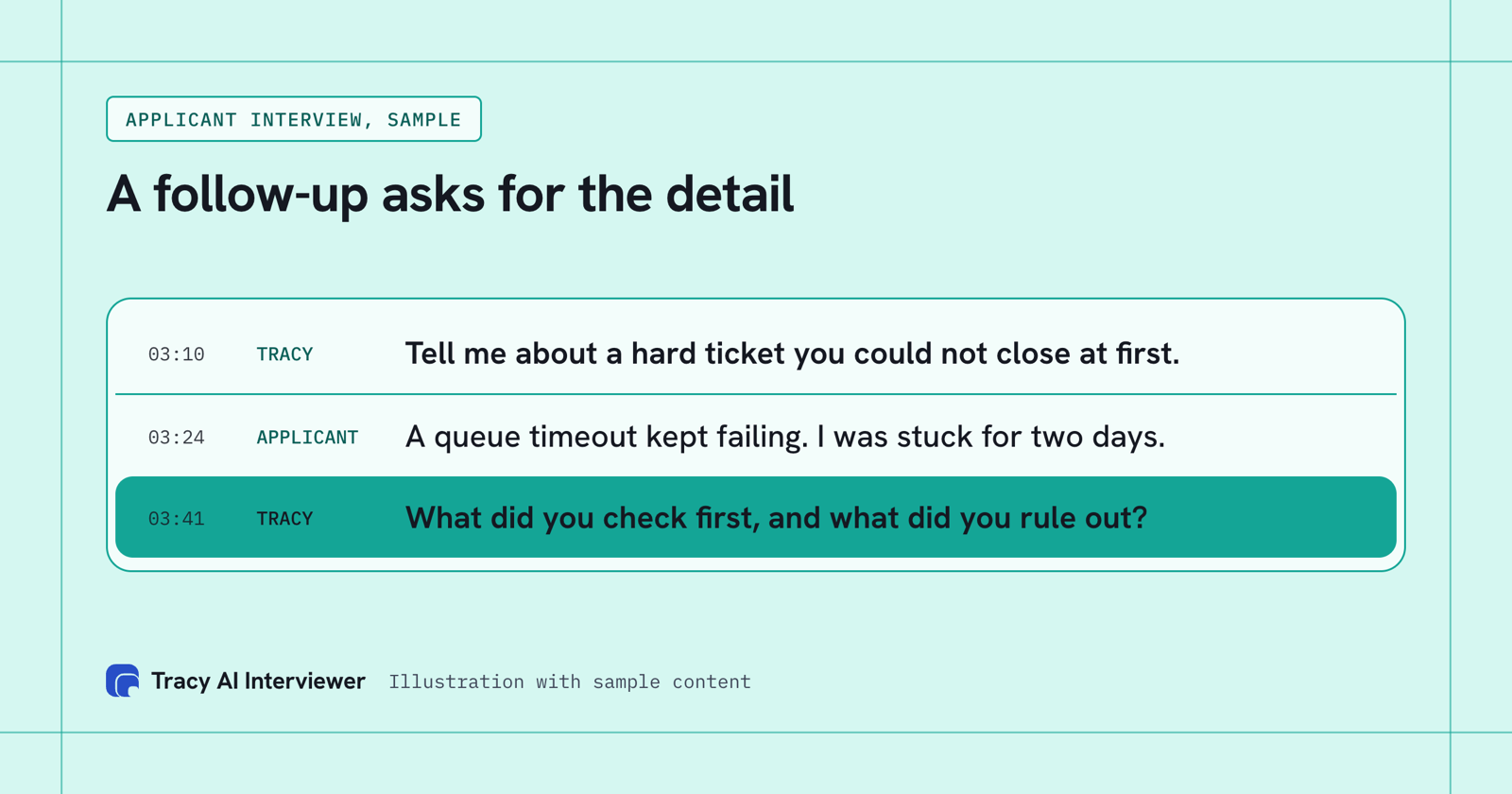
A vague first answer gets a follow-up that asks for the detail.
Decide (17 to 19)
17. Debrief from evidence
Write a debrief for [role] from these interview notes: what each person said about each must-have, where reviewers disagree, what is still unknown. No recommendation.
18. Offer message
Draft an offer message from these terms: [terms]. Keep it warm and clear. I will check numbers and wording before it is sent.
19. Decline with a reason
Write a decline for someone who finished the process, based on this reason: [reason]. Respectful, brief, no promises.
Report (20)
20. Funnel summary
Here are the stage counts for [role] this month: [paste]. Summarise where people drop out and list 3 questions I should ask before changing anything.
What the interview stage costs when people run it
Prompts 1 to 14 and 17 to 20 plan and write. Prompts 15 and 16 hand over the one stage where the conversation with each applicant is the work. Say a role draws 100 applicants and each first interview runs 20 minutes: that is about 33 hours of live calls for one role, and about 333 hours at 1,000. Tracy gives every applicant an in-depth interview that starts on click, so you see more than a CV shows and your hours go to reading what people said. In a customer's case, average time to hire went from 44 days to 7. Read how AI interview scoring works, where the reviewer scores and Tracy does not, see high-volume hiring with Tracy, or start with Claude for talent acquisition if your team uses Claude. Integrity signals on video interviews are shown to the reviewer with their evidence. They are never proof, candidates are told about the recording and a person reviews the results; nothing is decided automatically.
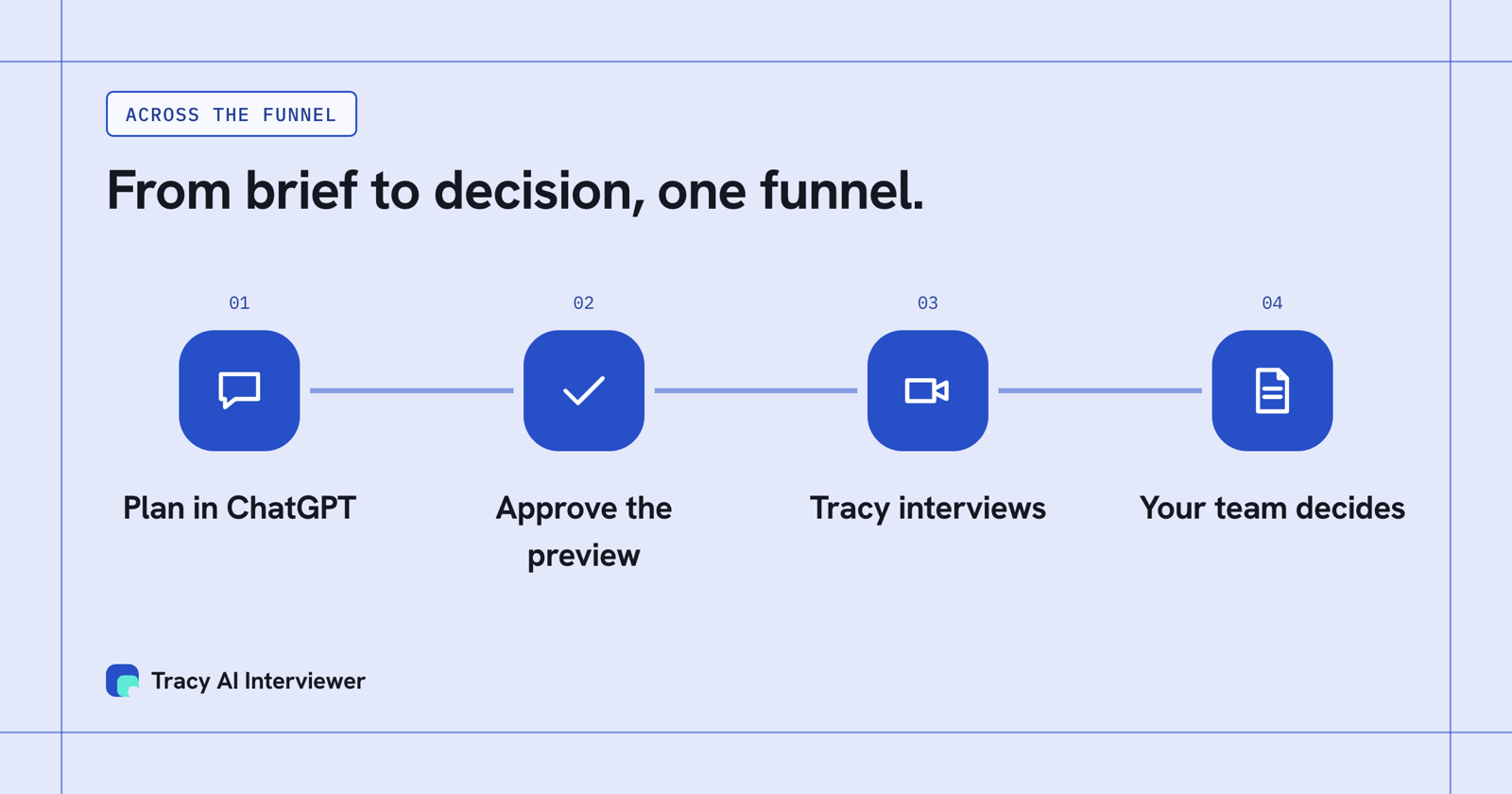
ChatGPT plans and drafts; Tracy interviews; people decide.
What Tracy adds to ChatGPT prompts for talent acquisition
Three things change when the interview moves from you to Tracy.
01
Reach every applicant
Each applicant can start on click, at any hour, with no scheduling and no recruiter on the call. The same first round reaches the whole list.
02
Ask the next question
Tracy follows the answer in the person's own field and waits for the end of the thought. A polished headline has to survive a specific follow-up.
03
Keep the evidence
Every result has a recording, a timestamped transcript and a written assessment per question with its reasoning. Your reviewer decides what it means.
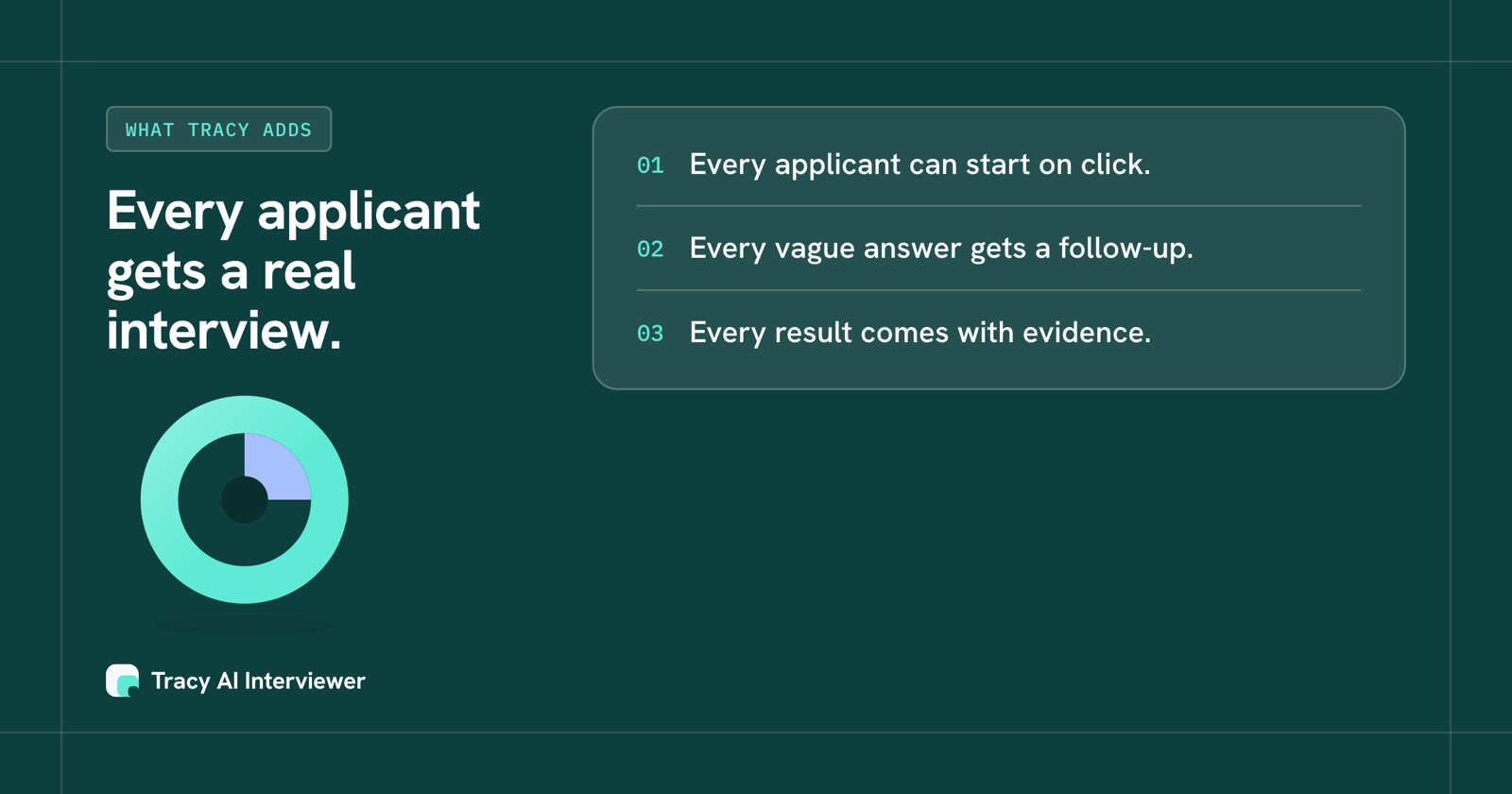
Every applicant gets a real interview.
Which path fits you
- Recruiters who want day-to-day prompts: ChatGPT prompts for recruiters.
- Many applicants for few roles: hiring at volume.
- Comparing AI tools: best AI tools for recruiters.
Common questions
What are good ChatGPT prompts for talent acquisition?
How should a TA team use ChatGPT?
Can ChatGPT interview candidates?
Is Tracy secure enough for a TA team?
Does Tracy decide who moves forward?
Run prompt 15 on one role
Connect Tracy in ChatGPT and draft an interview for your busiest role. The first 3 results are free.
Try it free (opens in a new tab) Book a demo (opens in a new tab)
Your first 3 results are free. No card needed.
Sources
- Add Tracy AI Interviewer to ChatGPT (public guide), retrieved 14 Nov 2026.
- Tracy AI Interviewer pricing, retrieved 11 Nov 2026.