
TLDR Tracy AI Interviewer makes skills based hiring work for every applicant: you set the skills and weights, she interviews each person and follows up on what they say.
Each result comes with a recording, a transcript and a written assessment per question, so a person can check the score.
A person decides who moves forward.
Next: run one role in Tracy and read the reports.
We make Tracy AI Interviewer.
Picture a recruiter who removes "degree required" from a job ad on Monday. By Friday the shortlist looks the same as last year, because the same person still skims the same CVs for the same names. The ad changed. The filter did not.
Skills based hiring is the practice of deciding who moves forward on evidence of what a person can do, not on where they studied or which titles they held. It only works if you can collect that evidence for every applicant. That is the hard part, and it is what this guide covers: which skills to name, how to check them with an interview, and how to score what you hear. Tracy AI Interviewer does the checking for every applicant, and our guide to screening candidates covers the wider screening process.
Skills based hiring fails when only the job ad changes
Dropping a requirement from the ad is not the same as hiring differently. A February 2024 study by the Burning Glass Institute and Harvard Business School's Managing the Future of Work Project followed 11,300 roles at large firms, drawn from the career histories of about 65 million US workers, between 2014 and 2023. On average, firms that removed a degree requirement raised the share of non-degreed hires in those roles by about 3.5 percentage points. Only 3.6 percent of roles dropped a requirement, so the authors estimate the real effect at not even 1 in 700 US hires.
The gap was not even. Nearly all of the change came from the 37 percent of firms that backed the policy with new hiring practice. About 45 percent changed in name only. Where it worked, non-degreed hires had a two-year retention rate of 58 percent, against 48 percent for their college-educated colleagues. The study measures degree requirements, which is one part of skills based hiring, but the lesson carries: the practice has to change, not the wording.
Name the skills and their evidence before the job ad
Pick three to five skills the work really needs, and write what evidence of each would sound like in an interview answer. Weight them before you meet anyone. This is the step most teams skip, and every later step depends on it.
| Skill (support engineer) | Weight | Evidence worth hearing |
|---|---|---|
| Troubleshooting | 35% | Names the steps in order, says what each ruled out |
| Customer care | 25% | A specific customer, what they said, what changed |
| Written clarity | 20% | Explains a fault in plain words, no jargon wall |
| Ownership | 20% | Says what they would change next time |
The table sets out four sample skills for a support engineer, each with a weight and the evidence worth hearing.
The weights are our example, not a standard. Set yours with the people who do the job. If you cannot say what a strong answer sounds like, an interview cannot test it, and a CV filter will fill the gap with proxies.
Interview every applicant on the skills, not a shortlist
A CV filter picks a shortlist, and a shortlist is where skills based hiring usually stops. Suppose someone reads 400 applications and chooses 30. The other 370 are judged on a page. If a skill is the test, every applicant needs a chance to show it.
Tracy gives each applicant a first interview from one link. It starts on click at any hour, with no scheduling and no recruiter present, and the applicant needs only a browser, with no account. Questions come from your job description and you can edit them or write your own. Tracy reads the CV when the CV check is on, asks in the applicant's own field and follows up on what they said. Your weights become the scoring criteria. Our guide to how AI interviews work shows the flow end to end.
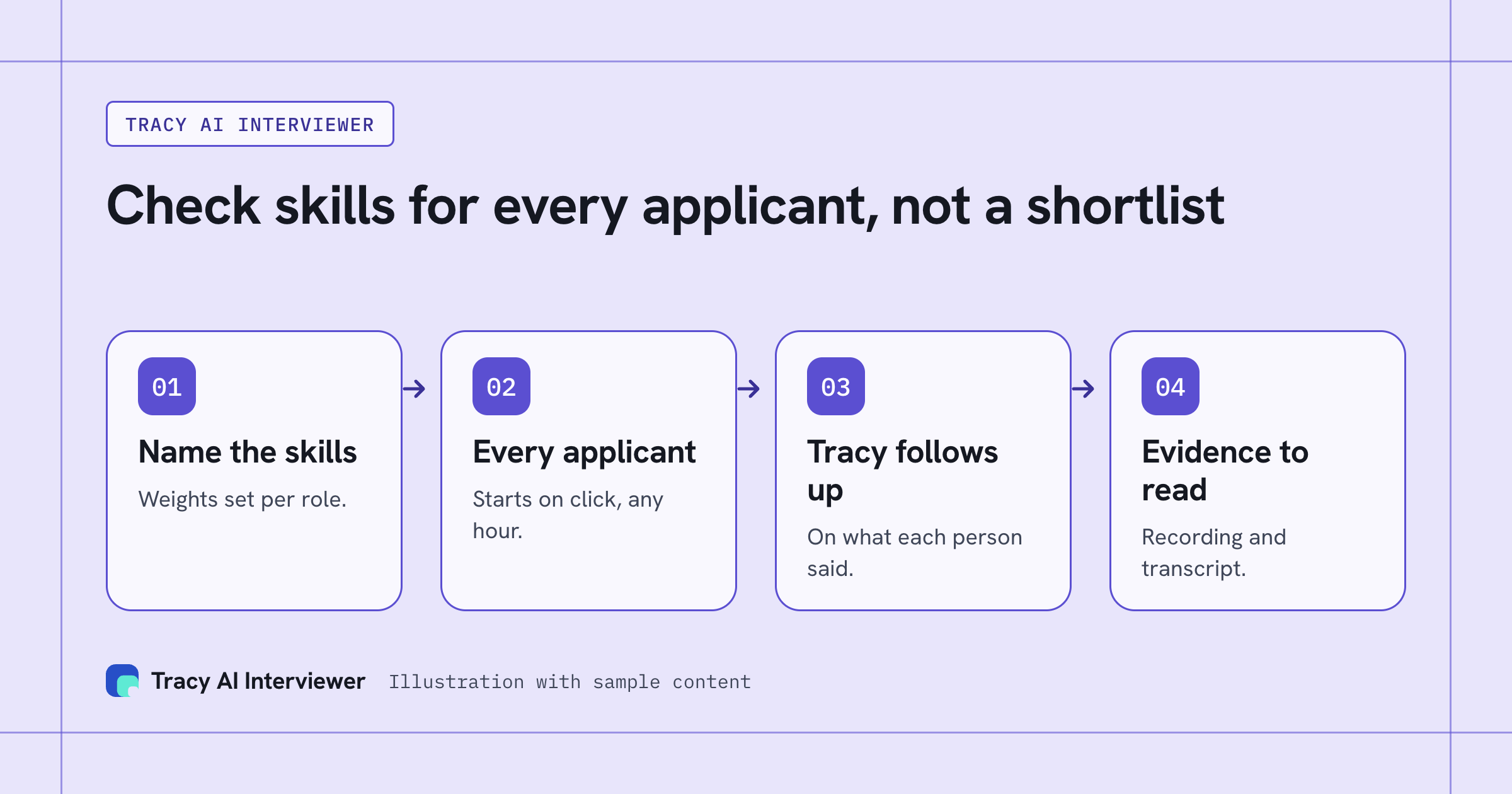
The skills come first; Tracy then interviews every applicant on them and leaves evidence to read.
Follow up on the claim, not the CV line
A claim on a CV is a starting point. "Data modelling" can mean a course or a career. The follow-up is what separates them, and it is what a form cannot ask.
Tracy: You list data modelling. What was the last model you built?
Applicant (fictional): A churn model for a subscription app.
Tracy: Which inputs did you leave out, and why?
This is an illustration with sample content. A strong answer names a decision and its reason. A weak one repeats the job title. Either way the reviewer has the words, not an impression.
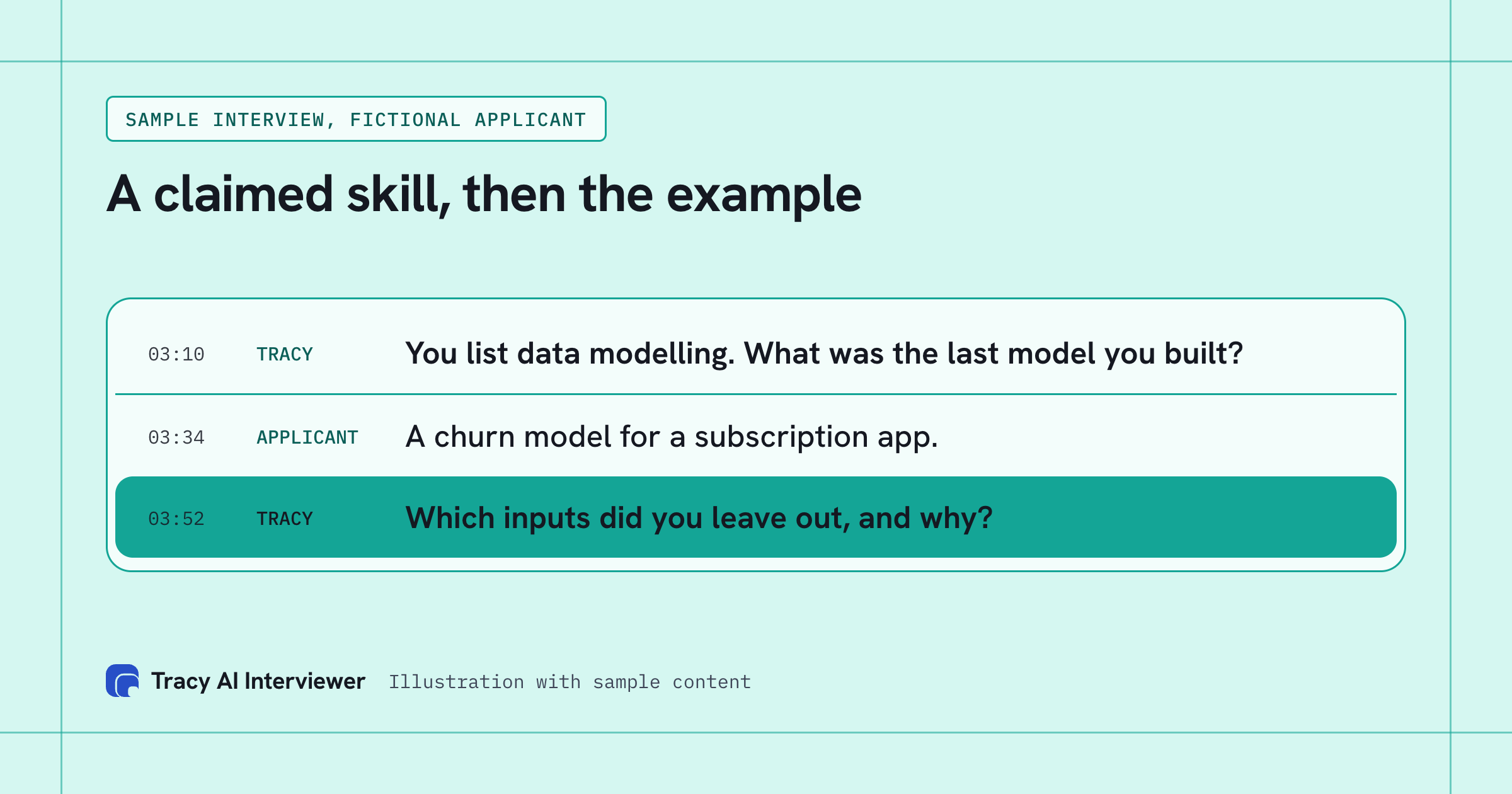
The follow-up turns a listed skill into an example the reviewer can judge.
Score on your weights and keep a person in charge
Each applicant is scored on the skills and weights you set. For each question, the reviewer gets a written assessment with its reasoning, and behind every result sit the recording and a timestamped transcript. Candidates are ranked against the others who took the interview, and strong ones are flagged to the recruiter. A person decides: they can override a rejection, move someone forward or invite them to interview again, and the history stays on the record. See AI interview reports for what the report holds.
Where this stops
Tracy is an interview. For work samples, take-home tasks and reference checks, use your own process, and a person makes the decision. For roles where the skill is a deliverable, such as a portfolio or a design, you still want to see the work. For technical roles, a coding task can sit inside the same interview, with follow-ups on approach and trade-offs.
Tracy publishes no bias audit, so do not describe the process as validated or fair on her say-so. What an interview gives you is evidence a person can read and challenge. If you hire a handful of people a year, a structured conversation by your own team is enough. The case for Tracy starts when applicants outnumber the hours you have.
Pilot it on one role
Run one role as a pilot, with a named owner and a stop condition.
- Choose one role where you have already removed a requirement from the ad.
- Write four skills, weights and the evidence for each. Load them into Tracy with your questions.
- Interview every applicant for four weeks. Let the owner read the reports for the people your CV screen would have rejected.
- Stop if the owner would not move anyone from that group forward.
- Measure applicants who finished, hours of reviewer time per hire, and hires from outside your usual CV pattern.
On time spent, Roy Junyoung Jang, Director, Residency & Investment at Antler Korea, says: "I was effectively spending around six hours a day on screening. With Tracy, I can now review and assess those candidates in approximately 1.5 hours."
Tracy costs $1 per credit, one credit per started 20 minutes, and the first 3 results are free with no seats. Try one on the Connect page, and see pricing.
Which path fits you:
- Many applicants for the same role: volume hiring.
- Technical roles: technical interviews.
- People teams setting up screening: people teams.
Good looks like this: the shortlist contains people your old filter would not have picked, and the owner can say why each one is there.
Questions
What is skills based hiring?
How is skills based hiring different from traditional hiring?
What are skills based hiring best practices?
Can an interview check skills for every applicant?
See the method applied in one real interview. Send us one role and we will build the interview plan in days, with a recording and report you can check. Try it free · Book a demo
Sources
- Burning Glass Institute and Harvard Business School Managing the Future of Work Project (2024), Skills-Based Hiring: The Long Road from Pronouncements to Practice, retrieved 9 Nov 2026.
- Burning Glass Institute and Harvard Business School Managing the Future of Work Project (2024), Skills-Based Hiring: The Long Road from Pronouncements to Practice, retrieved 9 Nov 2026.
- Burning Glass Institute and Harvard Business School Managing the Future of Work Project (2024), Skills-Based Hiring: The Long Road from Pronouncements to Practice, retrieved 9 Nov 2026.
- Burning Glass Institute and Harvard Business School Managing the Future of Work Project (2024), Skills-Based Hiring: The Long Road from Pronouncements to Practice, retrieved 9 Nov 2026.
- Tracy AI Interviewer home page, customer quotes, retrieved 9 Nov 2026.
- Tracy AI Interviewer pricing, retrieved 5 Nov 2026.