In short
A hiring manager who missed the call needs the answer and the proof on one page, and an interview report template gives both: recommendation first, evidence by requirement, concerns and next steps. Tracy AI Interviewer builds the record behind it from every interview, with a summary of what was said, an assessment per question with its words and timestamps, the recording and the transcript. Your reviewer writes the recommendation.
What a one-page report does well
A hiring manager who was not on the call has two minutes and one decision. A good interview report gives the answer and the proof on one page: who the candidate is, what the role needs, what was heard against each need, what is unclear and what happens next. Copy the interview report template below and see it filled in for a fictional QA engineer.
A report is a page of claims, and each claim is only as good as the moment it points to. Most of the writing is already in the interview. Tracy AI Interviewer keeps that record, and the section after the example shows how it lines up with the template.
What should an interview report include?
An interview report should give the recommendation first, then the evidence for each requirement, the concerns, what was not assessed and a link to the source. It is the page you send on to the person who decides.
It comes after the interview notes template, which records what happened in order, and the interview feedback form, which holds one interviewer's reasoning. The report has five jobs:
- Lead with the recommendation, so the reader knows the answer in the first two lines.
- Show the evidence by requirement. Each line says what the candidate said or showed and where to find it.
- State the concerns. A report that hides its doubts gets sent back.
- Say what was not assessed. Silence reads as a pass unless you say otherwise.
- Attach the source. A link to the recording and the transcript lets the reader check any line in a minute.
Keep it to one page. If it scrolls, cut.
The interview report template
Copy the tables into a document or a sheet. The report has five parts: a header, a summary, evidence by requirement, concerns and next steps.
Table 1: header
| Field | Entry |
|---|---|
| Candidate | |
| Role | |
| Interview date and length | |
| Interviewer or format | |
| Prepared by |
Table 2: summary
| Field | Entry |
|---|---|
| Recommendation | Advance, hold or stop |
| Why, in two sentences | |
| Biggest strength | |
| Biggest concern |
Table 3: evidence by requirement
| Requirement | What was said or shown | Where to find it |
|---|---|---|
| Requirement 1 | ||
| Requirement 2 | ||
| Requirement 3 | ||
| Requirement 4 |
Table 4: concerns and open questions
| Item | Why it matters | How to settle it |
|---|---|---|
Table 5: next steps and attachments
| Field | Entry |
|---|---|
| Next step | |
| Owner and date | |
| Recording | Link |
| Transcript | Link |
| Not assessed |
Take the requirements from the role's must-haves, and use the same ones in every report for that role.
Writing a report people trust
- Quote, do not describe. "Walked through a flaky test and how they fixed it" beats "strong on testing".
- Give each line one source. If a line has no place to find it, either find one or drop the line.
- Name the gap in the same place as the strength, so the reader sees both in one row.
- Use the same format for every candidate. Managers compare reports side by side, so the layout should not change.
- Keep observations separate from conclusions. If something looked off, write what was seen and when, and who will check it.
- For a numeric view, pair the report with the interview scorecard template. For a requirement-by-requirement judgement, use the candidate evaluation template.
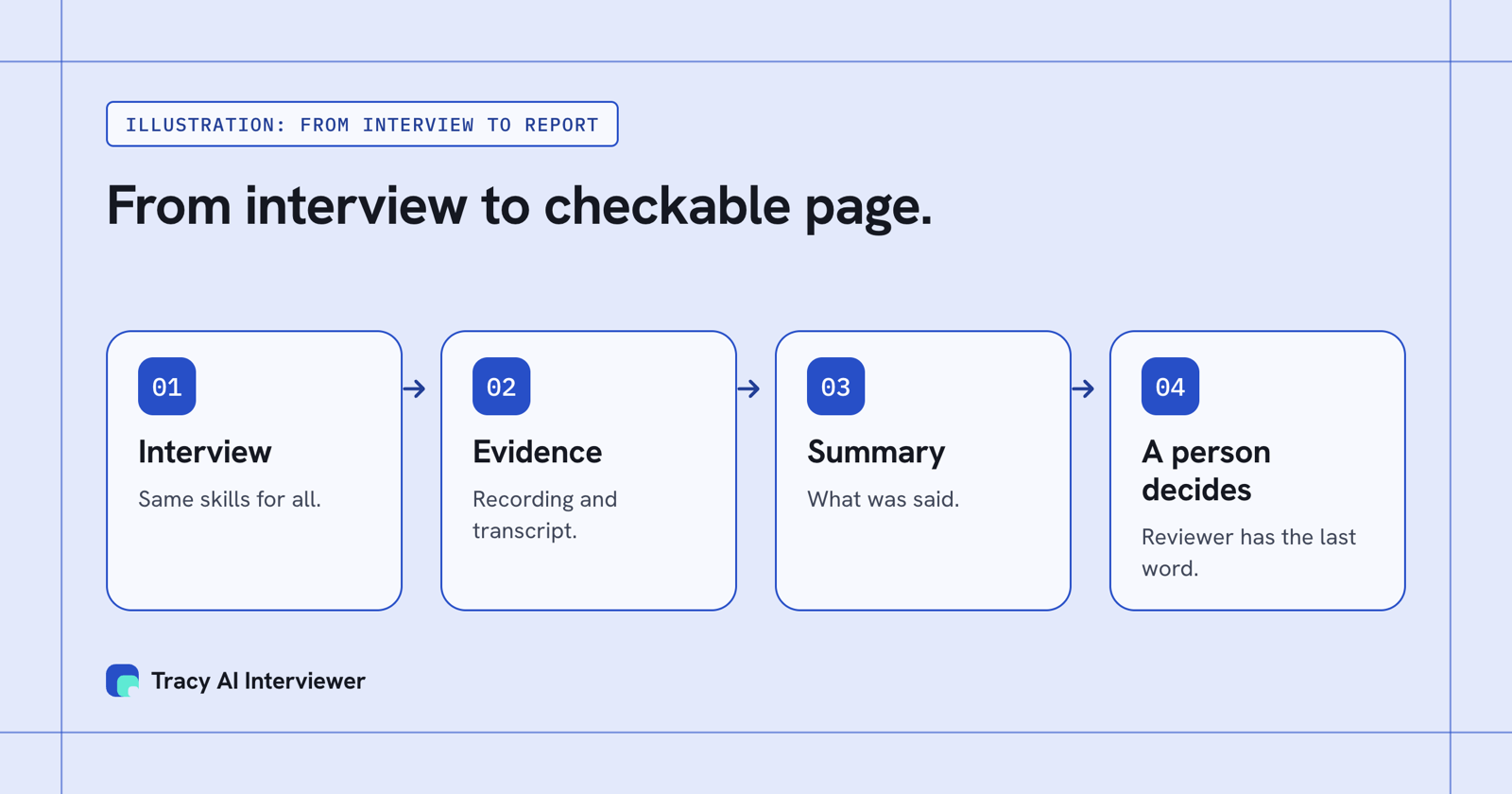
Every report is the end of a chain that starts with the interview and ends with a person deciding.
A filled example: QA engineer
A fictional candidate for a QA engineer role. The evidence is written for this page.
Table 6: filled example, summary
| Field | Entry |
|---|---|
| Recommendation | Advance to the technical round |
| Why, in two sentences | Showed clear test design and a habit of writing reproducible bug reports. Automation depth is the open question. |
| Biggest strength | Wrote a regression suite for a payments flow (06:10). |
| Biggest concern | Could not say how flaky tests were handled (16:40). |
Table 7: filled example, evidence by requirement
| Requirement | What was said or shown | Where to find it |
|---|---|---|
| Test design | Split a checkout flow into the main path, limits and failure cases, and named the case most likely to break. | Recording 06:10 |
| Bug reporting | Described a report with steps, expected result, actual result and a log excerpt. | Recording 11:25 |
| Test automation | Two years with one framework. Could not say how flaky tests were handled. | Recording 16:40 |
| Working with developers | Pairs on reproduction before filing. | Recording 21:05 |
Table 8: filled example, concerns and open questions
| Item | Why it matters | How to settle it |
|---|---|---|
| Flaky tests | Suites that fail at random get ignored. | Ask for the last flaky test and how it was fixed. |
Next step: technical round with the automation lead, owner the hiring manager, by Friday. Not assessed: written communication.
What the filled report shows that a blank one does not
Table 7 gives each requirement one line and one time. Test design sits at 06:10 and bug reporting at 11:25, so the manager can open the recording at either point and check the claim in a minute. The weak spot sits in the same table: test automation, with its time at 16:40. Four requirements, four times, one named concern and a way to settle it in Table 8.
Read as a manager, you can see the answer is to advance, the open question is flaky tests, and what the technical round must ask. A blank row cannot show that the strength and the gap belong together.
What Tracy adds to the interview report template
Three things change when Tracy does the interviewing.
01 Keep the evidence
Every result includes a recording of both sides, a timestamped transcript and a written assessment per question with its reasoning. Every line in Table 3 has a place to point to.
02 Ask the next question
Tracy follows what the applicant said in their own field and waits, so a thin answer gets the missing detail before it reaches your report.
03 Start from the role
Describe the role and Tracy drafts the questions. Edit them or bring your own, and use the same requirements in every report.
How a Tracy result fills the template
Here is how a Tracy result lines up with the template:
- For Table 2, the summary, Tracy gives a summary of what each person said, not a verdict.
- For Table 3, the evidence, it gives what the person said to each question, with the words and timestamps behind it.
- For Table 5, the attachments, the recording of both sides and a timestamped transcript sit behind every result.
- For concerns, on video interviews, integrity signals show the evidence Tracy captured so a reviewer can look. The candidate is told on the join screen that the conversation is recorded, a person reviews, and nothing is decided automatically.
Tracy does not rate or rank. The recommendation line in Table 2 is your reviewer's. For the full picture, see what a finished Tracy report shows and summaries of what each candidate said. To try it, copy the template, run one role as a Tracy interview and compare the result with your report.
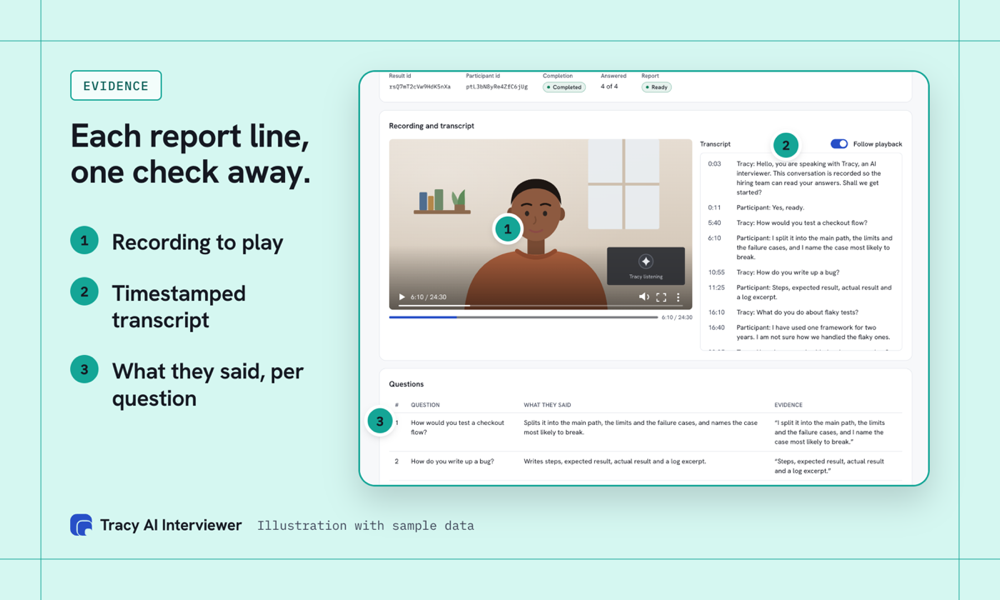
One Tracy result gives a reviewer a recording, a timestamped transcript and what the candidate said to each question.
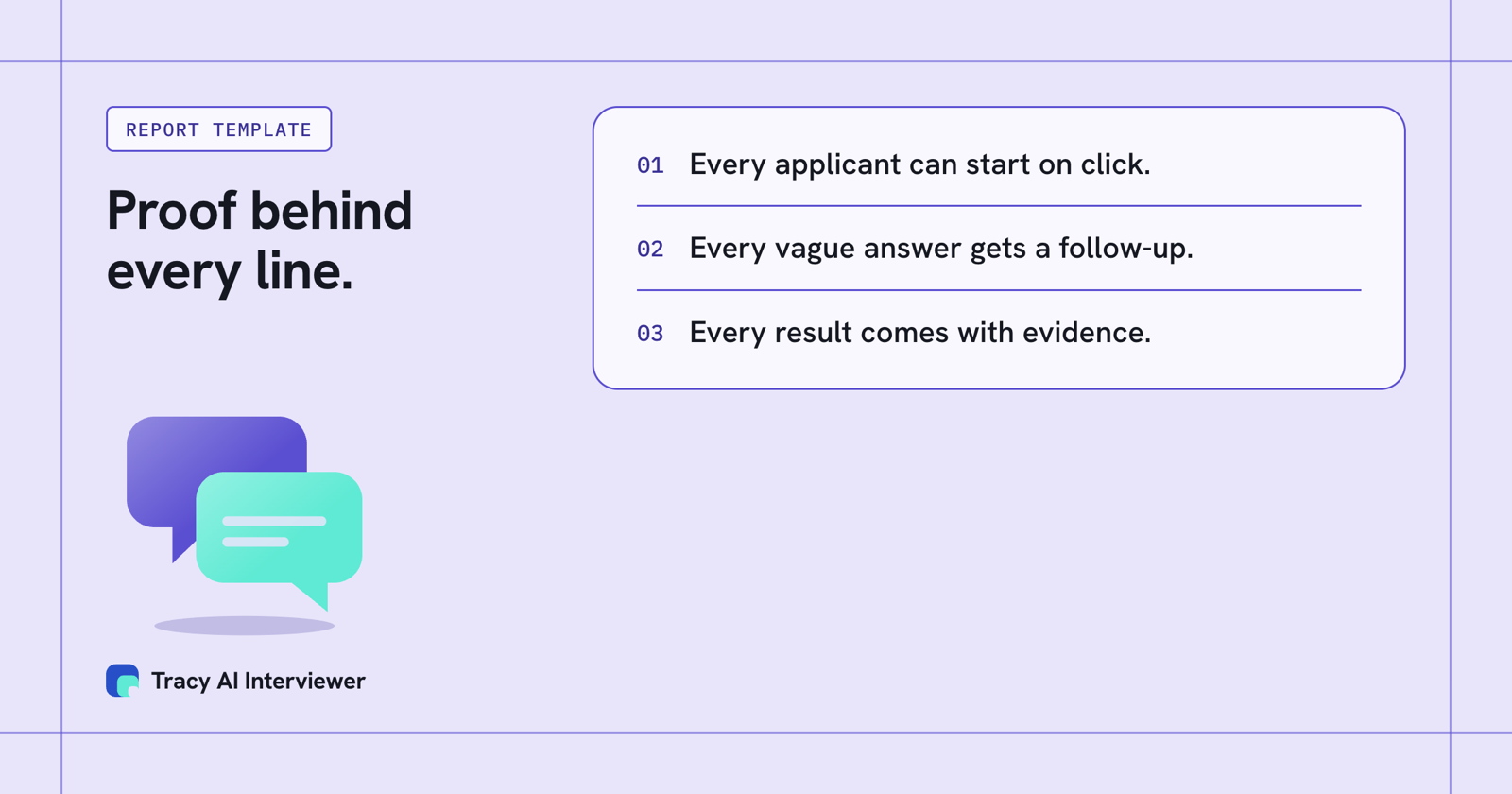
Every applicant can start on click, every vague answer gets a follow-up, every result comes with evidence.
Which path fits you
- Many applicants for one role, each needing a report: high-volume interviewing.
- Engineering roles: interviewing for engineering roles.
- Taking notes while a person runs the call: the interview notes template.
Common questions
What should an interview report include?
How long should an interview report be?
Is there an interview report template for Word?
What is a good interview report example?
What is the difference between an interview report and interview feedback?
Run this template as a Tracy interview
Copy the template, run one role as a Tracy interview and get the evidence behind each line. The first 3 results are free.
Try it free (opens in a new tab) Book a demo (opens in a new tab)
Your first 3 results are free. No card needed.
Sources
- Tracy AI Interviewer Connect page, retrieved 11 Nov 2026.