In short
Tracy AI Interviewer asks every applicant these cloud engineer interview questions, drafts them from your job description and follows up on each answer. The list is strong on its own: 15 provider-neutral questions on network access, permissions, failure, change and cost, each with a follow-up and what to listen for. Tracy adds the volume, plus the recording and timestamped transcript behind each answer. Your engineers decide who moves forward.
Say a cloud engineer role draws 220 applications. Most CVs list the same services and a certificate or two, and a CV cannot tell you who has locked down a public bucket at 2 a.m. and who has passed an exam. Good cloud engineer interview questions ask what the person did when the bill doubled.
Your questions are the easy part. Asking the second question 220 times is where the week goes, and that is the part Tracy takes. These 15 questions suit hiring managers and recruiters whichever provider the team runs. Plan 20 to 30 minutes for the first technical conversation, and keep a hands-on lab in your own account for a later round.
Put your provider and tools in the role description and Tracy drafts questions around them, then asks about the candidate's own answers: the bill, the bucket, the manual change. For the wider process, see volume hiring with Tracy. For the neighbouring role, see DevOps engineer interview questions.
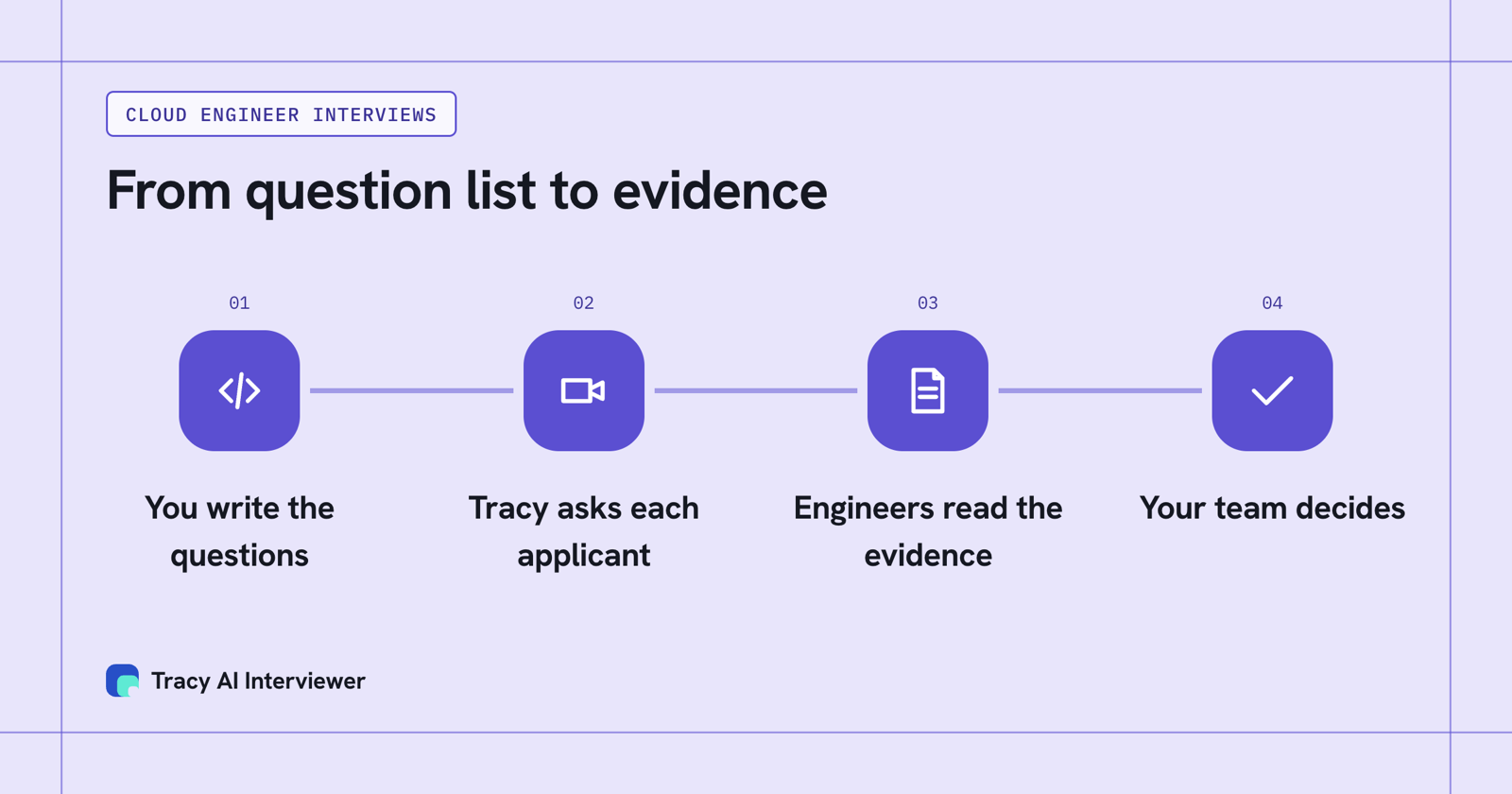
Your engineers write the questions and make the decision; Tracy asks each applicant in between.
What a good list of cloud engineer questions does well
It tests how the candidate keeps a cloud environment safe, available and affordable: network access, permissions, failure, change and cost. Service names come second, so the same questions work on AWS, Azure or Google Cloud, and every applicant is read against the same notes. A list cannot ask the follow-up for you. That is the gap Tracy fills.
Fifteen cloud engineer interview questions, grouped by what they test
Pick one or two questions from each group and ask the follow-up second. Write the strong answer down first, so every candidate is read against the same notes.
Group 1: Networks and access
1. A service in a private network cannot reach the internet. What do you check?
- Follow up with
- How would you let it out without exposing it?
- Listen for
- Routes, a NAT or egress gateway, firewall rules, DNS. Outbound only.
2. How do you lay out networks for development, staging and production?
- Follow up with
- What do you share between them and what do you not?
- Listen for
- Separate accounts or projects, planned address ranges, a limit on the blast radius.
3. How do you decide who can do what in a cloud account?
- Follow up with
- A developer needs access for one hour. How do you grant it?
- Listen for
- Least privilege, roles over users, short-lived credentials, audit logs.
Group 2: Reliability and cost
4. How would you make a service survive the loss of a zone?
- Follow up with
- What does that cost, and what do you not protect?
- Listen for
- Several zones, health checks, the stateful parts. Recovery targets and a failover that has been tested.
5. The cloud bill doubled this month. Where do you look?
- Follow up with
- How do you stop it happening again?
- Listen for
- Cost reports by tag, the biggest line items, idle resources, data transfer. Budgets and alerts.
6. How do you choose between virtual machines, containers and serverless?
- Follow up with
- When did you regret a choice?
- Listen for
- Workload shape, effort to operate, limits, cost at load. A real regret.
Group 3: Infrastructure as code and change
7. Someone changed a resource by hand in the console. What happens next?
- Follow up with
- How do you prevent it?
- Listen for
- Drift detection, import or revert, console write access limited, changes through review.
8. How do you structure infrastructure code for several environments?
- Follow up with
- How do you handle state?
- Listen for
- Modules, remote state with locking, limited access to the state, environments kept apart (separate state or workspaces), plan review.
9. How do you roll out a change with no downtime?
- Follow up with
- How do you roll it back?
- Listen for
- Blue-green or canary, health checks, a rollback plan. Database changes handled apart.
Group 4: Security and operations
10. A storage bucket turns out to be public. What do you do in the first hour?
- Follow up with
- What do you check afterwards?
- Listen for
- Closes it, reads access logs, works out what was exposed, rotates secrets, tells owners. Adds a guardrail.
11. How do you manage secrets for applications in the cloud?
- Follow up with
- How do you rotate one with no outage?
- Listen for
- A secrets manager, none in code or images, access by role. Old and new valid together during rotation.
12. What do you monitor, and what wakes someone up?
- Follow up with
- Tell me about an alert you deleted.
- Listen for
- Symptoms users feel over internal causes. Alert fatigue, a runbook for each page.
Group 5: Judgement and migration
13. Tell me about a migration to the cloud, or between providers.
- Follow up with
- What would you do differently?
- Listen for
- Phased, dependencies mapped, data transfer, a cutover plan. Honest regrets.
14. A team wants a service you think is too expensive. How do you handle it?
- Follow up with
- What numbers would you bring?
- Listen for
- Asks the need, cost per unit of work, alternatives. Shows, does not block.
15. How do you learn a cloud service you have never used?
- Follow up with
- What did you build to learn the last one?
- Listen for
- Docs, a small build, limits and pricing read first, then torn down. A specific example.
Freshers: where to start
If you are hiring a fresher, use questions 1, 3, 7 and 15, and accept a course project or a home lab as the example. Ask what they built, what broke and what they changed.
Weak and strong answers to the same questions
Three questions, each answered weakly and strongly.
Table 6: Weak and strong answers to the same questions, written as examples.
| Weak answer | Strong answer | |
|---|---|---|
| Question 5, the doubled bill | "I'd turn off the big servers." | "I'd group cost by tag to find which line item grew. Often it is data transfer or forgotten test resources. Then I'd add a budget alert." |
| Question 10, the public bucket | "I'd make it private." | "I'd close it, then read the access logs to see who read what. I'd rotate any secrets in it and add a policy that blocks public buckets." |
| Question 7, the manual change | "We should not do that." | "I'd check the drift, then either put the change in code or revert it. And I'd remove write access from the console for most people." |
What a question list cannot do alone
A list gives every applicant the same question. It cannot ask the second one. Question 5 shows the gap: the first answer is a guess, and the follow-up tells an engineer whether the person has ever read a bill. Asked live, 220 first conversations of 20 minutes come to about 73 hours of calls, so most teams ask the second question of a shortlist only. Tracy asks it of everyone, and your engineers read the chain instead of sitting on the call.
A made-up candidate and sample data, not a real interview. The chain starts from question 5.
Tracy: The cloud bill doubled this month. Where do you look?
Candidate (fictional): I would find the biggest servers and shut down the ones we do not need.
Tracy: How would you know which ones the extra cost came from?
Candidate: I would group the bill by tag and compare it with last month.
Tracy: Some resources have no tags. What do you do?
Candidate: Find the owner in the creation logs, tag them and block untagged ones.
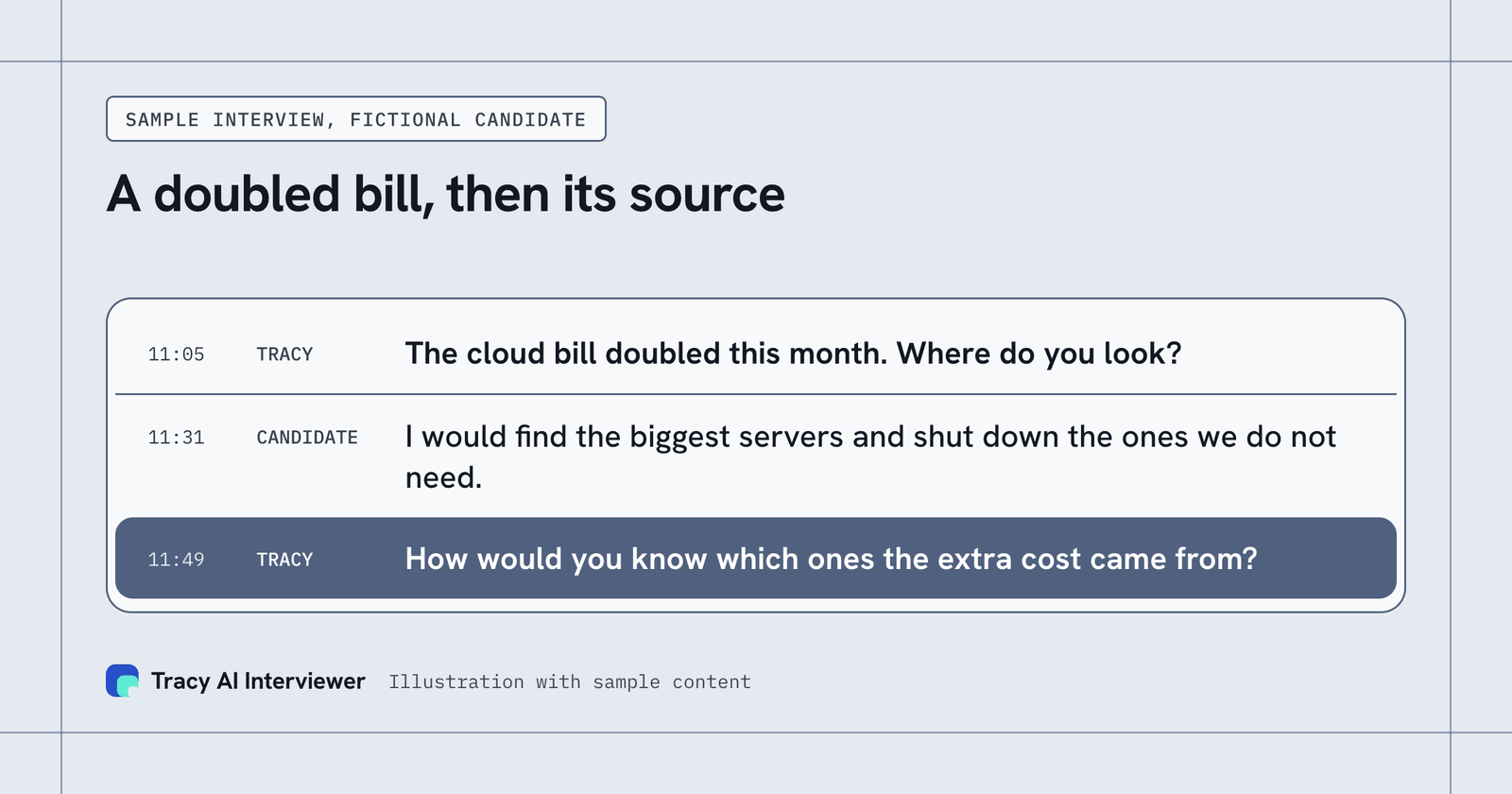
A second question built on the candidate's own answer shows whether they can trace the extra cost to its source.
What Tracy adds to cloud engineer interviews
01 Reach every applicant
Each applicant starts on click, at any hour, with no scheduling and no engineer on the call. All 220 applicants get the same first conversation.
02 Ask the next question
Tracy follows the answer in the candidate's own field and waits for it. A vague answer about the bill gets a question about tags.
03 Keep the evidence
Every result has a recording, a timestamped transcript and a written assessment per question with its reasoning. Your engineers check an answer against the moment it was given.
How do you run these questions with every applicant?
Create one interview from the role description, send applicants a link and read the results. Without that, 220 applicants need 220 calls, and a platform team already has a full week.
- Name your provider and tools in the role description; Tracy drafts questions from it, and you edit or replace them. See drafting from a job description. CV reading is a setting.
- Candidates join from a browser link whenever they like, without an account or a booked slot. The join screen tells them the conversation is recorded and transcribed. See what candidates go through.
- The result keeps the recording and a timestamped transcript, and lists what the candidate said to each question next to the result fields. See what a result report shows.
- Fullscreen exits, tab changes, gaze, face detection, delay before answers and external screens are captured as integrity signals, with the evidence shown to the engineer reading the result. A signal is a prompt to look closer and is not proof.
A cloud engineer will want the arithmetic. It is $1 per credit, one credit for each started 20 minutes of an interview that produced a result, no seats, and the first 3 results free. See pricing. In one customer result, time to hire fell from 44 days to 7, and Tracy did the work of 53 full-time recruiters in one month.
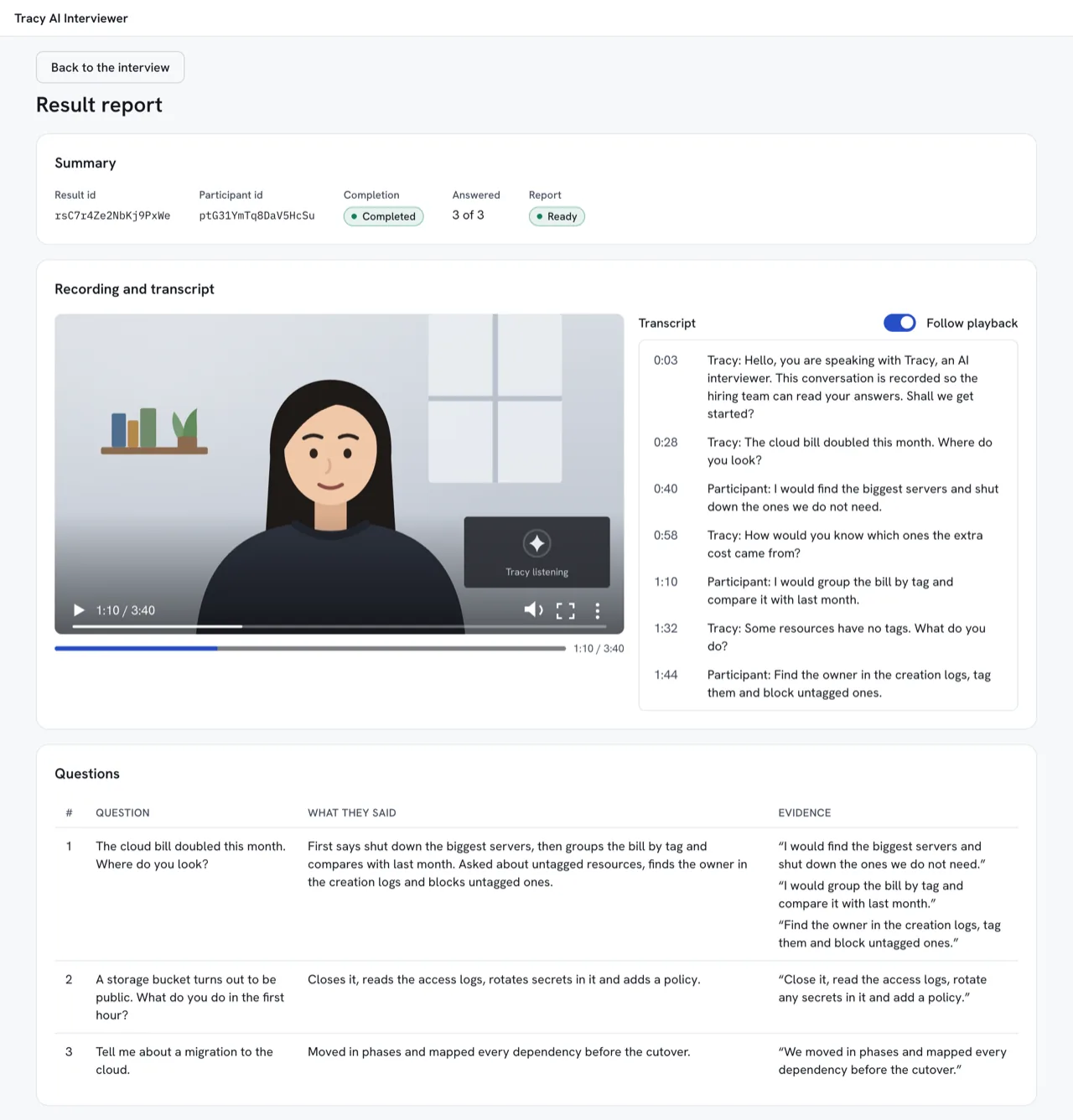
Your engineers can open the recording and the transcript behind each answer before they decide.
Keep three decisions with your engineers
- Who moves forward: the person who runs your cloud estate reads the report and decides, with the candidate's quoted answers in front of them.
- Calibration: two engineers read the same five transcripts independently. If they would not shortlist the same people, tighten the questions before you widen the pool.
- The hands-on lab: a task in your own account, with your tooling, stays with your team.
For two hires a year, a call with your own engineer is simpler; see a human call versus an AI interview. Tracy makes sense when the applicant pile is bigger than your engineers' week. To try it, paste one open cloud role and have an engineer read the first batch of results. For data platform roles, see data engineer interview questions.
Common questions
What are good cloud engineer interview questions and answers?
What cloud engineer interview questions suit freshers?
Can Tracy draft the interview from my cloud job description?
Does Tracy decide who to hire?
Create an interview for this role
Paste your cloud job description, edit the questions Tracy drafts and send one link. The first 3 results are free.
Try it free (opens in a new tab) Book a demo (opens in a new tab)
Your first 3 results are free. No card needed.
Sources
- Tracy AI Interviewer home page, retrieved 14 Nov 2026.
- Tracy AI Interviewer pricing, retrieved 14 Nov 2026.
- Tracy AI Interviewer Connect page, retrieved 14 Nov 2026.