
In short
A candidate interview summary is the page a hiring manager reads instead of the call, so every line needs a quote and a time behind it. Below: a copy-and-paste template, a three-line version and two filled examples.
Tracy AI Interviewer runs the interview and returns the record each line points to: a recording, a timestamped transcript and what the candidate said to each question. Your reviewer writes the recommendation.
A hiring manager who was not on the call reads the summary instead of replaying the interview. A good candidate interview summary gives the recommendation, the evidence for it and the open question in about 150 words. A weak one says "good communicator, nice energy" and nobody can check it. Copy the template below, read it filled in for a fictional candidate, then see what Tracy AI Interviewer returns so that each line has a source.
What should a candidate interview summary include?
A candidate interview summary should give the recommendation first, then what the candidate said for each requirement with a time, one concern, what was not assessed and what to ask next. It is the page you send on to the person who decides.
- The recommendation in the first line: advance, hold or stop.
- Evidence for each requirement: what they said or showed, as a short quote with its time.
- One concern, in the same place as the strength it belongs to.
- What was not assessed, so nobody assumes it was.
- What to ask next, if the candidate moves on.
It sits after your interview notes, which record the call in order, and before the debrief, where the panel decides. The longer interview report template covers the full page for a hiring manager. The summary is the short version, and it fits in a message.
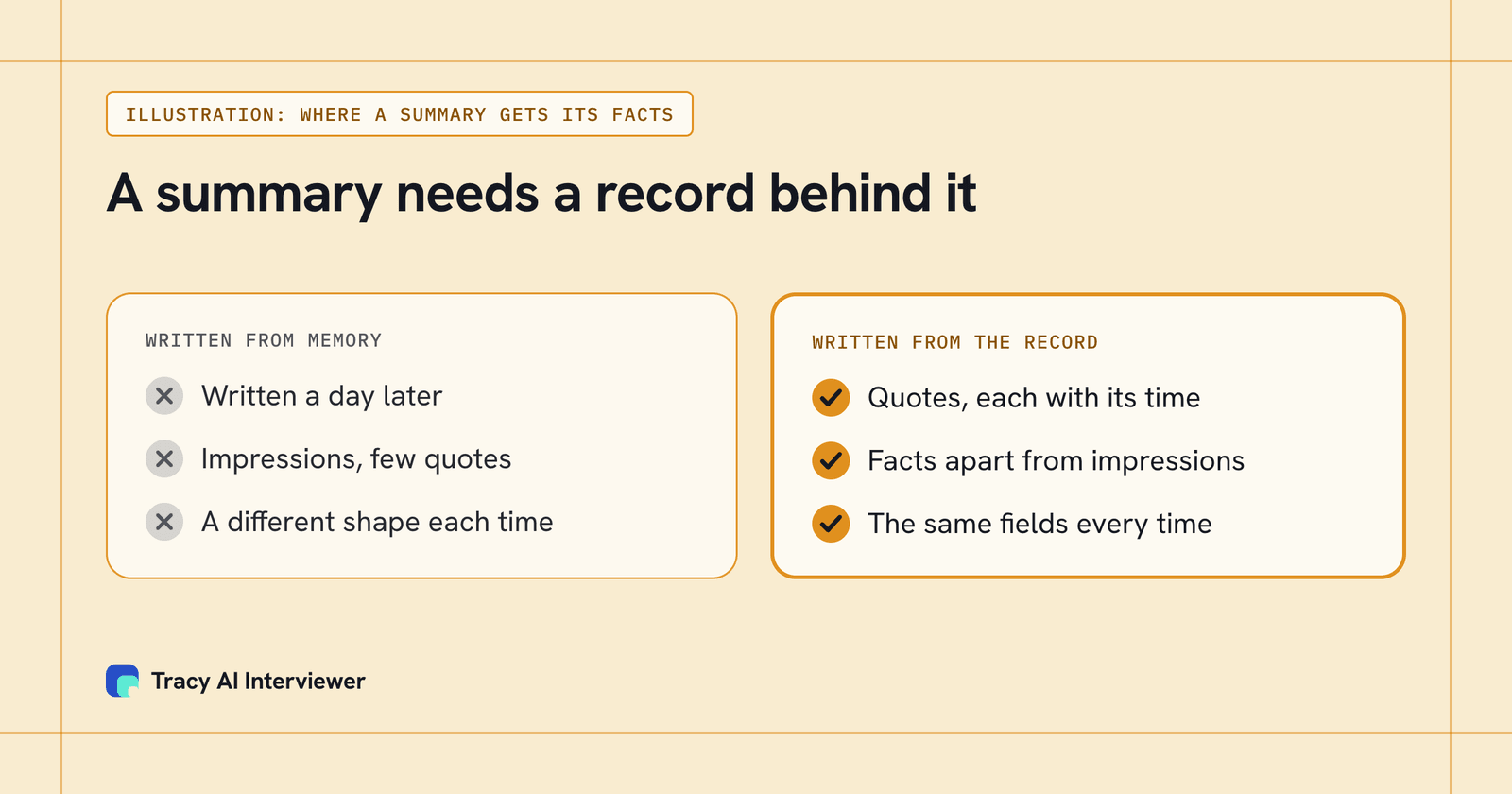
A summary is only as good as the record behind it.
The candidate interview summary template
Copy the tables into a document, a sheet or an email. Write it soon after the call, while you still remember which answer was which.
Table 1 is the header:
| Field | Entry |
|---|---|
| Candidate | |
| Role | |
| Interview date and length | |
| Format and recording link | |
| Written by |
Table 2 is the summary:
| Field | Entry |
|---|---|
| Recommendation | Advance, hold or stop |
| Why, in two sentences | |
| Strongest evidence (quote and time) | |
| Main concern (quote and time) | |
| Not assessed | |
| Ask next |
Table 3 is the evidence, by requirement:
| Requirement | What they said or showed | Time |
|---|---|---|
| Requirement 1 | ||
| Requirement 2 | ||
| Requirement 3 |
Take the requirements from the role, and use the same ones for every candidate so that summaries can sit side by side.
For a message to a hiring manager, paste this three-line version instead:
Recommendation: [advance / hold / stop], because [one sentence with a quote and its time]. Concern: [one sentence with a quote and its time]. Not assessed: [one item]. Ask next: [one question].
Candidate interview summary examples
A fictional candidate for a project coordinator role.
Example 1, a filled summary:
| Field | Entry |
|---|---|
| Recommendation | Advance to the next interview |
| Why, in two sentences | Runs competing deadlines from a shared board with a weekly check-in for each stakeholder. Moved one date with agreement. |
| Strongest evidence | "A shared board, and a Monday check with each stakeholder." (02:40) |
| Main concern | Tracks work in a task board and a weekly summary email. "A task board and a weekly summary email." (04:40) |
| Not assessed | Budget handling |
| Ask next | Who agreed to move the date? |
Example 2, filled evidence by requirement:
| Requirement | What they said or showed | Time |
|---|---|---|
| Competing deadlines | Used a shared board and a Monday check with each stakeholder; moved one date with agreement. | 02:40 |
| Stakeholder check-ins | Weekly, on Mondays. | 02:40 |
| Tracking work | A task board and a weekly summary email. | 04:40 |
Example 3, the same facts written weak and strong:
| Weak | Strong |
|---|---|
| Organised, good with people, would fit the team. | Uses a shared board and a Monday check with each stakeholder (02:40). Tracks work in a task board and a weekly summary email (04:40). |
| Not sure about tools. | Names a task board and a weekly summary email (04:40). Ask what happens between the weekly emails. |
The strong versions can be checked against the recording in a minute, which the weak ones cannot.
How to write a candidate interview summary
- Lead with the recommendation, so the reader has the answer in the first line.
- Quote the candidate. A short quote with a time beats "strong on process".
- Keep what was said apart from what you felt. Mark an impression as one.
- Give the concern the same weight as the strength, in the same place.
- Say what you did not assess, such as a skill the interview never reached.
- Use the same fields for every candidate for the role. That lets a manager read summaries side by side.
- Leave out anything unrelated to the job, such as age, family or health.
Keep it to a page so the panel reads it, and let anyone who wants more open the recording.
What a Tracy result gives you for each line
A summary is written only for the calls a person ran and wrote up, and a person can run only so many a day, so human-run calls do not scale. Tracy AI Interviewer runs the interview itself, so each applicant has a record without anyone taking notes. On enterprise, Tracy can also take notes on calls your own people run. Each line of the template maps to something in the result:
- Table 1 and the recording link: every result has a recording of both sides and a timestamped transcript.
- Strongest evidence and the evidence table: the result shows what the candidate said to each question, with the words and timestamps behind it.
- Main concern: when an answer is thin, Tracy asks for the missing detail and waits, so the gap is on the record before you write about it.
- Not assessed: the result also shows how many questions were answered, such as 2 of 2. What the interview never covered is for you to write down.
- Recommendation: your reviewer writes it. Tracy reports what was said, with evidence, and does not score, rank or reject anyone.
On video interviews, integrity signals show what was captured, such as leaving the full-screen window or the face leaving the frame, for a person to look at. Candidates are told on the join screen that the conversation is recorded, a person reviews, and nothing is decided automatically.
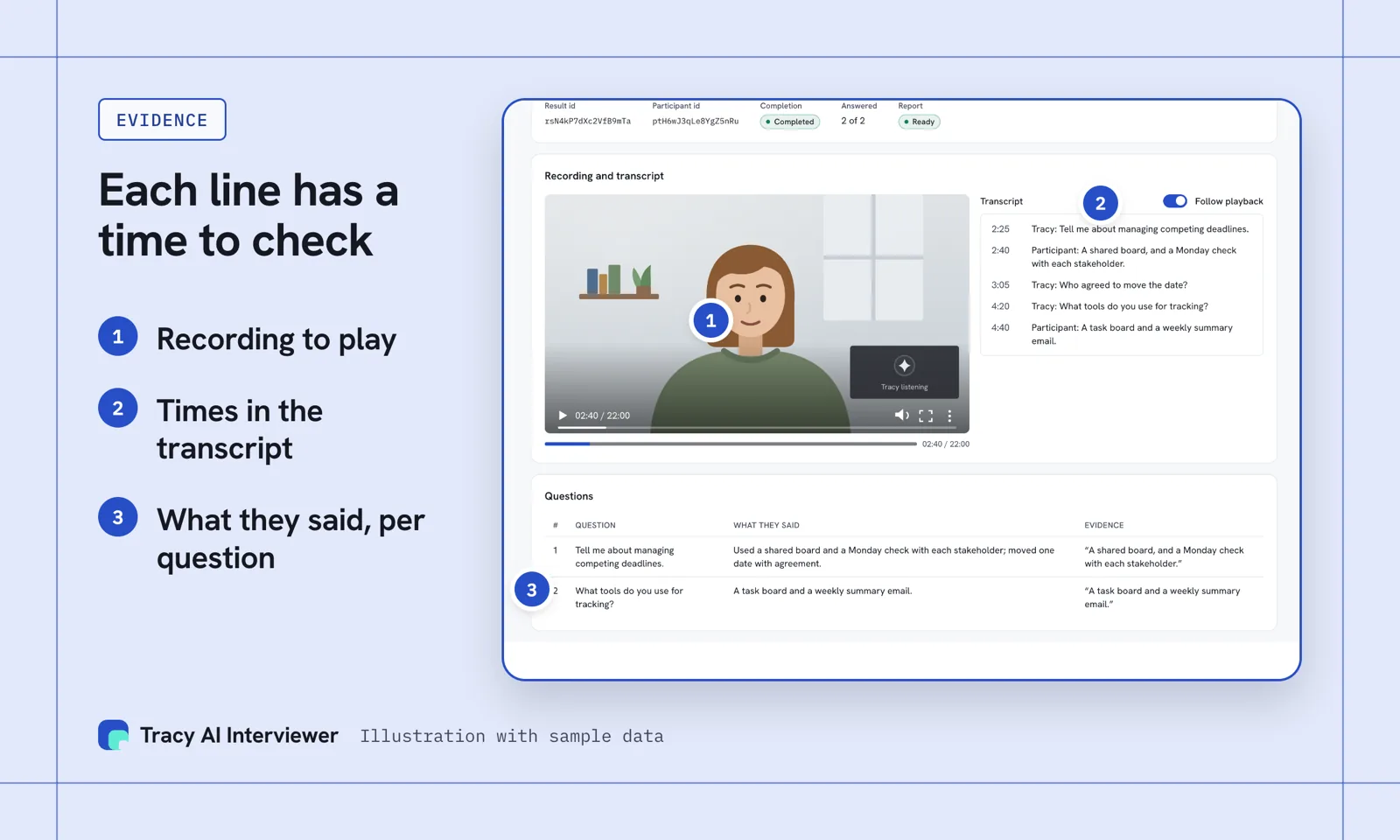
Each line of the summary can point to a time in the recording.
Run the template on one role
Take one role you are hiring for and write the three requirements in Table 3. Run it as a Tracy interview: describe the role and Tracy drafts the questions, which you can edit or replace with your own. Then write the summary from the result and see how many lines you can source in a minute. After three or four interviews, compare the summaries side by side.
For what an AI-written summary of an interview contains, see AI interview summaries. For the format that comes before the decision, see the interview feedback form and the interview scorecard template.
Which path fits you
- Many applicants for one role, each needing a summary: interview every applicant, not a shortlist.
- A summary that a person reads before deciding: what a Tracy interview report holds.
- Note taking on calls your team runs: a template for notes during calls your team runs.
Common questions
What should a candidate interview summary include?
How long should a candidate interview summary be?
What is the difference between interview notes and an interview summary?
How do you write a candidate summary after an interview?
Can an AI write a candidate interview summary?
Copy it, then run it
Copy the template, then run one role as a Tracy interview and see the record behind each line. The first 3 results are free.
Try it free (opens in a new tab) Book a demo (opens in a new tab)
Your first 3 results are free. No card needed.
Sources
- Tracy AI Interviewer Connect page, retrieved 22 Nov 2026.