In short
Good ChatGPT prompts for market research name the decision, the audience and the format of the answer. Twelve are below, in four groups: frame, scan, ask and write up. Copy them from the page.
ChatGPT covers the desk work. Prompts 7 to 9 draft the screener, guide and invitation, and Tracy AI Interviewer then runs those interviews on video from the same chat, following up each vague answer.
Every finding links to the recording behind it. Try one segment: the first 3 results are free.
What are good ChatGPT prompts for market research?
Prompts that start from the decision, not the topic. "Market research on project software" gets a generic overview; "I am deciding whether to add a client portal next quarter" gets questions you can act on. Each prompt below has brackets to replace and a check to run on the answer.
ChatGPT can do the desk part of a study: it reads what you paste or upload, and OpenAI says deep research can draw on uploaded files, the web or chosen domains and eligible connected apps, with a plan you can edit before it starts and citations or source links in the result. It cannot tell you what your own customers think, which is why groups three and four end in interviews. The text is on this page to copy; there is nothing to download.
Frame the decision: prompts 1 to 3
- "I am deciding whether to [decision] by [date]. List the four questions whose answers would change the decision, and say what kind of evidence would answer each: published data, our own data or customer conversations." Check: drop any question you could not act on.
- "List the five assumptions behind this plan. For each, give the cheapest evidence that would show it is wrong." Check: start with the assumption that would cost most if false.
- "Draft a one-page research plan for [question] aimed at [segment] in [region]. Name the sources, the order, and what each source cannot show." Check: if you use deep research, edit the plan before the run begins.
Scan the market: prompts 4 to 6
- "Here are the pricing pages of [three tools], pasted below. Build a table of plans, prices and who each plan is for. Write 'not stated' wherever a page is silent." Check: open each page again, because prices move.
- "Here are [N] public reviews of [category], pasted below. List the exact phrases reviewers use for the problem, grouped by theme, and count how many reviews use each theme." Check: name the review site and the month wherever you reuse a phrase.
- "Give me a rough size for [segment]: the number of buyers, a plausible spend per buyer and the arithmetic. Mark every estimate as an estimate and name its source." Check: treat the number as a lead until you have opened each source.
A spreadsheet export is fine for prompt 5. OpenAI says you can upload a spreadsheet to explore trends or create visualizations, with a limit of about 50 MB depending on row size.
Ask your customers: prompts 7 to 9
- "Write five screener questions to find [customers who did X in the last Y months]. Add one question that a person who did not do X would answer differently." Check: try it on a colleague first.
- "Write a guide for a 20-minute interview with [segment] about the last time they [did the job]. Ask about what happened, not what they would like. Add one follow-up for each question." Check: this is the guide you carry into the interview.
- "Write a 60-word invitation to [segment] asking for 20 minutes. Say that the conversation is recorded and transcribed, and that they can answer in a browser whenever it suits them." Check: send it from a person's name, not a team alias.
Set the guide against a bank of user interview questions when you want more wording options.
Make sense of it: prompts 10 to 12
- "Here are [N] open-ended answers. Group them into themes, give the shortest quote for each theme and list the answers that fit none." Check: read the unmatched list first.
- "Compare what the survey says with what the interviews said. Where do they disagree, and what question would settle it?" Check: the disagreements are the findings.
- "Write a one-page summary: the decision, three findings each with a quote and where it came from, and what we still do not know." Check: every quote must exist in the transcript.
For coding answers at larger scale, see ChatGPT for survey analysis.
A worked example, filled in
The example is invented. A small project-tracking tool for agencies is deciding whether to build a client portal next quarter.
Prompt 1, filled: "I am deciding whether to build a client portal by the end of Q1. List the four questions whose answers would change the decision, and say what kind of evidence would answer each." A usable answer has four questions such as how agencies share progress with clients today, what clients ask for most often, what has gone wrong when they did not get it, and who pays for a tool clients use. The first two sit in published material. The last two sit only with agency owners.
Prompt 8, filled, for the agency owners: "Write a guide for a 20-minute interview with agency owners about the last time a client asked for a progress update. Ask about what happened. Add one follow-up for each question." The opening question comes out as "Tell me about the last time a client asked where their project stood," with the follow-up "What did you send them, and how long did it take to put together?" That guide is the input for the next step.
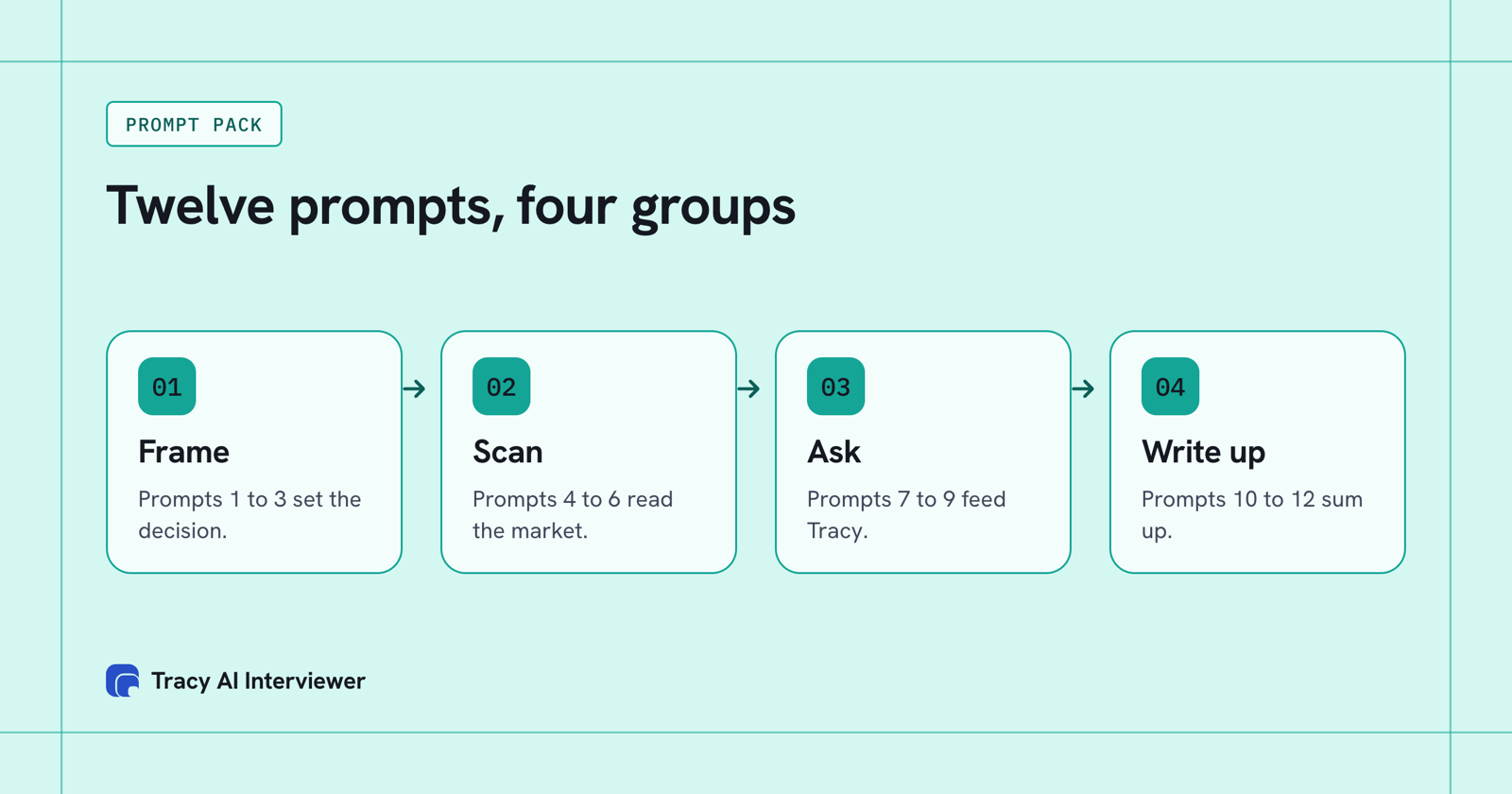
The twelve prompts run in four groups, and the third group hands the guide to Tracy.
How do you turn prompt 8 into interviews?
Add Tracy AI Interviewer to ChatGPT once: Plugins, Install plugin, sign in to Tracy, Allow. On a work or school workspace an admin may need to allow custom plugins first, and a missing custom MCP option usually means Developer mode is off in your settings. Tracy's ChatGPT guide has every step.
In a new chat, type @, choose Tracy AI Interviewer and paste the guide from prompt 8. ChatGPT shows the interview as a preview with each question and the report field it fills. Approve it and the interview exists; nobody is invited until you approve an invitation preview as well. Then paste the invitation from prompt 9, invite agency owners from your own list by email or share the public link (on by default, up to 20 people for 14 days; you can switch it off in the chat). Tracy does not look up addresses. Owners join in a browser at any hour with no account.
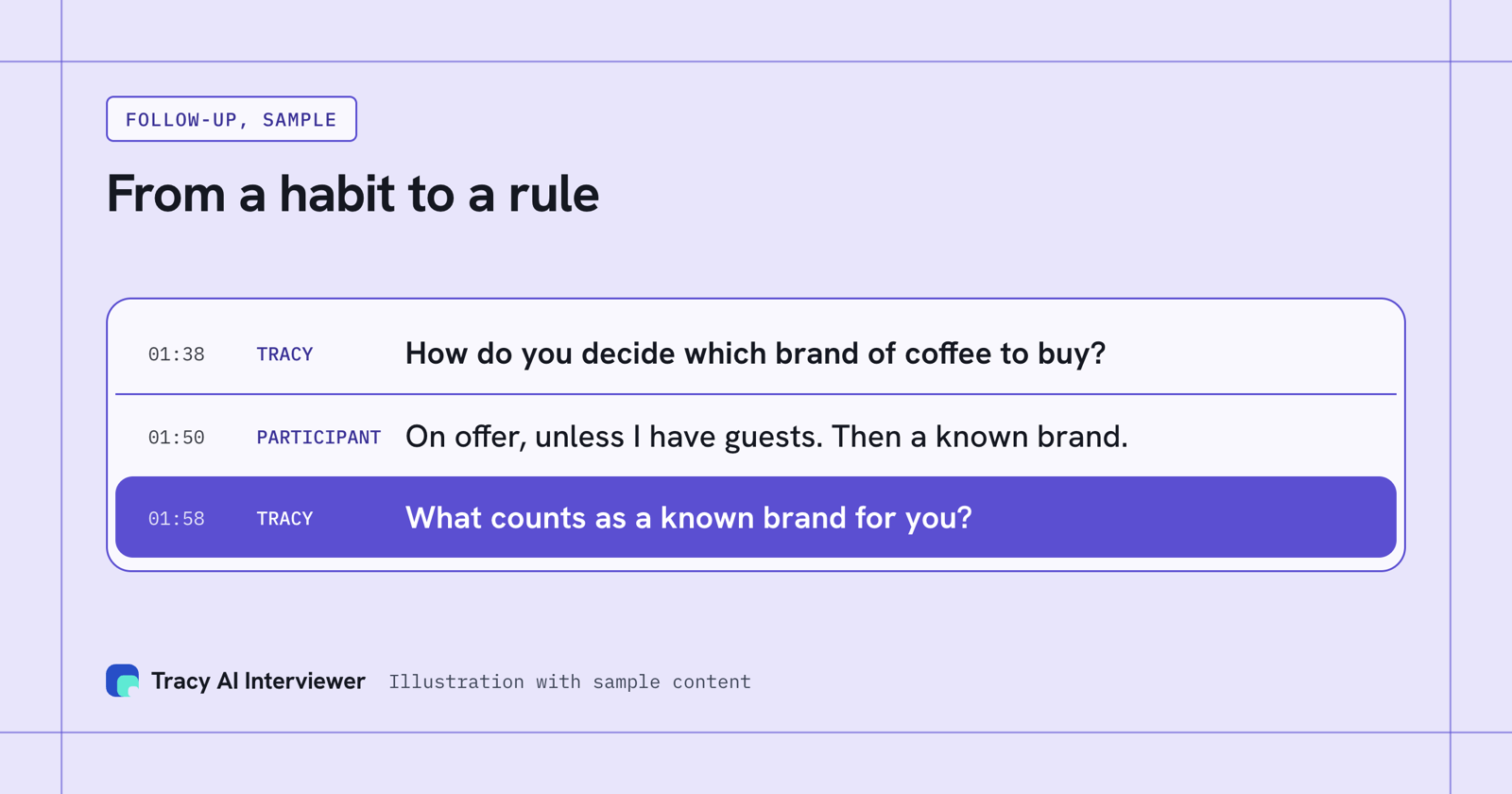
A stated habit becomes a reason once Tracy asks what a known brand means to the person.
What comes back
Tracy listens, lets the person finish and asks for the detail that is missing. Each answer is stored with its time: in the sample, a purchase-driver field reads "Promotion; known brand for guests", with evidence at question 1, 01:50, and the quote "On offer, unless I have guests. Then a known brand." The recording and a timestamped transcript sit behind it, and everyone gets the same guide, so answers compare across the round. Ask in the chat for the results and you get what each person said to each question, plus the result fields.
Tracy reports what people said and does not score or rank them. Prompts 10 to 12 then go back to ChatGPT with the transcripts, and you decide what the round means. Comparing answers across a round shows the comparison step, and how to run customer interviews covers the practice. Claude users can paste the same prompts: Claude for research shows where it differs, and ChatGPT vs Claude for market research compares the two.
Which path fits you?
- You only need the desk work: prompts 1 to 6, in ChatGPT or Claude for research.
- You need the why behind lost deals: win-loss interview questions.
- You already hold survey answers: ChatGPT for survey analysis.
- You want the whole flow in one place: the customer research use case.
Common questions
What are good ChatGPT prompts for market research?
Can ChatGPT do market research?
Do these prompts work in Claude?
Can I download the pack?
What does it cost to run the interviews?
Run the interview your prompts wrote
Connect Tracy to ChatGPT, paste the guide from prompt 8 and approve the preview. Customers answer from a link.
Try it free (opens in a new tab) Book a demo (opens in a new tab)
Your first 3 results are free. No card needed.
Sources
- OpenAI: Deep research, retrieved 23 Nov 2026.
- OpenAI: File uploads FAQ, retrieved 22 Nov 2026.
- Tracy AI Interviewer: ChatGPT guide, retrieved 14 Nov 2026.
- Tracy AI Interviewer: Pricing, retrieved 11 Nov 2026.