In short
Good fellowship interview questions ask what an applicant has done, then ask again for the detail. Below are ten, each with a follow-up and what to listen for, plus a sheet your panel can copy.
Tracy AI Interviewer runs the same interview with every finalist from your own questions, asks the follow-up in the applicant's own field and gives the panel what each person said to each question, with the recording behind it.
Try the sheet on a few finalists first, then put the rest through one Tracy link. The first 3 results are free.
Fellowship applications tend to look alike, with a strong project description, good references and a clean record. Fellowship interview questions are where a panel learns what each applicant has actually done and why. The ten below cover the work itself, what is finished, setbacks, the reason for this fellowship, the plan for the first months and how success will be judged.
If your panel awards money rather than a place, the scholarship interview questions page has a set for that. For a wider selection process, see admissions interview questions.
Which fellowship interview questions tell strong applicants apart?
Ask every applicant the same ten questions in the same order and follow each with one request for detail. The Thiel Fellowship's FAQ puts its bar as the need to "demonstrate meaningful progress toward a concrete vision". These questions test for that kind of progress, starting with what already exists. Pick six for a 20-minute slot, and keep the follow-ups.
1. What are you working on that you would keep working on without this fellowship?
Follow up with: What did you do on it last week?
Listen for: A recent, specific action with a date.
2. What have you finished so far?
Follow up with: If a stranger looked at it today, what would they see?
Listen for: Something that exists, with a date on it.
3. What did you try that did not work?
Follow up with: What did you change afterwards?
Listen for: What changed in the approach, in concrete terms.
4. Why this fellowship, and why now?
Follow up with: What would you do over the next year if you were not selected?
Listen for: A real plan B, which shows the goal does not depend on the award.
5. Who have you learned most from, and what did they say that you disagreed with?
Follow up with: What did you do about it?
Listen for: A named person and a view of the applicant's own.
6. Which part of the work is hardest for you personally?
Follow up with: Who could help, and have you asked them?
Listen for: A limit named without prompting.
7. What would your first 90 days in the fellowship look like?
Follow up with: What is the first thing you would stop doing to make room?
Listen for: A first step with a date or a name, and a trade-off.
8. How will we know in a year that it worked?
Follow up with: What would you show us at month six?
Listen for: A measure the applicant chose and a checkpoint on the way.
9. Tell us about a time you worked with others toward something.
Follow up with: What was your part, and what was theirs?
Listen for: A clear individual contribution inside a group result.
10. What question should we have asked you?
Follow up with: Why that one?
Listen for: What the applicant thinks matters and the application does not show.
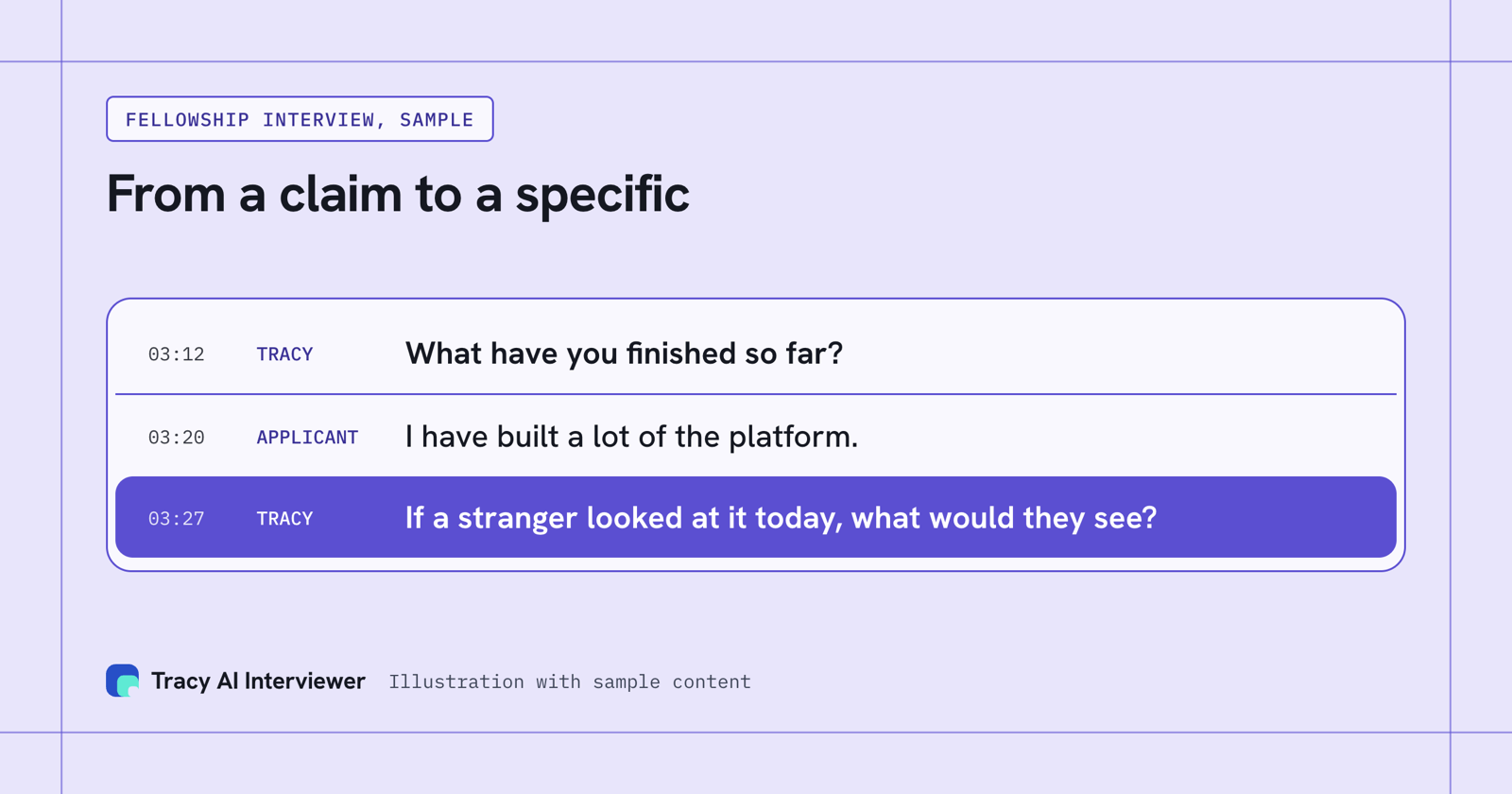
The follow-up turns a claim into a specific.
The panel sheet to copy
Copy this sheet into a shared document and give one to each panel member. They complete the last two columns alone, before anyone speaks, so the group begins from what the applicant said.
| Criterion | What a strong answer holds | Quote and time | Your note |
|---|---|---|---|
| Progress | Something finished or shipped, with a date | ||
| Learning | A setback and the change it caused | ||
| Fit | A reason tied to this fellowship, with a plan B | ||
| Plan | A first step with a name or a date | ||
| Candour | A limit named without prompting |
Scroll the table sideways to see all 4 columns.
Set the criteria with the whole panel before the first interview, and use the same five for every applicant.
What does a filled-in fellowship interview look like?
Invented sample data. A panel member sees one row per question: what the applicant said, the follow-up, and where in the recording to listen.
| Question | What the applicant said | Follow-up | Time |
|---|---|---|---|
| What are you working on, and who has the problem? | Cold chain checks for small food distributors; spoke to 30 distributors before building | What did the first three say that surprised you? | 02:10 |
| What have you done in the last month? | Signed two pilot customers and cut set up time from a week to one day | Not asked | 05:30 |
Scroll the table sideways to see all 4 columns.
The first answer gives a number, and the follow-up tests the claim behind it. The panel can open the recording at 02:10 and hear the answer in the applicant's own words before it debates.
How do you interview every finalist, not just the shortlist?
Calendars decide who gets a second conversation. Y Combinator took 260 companies for its Winter 2024 batch from over 27,000 applications, and no panel can hold 27,000 interviews. A fellowship with a few hundred finalists meets a smaller version of the same limit, because the panel's hours decide who gets a real conversation.
Tracy AI Interviewer lifts that limit. Paste the ten questions in as your own, or describe the fellowship and edit the questions Tracy drafts. Share one link; the link can go anywhere, a WhatsApp message included. Each finalist starts when ready, at any hour, in the browser, with no calendar slot. Tracy asks the follow-up in the applicant's own field and waits for the end of a thought before it speaks. A 30-minute interview uses 2 credits, which is $2 at $1 per credit.
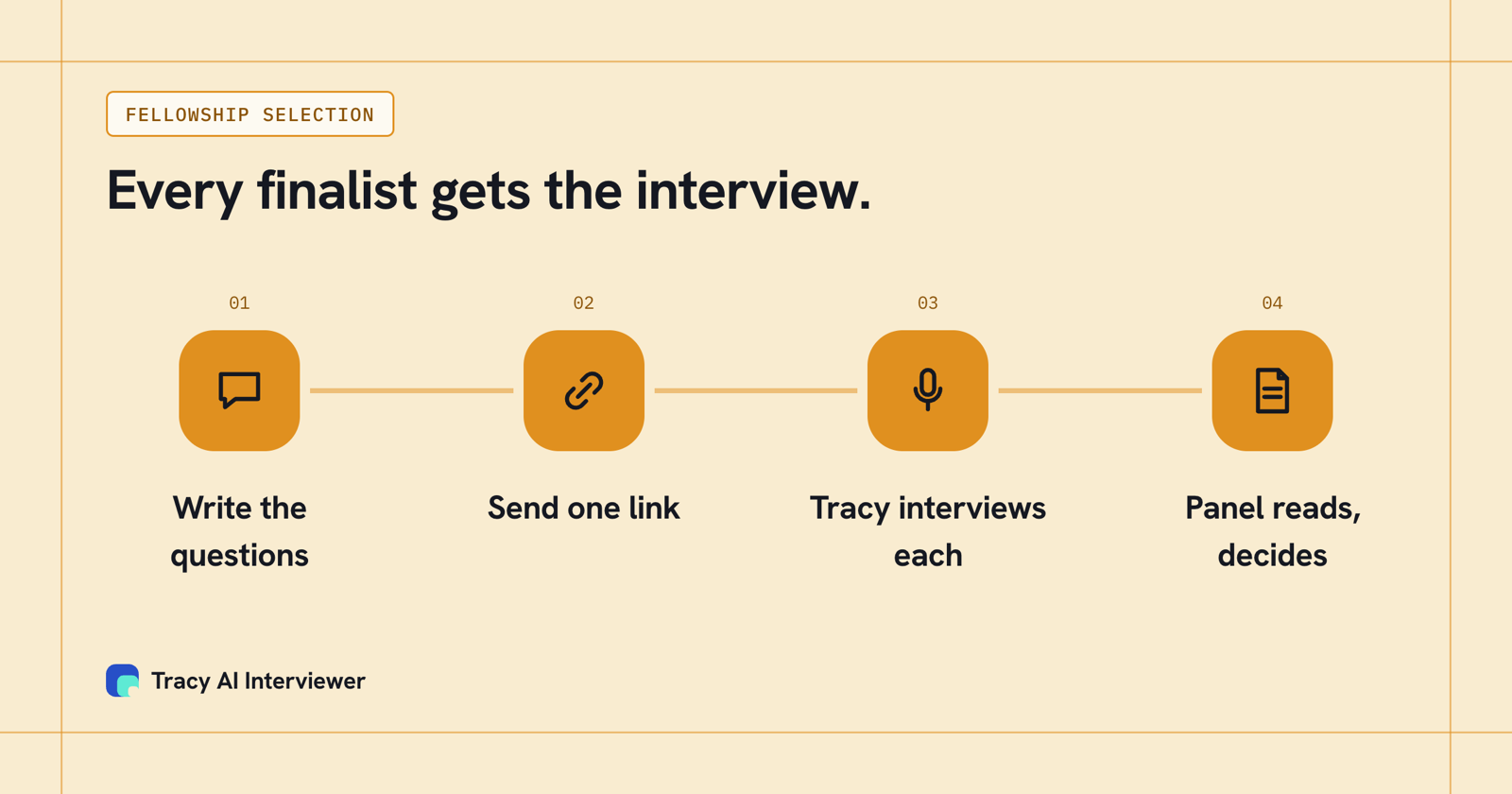
Your questions go in, every finalist gets the interview, the panel reads and decides.
What stays with the panel?
The panel keeps the decision. Tracy reports what each applicant said to each question, with a recording and a timestamped transcript, and does not score, rank or reject anyone. Every finalist is told on the join screen that the conversation is recorded and transcribed. Panel members read the reports, fill the sheet above and meet to compare what was said.
Which mistakes spoil a fellowship interview?
- Changing the questions between applicants makes the answers impossible to compare.
- When time runs short, cut a question and keep its follow-up.
- If the most senior panel member speaks first, the others tend to follow. Fill the sheet alone, then talk.
- A polished essay can describe work that never happened, so ask for the date and the artefact.
Which path fits you
- Running selection for a programme or fund: Tracy for applications.
- Comparing tools for a cohort: AI interview tools for accelerators.
- Building a question set for another process: interview guide template.
- Reading what the market looks like: accelerator statistics.
Common questions
What are good fellowship interview questions and answers?
What fellowship interview questions should a panel ask?
How long should a fellowship interview be?
Can the same questions be used for a scholarship?
Does Tracy score fellowship applicants?
Copy it, then run it
Copy the questions into one Tracy interview, send the link to your finalists and read what each said. The first 3 results are free.
Try it free (opens in a new tab) Book a demo (opens in a new tab)
Your first 3 results are free. No card needed.
Sources
- Tracy AI Interviewer pricing, retrieved 11 Nov 2026.
- Y Combinator, Meet the YC Winter 2024 batch (3 April 2024), retrieved 23 Nov 2026.
- Thiel Fellowship FAQ, retrieved 23 Nov 2026.