In short
A useful AI interview summary says what the person said to each question, with the quote and the moment in the recording behind it. Tracy AI Interviewer supplies both: it asks follow-ups in the person's own field, so there is something specific to quote, and each result links every point to the recording beside a timestamped transcript. Your team reads the notes, checks a point and decides.
What AI summaries do well
An AI interview summary is fast to read: one entry per question turns a long recording into something a manager can scan in a minute. It has to be trustworthy in that minute, though. A summary that says "strong communicator with solid support experience" gives you a conclusion and nothing to test. A summary that gives the answer, quotes the line and links to the moment in the recording gives you a conclusion you can check.
A summary can only quote what the interview produced, and a flat answer leaves nothing to quote. That is the gap Tracy's result report closes: Tracy AI Interviewer follows up in the person's own field, then keeps a recording, a timed transcript and what the person said to each question. This page covers what an AI interview summary should contain, how notes with quotes differ from a plain summary and how to check one in five minutes.
What should an AI interview summary contain?
An AI interview summary should say what the person said to each question, quote the words that show it and point to the moment in the recording. It should also show what was not answered and leave the decision to a person.
- One entry per question, so you can find the part that matters.
- What the person said, in plain words, kept separate from any interpretation.
- The supporting quote, word for word.
- A timestamp that opens the recording at that moment.
- What was not answered, so gaps are visible.
- No verdict. A person decides.
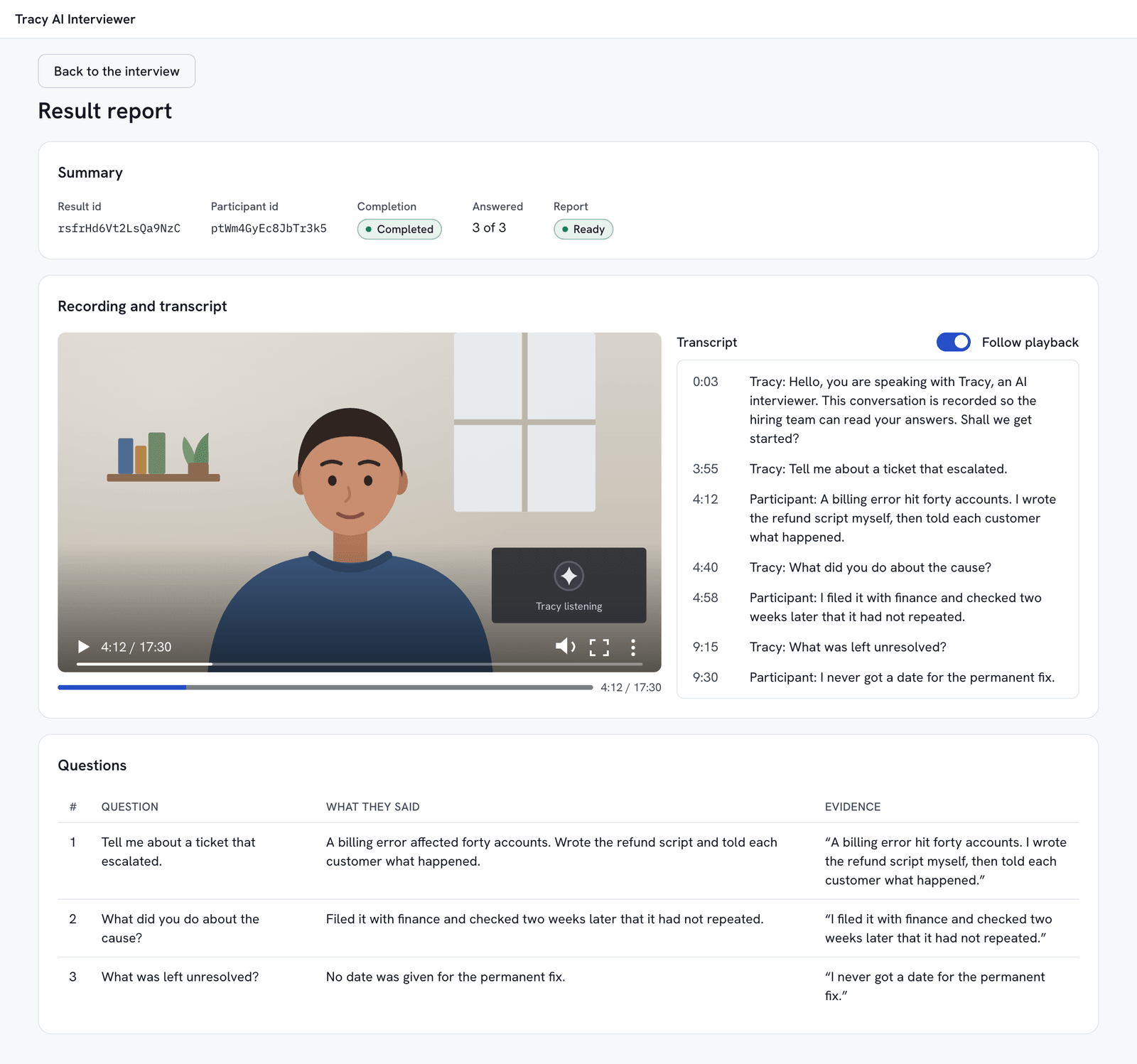
In Tracy's result, each question shows what the person said, every point links to the moment in the recording, and the full transcript sits beside the video. Tracy does not reject anyone. For a fuller list of what to check, see this checklist for reading a report and its evidence.
Plain summary or notes with quotes: what changes for the reviewer?
| Plain summary | Notes with quotes | |
|---|---|---|
| Checking a claim | Search the transcript yourself | Read the quote beside the claim |
| Finding the moment | Scrub through the recording | Jump from the timestamp |
| Seeing gaps | Easy to miss | Unanswered questions show up |
| Sharing with a manager | They take your word | They read the person's words |
| Tone | The writer's adjectives | The person's own words |
Two ways to write any interview summary, and what each leaves the reviewer to do.
The plain summary is faster to write. Notes with quotes are faster to trust, because the reader checks a point in seconds instead of redoing the interview.
What does a summary with quotes look like?
The result below is a recreation with fictional data. It shows three questions from one hiring interview. Each has what the person said and the quote behind it, beside the recording and a transcript timed to it. There is no score.
Take the first question. A plain summary would read "The candidate has strong experience handling escalations and communicates clearly." The notes with quotes add the line itself: "A billing error hit forty accounts. I wrote the refund script myself, then told each customer what happened." (4:12). The second version gives you a question to ask in the debrief.
Each answer is next to the quote and the moment it came from.
How do you check an AI interview summary in five minutes?
Read each question's entry first. Then open the recording at the two points that matter most to your decision and listen to the tone. Look for the question that was not answered. Add your own note, then decide.
Here is one question read from start to finish. First you see what the person said to it, in a line or two. Under that sits the quote that shows it, word for word. Then you follow the link to the moment in the recording and hear how it was said. Say the quote reads "we handled it" and the voice on the recording hesitates. Write that doubt in your own note, apart from the person's words, so the next reader can tell which is which.
A summary you can check this way is a summary you can hand to a hiring manager as it stands. They read the same quotes you did. If two reviewers read the same result, compare the points they opened in the recording, not only their conclusions.
What does a timestamp save at volume?
Replaying one 20-minute interview takes 20 minutes. Checking the two points that matter takes about five. Across 100 interviews, replaying everything is about 33 hours, while two checked points each is about 8. The timestamp is what makes the short version possible, because it opens the recording at the right second. A summary without one sends you back to scrub through the video, and a transcript alone loses the tone that the recording keeps.
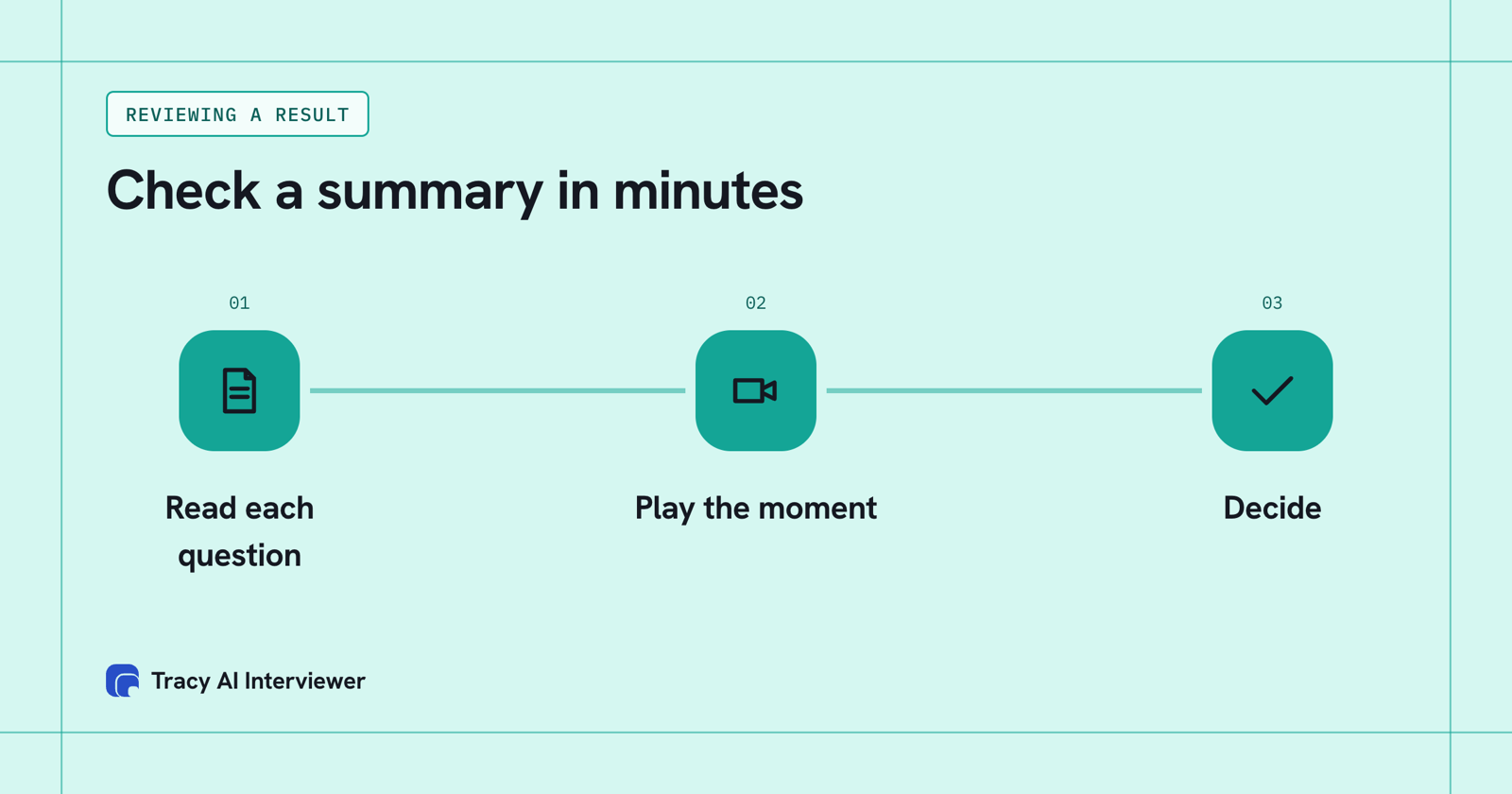
Read, play the moment, decide.
Where do AI summaries go wrong?
- A summary can drop the exception, the one answer that did not fit.
- It can put its own wording in the person's mouth.
- It can read a hesitant answer as a confident one.
- It can turn a gap into a vague adjective.
Quotes, timestamps and a transcript beside the recording are the fixes. They let the reader catch each of these. Keep the writer's interpretation visibly apart from the person's words. For the method behind turning transcripts into themes, see interview transcript analysis.
What Tracy adds to AI interview summaries
A summary is only as good as the answers it summarises.
- Reach every applicant. Each person starts on click, at any hour, with no scheduling and no recruiter on the call, so every person has a result to summarise.
- Ask the next question. Tracy asks each follow-up based on the answer before it and waits for the end of a thought, so a vague answer gets a sharper question and there is a line worth quoting.
- Keep the evidence. The interview is recorded on both sides, with a transcript timed to the recording and what the person said to each question.
For a template to write your own notes, see interview notes template and interview report template. For the difference between a transcript tool and a report, see interview transcription software vs interview reports.
Where should you start?
Open one result and check one point against the recording. Tracy costs $1 per credit, one credit per started 20 minutes, and the first 3 results are free.
Which path fits you
- Hiring reports in full: AI interview reports.
- Research interviews: customer research.
- Check-ins and exit interviews: people teams.
- Cost before you start: pricing.
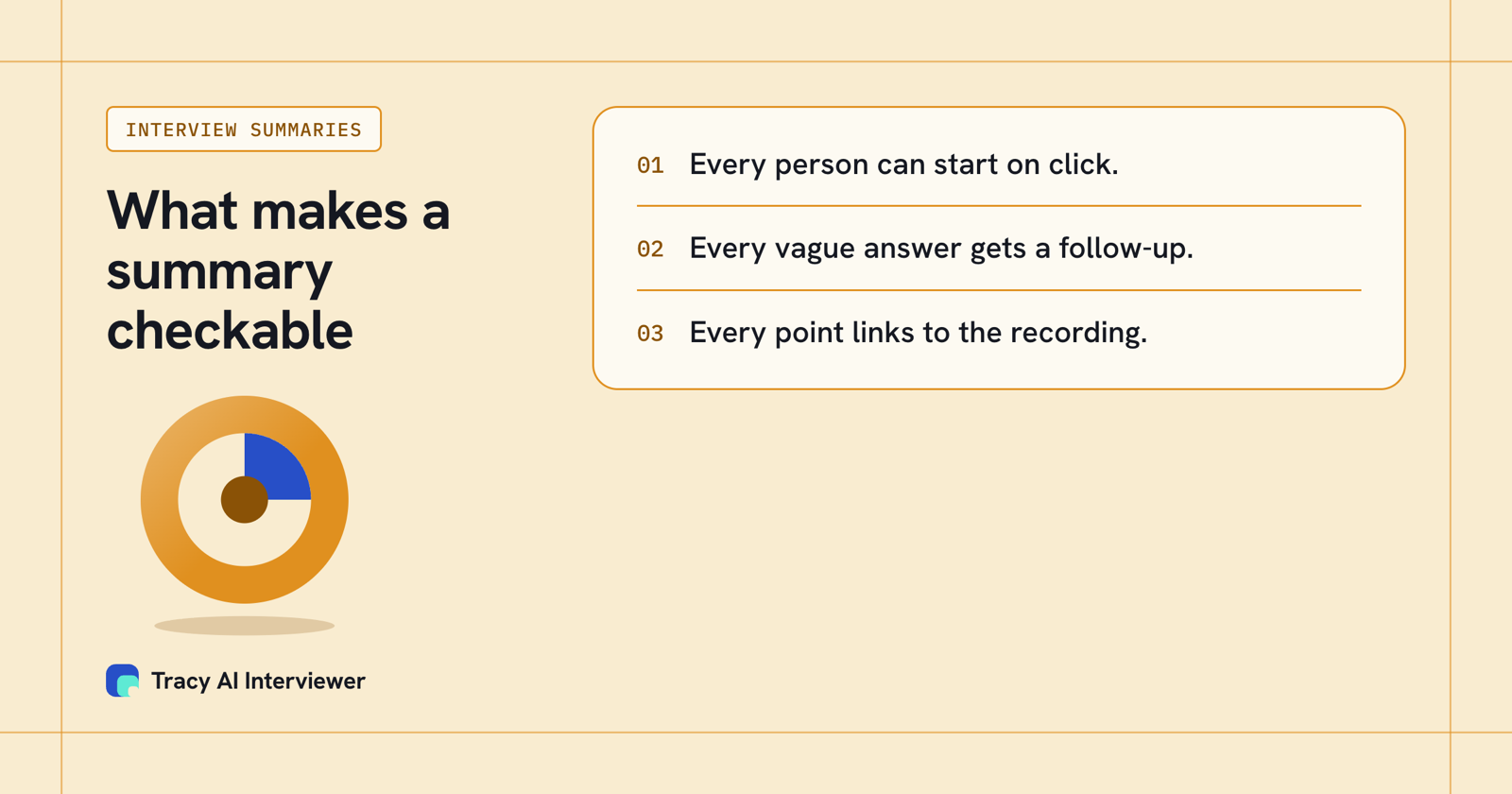
Three things Tracy adds to a summary.
Common questions
What is an AI interview summary?
Can AI summarise an interview accurately?
Should an AI interview summary include a recommendation?
What is the difference between a transcript, a summary and a report?
How do you write an interview summary yourself?
Open one result in Tracy
Create one interview, then read what each person said and play the moment behind a quote. The first 3 results are free.
Try it free (opens in a new tab) Book a demo (opens in a new tab)
Your first 3 results are free. No card needed.
Sources
- Tracy AI Interviewer product page, retrieved 14 Nov 2026.
- Tracy AI Interviewer pricing, retrieved 11 Nov 2026.