
In short
Good hiring manager intake questions fix three things before sourcing starts: the problem the hire solves, the skills that decide success and how each skill will show up in an interview. Below are 12 questions with follow-ups and an intake form to copy.
Tracy AI Interviewer turns those answers into a screening interview. Set it up from the job description, edit the questions or bring your own, and read what every applicant said to each question, with the recording behind it.
Run the intake, paste the three skills into one interview and send the link. The first 3 results are free.
A weak intake meeting ends with "a strong communicator, five years of experience" and a recruiter guessing at the rest. Hiring manager intake questions make the manager say what the job is, what good looks like and what they will do with the shortlist. Indeed says a typical intake meeting lasts between 30 minutes and an hour, so every question has to earn its minute.
The 12 below are in the order that works in the room. After them come an intake form, a filled example and a short guide to carrying the answers into screening. If you also need the interview side, the job scorecard template and candidate screening questions pick up where this page stops.
What should you ask in a hiring manager intake meeting?
Ask about the problem first, then the skills, then how the manager will recognise them, then the process. Take the questions in order and write down the answer to each follow-up as well. If the manager has 20 minutes, ask questions 1, 3, 4, 9 and 12.
1. What problem should this hire solve in the first six months?
Follow up with: What would a good first quarter look like?
Listen for: Outcomes the manager can name, not a list of duties.
2. Is this a new role or a replacement?
Follow up with: What did the last person do well, and what was missing?
Listen for: Concrete examples from a real person, not a wish list.
3. Which three skills decide whether someone succeeds here?
Follow up with: Which of them can the person learn on the job?
Listen for: A short list split into must-have and learnable.
4. What would you hear in an interview that shows someone has that skill?
Follow up with: Can you describe a past hire who showed it?
Listen for: An observable answer a recruiter can listen for.
5. Who will they work with every day, and who has a say in the offer?
Follow up with: Who will interview, and in what order?
Listen for: Names and roles, so no stage appears at the end.
6. What is the pay range, and is there room above it?
Follow up with: What would you do if the best candidate asks for more?
Listen for: A number before sourcing starts.
7. Which deal-breakers are real?
Follow up with: Is each one a rule, or a habit from the last hire?
Listen for: A reason behind every deal-breaker.
8. Where have good candidates come from before?
Follow up with: Which sources have produced nothing?
Listen for: Channels with evidence behind them.
9. How quickly can you give feedback on each candidate?
Follow up with: What happens to the shortlist if feedback takes a week?
Listen for: A commitment in days.
10. How soon is the hire needed?
Follow up with: What is the cost to the team of two more weeks?
Listen for: A real deadline and a reason for it.
11. What makes this job hard to fill?
Follow up with: What would you tell a candidate about it in the first call?
Listen for: The honest hard part, named early.
12. What should we ask every applicant before they reach you?
Follow up with: What answer would make you want to meet them?
Listen for: The manager's own screening question, ready to use.
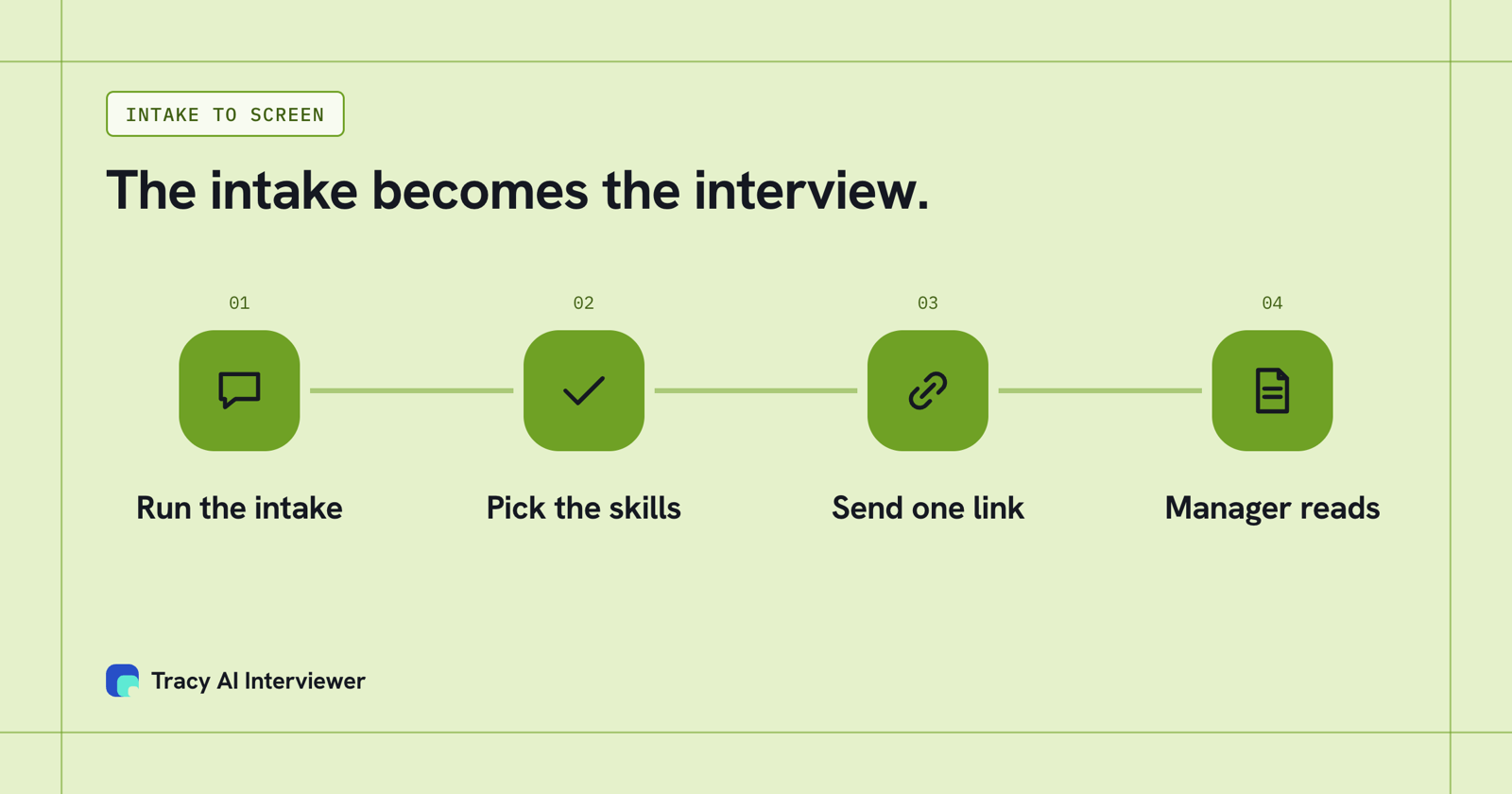
The intake answers become the screening questions.
The intake form to copy
Paste this table into a document and fill it during the meeting. Send it to the manager as a draft first so the meeting spends its time on the follow-ups.
| Field | What to record | Answer | Agreed on |
|---|---|---|---|
| Problem | What the hire must fix in six months | ||
| Must-haves | Three skills, each with how it shows in an interview | ||
| Learnable | Skills the person can pick up on the job | ||
| Deal-breakers | Each one with its reason | ||
| Process | Stages, interviewers and feedback time in days | ||
| Pay and timing | Range, start date and what slips if it is late | ||
| Screening question | The question the manager wants asked of everyone |
Scroll the table sideways to see all 4 columns.
The last row matters most for volume. A recruiter with 200 applicants cannot ask 200 people the manager's question on a call. The question can go into an interview that every applicant starts on their own.
What does a filled intake look like?
This is an invented example for an operations coordinator role at a staffing agency's client. The right-hand column shows what each answer becomes in the screen.
| Manager said | Recruiter heard | Question for applicants |
|---|---|---|
| "We lose time on late shipments" | The hire owns supplier follow-up | What did you do the last time a supplier was late? |
| "Needs to be local" | A commute limit, not a postcode | How far are you willing to travel for this role? |
| "Open to a short contract first" | Contract is acceptable | Are you open to a short contract before a permanent offer? |
The manager's own words stay in the left column, so every applicant question traces to something the manager said.
How do you turn the intake into a screening interview?
Tracy AI Interviewer takes the intake as the brief. Describe the role and Tracy drafts the questions, or paste the ones from the form as your own and edit freely. Each applicant starts from one link, in the browser, at any hour, with no calendar slot and no recruiter on the call. The link can be shared anywhere, a WhatsApp message included. Tracy asks the follow-up in the applicant's own field and waits for the end of an answer before she speaks.
The recruiter gets what each applicant said to each question, the result fields and a note for the applicant tracking system, which Tracy can write back to the ATS. The report is a link the manager can open. A customer cut its average time to hire from 44 days to 7, and Tracy did the work of 53 full-time recruiters in one month.
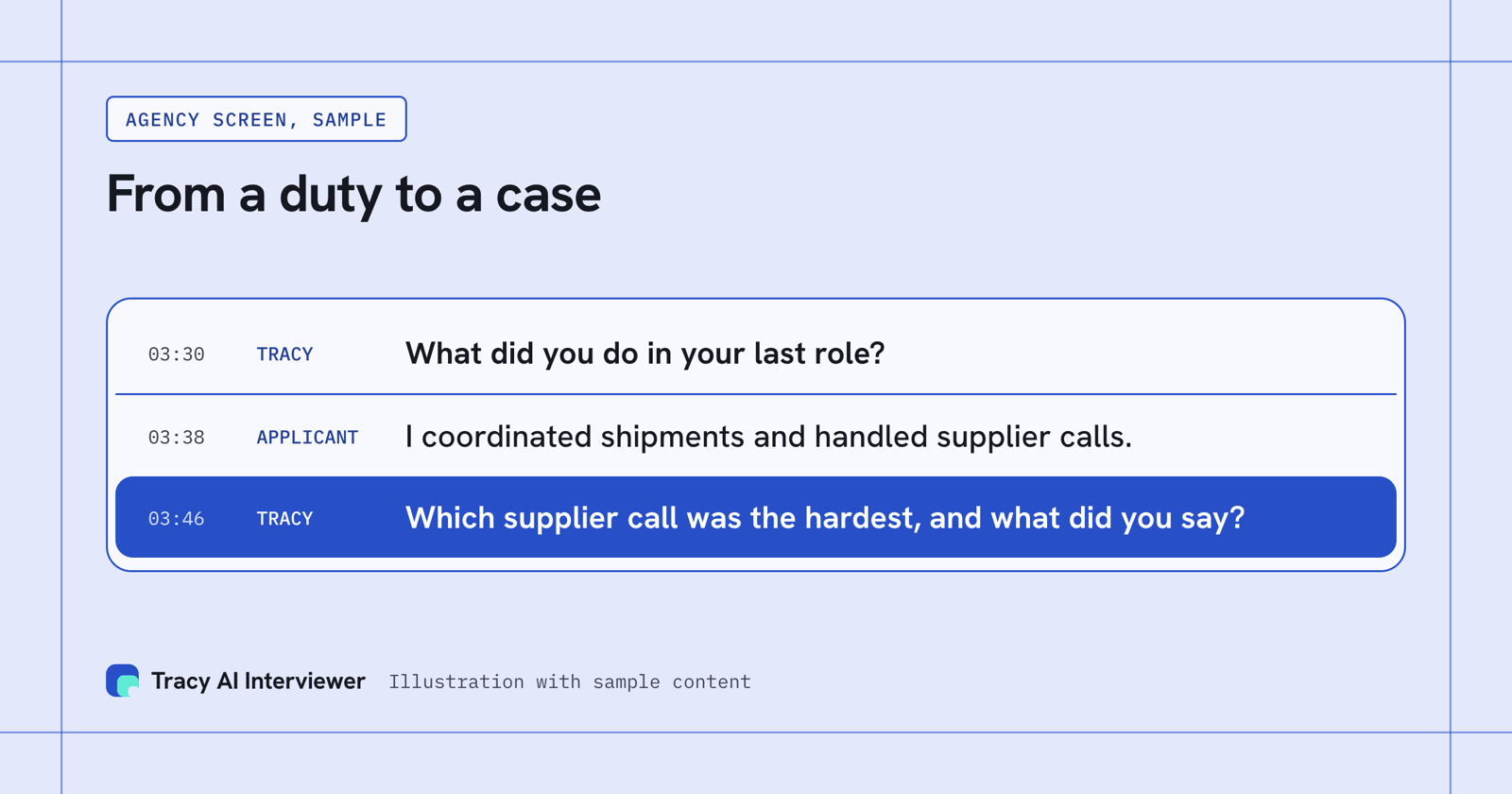
A follow-up turns a duty from the intake into evidence.
What does the recruiter read afterwards?
Each applicant leaves a short record. This is an invented sample from an agency screen.
| Question | What the applicant said | Time |
|---|---|---|
| Which roles are you open to? | Operations coordinator or office manager, within forty minutes | 01:40 |
| What did you do in your last role? | Coordinated shipments and handled supplier calls for a company with 60 staff | 03:30 |
The fields "Open to roles" and "Commute limit" are filled from those answers, each with its time, so the consultant can decide who to put forward. Tracy reports what was said and does not score, rank or reject anyone.
Which intake mistakes cost the most?
- If a manager cannot say how a skill shows in an interview, treat it as a preference and ask question 4 again.
- Deal-breakers with no reason usually come from the last hire.
- With no feedback time in days, the shortlist ages while candidates take other offers.
- When the screening question is skipped, the manager's best test never reaches most applicants.
Which path fits you
- Hiring for several clients at once: AI interview tools for RPO and staffing.
- Speeding up submissions: staffing speed to submit.
- Turning the intake into a role description: job specification vs job description.
- Running volume screens: Tracy for hiring at volume.
Common questions
What to ask in an intake meeting?
How long is an intake meeting?
What goes in an intake form?
Who should attend an intake meeting?
Can Tracy run the intake meeting?
Turn the intake into a screen
Paste the three must-haves into one Tracy interview, send the link and read what each applicant said. The first 3 results are free.
Try it free (opens in a new tab) Book a demo (opens in a new tab)
Your first 3 results are free. No card needed.
Sources
- Indeed Hire, intake meeting guide (updated 16 June 2025), retrieved 23 Nov 2026.
- Tracy AI Interviewer pricing, retrieved 11 Nov 2026.