AI Technical Interviews: Coding, System Design and Debugging Screens
TLDR
- Tracy AI Interviewer gives every engineering applicant a coding or system-design screen with adaptive follow-ups. Reviewers can see the candidate's reasoning and trade-offs, then check each score against their own words and the recording.
- Choose a test library for a standardized scored task. Choose Tracy when how someone explains and adapts their own solution is the hiring signal.
In this guide
- Why use Tracy as your AI technical interview platform?
- What can an AI technical interview cover?
- What does an AI coding interview follow-up chain look like?
- What does the reviewer get after an AI technical interview?
- How does Tracy compare with CodeSignal and HackerRank?
- How do you set up an AI technical interview tool?
- Questions
- Sources
An AI technical interview gives every applicant a technical first round with follow-up questions, like the ones a senior engineer asks. A test tells you whether the code passes; an AI technical interview also asks why it was written that way and what changes when the requirements move. This guide shows what that looks like on a real coding task, and how Tracy compares with CodeSignal and HackerRank.
Why use Tracy as your AI technical interview platform?
It interviews like your best engineer. Tracy runs natural two-way video interviews, follows up on vague answers, and can introduce a coding task and probe the trade-offs behind an answer. So you hear how a candidate reasons about complexity, scale and testing in their own solution, which is where a strong engineer and someone who memorised the pattern separate. Because the follow-ups come from the candidate's own answer, a copied solution still has to be explained.
Every point is traced to the answer. Each result is a readable summary "with the participant's own words attached", with every answer organised around the fields you define and the video and transcript alongside. The AI explains each answer score, and direct quotes give the context. Your engineers check the evidence for the strongest candidates instead of running another phone screen.
Tracy's interview integrity detection flags tab changes, abnormal eye tracking, live face detection, average delay before an answer, external screens and other unusual patterns, so a copied answer gets a second look (see how AI interview cheating detection works). Candidates rate Tracy 4.7 out of 5 on average.
What can an AI technical interview cover?
Tracy's technical interviews cover four task types: coding task, system design, debugging and code walk-through. Pick the ones that match the role.
- Coding task. A short problem solved live, then questions on the trade-offs, so you learn whether they understand their own solution.
- System design. For example, "Design a rate limiter," then follow-ups on concurrency, failure modes and testing, so you see how senior engineers handle open problems.
- Debugging. A bug and a failing symptom, so you see how they would find the cause in a real codebase.
- Code walk-through. The candidate explains code they wrote or a sample you provide, so you hear the choices behind it.
For AI-lab data platforms, the same format vets coding experts who write and review training data for labs. For other expert fields, see interview questions for AI trainers and domain experts.
What does an AI coding interview follow-up chain look like?
Example: an illustrative chain for a backend engineer, written for this guide. It is not a real candidate.
The task. "Write a function that reads a stream of log events and returns the 10 most frequent error codes in the last hour." The candidate uses a hash map of counts, a min-heap of size 10, and a queue that drops events older than an hour.
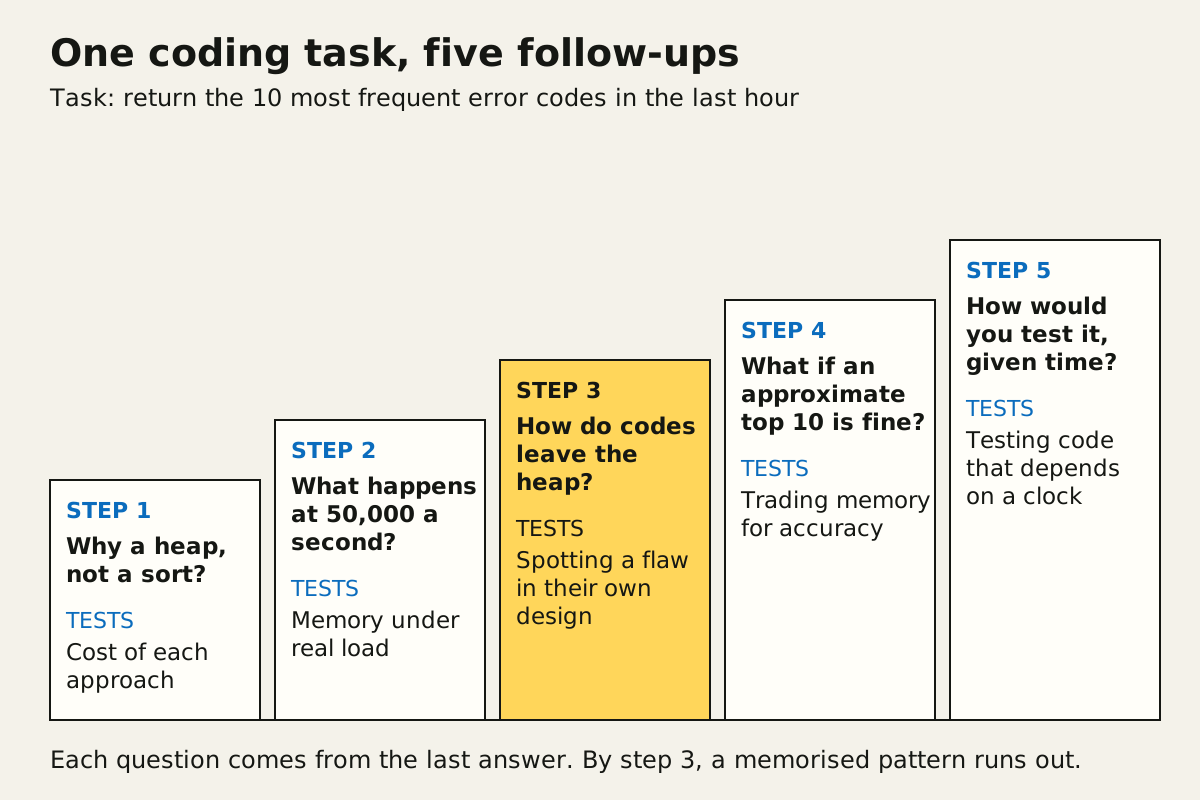
- "You used a heap of size 10. Why that over sorting the counts each time?" A strong answer compares O(n log k) with O(n log n) and says when the gap matters.
- "Your queue keeps every event from the last hour. What happens at 50,000 events a second?" A strong answer moves to per-second buckets, so memory depends on the window length instead of the traffic.
- "With buckets, how do you remove an error code from the heap when its count drops?" A strong answer spots that a plain heap can't update counts cheaply and proposes a fix, such as rebuilding it each second.
- "Say an approximate top 10 is fine. Would you change anything?" A strong answer names a sketch such as count-min and the trade: less memory for some error.
- "How would you test this, given that it depends on time?" A strong answer injects a clock, tests the window edge and handles events that arrive out of order.
At step 1, someone who memorised "use a heap for top-k" gives the right words. By step 3 they have to reason about their own design under a new condition, live.
What does the reviewer get after an AI technical interview?
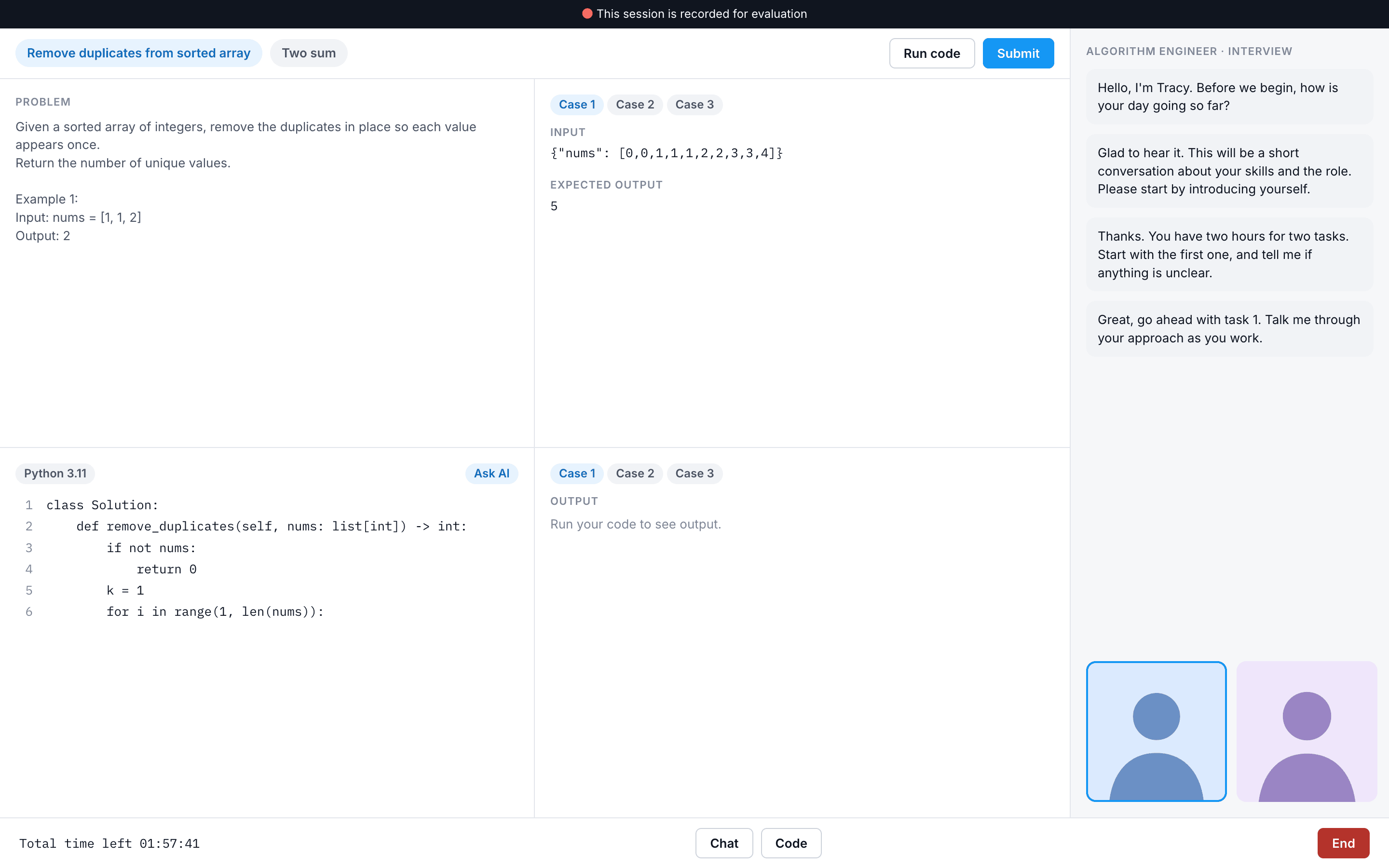
For the coding chain above, the report would read like this illustration with test data:
| Field | What the candidate said |
|---|---|
| Complexity trade-off | "The heap keeps it at n log 10, so basically linear. Sorting re-sorts every event." |
| Scaling the window | "I'd keep 3,600 one-second buckets, so memory is fixed whatever the traffic." |
| Heap updates | "A plain heap can't decrease a key cheaply. I'd rebuild it once a second from the buckets." |
| Testing | "I'd pass the clock in, so a test can jump 59 minutes and check the edge." |
Your team reads the fields, opens the video where it wants more, and decides who reaches the panel.
How does Tracy compare with CodeSignal and HackerRank?
CodeSignal and HackerRank built their names on test libraries and have since added AI interviewers. We make Tracy, so check each vendor's page too.
| Tracy | CodeSignal | HackerRank | |
|---|---|---|---|
| Interviews like your best expert | Follows up on vague answers and probes the trade-offs behind an answer on a coding task, with role-specific questions | Assessments "validated by IO psychologists"; its AI Interviewer "probes and asks follow up questions" when answers are thin. Plans list "Sales, CS, & Marketing AI Interviewers" and "Product, Design, & Engineering AI Interviewers" | Chakra "asks follow-up questions on the candidate's work to see how well they're able to defend their decisions" |
| Thousands of interviews, zero new hires | Applicants join from a link in their browser with no sign-up, whenever it suits them | Build plan: "60 Annual credits" for "Assessments & Interviews" | Starter: "60 candidate attempts / year"; Pro: 360 |
| Work with your stack | Workable, HubSpot, Zapier, Slack, WhatsApp, and AI assistants such as ChatGPT and Claude; bring your own questions | "Basic ATS Integrations" on the Grow plan | "ATS and calendar integrations" on the Pro plan |
| Every score, traced to the answer | A summary by the fields you define, with the candidate's own words attached and each answer score explained by the AI, plus video and transcript | "an in-depth skills report + full transcript with rationale" | "a clear 'why' for every score" |
| Price | $7 per credit; one credit covers up to 20 minutes. You pay for results, not seats. Enterprise: custom, based on your volume, as low as $1 per credit | Build from $79 a month billed annually; extra credits $20 each | Starter from $79 a month, $948 billed annually, Chakra included; extra attempts $20 each |
Tracy starts with a conversation and can put a task inside it, so reviewers hear how each applicant reasons about the solution. CodeSignal and HackerRank also offer AI interviewers alongside their test libraries. The same Tracy interviewer covers non-engineering experts, which matters if you vet both.
Pick CodeSignal or HackerRank instead if:
- You screen thousands of similar applicants, such as new graduates, and want one standard auto-scored test. Tracy then fits as the next step for those who pass.
- You need validated, comparable test scores over years. CodeSignal says each assessment is "backed by 2,800 hours of research and testing"; Tracy can sit after that test to hear how the top scorers reason.
- You want a large rotated question bank. CodeSignal's Build plan includes "Access to 2,000 Questions", and HackerRank's Starter plan lists "2000+ library questions". If your roles need your own questions, Tracy lets you bring them.
Our guide on how to screen candidates shows the test-then-interview set-up, and AI interview tools for staffing agencies covers agencies that submit engineers to many clients. For the wider field, see the best AI interview software for hiring teams.
How do you set up an AI technical interview tool?
- List what the panel wants to know, in three to five fields: problem solving, trade-offs, scaling, testing, communication.
- Pick the task types: coding for most roles, system design for senior roles, debugging for large codebases.
- Tell Tracy who you are interviewing and what you need to learn. Your questions are drafted for you, and you add the questions that matter.
- Decide whether AI help is allowed for the task and tell candidates at the start.
- Open the link yourself first and answer as a candidate would, then change anything that feels off.
- Send personal invites or a public link. Candidates join in the browser with no sign-up.
- Read reports field by field and invite the strongest to the panel.
- Tell candidates an AI runs the first round and that a person makes every decision.
Questions
What is an AI technical interview? A first-round interview where an AI interviewer sets a coding, system design or debugging task and asks follow-up questions about the candidate's answer. Your team reviews the report and decides who goes to the panel.
Can an AI coding interview run live? Yes. Tracy can introduce a coding task during the interview and then probe the trade-offs in the candidate's own solution.
Is an AI technical interview better than a coding test? They answer different questions. A coding test checks whether the solution works on a standard scale. An AI technical interview shows how the candidate reasons about it. Running a short test first, then an interview, gets you both.
Do CodeSignal and HackerRank have AI interviewers? Yes. CodeSignal lists AI Interviewers by role family in its plans, and HackerRank includes its Chakra AI Interviewer from the Starter plan. Check their pages for current details.
Is Tracy SOC 2 compliant? Yes. Tracy is SOC 2 Type 2 compliant, with the report on request at tracy@qode.world.
Read next: AI interview cheating detection: how to tell if a candidate is using AI
Sources
- CodeSignal, Technical Assessments. codesignal.com/technical-assessments. Retrieved 29 Oct 2026. Quote: "assessments written by subject matter experts and validated by IO psychologists, each backed by 2,800 hours of research and testing."
- CodeSignal, AI Interviewer. codesignal.com/ai-interviewer. Retrieved 29 Oct 2026. Quote: "If answers are thin, it probes and asks follow up questions based on your criteria." Also: "produces an in-depth skills report + full transcript with rationale."
- CodeSignal, Pricing and Plans. codesignal.com/pricing. Retrieved 29 Oct 2026. Quote: "Build $79 /mo Billed annually ... 60 Annual credits Use for Assessments & Interviews ... Product, Design, & Engineering AI Interviewers Access to 2,000 Questions." Also: "Sales, CS, & Marketing AI Interviewers Basic ATS Integrations" (Grow) and "CodeSignal charges on-demand credits at $20 each."
- HackerRank, Screen. hackerrank.com/products/screen. Retrieved 29 Oct 2026. Quote: "HackerRank has the largest library of developer hiring content in the world."
- HackerRank, Chakra. hackerrank.com/chakra. Retrieved 29 Oct 2026. Quote: "Then it asks follow-up questions on the candidate's work to see how well they're able to defend their decisions and approach." Also: "a clear 'why' for every score."
- HackerRank, Pricing. hackerrank.com/work/pricing (loaded in a browser; plain fetches return a cookie notice). Retrieved 29 Oct 2026. Quote: "Starter For teams making their first technical hires. $79 /mo $948 billed annually ... 60 candidate attempts / year Chakra - AI Interviewer ... 2000+ library questions." Also: "Pro ... 360 candidate attempts / year ATS and calendar integrations" and "Additional attempts $20 each".
- Tracy AI Interviewer, home page. tracyinterview.ai. Retrieved 29 Oct 2026. Quote: "Tracy AI Interviewer can ask role-specific questions, introduce a coding task, and probe the trade-offs behind an answer. CODING TASK SYSTEM DESIGN DEBUGGING CODE WALK-THROUGH Example brief Ask a backend engineer to design a rate limiter, then follow up on concurrency, failure modes, and testing." Also: "Tracy AI Interviewer runs natural two-way video interviews, follows up on vague answers, digs into the interesting ones"; "Your questions are drafted for you." and "add the questions that matter"; "People join in their browser whenever it suits them."; "Each person opens a link in their browser and joins with no sign-up."; "Each interview becomes a readable summary with the participant's own words attached"; "Direct quotes for context"; "your own repeatable interview, with every answer organized around the fields you define."
- Tracy AI Interviewer, pricing. tracyinterview.ai/pricing. Retrieved 29 Oct 2026. Quote: "$7 per credit, in USD. Credits never expire." Also: "You pay for results, not seats." and "1 credit for each started 20 minutes".
- Qode, Tracy product page. qode.world/tracy. Retrieved 29 Oct 2026. Quote: "4.7/5 average candidate rating across interviews."
- Qode, pricing. qode.world/pricing. Retrieved 29 Oct 2026. Quote: "Interview integrity detection: Tab changes, Abnormal eye tracking, Live face detection, Average delay time before answer, External screens, Other unusual patterns." Also: "Video & chapter breakdown", "Transcript", "Answer summary & score", "Explain answer score by AI Agent" and, for Enterprise, "Custom based on volume".
- Qode, 28 Oct 2026: enterprise pricing can go as low as $1 per credit, custom based on volume.
- Qode, confirmed product facts (integrations: ChatGPT, Claude, Gemini, Mistral, Grok, Slack, WhatsApp, Zapier, Workable, HubSpot; SOC 2 Type 2, report on request), 29 Oct 2026.