
TLDR Tracy AI Interviewer asks follow-ups on each person's own CV and work, then shows a reviewer signals with their times, such as delay before answers and tab changes, beside a recording and transcript.
A fake candidate is someone who is not who they say they are, or whose claimed experience is invented. No single sign proves it.
FBI alerts list signs such as lip movement out of step with audio and trouble answering simple questions about location or past.
Next step: send us one role and review the evidence on one interview.
We make Tracy AI Interviewer.
How to spot a fake candidate: three places to look
How to spot a fake candidate comes down to collecting evidence in three places and letting a person weigh it: the application, the interview and the first weeks of onboarding. A fake candidate here means an applicant who is not who they claim to be, or whose claimed work is invented. It is not a candidate who is nervous, has a poor connection or prepared well.
The signs below come from two sources, and our guide to AI interview cheating detection covers the AI-fed-answers case separately. Where the FBI's Internet Crime Complaint Center has described a sign, the table says so and gives the date. Where a sign comes from Tracy's signals or from our own practice, it says that. Nothing on the list is proof by itself.
Signs in the application
Some checks work before anyone joins a call. The FBI's January 2025 advice to employers includes cross-checking HR systems "for other applicants with the same resume content and/or contact information", and reviewing applicants' communication accounts, because North Korean IT workers "have reused phone numbers (particularly voice-over-IP numbers) and email addresses, on multiple resumes purportedly belonging to different applicants". The alert is about one scheme, and the same check is cheap for any pool of applicants.
If your applicant tracking system can search by phone and email, run that search before the interview and not after the offer.
Signs in the interview
These are the signs a reviewer can notice during a video interview, with where each one comes from.
| Sign | Where it comes from | What a reviewer does |
|---|---|---|
| Lip movement and actions that do not match the audio, or a cough that does not line up with the picture | FBI IC3, 28 June 2022 | Read the transcript around that minute, then ask the person to answer again in a short live call |
| Cannot answer simple questions about where they are located or key details of their past | FBI IC3, 16 May 2024 | Ask the same everyday questions of every candidate and compare the answers with the CV |
| Extra noise, or sounds as if the person is surrounded by others doing similar work | FBI IC3, 16 May 2024 | Note the time and ask in a follow-up whether anyone else is helping |
| The same resume content, phone number or email on applications under different names | FBI IC3, 23 January 2025 | Cross-check your applicant records before the interview |
| A pause before almost every answer | Tracy signal: delay before answers | Listen to a few of them. A slow connection looks the same |
| Leaving fullscreen, switching tabs or a second screen | Tracy signals | Ask what the person was doing, then follow up on the next answer |
| Knows the headline of a project but not one detail below it | Our practice | Follow up on the CV claim: what broke, who decided, what changed |
The table lists seven signs, each with the action that follows it. The FBI alerts describe remote-work fraud and one North Korean scheme, and they give no rate.
Two cautions apply. First, ask any check of everyone. A location question put only to some candidates is a screen on those candidates, and accent, name, camera quality and connection speed are not signs of anything. Second, one sign is a reason to look, not a reason to reject.
Signs after the interview
Checking does not stop at the interview. The FBI's January 2025 alert advises verifying identity "during interviewing, onboarding, and throughout the employment of any remote worker" and watching for changes in address or payment platform during onboarding. If the person who starts is not the person who interviewed, a recording of the interview is the first thing to compare.
In the US, the FBI's 2022 alert asks companies that identify this type of activity to report it to the IC3.
How Tracy puts the evidence in front of a reviewer
Tracy AI Interviewer runs the first round for every applicant, so the evidence is the same kind for each person. When the CV check is on, she reads the CV and asks about it (see the CV check). She asks questions in the person's own field, follows up on what they said and waits for the answer. For engineers she can set a coding task and probe the approach and trade-offs, so a copied solution still has to be explained. See AI technical interviews and our technical interviews use case.
She captures tab changes, abnormal eye tracking (gaze), live face detection, delay before answers, leaving fullscreen and external screens, and shows the evidence to a person in the report, with times. A recording of both sides and a timestamped transcript sit behind each result, with a written assessment per question. Nothing is decided in the interview. The person interviewed is told on the join screen that the conversation is recorded and transcribed, and the decision stays with your team. Identity verification is a separate step in your process. Tracy's recording and signals are evidence for the person who runs that check.
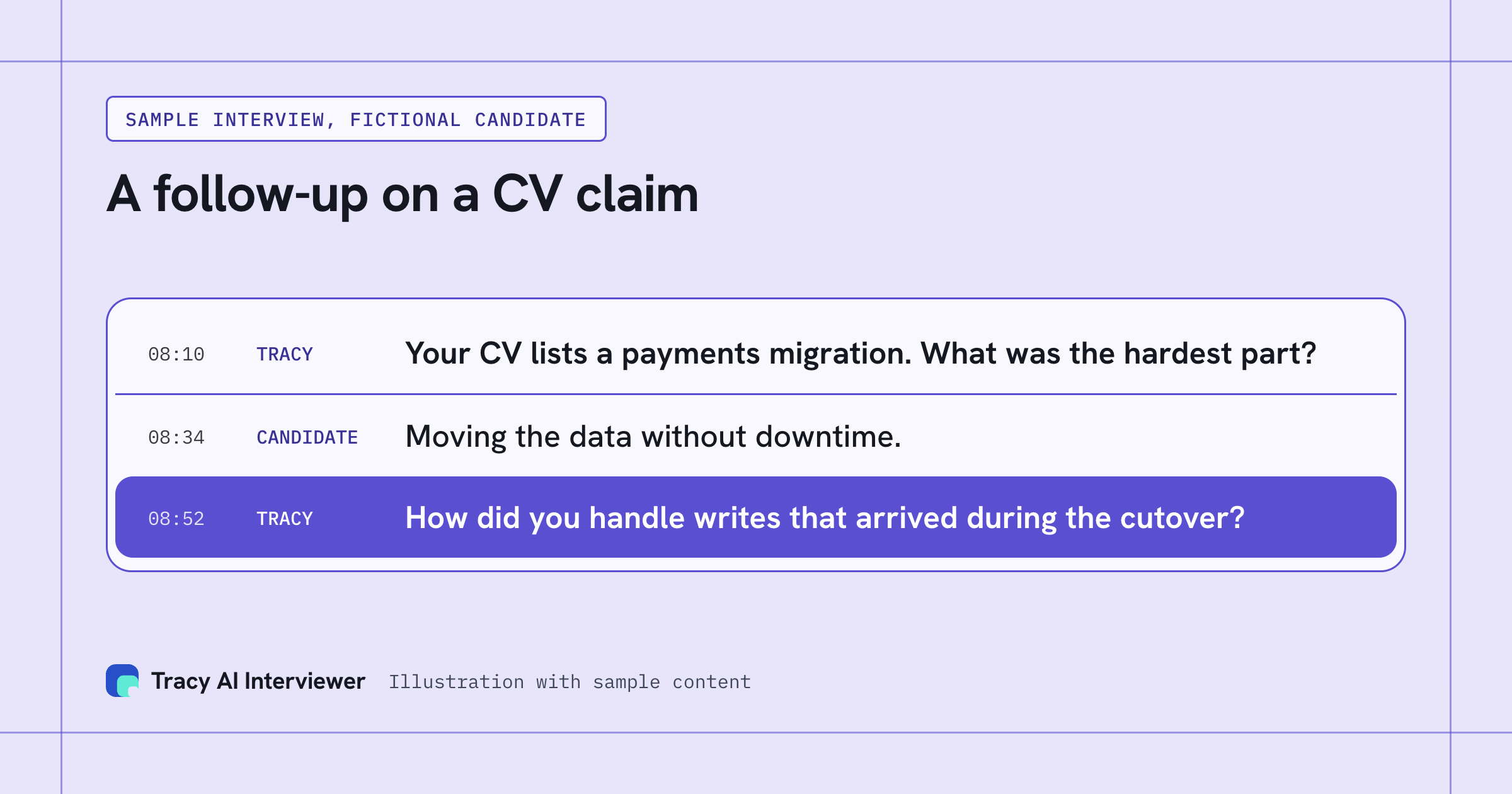
Tracy follows up on a claim in the CV, so a reviewer sees whether the person can go one level deeper.
A review routine for when a sign appears
When a sign appears, this routine keeps the decision fair and the evidence in one place.
- Read around the signal. Open the transcript at the minute it appeared.
- Compare with the CV. Does the person explain the work they claim, one level deeper?
- Ask in a short live call. Put a different follow-up on the same topic, with the same questions you would ask anyone.
- Run the separate identity check your process already has.
- Record the decision with the evidence behind it, so a second person can review it.
Tracy's signals sit inside the interview report with their times, which saves the reviewer from rewatching every interview. The illustration below shows what that looks like with sample data.
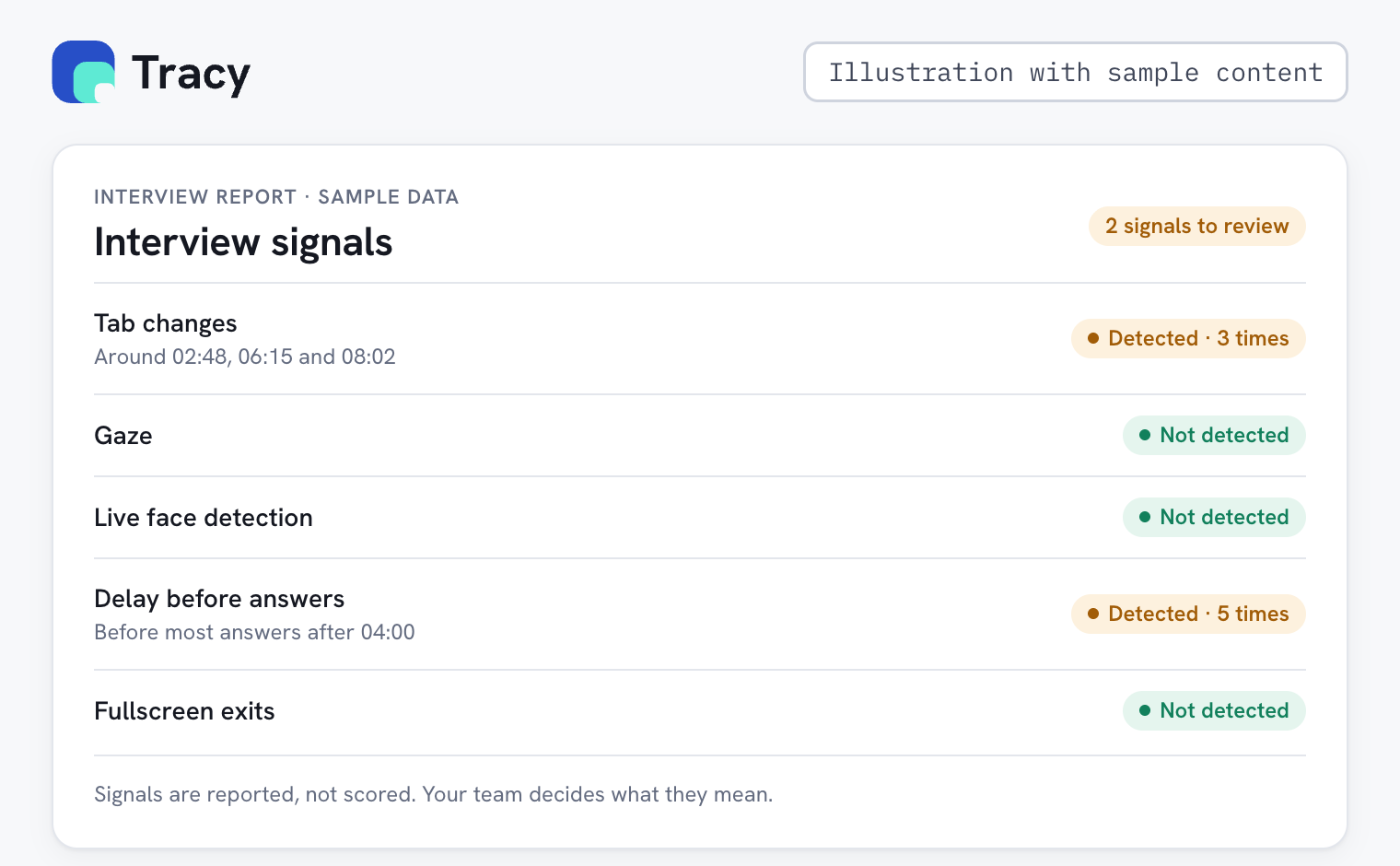
Signals appear in the report with their times, and your team decides what they mean.
Questions
How do you spot a fake candidate in a video interview?
How do you identify fake candidates in recruitment?
Can software tell you if a candidate is fake?
What should I do if I suspect a fake candidate?
Is a nervous or slow candidate a fake candidate?
See the method applied in one real interview: send us one role and we will build the interview plan in days, with a recording and report you can check. The first 3 results are free, with no card. Try it free · Book a demo
Sources
- FBI IC3 public service announcement I-062822-PSA, 28 June 2022: deepfakes and stolen PII used to apply for remote work, retrieved 9 Nov 2026.
- FBI IC3 public service announcement I-051624-PSA, 16 May 2024: North Korea leverages US-based individuals to defraud US businesses, retrieved 9 Nov 2026.
- FBI IC3 public service announcement I-012325-PSA, 23 January 2025: North Korean IT workers conducting data extortion, retrieved 9 Nov 2026.