
TLDR Tracy AI Interviewer gives a reviewer evidence from the interview: follow-ups on the person's own work, and signals such as delay before answers and tab changes, each with its evidence.
A deepfake candidate is an applicant whose video, voice or both are altered or generated to misrepresent who is on the call.
Signals are for a person to weigh. They are not proof, and the decision stays with your team.
Next step: send us one role and see the evidence on your own interview.
We make Tracy AI Interviewer.
What is a deepfake candidate?
What is a deepfake candidate? It is a job applicant who uses a deepfake to pass a remote interview as someone they are not. The FBI's Internet Crime Complaint Center defines deepfakes as "a video, an image, or recording convincingly altered and manipulated to misrepresent someone as doing or saying something that was not actually done or said".
The word covers two different things. A face swap changes what the interviewer sees, and a spoofed or cloned voice changes what the interviewer hears. The FBI's 2022 alert describes complaints about voice spoofing, or potentially voice deepfakes, in online interviews, and about stolen personal data used in the same applications.
A deepfake candidate hides who is on the call by altering the video or the voice.
What the FBI has said about deepfakes in job interviews
The FBI warned on 28 June 2022 of "an increase in complaints" about deepfakes and stolen personal data used to apply for remote work. The positions named were in information technology, programming, database and software roles, and some had access to customer personal data, financial data or corporate IT databases. The complaints describe interviews where on-camera lip movement and actions do not completely match the audio, and where coughing or sneezing does not line up with the picture.
On 23 January 2025 the FBI added that North Korean IT workers "have been observed using artificial intelligence and face-swapping technology during video job interviews to obfuscate their true identities". That alert is about one scheme. It does not say how common deepfake candidates are in general, and neither alert gives a rate. They tell hiring teams the pattern exists.
Deepfake candidate, proxy, stolen identity and AI help
People use several terms for people who are not who they seem in an interview. They are different problems, and each leaves different evidence.
Four deepfake-related terms: what is false and what a reviewer may notice (our grouping).
| Term | What is altered or false | What a reviewer may notice |
|---|---|---|
| Deepfake candidate | The face, the voice or both are altered or generated | Video and audio that drift apart. The FBI describes lip movement and actions that do not fully match the audio |
| Proxy or stand-in | A different real person answers | Answers that do not fit the CV |
| Stolen identity | The name and personal data belong to someone else | A background check that returns another person's data |
| AI-fed answers | A real person reads answers written by a tool | Delay before answers or gaze that looks abnormal, which can also have innocent causes |
The first two rows are about who is on the call. For how the whole family of problems is organised, see our guide to AI interview cheating detection, which covers the AI-fed-answers case in depth.
What an interview can and cannot show about a deepfake
A conversation cannot verify who someone is. An interview can produce evidence that something is off, and confirming identity belongs to a separate step. The FBI's January 2025 advice is to "implement identity-verification processes during interviewing, onboarding, and throughout the employment of any remote worker".
What an interview can show is narrower, and still useful:
- A video that stops matching the audio. The mismatch the FBI describes is something a reviewer can see and hear.
- Answers that need the live person. A question about the answer just given is hard to prepare for. A person using a face swap still has to answer it from their own knowledge.
- Behaviour on the screen. Tab changes, leaving fullscreen and extra screens can sit around an answer.
- Timing. A pause before each answer can mean a person is waiting for something, and it can also be a poor connection.
Each item is a reason to look. None of them settles the question alone.
How Tracy shows a reviewer the evidence
Tracy AI Interviewer captures tab changes, abnormal eye tracking (gaze), live face detection, delay before answers, leaving fullscreen and external screens, and shows the evidence to a person in the interview report. Live face detection is one signal among six that a reviewer reads. It is not a deepfake verdict. The signals go to a person, who decides. Nothing is decided in the interview. The person interviewed is told on the join screen that the conversation is recorded and transcribed, and the decision stays with the customer.
The follow-up carries the rest. Tracy asks about what the person just said, in the person's own field, and waits for the answer. For teams that vet experts remotely, see expert vetting. A recording of both sides and a timestamped transcript sit behind each result, with a written assessment per question, so a reviewer can read the transcript around the part they want to check. For the full report, see what an AI interview report shows, and for the interview itself, how AI interviews work.
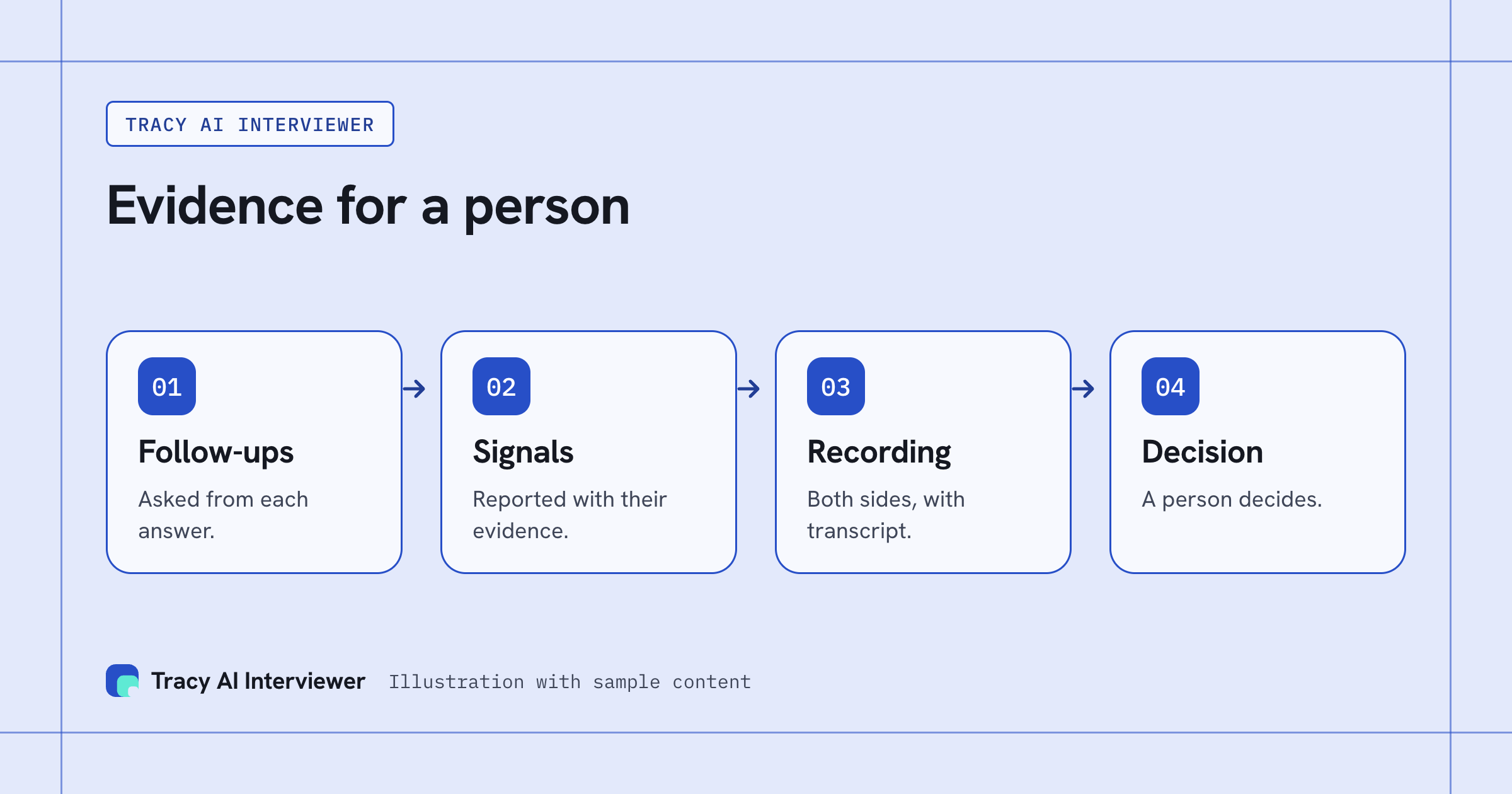
Tracy gives a reviewer follow-ups, signals, a recording and a transcript, and a person decides.
What should a reviewer do when something looks wrong?
Suppose a signal appears and something in the video looks wrong. A reviewer can do four things, in this order. Read the transcript around that minute. Ask the person a different follow-up on the same topic, in a short live call. Run the separate identity check your process already has (see how Tracy fits your process). Then weigh all of it against the rest of the interview.
Apply the same steps to every candidate. A check that only some people get is a check on those people, not on the process. Say in the invitation that the interview is recorded and that you review signals, so the rule exists before anyone can break it. To see the evidence on one of your own interviews, send us one role. The first 3 results are free, with no card.
Questions
What is a deepfake candidate?
What is deepfake detection?
How does a deepfake work?
Can you spot a fake candidate in a video interview?
Is a deepfake candidate the same as a proxy?
See the method applied in one real interview: send us one role and we will build the interview plan in days, with a recording and report you can check. Try it free · Book a demo
Sources
- FBI IC3 public service announcement I-062822-PSA, 28 June 2022: deepfakes and stolen PII used to apply for remote work, retrieved 9 Nov 2026.
- FBI IC3 public service announcement I-012325-PSA, 23 January 2025: North Korean IT workers conducting data extortion, retrieved 9 Nov 2026.
- Tracy AI Interviewer pricing, retrieved 9 Nov 2026.