AI Interview Cheating Detection: How to Tell If a Candidate Is Using AI
TLDR
- Tracy AI Interviewer gives reviewers better evidence when an answer raises a concern. It asks follow-ups based on each candidate's answer and flags five integrity signals for a closer look.
- Reviewers can check the answers, video and transcript before deciding. A signal calls for review; it does not establish that someone cheated.
In this guide
- How does AI interview cheating detection work?
- What does a follow-up chain look like?
- What does AI interview cheating detection show the reviewer?
- How common is interview cheating with AI?
- What interview cheating tools do candidates use?
- How to tell if someone is using AI in an interview
- Should you bring back in-person interviews?
- What should you do when a signal fires?
- Questions
- Sources
AI interview cheating detection works best in two layers. First, ask questions that build on what the candidate just said, which no script can prepare for. Second, watch for signals such as tab changes or reading eye movements, and treat each one as a reason to review. A person makes the decision. This guide shows how Tracy does both for every applicant, then gives steps you can use in any interview.
How does AI interview cheating detection work?
Tracy runs the first round as a natural two-way video interview and handles cheating in two layers.
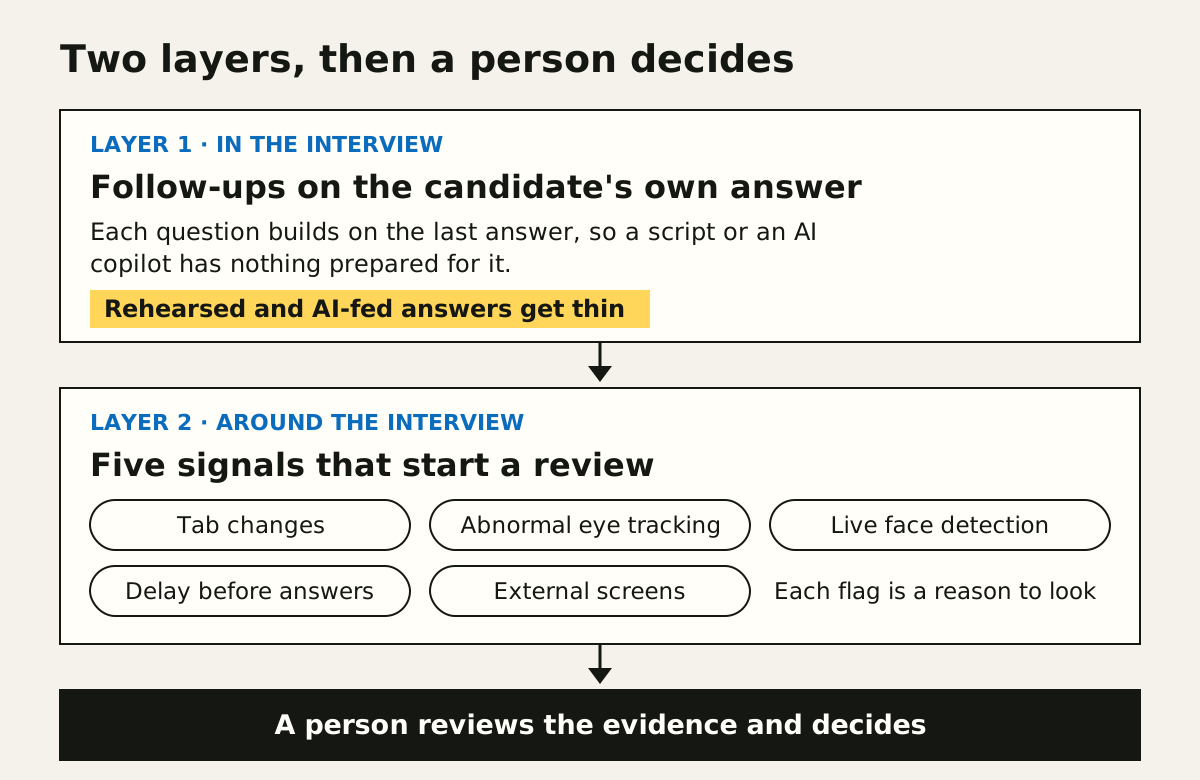
Layer 1: follow-ups. Tracy asks role-specific questions and follows up on vague answers, "a real follow-up, not a rigid script", so you hear how deep a candidate's knowledge goes, the way your best interviewer would. For engineers it can set a coding task and probe the trade-offs behind the answer, so a copied solution still has to be explained.
Layer 2: signals. Tracy's interview integrity detection flags five named signals (tab changes, abnormal eye tracking, live face detection, average delay before an answer and external screens) plus other unusual patterns. They appear in the interview report, so your reviewer knows which interviews to look at closely instead of rewatching all of them.
A person decides. Each interview becomes a summary "with the participant's own words attached" and direct quotes for context, and the AI explains each answer score, next to the video and transcript, so the reviewer judges from evidence and makes the call.
It runs from tools you already use, such as Slack, WhatsApp and Workable, so it fits the process you run today.
What does a follow-up chain look like?
A copilot can feed a good answer to a known question. It helps much less when the next question is about the answer itself.
Example: an illustrative first-round chain for a finance domain expert, the kind of role AI-lab data platforms vet at volume. It is written for this guide and is not a real candidate.
| Step | Tracy asks | A strong answer | An AI-fed answer tends to |
|---|---|---|---|
| 1 | "How would you value a SaaS company with negative free cash flow?" | A method, and why it fits | Give a correct textbook summary |
| 2 | "You said revenue multiple. Which comparables for 70% gross margin and 20% growth?" | Named companies or a clear rule | Repeat that comparables should be "similar" |
| 3 | "Two of those were acquired last year. Keep them in the set?" | A judgment, such as acquisition premiums skewing the multiple | Pause, then a general paragraph on M&A |
| 4 | "When did you last get a valuation wrong, and what did you change?" | A specific deal, the mistake and the fix | Offer no example, or one with no detail |
Step 1 is easy to fake. At step 3 the candidate has to reason about their own earlier choice under a new condition, live, and that is where a real expert gets more specific.
What does AI interview cheating detection show the reviewer?
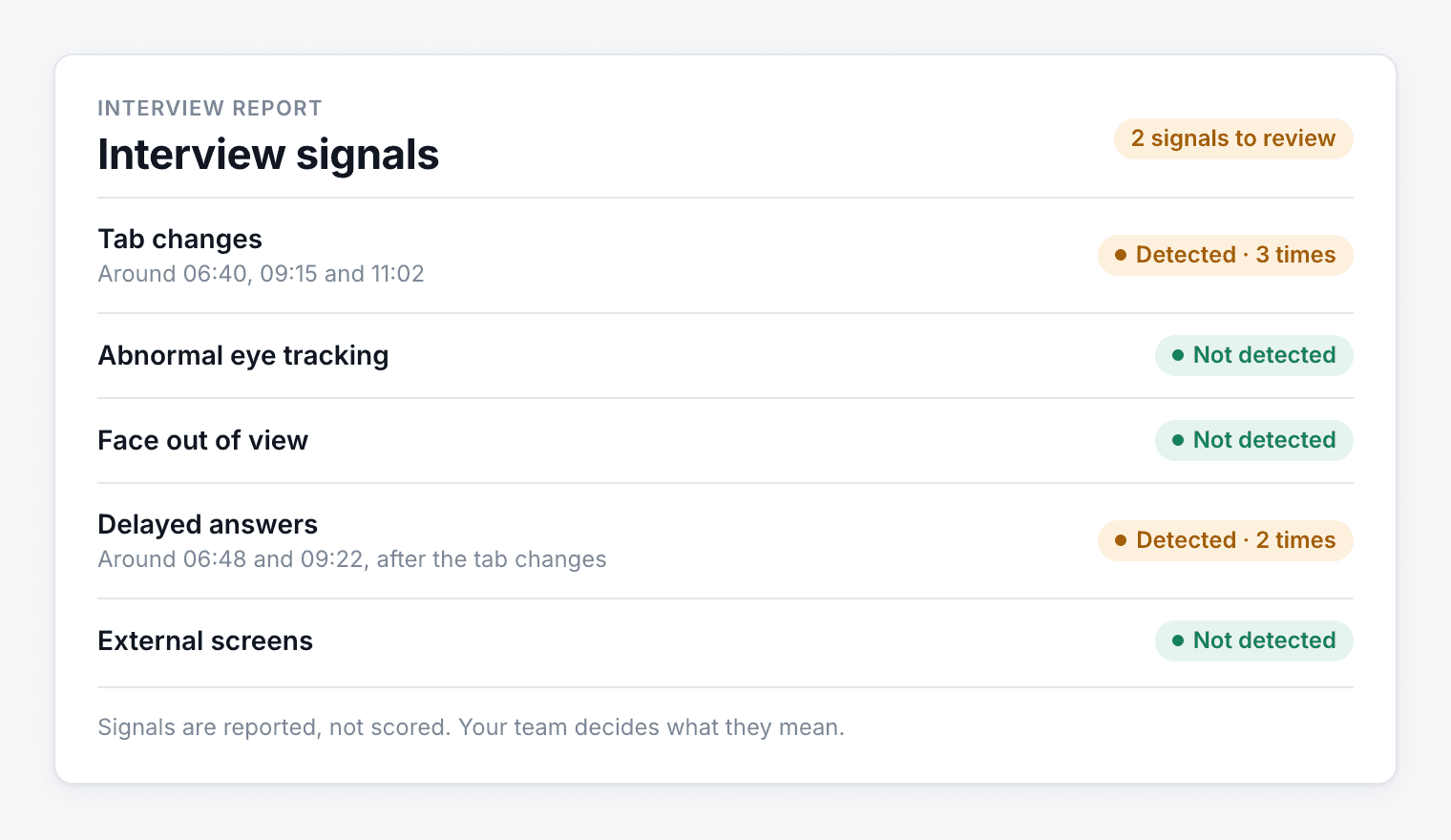
Here is part of a report for the chain above. It is an illustration with test data.
| Field | What the candidate said |
|---|---|
| Choosing comparables | "I'd drop the two acquired companies, because the deal price includes a control premium the public multiple doesn't." |
| Last valuation mistake | "Valuation always involves uncertainty, and you should use several methods." |
| Interview signals | Average delay before answer; abnormal eye tracking |
The reviewer sees two specific answers, one generic one, and two signals. They open the video at the generic answer, watch it and decide whether to invite the candidate to a live call.
Screening every applicant this way costs only what you use: $7 per credit; one credit covers up to 20 minutes. You pay for results, not seats, and a session with no answers is never charged. At high volume, enterprise pricing is custom, based on your volume, as low as $1 per credit.
How common is interview cheating with AI?
Two in three US hiring managers in Greenhouse's survey have caught it.
- Assessments. CodeSignal found that cheating and fraud attempt rates on its proctored assessments more than doubled, "rising from 16 percent in 2024 to 35 percent" in 2025. These are attempts its system flagged, not confirmed successes.
- Live interviews. In Greenhouse's 2025 AI in Hiring Report, 65% of US hiring managers had caught applicants using AI deceptively, including "reading from AI-generated scripts (32%)" and "showing up as deepfakes (18%)".
- Employers. Google, McKinsey and Cisco have brought back face-to-face steps, according to Round Zero.
For platforms that supply experts to AI labs, one fake expert can cost the lab's project. For technical hiring teams, AI-polished applications already look alike, and an AI-fed interview removes the last place depth showed.
What interview cheating tools do candidates use?
The best-known interview cheating AI tools are desktop apps that listen to the call or read the screen, then show a suggested answer in an overlay only the candidate sees. Cluely says it "gives real-time answers, all while completely undetectable" and "never shows up in shared screens, recordings, or external meeting tools." Interview Coder targets technical interviews, with "Support for all kinds of interviews(leetcode, system design, etc.)" and an overlay that "remains hidden when sharing your screen."
Screen sharing won't show these tools, and their answers are fluent. They are weakest against a question that depends on the candidate's earlier answer, asked straight after it.
How to tell if someone is using AI in an interview
Watch for the same five signals Tracy checks:
- Tab changes. The window loses focus while a question is open.
- Abnormal eye tracking. Eyes move in steady lines, as if reading, or keep going to one spot off camera.
- Live face detection. Review the relevant video alongside the signal; the signal alone does not explain what happened.
- Average delay before an answer. A pause before every answer, even easy ones, then a fluent paragraph, often opened with a stock filler line.
- External screens. Signs of a second device, such as turning to one fixed side before each answer.
None of these proves cheating. People look away to think and pause when nervous. Check the answers too. Watch for a polished first answer with a vague follow-up, correct terms with no example from their own work, or spoken answers that don't match the depth of the written application.
Seven steps that work in any video interview, with or without Tracy:
- Say the rules at the start, including whether AI, notes or a second screen are allowed.
- Ask about their own work. "What was the worst result you got, and what did you change?" needs a memory a copilot doesn't have.
- Follow up on the detail they just gave, then follow up again.
- Change the problem halfway: double the traffic, cut the budget, remove the library they used.
- Ask them to explain one line of their code, or the assumption they are least sure of.
- Keep the camera on and note timing. One long pause is nothing; a pause before every answer is a pattern.
- Compare the interview with the application and look closer when the depth doesn't match.
For technical roles, our guide to AI technical interviews shows a full chain on a coding task. For expert vetting, see interview questions for AI trainers and domain experts.
Should you bring back in-person interviews?
For the final round, often yes. Round Zero reports that "Google reinstated at least one in-person round for technical hires" and that "McKinsey now asks hiring managers to meet candidates face to face before an offer goes out."
An onsite round proves the person is real. It also costs travel and interviewer hours for every finalist, and it can't cover a first round of thousands of applicants across countries. A remote first round with deep follow-ups and signals, then an in-person final for a short list, puts the onsite hours on people who already showed depth. Our guide on how to screen candidates covers the first-round side.
What should you do when a signal fires?
- Read the answers first. Specific, consistent follow-ups outweigh a single pause.
- Watch the flagged interview. Many flags have an innocent cause, like a noise or a candidate thinking.
- Look for a pattern across questions, not one moment.
- Ask for a short live call on the same topic when in doubt.
- Write down why you decided, so reviewers stay consistent.
- Tell candidates up front that an AI runs the interview, what it checks, and that a person decides. What you must disclose depends on where you hire, so check with your own counsel.
Comparing tools? See the best AI interview software for hiring teams or Tracy vs HireVue.
Questions
Can AI interview cheating detection catch tools like Cluely? Their makers say the overlay is hidden from screen sharing. The candidate's behaviour still shows: reading eye movements, a pause before each answer, a second screen. Follow-ups on their own answer are harder for any copilot to keep up with.
What are interview cheating detection tools? Software that flags signs of cheating during an interview or test, such as tab changes, a second face or a second screen. In Tracy, the signals sit in the same report as the follow-up answers, so a reviewer judges both together.
Is interview cheating AI getting more common? Yes. CodeSignal's flagged attempts more than doubled from 2024 to 2025, and a third of US hiring managers in Greenhouse's survey had caught an applicant reading an AI-generated script.
Does Tracy tell me a candidate cheated? It flags signals for a person to check, next to what the candidate said. Your reviewer looks at the answers and the video, and decides.
Is it fair to nervous candidates? Yes, when signals start a review and a person decides. Nervous candidates pause too, but their follow-up answers stay specific.
Read next: AI technical interviews: coding, system design and debugging screens
Sources
- CodeSignal, "CodeSignal detection systems identify and stop record-high cheating attempts as assessment fraud more than doubled in 2025", press release, 25 Feb 2026. codesignal.com. Retrieved 29 Oct 2026. Quote: "cheating and fraud attempt rates for proctored assessments more than doubled, rising from 16 percent in 2024 to 35 percent." Also: "these signals reflect fraud and cheating attempts that were detected and flagged, not successful circumvention of assessment standards."
- Greenhouse, 2025 AI in Hiring Report release, 19 Nov 2025. greenhouse.com. Retrieved 29 Oct 2026. Quote: "companies in the U.S. cite an integrity crisis. ... Two in every three (65%) hiring managers have caught applicants using AI deceptively, like reading from AI-generated scripts (32%), hiding prompt injections in resumes (22%), or showing up as deepfakes (18%)."
- Round Zero, "In-person interviews are back", Danish Siddique, 25 Aug 2026. joinroundzero.com. Retrieved 29 Oct 2026. Quote: "Google reinstated at least one in-person round for technical hires. McKinsey now asks hiring managers to meet candidates face to face before an offer goes out. Cisco and others have made similar moves."
- Cluely, home page. cluely.com. Retrieved 29 Oct 2026. Quote: "Cluely takes perfect meeting notes and gives real-time answers, all while completely undetectable." Also: "Cluely never shows up in shared screens, recordings, or external meeting tools."
- Interview Coder, home page. interviewcoder.co. Retrieved 29 Oct 2026. Quote: "Support for all kinds of interviews(leetcode, system design, etc.)" Also: "Overlay remains hidden when sharing your screen, ensuring interviewers can't detect the assistance tool visually."
- Tracy AI Interviewer, home page. tracyinterview.ai. Retrieved 29 Oct 2026. Quote: "Tracy AI Interviewer runs natural two-way video interviews, follows up on vague answers, digs into the interesting ones, and turns every conversation into structured results." Also: "Tracy AI Interviewer can ask role-specific questions, introduce a coding task, and probe the trade-offs behind an answer." "A real follow-up, not a rigid script." "Each interview becomes a readable summary with the participant's own words attached." "Direct quotes for context."
- Tracy AI Interviewer, pricing. tracyinterview.ai/pricing. Retrieved 29 Oct 2026. Quote: "$7 per credit, in USD. Credits never expire." Also: "You pay for results, not seats."; "1 credit for each started 20 minutes"; "A session with no answers is never charged."
- Qode, pricing. qode.world/pricing. Retrieved 29 Oct 2026. Quote: "Interview integrity detection: Tab changes, Abnormal eye tracking, Live face detection, Average delay time before answer, External screens, Other unusual patterns." Also: "Video & chapter breakdown", "Transcript", "Answer summary & score", "Explain answer score by AI Agent" and, for Enterprise, "Custom based on volume".
- Qode, 28 Oct 2026: enterprise pricing can go as low as $1 per credit, custom based on volume.
- Qode, confirmed product facts (integrations: ChatGPT, Claude, Gemini, Mistral, Grok, Slack, WhatsApp, Zapier, Workable, HubSpot), 29 Oct 2026.