In short
Claude is useful for the first half of sourcing: planning the search, drafting outreach and sorting what you paste in, while the people search runs in tools you are licensed to use. Tracy AI Interviewer connects to Claude, so each person on your shortlist gets the same video interview on click, with follow-ups in their own field. Your reviewer reads the evidence and decides who moves on.
What Claude for sourcing does well
This page covers sourcing candidates for open roles. If you meant sourcing in procurement or sales, it is a different page.
With Claude for sourcing, a recruiter asks for a plan and gets a good one by lunch: where a kind of engineer works, strings for your own tool, outreach in your voice. A sourcing plan ends with names, though, and names still need questions put to them. This page shows how to set Claude up, which prompts to start with, and how to turn the shortlist into interviews with Tracy AI Interviewer from the same chat. If you work in ChatGPT, see ChatGPT for sourcing candidates.
Can Claude source candidates?
Claude can plan and write, but it is not where people are found. Its web search brings in real-time data with a citation on every response, and Research, on paid plans, runs multiple searches that build on each other across the web and the connectors you turn on. That suits mapping where a kind of engineer works: which employers, which open-source projects, which communities and talks.
It does not change the rules of the sites that hold profiles. LinkedIn's User Agreement bars software, scripts and robots that scrape or copy profiles and other data. So run the people search in a seat or data product you are licensed to use, and bring the results back to Claude to sort, summarise and draft against, if your company policy allows candidate data in a chat.
How do you set up a sourcing Project in Claude?
Make one Project per role family. A Project is a self-contained workspace with its own chat histories, a knowledge base and project instructions, so the brief travels into every chat.
Put four things in it: the role brief and the team's problem in a paragraph; a must-have and nice-to-have list; two or three examples of the message style that works for you; and the stack and the places you have already searched. A starting instruction: "You are helping me source [role]. Keep outreach under 80 words. Never invent a person, employer or link. If you do not know, say so."
If you repeat the routine weekly, package it as a skill. Skills give Claude specialised knowledge and workflows, are on every plan and need code execution switched on.
Which Claude prompts help with sourcing?
- Search map: "Using Research, list the employers, open-source projects and communities where [role] people work on [problem]. Cite each source." Check: open the citations.
- Strings for your tool: "Write Boolean strings for [seat or database] for [role] in [location], one tight and one wide, and say what each excludes."
- Sort a pasted list: "Here are twelve profile summaries. Group them by which must-haves each one shows evidence for, and name the missing evidence for each." Check: this is a sorting aid. You pick who to contact.
- Outreach in your voice: "Write a first message in the style of the two examples in the Project, for a candidate whose public work is [link]. Eighty words, one easy reply."
- Turn the shortlist into questions: "From the brief, write six first-interview questions for [role] with one follow-up each." This is the hand-off prompt: its output goes straight into the interview setup below.
Why a shortlist of fifty is about 17 hours of calls
Prompt 5 ends with six questions for a shortlist. Say the shortlist has fifty names and each first call runs 20 minutes: that is about 17 hours of live calls before anyone is ruled in or out. Claude cannot make those calls, and a longer list only makes the pile bigger. Through Tracy each person opens the link at any hour and is asked the same questions, with a follow-up when an answer is thin, so your hours go to reading what people said.
How do you move a shortlist into interviews from Claude?
Add Tracy AI Interviewer to Claude as a custom connector at tracyinterview.ai/mcp (five-step setup). Then: "Use Tracy AI Interviewer to set up a screening interview for senior backend engineer candidates. Use these questions: [paste]. Show me the draft."
Claude asks before each use of a Tracy tool, and nothing is created until you approve the draft. Choose Allow once while you learn it. Then:
- Invite by email from addresses you already hold; Tracy does not look any up.
- Share the public link in your outreach. A new interview starts with it on, so anyone with the link can join, up to 20 people for 14 days; you can switch it off in the chat.
- Check your balance before a batch. Ask Claude how many free results and credits you have left.

Ask Claude for your balance before you send a shortlist the link.
What Tracy adds to Claude for sourcing
Three things change when the interview moves from you to Tracy.
01
Reach every person
Each person can start on click, at any hour, with no scheduling and no recruiter on the call. The same first round reaches the whole list.
02
Ask the next question
Tracy follows the answer in the person's own field and waits for the end of the thought. A polished headline has to survive a specific follow-up.
03
Keep the evidence
Every result has a recording, a timestamped transcript and a written assessment per question with its reasoning. Your reviewer decides what it means.
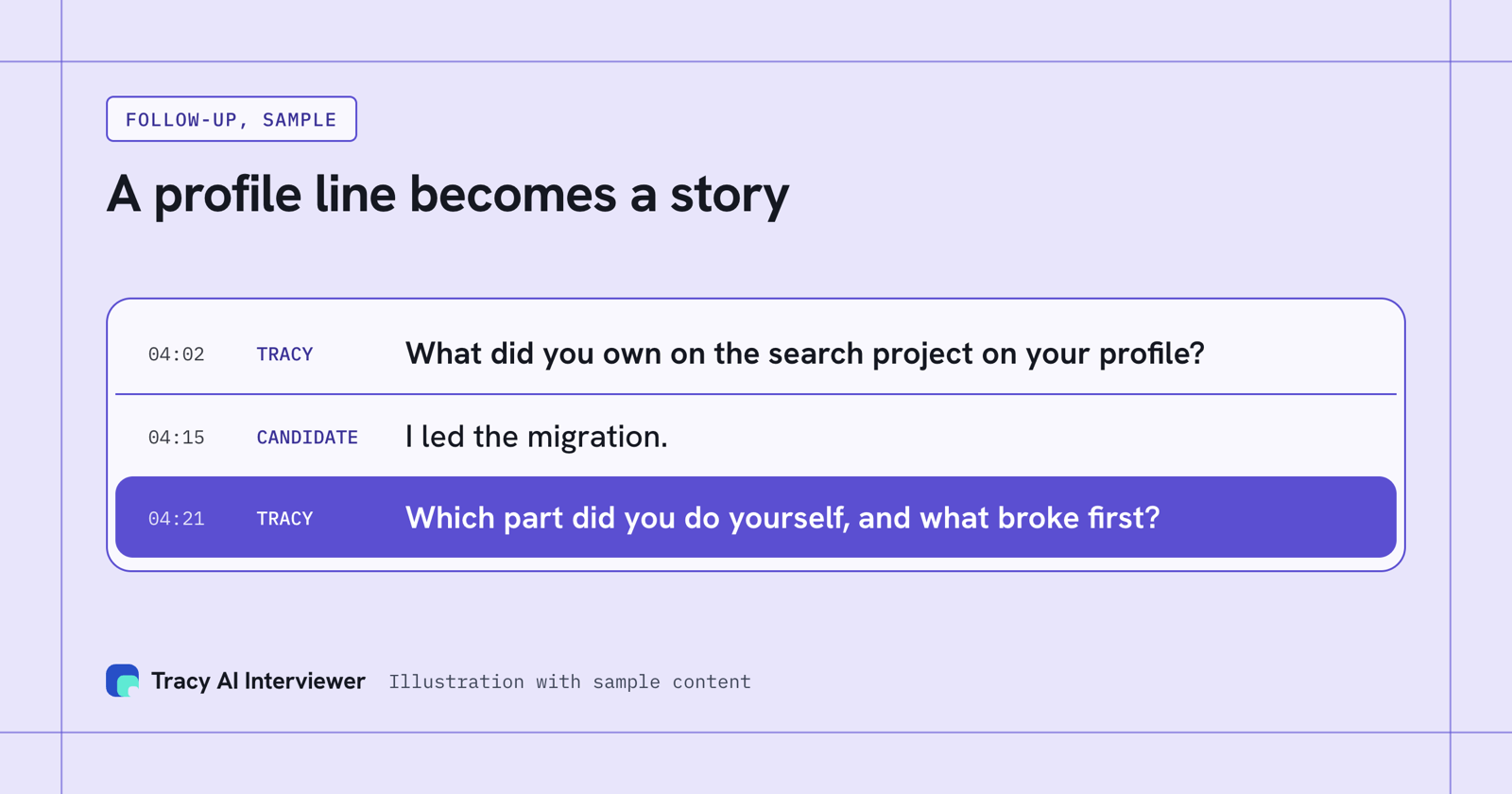
A profile line becomes a story.
What do the candidate and the reviewer get?
The candidate opens a link in a browser at any hour, with no account and no calendar, and is told on the join screen that the conversation is recorded and transcribed. Tracy asks your questions and follows up in their own field, and waits for the end of the thought. What a candidate sees shows the screens.
Asked in Claude, the results come back as what each person said to each question, the result fields and a note for your ATS. In Tracy you also get a recording of both sides, a timestamped transcript and findings linked to the moment. Candidates rate the experience 92 on NPS. Tracy does not score, rank or reject anyone, and a person decides. Integrity signals on video interviews, such as leaving full screen, are evidence for the reviewer and never proof. For the format, read AI screening interviews; for the questions, candidate screening questions.
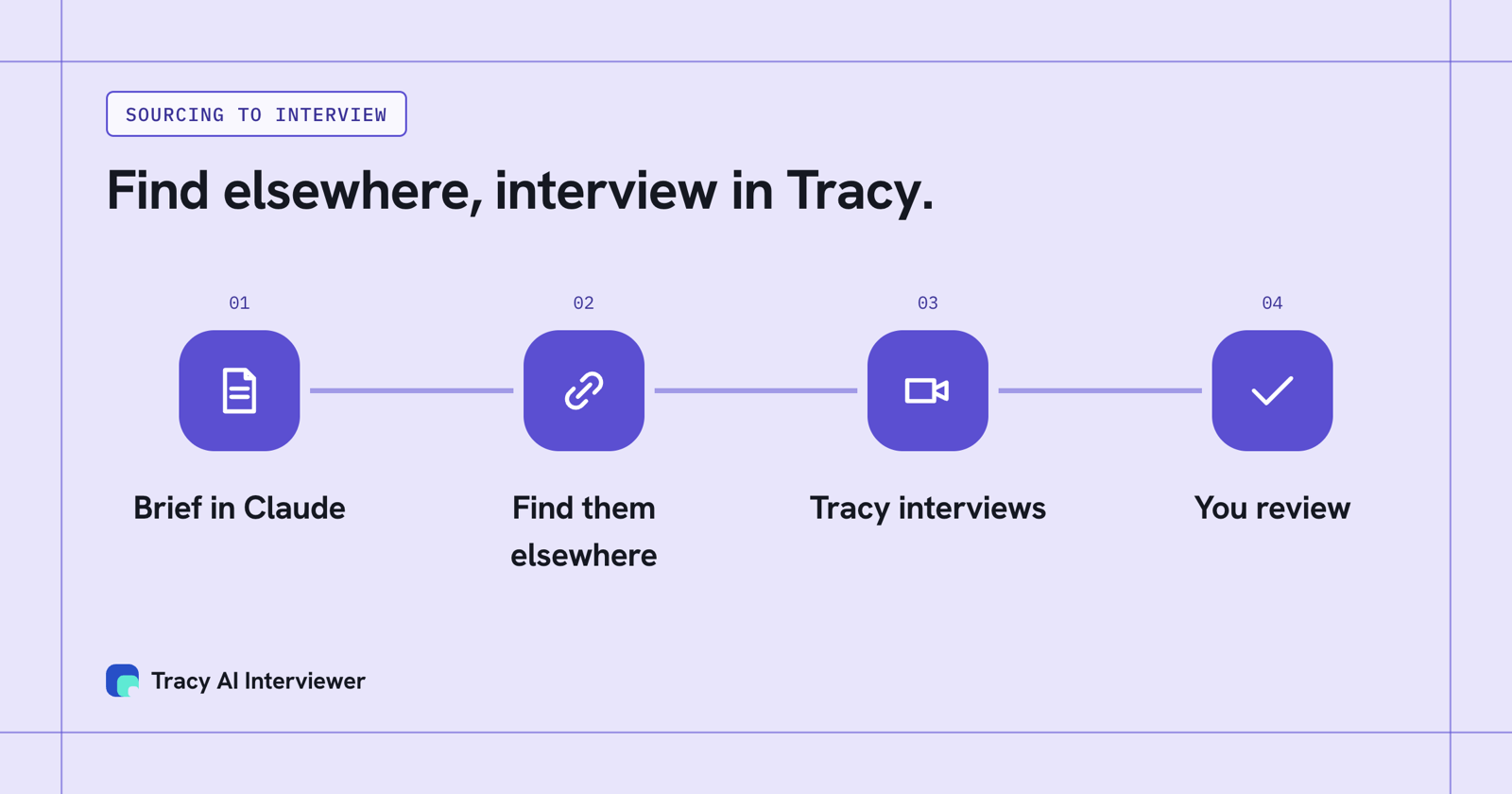
Brief in Claude, find people elsewhere, Tracy interviews them, you review.
What stays with you?
- Where you search stays with you, and so does what your outreach and consent rules allow.
- The questions are yours, or a draft you edit, for volume hiring or a technical role.
- A person reads the results and decides who moves on.
Pay as you go is $1 per credit, one credit per started 20 minutes, with the first 3 results free and no seats. A hundred 20-minute interviews is $100. See pricing.
Common questions
Can Claude source candidates?
Is there a Claude sourcing agent?
How do I use Claude for sourcing?
Does Tracy look up candidates' emails?
Interview your shortlist from Claude
Add the Tracy connector, approve one draft, then share the link. The first 3 results are free.
Try it free (opens in a new tab) Book a demo (opens in a new tab)
Your first 3 results are free. No card needed.
Sources
- Anthropic: Using Research on Claude, retrieved 14 Nov 2026.
- Anthropic: Enabling and using web search, retrieved 14 Nov 2026.
- Anthropic: What are projects?, retrieved 14 Nov 2026.
- Anthropic: Using Skills in Claude, retrieved 14 Nov 2026.
- LinkedIn User Agreement, section 8.2, retrieved 14 Nov 2026.
- Tracy AI Interviewer: Claude guide, retrieved 14 Nov 2026.
- Tracy AI Interviewer: Pricing, retrieved 11 Nov 2026.