
TLDR Tracy AI Interviewer shows a reviewer the evidence behind an interview, such as tab changes, gaze and delay before answers, each with its times.
Interview fraud is misrepresenting who you are or what you can do in a hiring interview, so the employer decides on a false picture.
Signals are for a person to review and are not proof. Nothing is decided in the interview, and candidates are told on the join screen that it is recorded and transcribed.
Next step: send us one role and see the signals on your own interview.
We make Tracy AI Interviewer.
Interview fraud means the employer decides on a false picture of the person.
Interview fraud is misrepresenting who you are or what you can do in a hiring interview, so that the employer decides on a false picture. It covers a person who is not who they say they are, and a person who is who they say but cannot do what they claim. People also call it candidate fraud or interview cheating. The terms overlap, but fraud is the wider one: it includes a stolen identity or a made-up work history, not only a prompt whispered off camera.
A remote interview is where it is easiest to try and where it is hardest to see. The reviewer cannot see the desk, the second screen or the person sitting out of frame. That is why the term matters most to teams who hire or vet people over video, such as expert vetting for AI projects. If the interviewer is itself an AI, our guide to what an AI interviewer is explains how it works.
Five common forms of interview fraud
These are the common forms as this guide groups them. They are not exclusive, and one interview can contain more than one.
- Someone else answers. A proxy takes the interview, and a different person does the job. The face and voice on the call are not the hire's.
- Undisclosed outside help. The person is real, but another person or an AI tool is feeding answers. This is the case employers argue about most, because the rules on tools differ by employer and by role.
- A deepfake or cloned voice. The video or audio is altered to look or sound like someone else.
- A stolen or false identity. Another person's name and details are used to apply, and sometimes to pass a background check.
- Invented credentials or work history. The person is real and present, and the CV or the story is not true.
The first four are about who is in the interview. The fifth is about what they say. A good process treats them differently, because a check that helps with one does little for another.
What counts as fraud, and what does not
Fraud needs misrepresentation: the employer is led to believe something false about the person or their ability. A nervous pause, notes on the desk or a repeated question are not that.
The line on tools depends on the employer. A company that allows an assistant for a coding task has no fraud if the candidate uses one. A company that forbids it, and says so before the interview, does. We recommend stating your rule in the invitation, because a rule that was never said is not one a person can break on purpose.
The FBI has warned about deepfakes and stolen identities in remote job applications
The FBI has documented the problem. In a public service announcement dated 28 June 2022, the FBI's Internet Crime Complaint Center warned of "an increase in complaints reporting the use of deepfakes and stolen Personally Identifiable Information (PII) to apply for a variety of remote work and work-at-home positions". The announcement says some of the positions include access to customer data, financial data or corporate IT databases.
It also describes what reviewers noticed. In some interviews, "the actions and lip movement of the person seen interviewed on-camera do not completely coordinate with the audio of the person speaking". And in some cases, "pre-employment background checks discovered PII given by some of the applicants belonged to another individual."
The announcement gives no rate and does not say how common this is. It warns that the pattern exists, and it comes from the agency that receives the complaints.
No single check proves interview fraud, so reviewers look at several
Interview fraud detection is not one test. Teams combine what they can see:
- The content of the answers. Does the person explain how they got to a result, and can they go one level deeper when asked?
- How the answers arrive. Long, regular pauses before each answer can mean a person is waiting for something.
- What the person does on the screen. Switching tabs, leaving fullscreen or a second display.
- Whether the face and voice stay consistent. A video that stops matching the audio is a reason to look closer.
- What the CV and the interview say about each other. A claimed specialty the person cannot discuss is a mismatch.
- A separate identity or credential check. Verifying an ID or a licence is its own step in your process.
Each of these is evidence for a person to weigh. None of them settles the question alone, and a team that treats a single signal as proof will reject honest people. For the full product, see how Tracy works.
How Tracy shows the evidence to a reviewer
Tracy AI Interviewer captures tab changes, abnormal eye tracking (gaze), live face detection, delay before answers, leaving fullscreen and external screens, and shows that evidence to a person in the interview report. She reports them with their times, and nothing is decided in the interview. The person interviewed is told on the join screen that the conversation is recorded and transcribed, and the decision stays with the customer.
The follow-up is part of the evidence as well. She asks about what the person just said and waits for the answer. The reviewer reads how each answer holds up one question deeper. The recording and the timestamped transcript sit behind each result, so the reviewer can go to the minute a signal appeared and listen.
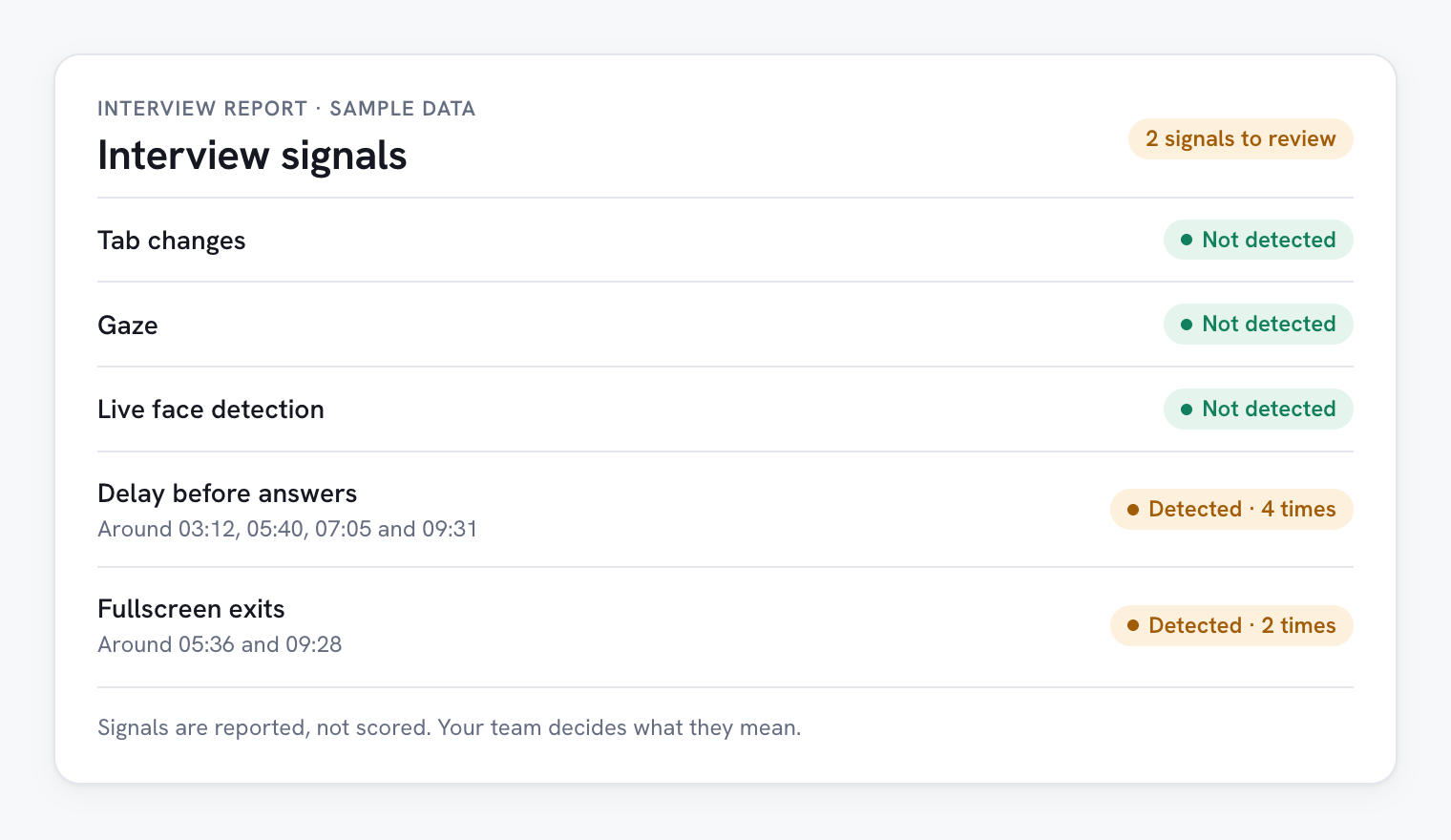
The signals come with their times, so a reviewer can listen to those minutes and decide.
What should a reviewer do when a signal appears?
Take the sample above. A pause appears four times, and the person leaves fullscreen twice, at 05:36 and 09:28, a few seconds before two of the pauses. That pattern is a reason to listen to those minutes and ask the person about them, and no more than that. A long pause can be a bad connection, a notification or a candidate who thinks slowly. Leaving fullscreen can be an accident.
So the reviewer does three things: reads the transcript around the signal, asks the person to explain the answer in their own words, and compares it with the rest of the interview. We would not reject anyone on a signal alone, and a good process does not need to. Our guide on how integrity signals work in an AI interview explains what each one means and what a reviewer should do with it, and what an AI interview report shows covers where the evidence sits. To see the signals on one of your own interviews, send us one role.
Questions
What is interview fraud?
How is interview fraud detected?
Is using AI in an interview fraud?
Can an AI interviewer help with interview fraud?
Who should decide when a signal appears?
What is the difference between interview fraud and interview cheating?
See the signals and evidence in one real interview: send us one role and we will build the interview plan in days, with a recording and report you can check. The first 3 results are free, with no card. Try it free · Book a demo
Sources
- FBI IC3 public service announcement I-062822-PSA, 28 June 2022: deepfakes and stolen PII used to apply for remote work, retrieved 9 Nov 2026.
- Tracy AI Interviewer pricing, retrieved 5 Nov 2026.